
Notes on the Diagnosis of the Species of the Genus Prisopus Le Peletier & Audinet-Serville, 1828 (Phasmida: Prisopidae: Prisopini) Present in Costa Rica
The genus Prisopus previously only recorded three species for Costa Rica: P. ariadne, P. bioley and P. berosus. This article reports two more species for Costa Rica: P. horstokkii and P. ohrtmanni, previously only recorded in South America. An identification key and several important aspects of the diagnosis of the species are also provided
Introduction
The genus Prisopus Le Peletier & Audinet-Serville, 1828 is a rather interesting group due to its great specialization to simulate lichens with its camouflage, which not only involves the simulation of chromatic patterns, but its entire body has projections, warts and structures dedicated to this purpose [1]. This genus is present mainly in America, with a distribution ranging from southern Mexico to Brazil, the species P. apteros Camousseight, 2010 reported for the Talca area in Chile [2] and there are still no reports of this genus for Argentina and Uruguay [1, 2].
In 2020, a new genus within Prisopodini called Prisopoides Heleodoro [3] was described, which included four new species and the relocation of the species Prisopus villosipes; however, it was quickly synonymized with Prisopus [1, 3, 4]. In Costa Rica only five species are reported: P. ariadne Hebard, 1923, P. berosus Westwood, 1859, P. biolleyi Carl, 1913, P. hortokki Haan, 1842 and P. ohrtmanni (Lichtenstein, 1802).
Due to their habits of inhabiting the forest canopy and the little study that is given to them in the country, a sufficiently exhaustive sampling effort has not been made to rule out the presence of other species, but even so, the collection of the National Museum of Costa Rica (MNCR) has well-preserved specimens from different parts of the territory, which were used to generate the present rapid study on the most important diagnostic characters of the national species.
Metodology
Review
The species of the genus Prisopus are quite similar to each other, and in the first instance, the collection was found separated considering only the color and size of the specimens, so it was decided to review it based on the following diagnostic characters that are easy to recognize with the naked eye:
- Dark markings on the venation of the hind wings.
- Presence and shape of horns on the vertex.
- Presence of irregular warts on the tegmen.
- Dark ventral markings on the abdominal segments.
Reviewed Specimens
Prisopus ariadne: MNCR-A 2350270, MNCR-A 1205506, MNCR-A 2212945, MNCR-A 4132104, MNCR-A 1205505, MNCR-A 252514, MNCR-A 410242, MNCR-A 1869886, MNCR-A 1255068, MNCR-A 445301, MNCR-A 875958, MNCR-A 1755921, MNCR-A 4298364, MNCR-A 1308375, MNCR-A 2168526, MNCR-A 1137337, MNCR-A 2547466.
Prisopus berosus: MNCR-A 3353590, MNCR-A 4317565, MNCR-A 4317559, MNCR-A 825703, MNCR-A 4138179, MNCR-A 629672, MNCR-A 3076087, MNCR-A 427770, MNCR-A 1875492, MNCR-A 3353591, MNCR-A 3354991, MNCR-A 4225243, MNCR-A 3358472, MNCR-A 790036, MNCR-A 1817152, MNCR-A 1955264, MNCR-A 4317555, MNCR-A 4317566, MNCR-A 4317557, MNCR-A 734818, MNCR-A 2329579, MNCR-A 1723267, MNCR-A 150967, MNCR-A 2298906, MNCR-A 427733, MNCR-A 4317567, MNCR-A 2169451, MNCR-A 4163463, MNCR-A 1341900, MNCR-A 4317558, MNCR-A 1793125, MNCR-A 3959694, MNCR-A 1261379, MNCR-A 1984352, MNCR-A 4317561, MNCR-A 2236668, MNCR-A 2364600, MNCR-A 4317554, MNCR-A 4317560, MNCR-A 4317562, MNCR-A 138626, MNCR-A 94114, MNCR-A 1292177, MNCR-A 1363735, MNCR-A 1875277, MNCR-A 834018, MNCR-A 1930342, MNCR-A 4138176, MNCR-A 4138177, MNCR-A 3358756, MNCR-A 3718340, MNCR-A 3959692, MNCR-A 3328772, MNCR-A 3355303, MNCR-A 4157876, MNCR-A 4138175, MNCR-A 4138178, MNCR-A 2039910, MNCR-A 4138174, MNCR-A 629673, MNCR-A 1255077, MNCR-A 1213201, MNCR-A 709165.
Prisopus biolleyi: MNCR-A 767905, MNCR-A 623591, MNCR-A 627110, MNCR-A 4317595, MNCR-A 2476873, MNCR-A 1309562, MNCR-A 145007, MNCR-A 4317594, MNCR-A 1357839, MNCR-A 1636460, MNCR-A 2248526, MNCR-A 793863, MNCR-A 2113122, MNCR-A 43175993, MNCR-A 3739948, MNCR-A 445904, MNCR-A 1756274.
Prisopus horstokki: MNCR-A 964994, MNCR-A 37089, MNCR-A.
Prisopus ohrtmanni: MNCR-A 613287, MNCR-A 203404, MNCR-A 4181565.
Results
Abdominal markings were found to be the quickest and easiest way to separate species even in the field, as the markings are quite distinctive (Figure 1). Lateral projections were also found to be an important character to observe (Figure 2), but since in some cases they have a very similar shape, it is necessary to complement this feature with others to avoid confusion. However, other important features were also considered and an identification key was developed; in order to use it, specimens must be mounted with at least one pair of wings open.
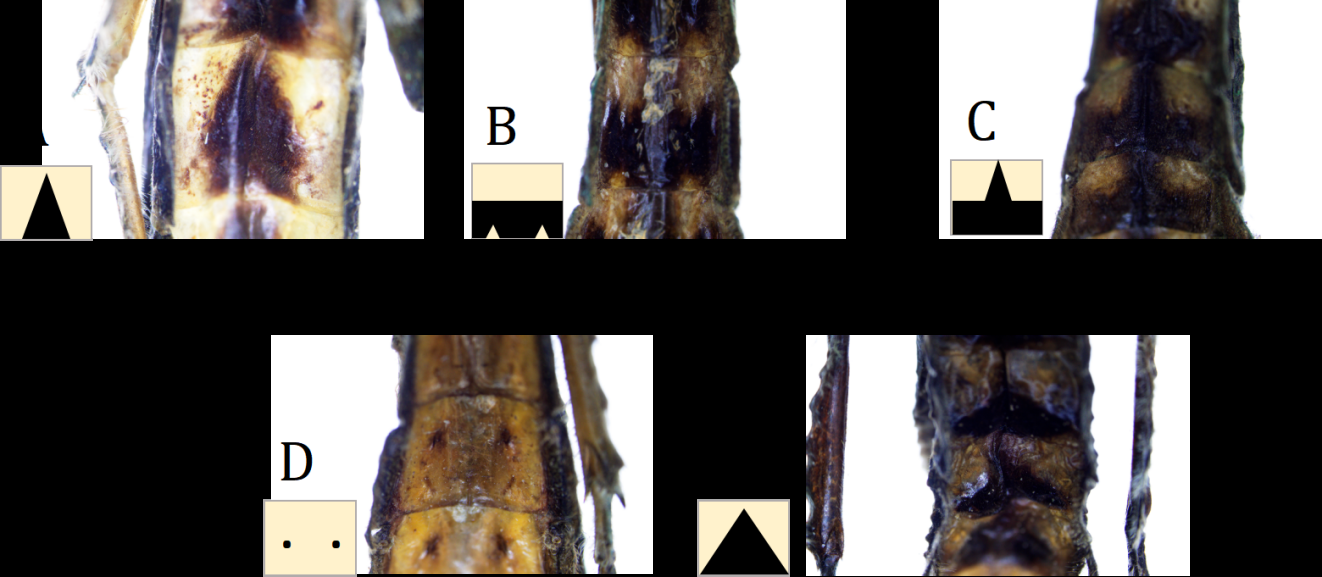
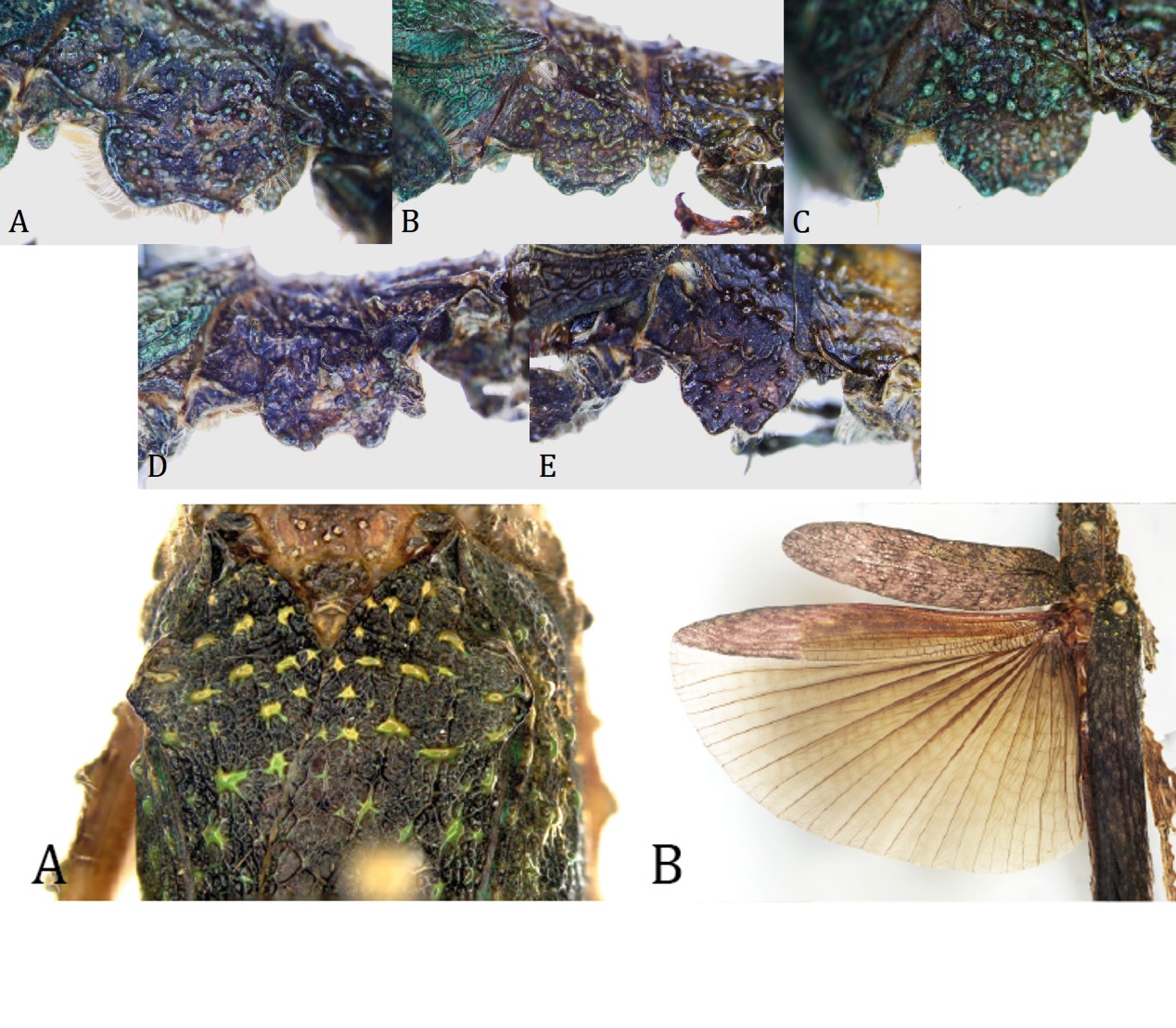
Figura 2: Lateral thoracic projection of P. ariadne (A), P. berosus (B), P. biolleyi (C), P. horstokki (D) and P.ohrtmanni (E). Photograph taken with the specimen’s head positioned to the right.
Identification key for Prisopus from Costa Rica
1 Vertex with a pair of well-defined conical horns____2 1’ Vertex without horns___3 2 Horns equal to or longer than eye diameter and hind wings one-third longer than wide__P. biolleyi 2’ Horns shorter than eye diameter and hind wings almost as long as wide___P. ohrtmanni 3 Tegmen with well-defined irregular warts on proximal half and hind wings without black markings on venation___P. ariadne 3’ Tegmen without warts on proximal half and hind wings with black markings on venation____4 4 Hind wings almost twice as long as wide and ventral abdominal markings with in Figure 1D__P. horstokki
4’ Hind wings less than one-third as long as wide and ventral abdominal spots as in Figure 1B___P. berosus
Prisopus ariadne (Hebard, 1923)
This is the only species that has small and irregular vesicles on the proximal third of the tegmen (Figure 3A). They can be seen as a slight relief on the intersections of the reticulated vein pattern. Another very important characteristic is that the hind wings do not have dark coloration on the veins, contrary to the rest of the species (Figure 3B). This species is restricted to the provinces of Guanacaste and Puntarenas, between 0 and 700 meters above sea level.
Prisopus berosus (Westwood, 1859)
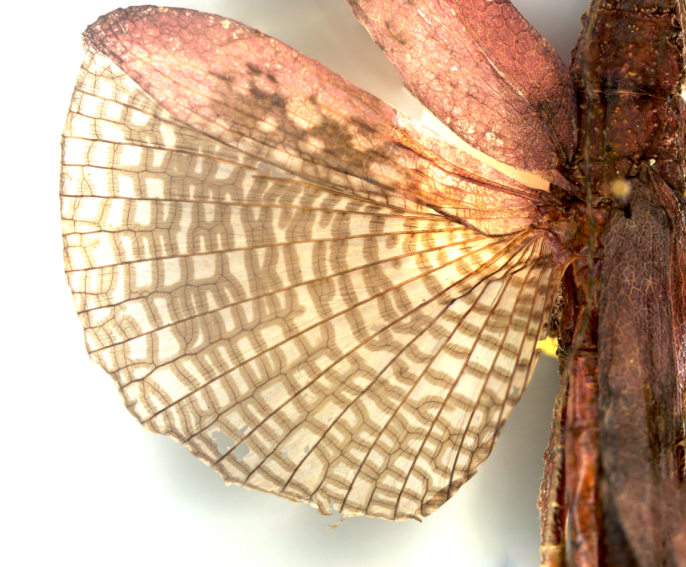
=Prisopus mexicanus (Saussure, 1859) It does not have horns or warts, but its body is more robust than the other species, generally with a reddish- brown coloration throughout the body. Its wings, like P. ohrtmanni, are about two-thirds as wide as they are long, and are shorter compared to the other species (Figure 4). It is estimated that it is distributed throughout the country, from 100 to 1400 meters above sea level.
Prisopus biolleyi (Carl, 1913)
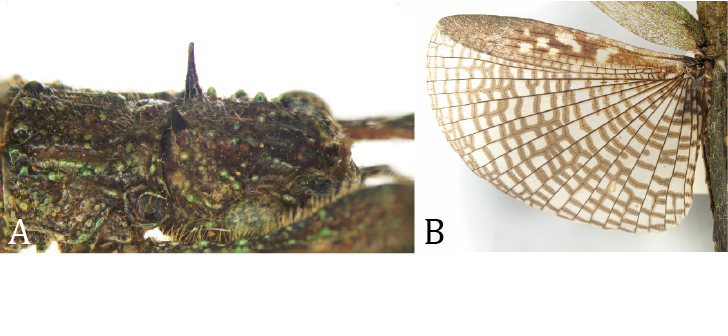
It is the only species that has two long, thin horns on the vertex (Figure 5A), which easily identifies it from the other species. Its wings have venation outlined in black and its width corresponds to two thirds of its length (Figure 5B). It is present on the Pacific slope in the provinces of Guanacaste, Puntarenas and Cartago between 300 and 1550 meters above sea level.
Prisopus horstokki (Haan, 1842)
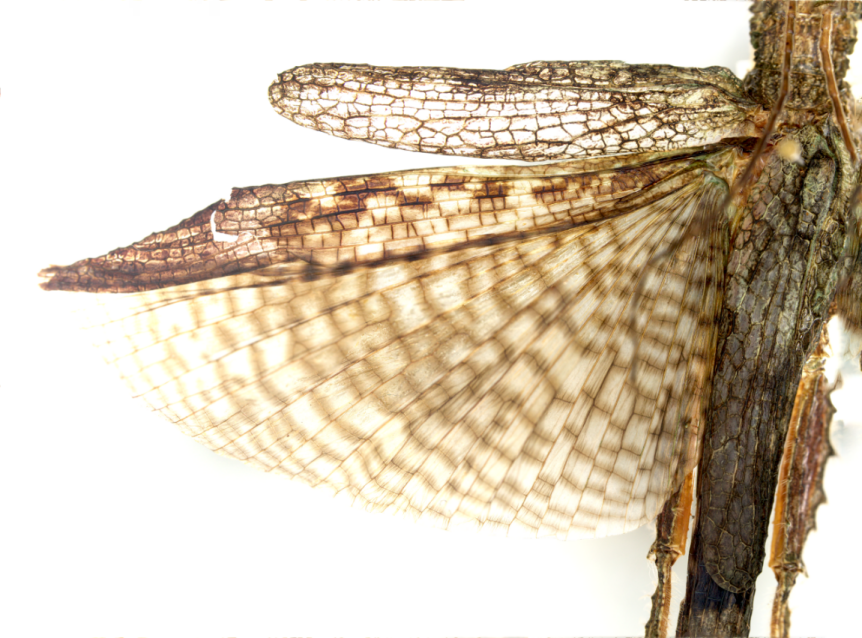
=Prisopus fisheri Gahan, 1912 This species has a very simple appearance without distinctive peculiar characters compared to the other species, even the outline of the venation of its wings is the same as the other species (Figure 6), so to separate it quickly it is necessary to use the ventral maculations (Figure 1). This species is a little collected species, so far it has only been collected in the province of Punterenas, between 50 and 80 meters above sea level (masl).
Prisopus ohrtmanni (Lichtenstein, 1802)
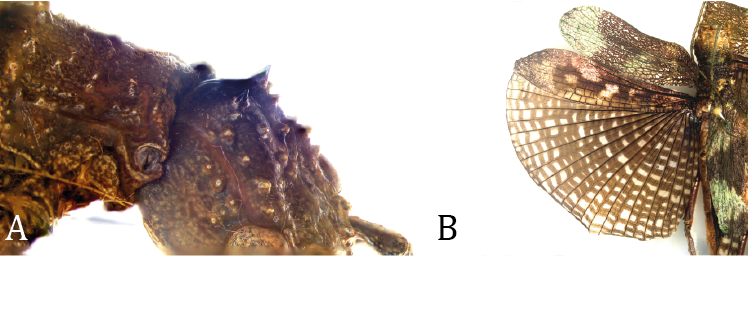
=Prisopus cornutus Gray, 1835 =Prisopus spiniceps Burmeister, 1838 =Prisopus spinicollis Burmeister, 1838 This species, like P. biolley, has two well-defined horns on the vertex, but they are shorter and wider (Figure 7A). It has the shortest wings of the national species, with a width proportional to three-quarters of the length and a black outline on the venation that is denser than in the other species (Figure 7B). Its distribution is currently restricted to the province of Guanacaste between 1000 and 1600 masl.
Discussion
The Phasmida order has been very little studied in Costa Rica, and despite how striking the Prisopus species are, they are no exception. This is why the MNCR collection actually has few specimens, which, despite their good state of conservation, belong to a few sampling points restricted to the Pacific slope.
Most of the specimens in this collection were collected by the former National Institute of Biodiversity (INBio), who, as part of their visionary project to inventory the biodiversity of Costa Rica, mainly used sampling methods such as malaise traps and snap nets, given that Prisopus are strictly associated with the canopy zone, and considering that the national forests have canopies with altitudes exceeding 40m, it is very difficult to collect them in the forests of the Caribbean zone, but it is not ruled out that the genus may be present throughout the national territory, with the exception of highly urbanized areas.
Due to the above, the results presented should be considered preliminary and very early, since there is no sampling effort directed at this group and using specific sampling methods for the canopy area that is reflected in the collection. Another important aspect is that there is no record of the specimens that may have been deposited in private or foreign collections, so there is still a large information gap that represents a good potential for future research.
Conclusions
The genus Prisopus only records five species due to the little study it presents in the Costa Rican territory, but the presence of other species is not ruled out.
The ventral maculations of the abdominal segments are the easiest feature for a quick pre-identification in the field of the specimens, and not so much the lateral projections of the mesothorax, which although they are distinct and diagnostic require other features to make a correct identification.
For an accurate separation of the specimens the following characteristics are necessary: presence of horns, presence of warts on the wings, ventral maculations of the abdominal segments and characteristics of the membranous wings.
References
-
Conle OV, Hennemann FH, Bellanger Y, Lelong P, Jourdan T, et al. (2020) Studies on neotropical Phasmatodea XX: A new genus and 16 new species from French Guiana. Zootaxa 4814(1): 1-136.
-
Camousseight A (2010) Prisopus apteros n. sp. (Phasmatodea: Pseudophasmatidae) of Chile. Revista Chilena de Entomologica 35: 5-13.
-
Heleodoro RA, Rafael JA (2020) Review of the genus _Dinelytron_ Gray (Prisopodidae: Prisopodinae: Prisopodini), with a phylogenetic analysis of the genera of the Prisopodini, including the description of a new genus. Zoologischer Anzeiger 285: 37-80.
-
Büscher T, Gorb S (2017) Subdivision of the neotropical Prisopodinae Brunner von Wattenwyl, 1893 based on features of tarsal attachment pads (Insecta, Phasmatodea). Zoo Keys 645: 1-11.
- Mitochondrial Bio-Logistics: Steering Co-Enzyme Q10 and Lycopene Synergies within the Science 4.0 Bio-OS Framework
- Hymenoptera Specimens from the Caño Negro Wetland, of the National Museum Collection, Costa Rica
- Science 4.0: Comprehensive Architecture of the Biological Operating System (Bio-OS) A Framework for Systemic Resilience and Industrialized Bio-Governance
- Rabbit on, or Hare Back? Understanding Climate Change
- Clinical Validation of Science 4.0: Flow Steering and Epigenetic Drift Inversion on a 76-Year-Old Hybrid System
- Seeds Planted by another Mind