
Wound Treatment in Cerdocyon thous (crab-eating fox) Using Calcium and Silver Alginate Dressing-Case Report
The crab-eating fox (Cerdocyon thous) is a wild canid widely distributed in South America, inhabiting various biomes, including forested areas and grasslands. Wound dressings may be necessary since these canids are often brought up to rehabilitation after accidents such as vehicle collisions. The calcium alginate and silver dressing does not require daily replacement, thereby reducing the need for frequent handling of the animal. This case report describes the wound management protocol in a C. thous with a calcium alginate and silver dressing. Dressing changes were performed every 10 days and a total of 50 days were necessary for complete wound resolution. The use of the calcium alginate and silver-based biological dressing was effective and essential for wound healing in the crab-eating fox (C. thous), despite certain limitations. Therefore, further studies should be published to provide more information on the use of this dressing in the treatment of wounds in other species of wild animals.
Depelegrin C¹*, Morel AP¹, Aguiar JF² and Da Silva MH³
¹DVM Zoologico Municipal de Canoas (Canoas Municipal Zoo), Brazil ²DVM Independent Researcher, Brazil ³Veterinary Medicine Student, Brazil Keywords: Canidae; Injury; Wildlife Collision; Bandage
Introduction
The crab-eating fox (Cerdocyon thous) is a wild canid widely distributed in South America, inhabiting various biomes, including forested areas and grasslands [1]. The species also occupies anthropogenic environments and, although it is not considered threatened, individuals are frequently victims of roadkill, accidents, and negative interactions with human activities, often requiring specialized veterinary care [2].
The calcium alginate and silver dressing does not require daily replacement, thereby reducing the need for frequent handling of the animal and, consequently, minimizing stress and the risks associated with physical restraint during treatment [3]. It is composed of calcium alginate salts, a polysaccharide derived from brown seaweed (Algae Phaeophyceae), which forms a gel upon contact with wound exudate, creating a moist environment ideal for tissue regeneration. It also has high absorptive capacity, making it suitable for wounds with moderate to heavy exudate [4].
The present case report aims to describe the wound management protocol in the crab-eating fox (C. thous) using a calcium alginate and silver dressing.
A young female crab-eating fox (C. thous), estimated to be less than one year old, was brought to the zoo for medical care after being hit by a vehicle. Upon initial examination, bone instability was noted in the left thoracic limb (LTL) and left pelvic limb (LPL), as well as respiratory distress. After initial stabilization with analgesics and anti-inflammatory drugs, the animal underwent radiographic examination the following day. Fractures were identified in the proximal radius and ulna of the LTL and in the distal femur of the LPL, along with signs of pulmonary contusion and pneumothorax.
Due to the animal’s overall condition, surgical procedures were initially not feasible, and the fractures were temporarily stabilized using splints. After five days of treatment, the animal was deemed fit for surgery. Both limbs were immobilized using external fixators, as the proximity of the fractures to the joints did not allow for proper placement of bone plates.
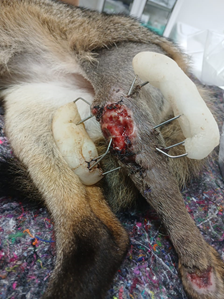
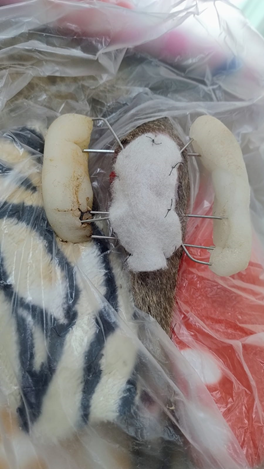
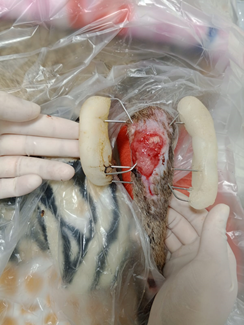
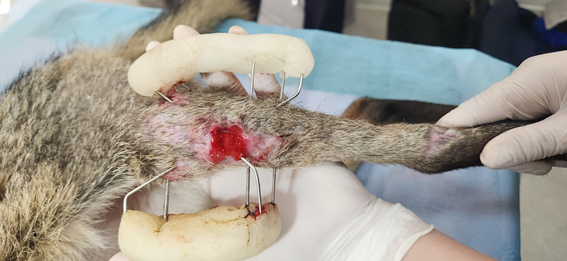
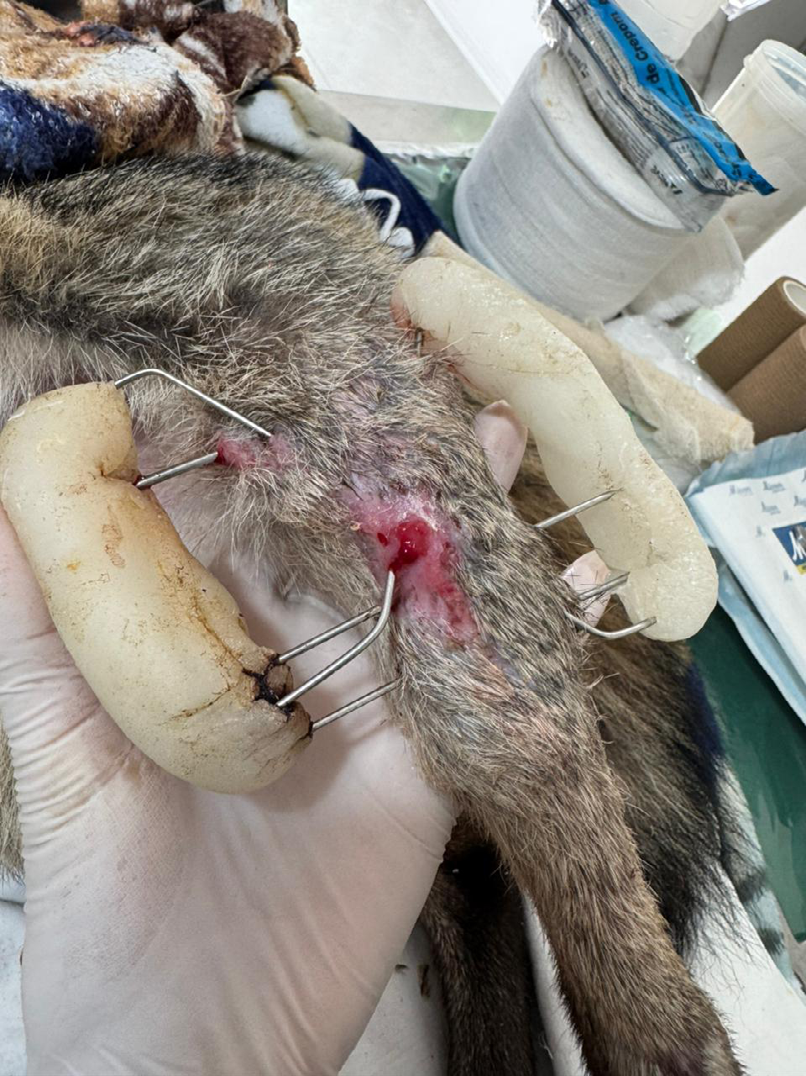
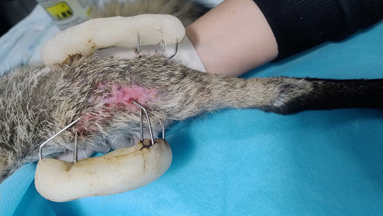
Two days after the surgical stabilization of the fractures with external fixators, the animal developed dehiscence of the skin and subcutaneous tissue on the left pelvic limb. Due to the extensive retraction of the wound edges, primary closure was not possible, and a local treatment with a calcium alginate and silver-based biological dressing was initiated. The wound was cleaned with saline solution and 0.05% chlorhexidine solution, followed by application of the calcium alginate with silver dressing, restricted to the lesion area. To better secure the dressing, the wound edges were sutured and covered with bandages to reinforce stabilization. Dressing changes were performed approximately every 10 days, always under sedation. During the treatment period, complications occurred, including premature removal of the dressing on two occasions, which required reassessment of the containment strategy. As additional measures, an Elizabethan collar was used, and the bandage was reinforced to also cover the external fixator.
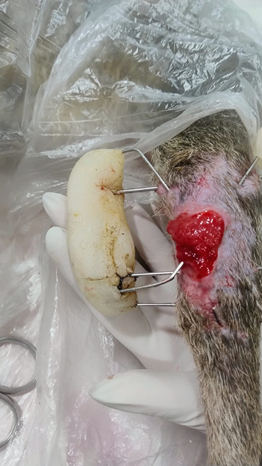
The biological dressing treatment lasted for approximately 50 days, with favorable clinical progression and complete wound resolution.
Discussion
Calcium alginate has a high absorption capacity, promoting the formation of a gel that maintains a moist environment and supports healing, while silver acts as a broad-spectrum antimicrobial agent, controlling local infections and preventing complications. These dressings are particularly indicated for wounds with moderate to heavy exudate, as observed in the present case, and reduce the need for frequent changes — a relevant aspect when dealing with wild animals that require sedation for restraint [5].
The protocol recommended by the manufacturer of these dressings involves changes every 3 to 5 days to maintain the effectiveness of the material and prevent bacterial colonization [3]. However, due to the need for sedation during each procedure, dressing changes were scheduled approximately every 10 days, using restraint strategies (Elizabethan collar and reinforced bandaging), also mentioned by another author as effective in reducing handling in stressed wild animals [6].
This decision was supported by evidence that silver- based dressings may retain antimicrobial activity for up to 7–14 days, depending on wound exudate and local conditions [7]. Furthermore, some authors highlight that, in wildlife medicine, dressing protocols must be adapted to reduce stress and promote recovery, even if this involves less frequent interventions [6].
Regarding the active ingredients used, the effectiveness of calcium alginate impregnated with silver remains a topic of debate in the literature. Although its antimicrobial and healing effects are well documented in different species, including dogs [8], some studies highlight important limitations. Silver alginate dressings are not recommended for dry wounds or those in advanced stages of healing, as their therapeutic action depends on the formation of a gel in the presence of exudate [9, 10].
Furthermore, ionic silver, while effective against resistant microorganisms, may exhibit cytotoxicity at high concentrations or with prolonged use, inhibiting the proliferation of fibroblasts and keratinocytes, which are essential for the proliferative phase of wound healing [11, 12]. These findings underscore the importance of a thorough assessment of the wound type, stage of tissue repair, and the specific characteristics of the species being treated, in order to avoid the indiscriminate application of this technology. Rational use, based on continuous clinical monitoring, is essential to ensure the effectiveness and safety of the treatment, especially in wildlife patients, whose physiological response may differ significantly from that observed in domestic animals [11, 12].
Despite complications such as premature removal of the dressing on two occasions, the condition evolved positively, with the formation of healthy granulation tissue and complete wound resolution after about 50 days of treatment.
Healing in wildlife can be compromised by various factors, including stress-related immunosuppression, difficulties in infection control, and limited access to advanced therapies in emergency care settings [5, 6]. Repeated physical and pharmacological restraint can increase stress and impair the animal’s recovery, justifying the choice of dressings that require fewer interventions [13].
The case described exemplifies how technical knowledge, combined with practical adaptations based on the reality of wildlife management, can lead to satisfactory clinical outcomes, even in the face of structural or behavioral limitations. The scarcity of publications reporting the use of dressings such as silver-impregnated alginate in wild animals underscores the relevance of this case report, which contributes to the documentation of successful approaches that may guide future clinical interventions in similar species. It becomes clear that further studies on wound healing in free-ranging animals are needed, with emphasis on the physiological, immunological, and behavioral particularities of these species.
However, this study presents inherent limitations typical of single-case reports. The absence of a control group restricts the ability to directly compare the efficacy of calcium alginate and silver dressings with alternative wound management strategies. Additionally, individual variability related to the animal’s young age and overall health condition may have influenced the healing process. Therefore, while the positive clinical outcome reported here is encouraging, further research involving larger sample sizes and controlled experimental designs is necessary to better understand the effectiveness and safety of this treatment approach in wild canids and other wildlife species.
Conclusion
The use of the calcium alginate and silver-based biological dressing was effective and essential for wound healing in the crab-eating fox (C. thous), despite certain limitations. Therefore, further studies should be published to provide more information on the use of this dressing in the treatment of wounds in other species of wild animals.
Ethical Statement
This case was managed under the protocols of the Wildlife Rehabilitation Program of the Zoológico Municipal de Canoas, following national legislation for the care of wild animals (e.g., former IBAMA Normative Instruction No. 179/2008, now revoked, and current applicable regulations) [14]. All procedures were conducted by licensed professionals in accordance with animal welfare regulations. Formal ethics committee approval was not required for individual clinical case reports.
References
-
Motta JC, Tavares AS (2014) Order Carnivora: Canids in Treatise of Wild Animals: Veterinary Medicine. In: 2nd (Edn.), Cubas ZA, Silva JCR, et al. (Eds.), São Paulo: Roca, pp: 709-726.
-
Beisiegel BM, Lemos FG, Azevedo FC, Queirolo D, Jorge RSP (2013) Extinction risk assessment of the crab-eating fox Cerdocyon thous (Linnaeus, 1766) in Brazil. Brazilian Biodiversity 3(1): 138-145.
-
Hoerning TC (2020) Wound management in a dog using calcium alginate dressing: A case report, Undergraduate Thesis, Federal University of Paraná.
-
Filho NPR, Mendes DS, Souza MSB, Arias MVB (2014) Use of wound dressings in the treatment of injuries in dogs and cats. Medvep Scientific Journal of Veterinary Medicine Small Animals and Pets 12: 41.
-
Barnea Y, Weiss J, Gur E (2025) A review of the applications of the hydrofiber dressing with silver (Aquacel Ag®) in wound care. Therapeutics and Clinical Risk Management 6: 21-27.
-
Trindade M (2019) Biological dressings in the treatment of wounds in wild animals: literature review. Revista de Medicina Veterinária e Zootecnia.
-
Lansdown AB (2002) Its antibacterial properties and mechanism of action. J Wound Care 11(4): 125-130.
-
Percival SL, McCarty SM (2015) Silver and alginates: Role in wound healing and biofilm control. Adv Wound Care (New Rochelle) 4(7): 407-414.
-
White RJ, Cutting KF (2006) Modern exudate management: a review of wound treatments. World Wide Wounds. 2(1): 56-60.
-
Qin Y (2005) Silver‑containing alginate fibres and dressings. Int Wound J 2(2): 172-176.
-
Poon VKM, Burd A (2004) In vitro cytotoxicity of silver: implication for clinical wound care. Burns 30(2): 140- 147.
-
Trop M, Novak M, Rodl S, Hellbom B, Kroell W, et al. (2006) Silver-coated dressings reduce biofilm formation: An in vitro study. Wound Repair Regen 14(3): 314-318.
-
Silva FX, Lima RS, Oliveira PR (2019) Chronic stress in wild mammals subjected to physical restraint and sedation: physiological and immunological implications. Braz J Wildl Res 12(3): pp. 145-156.
-
Brazilian Institute of Environment and Renewable Natural Resources (IBAMA) (2008) Normative Instruction, Provides for the destination of wild animals received by screening and rehabilitation centers. Brazil.
- Mitochondrial Bio-Logistics: Steering Co-Enzyme Q10 and Lycopene Synergies within the Science 4.0 Bio-OS Framework
- Hymenoptera Specimens from the Caño Negro Wetland, of the National Museum Collection, Costa Rica
- Science 4.0: Comprehensive Architecture of the Biological Operating System (Bio-OS) A Framework for Systemic Resilience and Industrialized Bio-Governance
- Rabbit on, or Hare Back? Understanding Climate Change
- Clinical Validation of Science 4.0: Flow Steering and Epigenetic Drift Inversion on a 76-Year-Old Hybrid System
- Seeds Planted by another Mind