
Description of a Nest of the Ultramarine Grosbeak Cyanoloxia brissonii from Northern Venezuela, with Further Information about its Breeding Behavior
The Ultramarine Grosbeak Cyanoloxia brissonii is a polytypic species with five recognized subspecies discontinuously distributed throughout South America, with limited knowledge about breeding and nesting behavior for most of them. Here, I describe a nest of Cyanoloxia brissonii minor for the first time, the most septentrional subspecies of the continent. In addition, this work informs some aspects about its breeding behavior, nestling development, and parental care hitherto unknown. All data collected was based on direct and circumstantial observations on the field. Prior to copulation, males established territories ranging 2,000-3,800 m2. In response to a male song, a female entered the male's territory uttering continuous “pitsh” notes, offering herself for mating, and initiating a chase-like behavior that ended when the copulation occurred. Then, a nest was discovered on a bush, 1.4 m above the ground, with two ovoid dirty-looking eggs inside, grayish-white in color, with thin reddish-brown streaks arranged longitudinally over the entire shell. The nest was a typical open, somewhat untidylooking bowl at the confluence of three branches (inverted tripod), externally lined with thin, fibrous lianas (Ø = 0.8-1.2 mm) and several tendrils. Internally, a bed of finer plant fibers was noticeable, rising 10 mm from the nest’s bottom. Measurements were (mm): cup-rim length 90.9-101.5; cup-rim wide 58–63; cup-rims thickness 21.5-27.0; outer-cup depth 90; and inner-cup depth 40. The day following the nest encounter, two newly-hatched nestlings occupied its interior. They were born completely naked, with skin smoked-brown in color, noticeable black ocular globes, black beak with buffy-white edges (tomios), and eyes fully closed. This work also reports information about nestling development from hatching to fledging time. Nestlings were brooded and fed by both parents. Parents appeared every 15-35 minutes carrying food from early morning (06:30 h) to early evening (19:00 h). Food items consisted of insects, seeds, and fruit. Parents regurgitated and kneaded the food in the beak before giving it to the nestlings. The nestlings defecated in “fecal sacs” removed by the parents. Nestlings left the nest 11 days after hatching. Finally, this study establishes that the Ultramarine Grosbeak breeding season extends from June to August in Venezuela. The present study fills an important gap in the knowledge of the Ultramarine Grosbeak breeding behavior.
Introduction
The Ultramarine Grosbeak Cyanoloxia brissonii (Lichtenstein, 1823) is a Cardinalidae member characterized by its dichromatic plumage pattern where males are typically dark slate blue color while females are uniform dark reddish-brown [1]. It is a widely distributed inhabitant of forests, scrublands, and disturbed habitats throughout the lowlands of eastern South America, between the Amazonian lowlands and the Patagonian steppe; with discontinuous populations in Colombia and Venezuela [2]. Currently, five subspecies are recognized [3]: Cyanoloxia brissonii brissonii (Lichtenstein,1823) of NE Brazil; C. b. argentina (Sharpe, 1888) of E Bolivia, S Brazil, Paraguay, and N Argentina; C. b. caucae (Chapman, 1912) of SW Colombia; C. b. sterea (Oberholser, 1901) of E and S Brazil, E Paraguay, NE Argentina, and Uruguay; and C. b. minor (Cabanis, 1861) of Coastal Mountain Range in northern Venezuela, from Falcón and E Lara to Monagas and Sucre. Despite its broad distribution, the information on its nest and nesting behavior is still scarce, and chiefly known from the austral subspecies C. b. argentina [4, 5, 6, 7]. In Argentina, the nest is usually build in open places or edges of forests [5], semi-hidden [7], on horizontal leafy tree branches or their forks; also in shrubs, including Lithraea molleoides, Schinus fasciculata (Anacardiaceae), Geoffroea decorticans, Neltuma spp. (Fabaceae), Celtis iguanea (Cannabaceae), Aloysia gratissima (Verbanaceae), Castela coccinea (Simaroubaceae), and also coconut plants (Arecaceae), generally at low or medium height, between 1.3-3.0 m from the ground [4, 5, 6, 7, 8, 9, 10]. The nest, more or less rounded, has been described as an open cup or hemisphere [2, 5, 7, 11] of simple, lax, somewhat translucent and shallow construction, relatively weak to support its own mass [4, 5], lined externally with small dry branches and plant fibers, with abundant horsehair and/or fine fibers in the center [4, 5, 7, 8, 9, 10], sometimes with pieces of lichens such as Usnea sulcata (Parmeliaceae) or the fern Microgramma vacciniifolia (Polypodiacea) inside [5]. Dimensions reported include (mm): total height 75; outer diameter 90; internal diameter 55×50; cup depth 30-50 [2, 4, 7]. Clutch size and external egg color pattern vary: two to four eggs, generally some kind of white as background that may be bluish-white, grayish- white, or ferruginous-white, slightly satiny, with more or less intense spots of pale cinnamon, reddish-brown, and/or pale purple, heavier at the blunt end [2, 4, 7, 8, 9, 10, 12]. The egg shape also varies, typically ovoid, with one end more pointed than the other, but eggs with equal poles have also been reported [7, 9].
In Venezuela, information associated with the nest and breeding behavior of the Ultramarine Grosbeak is practically nonexistent [13]. A few references only describe the extension of its breeding season, which runs from May to July [14, 15]. In this sense, the present work reports the physical characteristics of a nest found in northern Venezuela, as well as some aspects about its breeding behavior, nestling development, and parental care hitherto unknown.
Materials and Methods
Study area. The study was carried out in Los Naranjos farm, a disturbed area on the Coastal Mountain Range, southeastern suburbs of Caracas, El Hatillo County, Miranda state, northern Venezuela (10°26’14”N, 66°47’27” W; ±900 m a.s.l.). This locality was described by Verea [16] as a pastureland with dispersed fruit trees such as avocado, banana, and citrus, that grew around a few resident houses. Among the grasses, Guinea Grass Megathyrsus maximus and Itch Grass Rottboellia cochinchinensis (Poaceae) were predominant. Quebrada Santa Rosa, a little creek that runs close from the nest site (less than 30m), supports tall trees (10-30 m) of Fabaceae, Burseraceae, and Cecropiaceae, among others. Plants of Asteraceae, Caricaceae, and Heliconiaceae are also present [17]. The area experiences two climatic seasons: a dry season (December to April) and a rainy season (May to November), and an annual precipitation of 1,000 mm [18].
Subspecies studied. According to taxonomic and distribution literature [1, 19, 20, 21] the subspecies studied correspond to Cyanoloxia brissonii minor (Cabanis, 1861).
Data collecting. All data collected was based on direct and circumstantial observations on the field. Similar to other nests studied in the area (16,17), nest dimensions, including outer-cup depth, cup-rim thickness (distance between outer-inner edges), cup-rim length (distance between outer edges), and cup-rim wide (distance between inner edges) were taken with a plastic dial caliper Spi 31-415-3 model with 0.1 mm readability, whereas the inner-cup depth was measured with a metallic rule with 1.0 mm readability. Additional notes on mating behavior, nestling development and parental care were recorded with the help of Swarovski™ SLC binoculars (10 X 42). A set of photographs was taken with a Nikon™ Coolpix P510 camera with a 42x NIKKOR lens (24-1.000 mm), and a 16.1 MP CMOS sensor, ideal for long- range photography. After the study was completed, the nest was collected and deposited in the Phelps Ornithological Collection, Caracas. Information on literature associated with the Ultramarine Grosbeak nesting was provided by Matta-Pereira et al. [13].
Results
In June 2025, I took field notes on the Ultramarine Grosbeak’s mating behavior. Prior to copulation, males established contiguous territories ranging from 2,000 to 3,800 m2 (n=3). Thence, they sang vigorously from concealed locations such as bushes with tangled foliage, within the canopy, or from treetops. In response to a male song, a female entered the male’s territory uttering continuous “pitsh” notes. When the male appeared, the female flew to a nearby branch, beating her wings nervously, increasing the frequency of the notes, and offering herself for mating. As the male approached, she moved to another branch, initiating a chase-like behavior. She often repeated this pattern until copulation occurred. The female disappeared afterward, and the male returned to the singing spot, resuming the songs. From this point on, I had no additional knowledge on their behavior until the discovery of the nest.
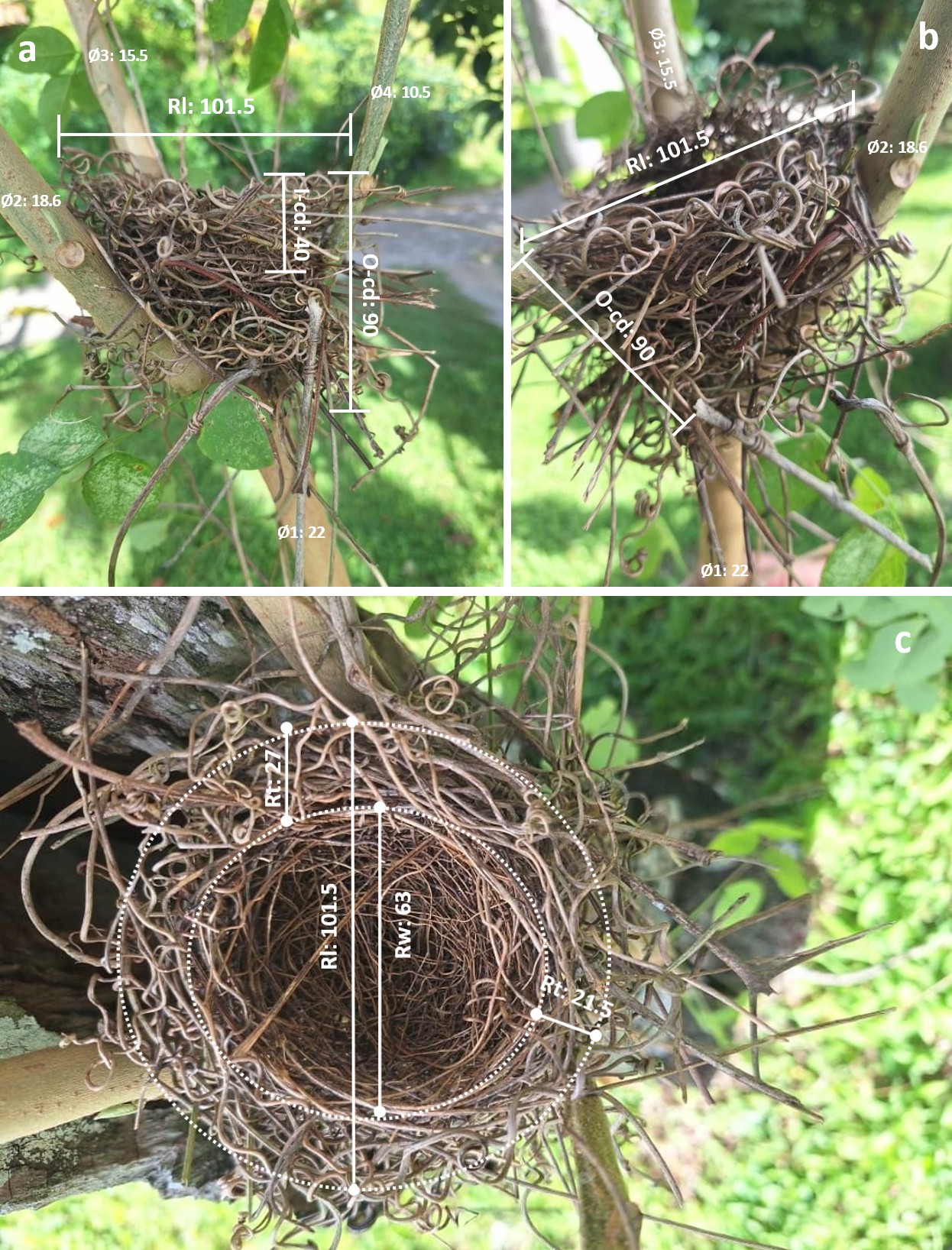
Figure 1: Ultramarine Grosbeak Cyanoloxia brissonii nest measures: a, front view; b, back view; c, over view. Nomenclature: Outer-cup depth (O-cd); Inner-cup depth (I-cd); Cup-rim thickness (Rt); Cup-rim length (Rl); Cup-rim wide (Rw). Nest support plant, Cassia fruticosa (Fabaceae). Ø1–Ø4 = support branch diameters. All measures in mm. Photos: C. Verea.
The nest of the Ultramarine Grosbeak was discovered on July 27, 2025 at 17:15 h, while a local gardener was weeding a pastureland of Guinea grass where the nest laid hidden on a Cassia fruticosa (Fabaceae: Caesalpinioideae) bush, 1.4 m above the ground, among the cutting-leaves of the grass that grew up to two meters high on a very steep terrain (>45°). Due to the terrain characteristics, I could barely approach the nest where two ovoid dirty-looking eggs were observed, grayish-white in color, with thin reddish-brown streaks arranged longitudinally over the entire shell. Without tools to take any measurement, note, or photograph, I decided to visit the nest the next morning. At 08:00 h on July 28, I got close to the nest. As I was fifteen meters before, the female left the nest scared, an obvious reaction to my presence. Once again, reaching the nest was difficult. But this time, there were no eggs. Instead, two newly-hatched nestlings occupied the nest. Because the Ultramarine Grosbeak showed a very anxious and skittish behavior, I decided not to handle the nestlings to avoid parent’s nest desertion. After I left the site, I took notes on the nest structure. It was a typical open, somewhat untidy-looking bowl at the confluence of three branches (inverted tripod). The main stem of the support shrub (diameter = Ø1 = 22 mm) divided at the top into three minor branches of different diameters (Ø2 = 18.6; Ø3 = 15.5; Ø4 = 10.5). Externally, the nest was composed of thin, fibrous lianas (Ø = 0.8-1.2 mm), and lined with several tendrils. Internally, a bed of finer plant fibers, perhaps some kind of rootlet (Ø = 0.2-0.6 mm) was noticeable, rising 10 mm from the nest’s bottom. Because the edges were not perfectly defined, the cup-rim length, measured from different points, ranged from 90.9-101.5 mm; the cup-rim wide ranged from 58-63 mm; and the cup-rim thickness 21.5-27.0 mm. The outer-cup depth was 90 mm, and the inner-cup depth was 40 mm (Figure 1).
From a safe distance of 15 meters, and assisted by the photographic camera, I recorded several parameters related to the nestlings and their parents over the following days. I observed that nestlings were born completely naked, with skin smoked-brown in color, noticeable black ocular globes, and eyes fully closed. They also had a black beak (bright- black at upper jaw, dull-black at lower jaw) with buffy-white edges (tomios). By the third day, the quills of both the dorsal and wing feathers quills became visible, and the body took on a dark, leaden hue. On the fourth day, the nestlings’ eyes opened. By the fifth day, the feather quills on the wings had opened significantly. On the ninth day, the body feathers were nearly complete, dark -brown on top and dull-brown underneath. Only the head remained featherless, including the lateral sides (eye ring, supercilium, loreal patch, auricular and malar areas), with two lines of white quills visible at the crown, some slightly open. On the tenth day (August 8, 2025), the nestlings perched on the nest’s edges, stretching their legs and flapping their wings. The female called them persistently from a nearby branch, and they finally left the nest on the eleventh day (August 9, 2025).
Both parents brooded the nestlings. When the female stayed in the nest, the male surveilled from the top of a nearby tree/bush. During this time, the male sang energetically, often in response to other nearby males. Also, both parents fed the nestlings. They established an “air bridge” in order to continuously provide food to them. They appeared every 15-35 minutes from surrounding areas within a 50-60 m radius, carrying food from early morning (06:30 h) until early evening (19:00 h). Food items consist of insects, among them winged forms of Isoptera; seeds of Guinea Grass and Itch Grass; and unidentified wild fruits. When any of the parents arrived at the nest, both nestlings immediately raised their heads begging for food from the first day. Parents regurgitated and kneaded the food in the beak before giving it to the nestlings. The nestlings defecate in “fecal sacs” removed by the parents to keep the nest clean.
Discussion
This work reveals the physical characteristics of a nest of the tropical subspecies Cyanoloxia brissonii minor for the first time. My observations indicate that it had the same structure of those nests described for the austral race C. b. argentina (4-10), except for a few complementary materials, such as horsehair, lichens, and fern. Instead, the nest studied highlighted by the numerous tendrils that externally lined it, perhaps as decorative elements or camouflage, not as interwoven support to give stability to the nest, because many of them were loose fragments. Nest dimensions did not differ notably from previous information. Only the outer-cup depth (90 mm) was slightly greater than previous knowledge (75 mm), perhaps in response to the kind of support exploited (tripod instead of a horizontal leafy branch). Although my observations on the eggs’ characteristics are unique in Venezuela, it matches with the egg’s description given by Smyth [12]: “… grayish-white, lightly speckled and stained across the entire surface with reddish-brown…”. However, we could expect more color variations of Ultramarine Grosbeak’ eggs in the country, given the diversity of color patterns described in Argentina. Unfortunately, I had no chance to measure the eggs, a piece of information still requiring further observations in Venezuela.
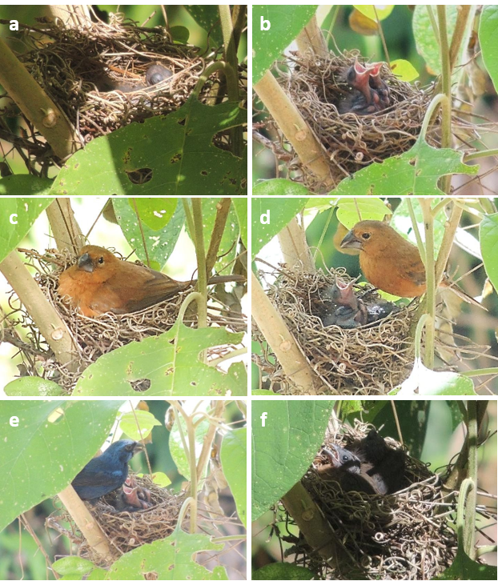
Besides the nest and egg descriptions of the species, further information on breeding biology of the Ultramarine Grosbeak is limited in literature [2]. Di Giacomo [5] already warns about this problem, and provides some field notes, such as male/female participation in incubation/feeding, and number of days that nestlings remain in the nest. With regards to that, I also recorded that both parents brooded the nestlings, so I assumed that both incubate the eggs as well.
But Di Giacomo [5] informs that only the female incubates. With no other data, the information requires confirmation. Similar to Di Giacomo [5], nestlings were fed by both parents. Likewise, Studer [11] shows evidence of a male tending to a nestling in the nest. From my observation spot, I observed that the male was quite active when it came to the nestlings’ feeding. Daily, the male mainly consumed Itch Grass seeds, and then traveled to the nest to deliver the nestlings a doughy mass prepared with the beak. Among the insects delivered, I could only identify winged forms of Isoptera. This work also reports information about nestling feather development from hatching time to fledging. Ochoa de Masramon [4] only points out that nestlings develop brownish feathers on the back, rump, and head; and lighter cinnamon underparts; a color pattern that resembles the female appearance [9]. A similar plumage was recorded for the fledging here, although it appeared darker than that observed in the female (Figure 2). Nonetheless, the brooding time recorded here (11 days) was shorter than 16 days reported by Di Giacomo [5]. Without other data to compare, I think that nestlings may have left the nest prematurely, encouraged by the calls of the female due to the insecure environment created after the weeding around the nest. In fact, their heads were featherless when they were gone. In addition, a set of potential nest raiders, including the Crested Oropendola Psarocolius decumanus [17], and the Yellow-headed Caracara Daptrius chimachima [18, 19, 20, 21, 22] regularly patrolled the area. For latter species, an exposed nest is usually an easy target.
Poor information links the Ultramarine Grosbeak breeding season to climatic conditions. In Argentina, de la Peña (2013) barely informs of breeding activity during the austral summer in December. But Venezuela doesn’t have a “summer season” per se, and earlier reports indicate breeding activity during the rainy season from May to July [14, 15]. However, my observations reveal that the breeding season extends at least until August.
Finally, the present study fills an important gap in the knowledge of the Ultramarine Grosbeak, providing evidence-based insights, including nest and eggs of the Cyanoloxia brissonii minor subspecies, breeding territory dimensions, mating behavior, nestling behavior and plumage development, nestling diet, parental care, nest care, breeding season length, and potential predators.
Acknowledgments
The author thanks Nelson Esposito for providing information regarding the nest location. Also, Phelps Ornithological Collection Library kindly allowed me to consult some works cited in the list of references.
Conflicts of Interest
The author declares no conflict of interest.
References
-
Meyer de Schauensee R, Phelps WH (1978) A guide to the birds of Venezuela. Princeton University Press, Princeton, USA.
-
Brewer D (2020) Ultramarine Grosbeak (_Cyanoloxia_ _brissonii_). In: del Hoyo J, Elliott A, et al. (Eds.), Birds of the World Cornell Lab of Ornithology, Ithaca, USA, 1.
-
Zoonomen (2026) _Cyanoloxia brissonii_ (Lichtenstein) 1823. In: Alan Peterson P (Ed.), Zoonomen Nomenclatural Data, Walla Walla, WA.
-
Ochoa de Masramón D (1979) Contribución al estudio de las aves de San Luis. Tercera parte. El Hornero 12: 59- 68.
-
Di Giacomo AG (2005) Aves de la Reserva El Bagual. In: Di Giacomo AG, Krapovickas SF (Eds.), Historia Natural y Paisaje de la Reserva El Bagual, Provincia de Formosa, Argentina. Temas de Naturaleza y Conservación- Monografía de Aves Argentinas N° 4. Aves Argentinas, Asociación Ornitológica del Plata, Buenos Aires, Argentina, pp: 201-465.
-
Maragliano REL, Marti J, Ibañez LM, Montalti D (2009) Comunidades de aves urbanas de Lavallol, Buenos Aires, Argentina. Acta Zoológica Lilloana 53: 108-114.
-
de la Peña MR (2013) Nidos y reproducción de las aves argentinas: Serie Naturaleza, Conservación y Sociedad N° 8. Ediciones Biológica, Santa Fe, Argentina.
-
Hartert E, Venturi S (1909) Notes sur les oiseaux de la Republique Argentine. Novitates Zoologicae 16: 159- 267.
-
Dinelli L (1924) Notas biológicas sobre las aves del noroeste de la República Argentina. El Hornero 3: 253- 258.
-
Pereyra JA (1951) Avifauna argentina (Contribución a la Ornitología). El Hornero 9: 291-347.
-
Studer A (2015) Aves (Aves) da Reserva Biológica de Pedra Talhada. In: Studer A, Nusbaumer L, et al. (Eds.), Biodiversidade da Reserva Biológica de Pedra Talhada, Alagoas, Pernambuco - Brasil. Editions des Conservatoire & Jardin Botaniques de la Ville de Genève, Chambésy, Switzerland, pp: 377-405.
-
Smyth CH (1928) Descripción de una colección de huevos de aves argentinas. El Hornero 4: 125-152.
-
Matta-Pereira M, Lentino M, Lentino L, Angelozzi G, Piñero P, et al. (2021) Inventario bibliográfico sobre los nidos de las aves de Venezuela. Revista Venezolana de Ornitología 11(S): 4-185.
-
Schäfer E, Phelps WH (1954) Las aves del Parque Nacional “Henri Pittier” (Rancho Grande) y sus funciones ecológicas. Boletín de la Sociedad Venezolana de Ciencias Naturales 83: 1-167.
-
Verea C, Solorzano A, Díaz M, Parra L, Araujo MA, et al. (2009) Registros de actividad reproductora y muda en algunas aves del norte de Venezuela. Ornitología Neotropical 20: 181-201.
-
Verea C (2016) Nest and nestling development of the Sooty-capped Hermit (_Phaethornis augusti_) from Venezuela. Revista Brasileira de Ornitologia 24(4): 338- 343.
-
Verea C (2023) Further information about the nest, eggs and nestlings of the Copper-rumped Hummingbird _Saucerottia tobaci_ from Venezuela. International Journal of Zoology and Animal Biology 6(5): 504.
-
World Weather Information Service (2026) World Meteorological Organization (WMO), United Nations Organization (UNO), New York, USA.
-
Phelps WH, Phelps WH (1958) Lista de las aves de Venezuela con su distribución, Tomo 2, Parte 1, No- Passeriformes. Boletín de la Sociedad Venezolana de Ciencias Naturales 19: 1-317.
-
Hilty SL (2003) Birds of Venezuela. Princeton University Press, Princeton, USA.
-
Restall R, Rodner C, Lentino M (2006) Birds of northern South America. Christopher Helm, London, UK.
-
Verea C (2023) Nesting area, eggs and nestling development of the Common Pauraque _Nyctidromus_ _albicollis_ from Venezuela. International Journal of Avian and Wildlife Biology 7: 92-98.
- California Red-Legged Frog and Non-Listed Amphibians Response to Non-Native Fish Removal
- Industrial Standardization of the Bio-OS: Algorithmic Codification of Resilience Engineering Guidelines and Version V8 Architecture
- Climate Variability and the Sustainability of Snail Farming in Nigeria: Past Trends, Present Challenges and Potential Outlook
- The Evaluation of the Surveillance System of Anthrax in Gilgit-Baltistan, Pakistan, 2018
- Natural Decline to Extinction of A New Zealand Rabbit Population
- Mitochondrial Bio-Logistics: Steering Co-Enzyme Q10 and Lycopene Synergies within the Science 4.0 Bio-OS Framework