
Expression of the Emotions in Pigeons
Unexpressed emotions in dove showed its body expression 13 (81.25%) like incubating, tender, aggressive, feeding, regurgitation, flying, courtship, nesting, mating, post-mating, frightened, resting, and helpless where facial expression were only 3 (18.75%) out of 16 behaviours. Age-related characteristics were incubating, aggressive, regurgitation, courtship, nesting, mating, post-mating, and shame (50%). Except incubating, feeding, regurgitation, courtship, nesting, mating, and post-mating other behaviours were depended on environmental factors (56.25%) and genetical characteristics were 43.75%. Facial expressions were not seen for lacking facial muscles of the pigeons. Only aggressive and mating behaviour were prominent by observing the puffing of the feathers.
Introduction
Scientifically there is no difference between a pigeon and a dove. The word pigeon comes from Latin word pipio which is cheeping and dove from Norse origin in 14th century as dova or douve which is diving. Lots of pigeon towers were seen in Egypt and Iran. 3000 years ago, racing pigeons were used in flying as competition. In 1860 pigeons acted to carry news from Brussels to Aachen. Charles Otis Whitman hybridized several species of pigeons and sought to confirm his ‘Orthogenesis’ which is a form of internal force that modified species. Experimentation with pigeons and doves in the field of social behaviour is complicated [1, 2]. Moreover, ring neck doves were domesticated for 2000 to 3000 years ago. This dove is originated from African and Asian species Streptopelia roseogrisea [3]. Domesticated variety is larger than wild variety [4]. This dove has no homing ability and restricted vision in bright light. Dr Wilmer J Miller who is was a renowned dove expert of Iowa State mentioned that this domestic variety is kept for thousands of year. This is bred in cages from biblical times and genetic research started since 1800s. Now this variety has 40 colour combinations. 38 colour variations have published by Professor Bob Lockhart in 1999.
Like pigeons, doves are not domesticated randomly through selection except Barbary and Diamond dove. Due to close connection with human all pigeons have been changed through its colour and structure. It has gained a lot of peculiar characteristics (eg- tumbling/rolling, tremule, muff, tallness, erect tail, care etc) but not in dove. Pigeons spend a lot of time in cleaning, preening and grooming. Hand reared birds showed a great social attachment to human. Fighting behaviour which is a great fault comes in pigeons and doves at the age two or more months. Birds are covered by feathers and have no facial muscle so it cannot express emotions clearly. In pigeons and doves aggressiveness with puffy feathers is remarkable expression. Normally all behaviour is expression but all expression is not behaviour. Behaviour is a group of phenomena but expression is special and it ends through emotion. French physician Duchenne suggested that expression comes from neurological problems and muscular disorders. There are three categories of the emotions- fear, anger and aggressiveness. In cat and dog these expressions are prominent. Emotion for pain is remarkable in most non-human animals. Side effects of some drugs on animals cause palpitation, tremor, and flushed feelings of the face.
Materials and Methods
Fancy Breeds
For this study, tumbler pigeons and Eurasian Collared Dove (Streptopelia risoria) were reared. Inexperienced and young pigeons and doves with adults showed equal expression. By the presence of predator birds like kite, falcon, and accipiter doves were shown frightened or escaping expression with short and repeat voice. Predator birds were available from noon to afternoon and for this incident some alarming birds like drongo, crow, bulbul, and blue rock pigeon were significant.
Food and Nest Materials
Less feeding, one-time feeding and group feeding were maintained for observing various expressions in doves or pigeons. Mud pot with its base, bamboo basket, newspaper for the nest material, and plastic eggs were used for observing its breeding performance.
Semi-intensive System
Everyday two times released those birds for enjoying their flying. The experimental cages were in size 24 x 24 x 36 and 18 x 16 x 12 inches. For observing such behaviours needed to ensure the room temperature 950- 970 Fahrenheit for proper metabolism [5]. When squab got the age 30 days they were separated from parent for avoiding usual attacks. Cages with 18 inches cube were maintained but 24 inches was ideal for a single pair breeding. Circular cage is good for observing behaviour because here birds not get chance to take any corners [6].
Results
Feeding
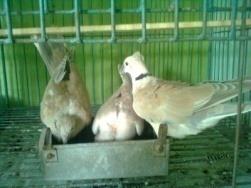
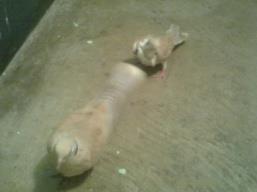
In very hungry condition, this behaviour can be identified easily. After serving food within 5-10 minutes birds do not look any sides. In group feeding, very hungry birds sometime try to take food first (Figure 1). Female pigeon fights with competition for the last few grains [6].
Courtship
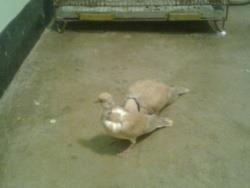
This time male is continued to excite the female. If female is in heat, shows its acceptance to the male. Hormonal reaction and action plays a major functional role at this stage. Completely healthy pigeons showed their perfect courtship behaviour. In some breeds especially tumblers spend more time to the female during this expression than others. Huge fighting phenomena are found in lotan or kokah breeds at this case (Figure 2). Male is always stimulated female [7]. The courtship and other behaviour patterns in pigeons have been discussed in the classic work of Whitman, Craig and Gifford [8, 9, 10].
Nesting
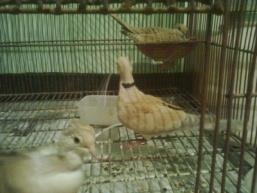
After maturation of male and female they try to collect sticks or straws for making nest (Figure 3).
Mating
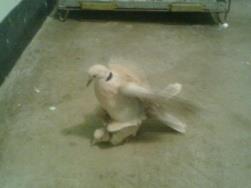
After billing (oral sex) the mating is ended by cloacal kiss when male takes place on the female. This is very short time expression (Figure 4).
Post-Mating
This is really a real expression of the pigeons and doves. After mating, short flying or cooing in both male and female and display of wing spreading or puffy feathers are mentionable. This inner feeling is enjoyable in both pre-adult and adult birds (Figure 5).
Incubating
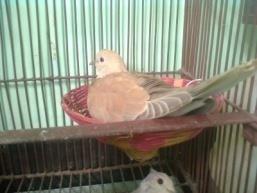
This is one kind of peaceful stage of the pigeons. Mind satisfactory expression is found at this stage in both male and female. Adult or very experienced or successful parents are easily attached with this behaviour (Figure 6). The male testosterone hormone had no effect on this incubation behavior [7].
Tender
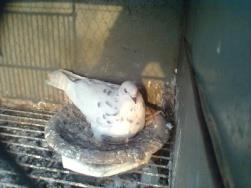
When squabs are medium in size their parents passed time by standing (Figure 7).
Shame
Unpaired/Newly paired heated female sometimes shows this phenomenon. Slight cooing and very tame expression is noted (Figure 8).
Regurgitation
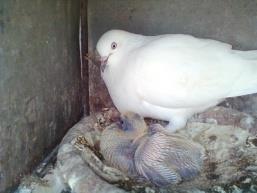
After hatching to 30-40 days of squab this exciting expression was found. In suckling stage sometimes parents especially female not takes any food. If female lies egg again beside squab that time male is totally responsible for feeding. At the end of this behaviour for egg lying again female (mother) shows aggressive behaviour to its own squabs (Figure 9). This time it is urgent to separate this squab. Prolactin hormone is more effective on regurgitation [7].
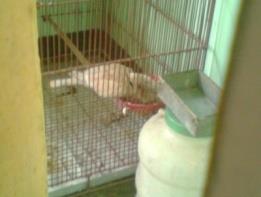
Flying
If we try to hold pigeons this expression is very often. Landing after flying its breathing is high so that painful expression was found. This expression is very clear in tumblers and racing homer pigeons (Figure 10).
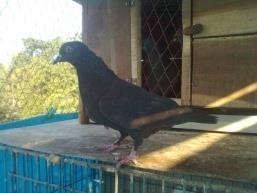
Frightened
Escaping and frightening expression were showed by the presence of predator animals or when introducing new birds in the loft. Young and adult all are vulnerable with this behaviour (Figure 11).
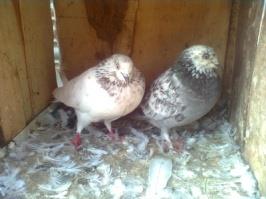
Aggressive
This is bodily expression of the pigeon during holding it or they show it for protecting their squab or egg. The feathers are erected at this behaviour. Very sharp beak of pigeons is serious in some cases to the rearer. Heat producing food is sometimes causing for this behaviour. After egg lying, incubating, and hatching both male and female shows this aggressive behaviour (Figure 12). Bennett and Diebschlag suggested that territoriality plays an important role in the establishment of a dominance order [11, 12].
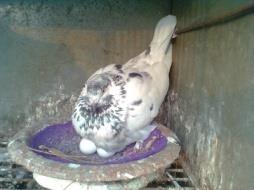
Observing
When any new bird comes in a loft or it looks any flying birds observing expression may found. This time birds slight bend its head. Very static or fixed eyes are shown very brilliant at this case (Figure 13). According to Carpenter pigeons will forget their mates after about 24 days [13].
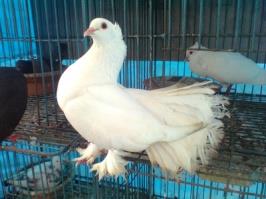
Helpless
Very helpless body expression is found if we hold a pigeon. Healthy or powerful pigeons try to escape from our hand. Feather growing squabs are very helpless too (Figure 14).
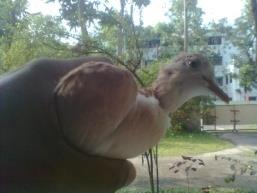
Illness
In this expression pigeons look like just an ill person. Silent sitting and semi or close eyed resting was found. Any long and short experienced bird keeper can observe it. At the time of egg laying this expression is common (Figure 15).
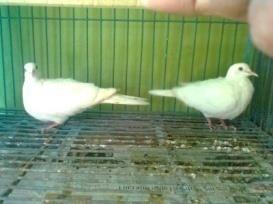
Resting
After taking food or when female sits on egg or squab and then if another individual comes near this expression happens. Sometimes the pigeons take rest on its wing or lateral sitting. In some cases pigeon stands by using only one leg at this stage; this is an evolutionary characteristic. When one is in rest another uses its beak to itch neck, head, and around the eye of its partner. This is very sensationally and lovely expression (Figure 16).
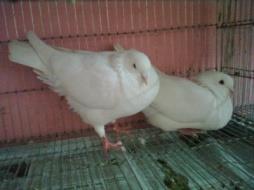
Discussion
Lots of theories on expression and emotions of man and animals were found in ancient Greek. The mammals’ hypothalamus of the brain controls such emotions. If there lesions in temporal region of the brain the animals show the tame and friendly behaviour and if losses then aggressiveness come. Feeding and fighting behaviour comes from these which are useful for its self-protection and self-preservation. The brain, spinal cord, sense organs, muscle, and glands are accessories for such kinds of behaviour and expression of the animals [14]. The brain of pigeon maintains central nervous system and spinal cord which are composed of huge neurons. When soul interacts with mind it expresses emotion [15]. The olfactory lobe of forebrain of pigeon maintains very poor smell mechanism and the hindbrain connects with spinal cord which controls the muscular power of pigeons.
This muscle is useful for long time flying behaviour of tumbler/highflyer/homer pigeons. The cerebral hemisphere of the brain controls pigeon instinct behaviour, intelligence, and emotions. Diencephalon which is a small rounded portion behind the cerebral hemisphere maintains cold, heat, and pain of the pigeons [16]. The cooing voice of pigeon comes from different environmental and social sources [17]. Professor Whitman collected lots of splendid pigeons from the different corners of the world. Sometimes non-mating experienced female lays egg without nest [18]. Always male pigeon initiates female for egg laying or incubating by its continuous voice and patience [19]. Limited space, lack of flight, and social contact causes severe physical complexicity in birds [20]. In captivity the process homeostasis may be lost and abnormal behaviour begins and it leads to abnormal physiology in birds [21, 22].
References
-
Masure RH, Allee WC (1934) The social order in flocks of the common chicken and the pigeon. Auk 51(3): 306-327.
-
Bennett MA (1939) The social hierarchy in ring doves. Ecology 20(3): 337-357.
-
Michael WG (1989) Ringneck dove, doves. TFH Publications Inc., Neptune City NJ, pp: 76-80.
-
Derek G (1967) African Collared Dove (Streptopelia roseogrisea) Pigeons and Doves of the World. Trustee of the British Museum (Natural History), London, pp: 131-132.
-
Danny B (1995) Barbary Dove Streptopelia risoria, A Guide to Pigeons, Doves and Quail: Their Management, Care and Breeding. South Tweeds Heads, Australian Bird Keeper, Australia, pp: 122- 125.
-
Castoro PL, Guhl AM (1958) Pairing behavior of pigeons related to aggressiveness and territory. Dept. of Zoology, Kansas State College 70(1): 57-69.
-
Lehrman DS (1964) The reproductive behavior of ring doves. WH Freeman and Company, California.
-
Whitman CO (1919) The Behavior of Pigeons. In: HA Carr, (Ed.), Posthumous works, Carnegie Inst. Wash 3: 1-161.
-
Craig W (1918) Appetites and aversions as constituents of instincts. Biol Bull 34: 91-107.
-
Gifford EW (1941) Taxonomy and habits of pigeons. Auk 58: 239-245.
-
Bennett MA (1940) The social hierarchy in ring doves. II. The effect of treatment with testosterone propionate. Ecology 21(2): 148-165.
-
Diebschlag E (1941) Psychologische Beobachtungen iiber die Rangordnung bei der Haustaube. Zeitschr J Tierpsychol 4: 173-187.
-
Carpenter CR (1933) Psychological studies of social behavior in Aves. J Comp Psychol 16: 25-97.
-
Levinthal CF (2003) Introduction to Physiological Psychology. Prentice, Hall of India Private Limited, New Delhi- 110001, pp: 522.
-
Jalal S MA (2009) Mystery of Biological Memory. Munni Prakashani, Dhaka, Bangladesh, pp: 63.
-
Kotpal RL (2000) Modern Textbook of Zoology (Vertebrates). Rastogi Publications, Meerut, India, pp: 632.
-
Craig W (1908) The voices of pigeons regarded as a means of social control. Am J Social 14(1): 86-100.
-
Craig W (1913) The stimulation and inhibition of ovulation in birds. J Animal Behavior 3: 215-221.
-
Levi WM (1992) The Pigeon. Levi Publishing Co., Inc., Sumter, SC, pp: 640.
-
Mehen CL, Garner JP, Mench JA (2004) Environmental enrichment and development of cage stereotypy in Orange-winged Amazon Parrots (Amazona amazonica). Developmental Psychology 44(4): 209- 218.
-
Echols MS (2010) Captive bird welfare and enrichment (part 1-4). AAVAC/UEPV Annual Conference Hobart, pp: 129-200.
-
Bob L (1999) Ringneck dove colors. 2nd (Edn.), pp: 22.
- In Situ Evaluation of the Anthelmintic Effect of the Aqueous Extract of Syzygium aromaticum (L) Merr and Perry on Bovine Strongyles
- Successful in Vitro Embryo Production with Oocytes Aspirated from Live White-Tailed Deer (Odocoileus Virginianus Texanus) Donors under Captivity in Northeast Mexico
- Bangladeshi Finches with their Evolutionary Thoughts (Aves: Passeriformes)
- Note on the Survival Status of Przewalski’s Horse, Equus ferus przewalskii (Perissodactyla: Equidae)
- In-Situ and Ex-Situ Protection of White-Breasted Waterhen (Amaurornis Phoenicurus) (Pennant, 1769) (Aves: Rallidae)
- Meat Examination in the Laboratory, the Acceptability and the Human Health