
Analysis of Rasasindura Employing NPST
<p>Rasasindura is commonly used in Kupipakwa Rasayana, a herb mineral preparation. This is prescribed for different diseased condition including Prameha (Diabetes mellitus), Kushtha (Leprosy), Pradara (Menorrhagea) and Jwara (Fever). Before introducing to the market a product has to undergo a systemic analysis as a primary step. In this study we selected Namburi Phased Spot Test (NPST) analysis as a qualitative step. Rasasindura underwent NPST analysis. The result observed here was brick red solid spot with dark brown periphery proving Rasasinduratallies with that of standard</p>
Introduction
Rasasindura is a sublime product of a mixture of 1part of Navasadara and 8 parts of Kajjali [equal quantity of Parada (Mercury) and Gandhaka (Sulphur)] [1, 2]. This is used for therapeutical purpose in many conditions like Prameha (Diabetes mellitus), Kushtha(Leprosy), Pradara (Menorrhagea), Jwara (Fever), Shwasa (Hiccough) and Bhagandara (Fistulo in ano) [3]. It is also used in different formulations like Kampavatari rasa and Ekangaveera rasa [4]. The purity of any preparation is important before prescribing it to the patients. Methods are available to verify the purity of a preparation. In this study an attempt is made to understand the quality of Rasasindura
Materials and Methods
Procedure: Rasasindura (0.25 gm) was taken into centrifuge test tube and to which drop by drop a freshly prepared 0.5 ml aqua regia was added. Solution was kept undisturbed for about 30 minutes for its reaction to be taken place. Then it was heated gently on a spirit lamp for about a minute. The solution was shaken occasionally during 48 hrs and allowed to react. Afterwards one drop of sample was put on the 10% Pot. Iodide paper prepared by using Whatman filter paper No 1. Single sample was used for the analysis of Rasasindura [5, 6].
Observation and Results
Colour changes during a study were observed in three different phases, 1st phase: 0 to 5 min, 2nd phase: 05 min to 20 min and 3rd phase: 20 min to 72 hours. At the end of third phase reaction showed Brick red solid spot with dark brown periphery.
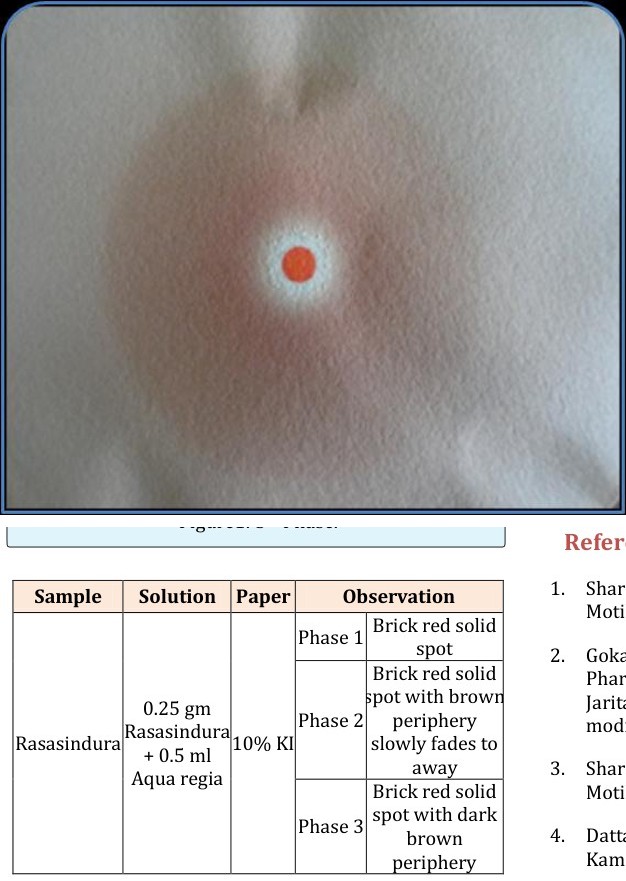
This is based on chemical reaction between chemical reacting paper and solution of drug prepared in different reagents. The Central Council for Research in Ayurvedic Science (CCRAS) accepted this is one of the basic steps for quality control of Rasaushadhi. NPST analysis is based on colour which is observed on three different phases at three different intervals. After the addition of bhasma into reagents effervescence started and later it got settled. The solution got cleared after heating and colour of residue was red. The solution was slightly yellowish in colour due to the reagent used in preparation of solution. The reacting papers were slightly brownish in colour, after putting a drop of clear solution brick red colour was developed within a fraction of time then slowly fades to brown, similar observation was reported earlier [7].
Conclusion
In the present study Rasasindura showed positive result in comparison with standards.
- Figure1: 3rd Phase.
- Sample
- Solution Paper
- Observation
- Phase 1 Brick red solid spot
- Brick red solid spot with brown
- 0.25 gm
- Rasasindura
- Phase 2 periphery slowly fades to
- Rasasindura
- 10% KI
- + 0.5 ml
- Aqua regia away
- Brick red solid spot with dark
- Phase 3 brown periphery
Table 1: Results of NPST analysis.
Rasaushadhi’s is one of the medicaments in treating several diseases due to its quick action and use in smaller doses. Rasasindura is one among them which is commonly used drug in a day today practice. Before made available in the market drugs have to undergo several qualitative tests. In this study we selected NPST analysis as a primary test to check its potentiality. NPST is a qualitative test used to identify the Bhasma or Sindura.
5. CCRAS (2010) Ministry Of Health And FW Government Of India, New Delhi, Application of Standardized Namburi Phased Spot Test in identification of Bhasma and Sindura Preparations of Ayurveda. pp: 53.
6. Nambhuri RH Application of StandarsisedNamburi
Phased Spot Test. Project work submitted to CCRAS, New Delhi.
7. Veena BK, Jadar PG (2014) Namburi phased spot test analysis of Rasasindura. Int j Sci Resea 3(11): 19-20.
Copyright© Veena BK, et al.
Veena BK, et al. Analysis of Rasasindura Employing Namburi Phased Spot Test (NPST). J Nat Ayurvedic Med 2018, 2(4): 000137.
- Management of Ear Keloid with Ksharsutra: A Case Study
- Yoga and Global Sustainability: A Holistic Path to One Earth, One Health
- Autoimmune Diseases in Ayurveda: A Narrative Review with Classical and Modern Perspectives
- Management of Cluster Headache Associated with Pituitary Apophysitis by CERT (Chakrasiddh Energy Release Technique): A Case Report on Energy Rebalancing
- Zygophyllum Geslini Coss : Biochemicals and Antioxidant Activity
- Observations of a Beginner Vaidya