
Ayurvedic Management of Avaranjanya Madhumeha WSR Type 2 Diabetes Mellitus-A Case Report
Diabetes mellitus (DM) commonly referred to as diabetes. It is a group of metabolic disorders in which there are high blood sugar levels over long period of time. Its symptoms include frequent urination, increased thirst and increased hunger. Proper medication is not provided in period of time, than it may cause many complications. Acute complications can include diabetic ketoacidosis, hyper osmolarity and hyperglycemic state. Serious long term complications include foot ulcers, blindness, chronic kidney disease, cardiovascular disease and stroke may leads to death. In Ayurveda it can co-related with Avaranajanya Madhumeha characterized by madhuryamasyata, karapadadaha, sweda-angagandha, shithila-angata etc. A 35 year old male patient reported to the outdoor department of Sharir Kriya NIA, Jaipur, with the complained of shithilangata, kriya-hani, klam, mootraadhikta, kara-paad tale daah for more than 2 to 3 months. The patient was diagnosed as Madhumeha. Regular fifteen days visit was done in the form of follow up for 2 months. After 2 months of treatment significant responses were found.
हिन्दी सारांश
अवरणजन्य मधुमेह व्याधध में अयुवेद धिककत्सा डॉ. िुडासमा हार्ददक, डॉ. राकेश धिम्पा, डॉ. यादव सी. अर., प्रो. ओ.प्र.दाधीि मधुमेह सामान्यतः प्रमेह व्याधध के स्वरुप में जाना जाता है, यह एक ियापिय जन्य धवकारों का समूह है धजसमे की रक्त में शककरा की मात्रा ऄधधक समय तक बढी रहती है | उनके लक्षणों में बार बार मूत्र प्रवृधत होना, भूख एवं प्यास की मात्रा में वृधि होना सामान्य रूप से माना जाता है, जो की सही समय पर उधित धिककत्सा नहीं दी जाए तो वो काफी सारे उपद्रव पैदा कर सकती है | नवीन उपद्रवो में डायधबटीस कीटोऄधसडोधसस, हाआपर ओसमोलर एवं हाआपर ग्लैसेधमक ऄवस्था या मृत्यु जीणक उपद्रवो में हृद वाधहनी धवकार , हृदयघात , जीणक वृक्क धवकार, डायबेटटक फूट ऄलसर और अखों पर दुष्प्प्रभाव | अयुवेद में आस की तुलना प्रमेह के साथ की जा सकती है आनके लक्षणों में मधुरास्यता, कर-पाद दाह, स्वेदो ऄंग गंधता, धशधथल ऄंगता आत्याकद | प्रस्तुत शोध में एक पुरुष धजनकी उम्र ३५ वषक, धनरंतर २- ३ माह से धशधथलान्गता, कियाहाधन, क्लम, मूत्राधधक्य, हस्त-पाद तल दाह अकद समस्याओं से परेशान थी | अयुवेद धसिांतो के ऄनुसार धनदान अवरणजन्य मधुमेह धनधित ककया गया | धनयधमत १५ कदन के ऄन्तराल पर बधहरंग धवभाग में २ माह के धिककत्सीय परामशक के बाद उपरोक्त लक्षणों में ऄच्िा लाभ प्राप्त हुअ |
Introduction
Diabetes mellitus is a clinical syndrome characterized by hyperglycemia due to absolute or relative deficiency of insulin. This can arise in many different ways but it is most commonly due to autoimmune type 1 diabetes or to adult onset type 2 diabetes [1]. In the year 2000, 171 million people had diabetes, and this is expected to double by 2030. This is globally pandemic principally involves type 2 diabetes, to which several factors contribute, including grater longevity, obesity, unsatisfactory diet, sedentary lifestyle and increasing urbanization. Many case of type 2 diabetes remain undetected. However the prevalence of both type of diabetes varies considerably around the world, and is related to differences in genetic and environmental factors.
According to Ayurveda it is co-related with the disease Prameha which manifests in the form of madhuryamasyata, karapadadaha, sweda-angagandha, shithila-angata etc [2]. Madhumeha arises in two ways, by the aggravation of vata caused by a) dhatuksaya- depletion/loss of tissues and b) obstruction of its path (movement) by the doshas covering it. In the obstructed kind, it (vata) exhibits the symptoms of the dosha covering it, without any other reason, occasionally, hence the bladder is found sometimes empty and sometimes full, and the diseases becomes difficult to cure. All varieties (of prameha) if neglected will, in course of time, become madhumeha. The line of the treatment of diabetes is-dietary and life style modification, oral-anti diabetic agent and insulin by injection [3].
Looking in to these limitations in the treatment and prognosis of Diabetes mellitus type 2, a single case of Prameha generally obese patient should be treated with purification therapy and those who are not suitable for purification should be treated with saman (therapy to mitigate the dosha). So, here patient was observed by using Deepan Pachan (Digestive-Carminative), Strotas shodhak (Rasa, Meda and Mutravaha strotas) and Ruksha, Ushna, Tikshna dravyas to analyze its effect in the management of the disease [4].
Aims and Objectives
To estimate the efficacy of Ayurveda drug in management of Avaranajanya Madhumeha W.S.R. Type 2 Diabetes mellitus.
Material and Methods
Types of Study
Single observational case without any control group.
Study center
National Institute of Ayurveda Hospital, Jaipur (Rajasthan).
Study details
A Hindu, married 35 year old male patient visited (November 13, 2017) the outdoor department of Sharir Kriya of NIA, Jaipur with OPD no 8213112017 for the chief complains of madhuryamasyata (Sweet taste of mouth), karapadadaha (Burning sensation at sole), sweda-angagandha (Excessive Perspiration), shithilangata (Debility), kriya-hani (Uneasiness), mootraadhikta (polyurea) for more than 2 to 3 month, and other associated complains were Kshudha Vriddhi (Excessive hunger) Nindra vriddhi (Excessive sleep), Vibandha (constipation) for last 1 month.
Personal history revealed that the patient is vegetarian and used to take extra oily and fatty diet, with regular habit of intake of Homemade food, Excessive sleep, frequency of micturation 12-14 times/day and patient has no addiction. The patient has constipation and urge of defecation in once / 2 day. Past history-Patient was suffering from type 2 Diabetes mellitus for more than 1 and half years. But he was very much irregular in taking medicines and routine checkup of Blood sugar Level. Drug History: Patient was on metformin in other system of medicine such as allopath system. Family history-There is no any significant family history.
The General examinations of the patient showed dryness of tongue and vitals were; pulse rate 84/min, respiratory rate of 18/min, blood pressure of 120/70 mm of Hg and body weight is 80kg. Per abdominal examination showed fullness of abdomen and tenderness in Right hypochondriac region, epigastric and umbilical region. The impression of Blood Sugar Level and Urine analysis on November 13, 2017 implies Fasting Blood sugar level 283 mg/dl (65-110 mg/dl Normal), Post prandial Blood Sugar level 483 mg/dl (90-140 mg/dl Normal), In Urine- Appearance Dark yellow, PH 5.0, Specific gravity 1.030, Sugar 3+, Protein 2+, Epithelia cell 1-2, WBC 0-1 RBC and Crystals are Nill. Based on clinical presentation, Patient was diagnosed as a case of Prameha.
Treatment Plan
The Following oral medicines were administrated for 3 month.
- A combination in powder form of Madhumehari (5g) and Prameha prahar (2g) twice a day with Luke warm water before Meal.
- Arjuna twak Churna (5g) twice a day with Luke warm water after Meal.
- Tab Basant Kusumakar Rasa (2 tab) are administrated with Luke warm water twice a day after meal.
- Tab Shiva Gutika (1 Tab) And Chandraprabha Vati (2 tab) twice a day with Luke warm water are administrated after Meal.
- Triphala Churna (5g) is administrated orally at night with Luke warm water.
On the first follow up (after 15 days of the treatment) patient reported reduction in previous mentioned symptoms. Improvement was noted in weakness, sleep, and appetite and bowel habit. On the second follow up digestion power of patient was improved. On the third follow up appetite of Patient was improved and patient feel lightness and energetic in routine activity on the fourth follow up. At that time of every visit he again advised to investigate Blood Sugar Level and Urine analysis.
The patient was on follow up till 2nd month without any single episode of replace. In this case study, assessment was done on the basis of sign and symptoms as well as of Blood Sugar Level and Urine analysis. After 2nd month of drug intervention Fasting Blood sugar level 283 mg/dl reduce to 108.0mg/dl, Post parandial Blood Sugar level 483 mg/dl reduced to 179.0mg/dl. In Urine- Appearance Dark yellow changed to Pale yellow, PH 5.0, reduced to 6.0 , Specific gravity 1.030 reduced to 1.015 Sugar 3+ reduced to Nill, Protein 2+ reduced to Nill after 2 month. This indicates that after orally medication and restriction of the food relief was noted (Tables 1-4).
| S | r. no | Follow Up (Time of Period) | Fasting Blood Sugar (FBS) | Post prandial Blood Sugar (PP2BS) | ||||
|---|---|---|---|---|---|---|---|---|
| 1 | 1st Visit 13/11/2017 | 283 mg/dl | 483 mg/dl | |||||
| 2 | 2nd Visit 30/11/2017 | 107 mg/dl | 192 mg/dl | |||||
| 3 | 3rd Visit 18/12/2017 | 138 mg/dl | 184 mg/dl | |||||
| 4 | 4th Visit 31/12/2017 | 108 mg/dl | 179 mg/dl |
Table 1: Assessment of Blood Sugar Level (God-Pod Method).
Sr. no Follow Up Appearance Color Reaction(Ph) Albumin Sugar Specific Gravity 1 1st Visit 13/11/2017 Clear Dark Yellow 5.0 2+ 3+ 1.030 2 2nd Visit 30/11/2017 Clear Pale Yellow 6.0 Nill Nill QNS 3 3rd Visit 18/12/2017 Clear Dark Yellow 5.5 1+ Trace 1.030 4 4th Visit 31/12/2017 Clear Pale Yellow 6.0 Nill Nill 1.015 Table 2: Assessment of Urine Analysis.
| Sr. N | o | Characteriscs Features | Before Treatment | After Treatment | |||||||
|---|---|---|---|---|---|---|---|---|---|---|---|
| 1 | Madhurasyata | 3 | 2 | ||||||||
| 2 | Karapada daha | 3 | 1 | ||||||||
| 3 | Sweda angagandha | 3 | 2 | ||||||||
| 4 | Shithila-angata | 3 | 1 | ||||||||
| 5 | Ati Shyya- Asana | 3 | 1 | ||||||||
| 6 | Ati swapna sukhata | 3 | 1 | ||||||||
| 7 | Gala talu sosha | 3 | 1 | ||||||||
| 8 | Hrud-Netra-Jihva-Upadeha | 3 | 1 |
Table 2: Assessment of Classical Sign & Symptoms.
| 1 | Cure | 0 |
|---|---|---|
| 2 | Better | 1 |
| 3 | Moderate relief | 2 |
| 4 | Mild relief | 3 |
Table 3: Grading Suggests.
Discussion
1. Madhumeha is Kapha Vata pradhan Tridoshaj vyadhi. It
has two types as per vagbhatta Dhatu Kshayaj Madhumeha (type 1 Diabetes Mellitus) Avaranajanya Madhumeha (type 2 Diabetes Mellitus) [5]. 2. Patient being diagnosed as Avaranjanya Madhumeha, drugs acting upon main component of pathology like meda dhatu, Kleda, Kapha and Meda Dhatvagni as well as having Deepan, Pachan, Lekhan and Avaranhar properties were selected to assess its efficacy on Avaranjanya madhumeha. 3. The drugs which have Deepan- pachan properties like - Chitrak, Musta, Sunthi, Bilva, Shatpushpa etc [6]. Lekhan properties like Musta, Chitrak, Vansha, Dalchini, Madhu, Methika, Shilajatu, Pushkarmool, Rasna etc [7]. Avaranhar Properties like- Haritaki, Sonamukhi, Kankol, Methika [8]. 4. Probable pharmacological activities and probable mode of action of the drug is mentioned below (Table 5) (Figures 1 & 2).
| S.No | Drugs | Reported Activity | ||||||
|---|---|---|---|---|---|---|---|---|
| 1 | Madhumehari Churna [9] | Immunomodulatory, Antihyperglycemic | ||||||
| 2 | Prameha Prahar Churna | Hypolipidaemic, Antidiabetic | ||||||
| 3 | Arjuna tvak churna [10] | Cardiac tonic, Hepatoprotective, Hypoglycemic | ||||||
| 4 | Vasant Kusumakar rasa [11] | Antioxidant, Immunomodulator, Antihyperglycemic | ||||||
| 5 | Shiva gutika [12] | Antioxidant, Antidiabetic | ||||||
| 6 | Chandra prabhavati [13] | Antioxidant, Antidiabetic, Hypolipidaemic | ||||||
| 7 | Triphala Churna [14] | Antidiabetic, Antioxidant |
Table 4: Reported Pharmacological Activities of Drugs.
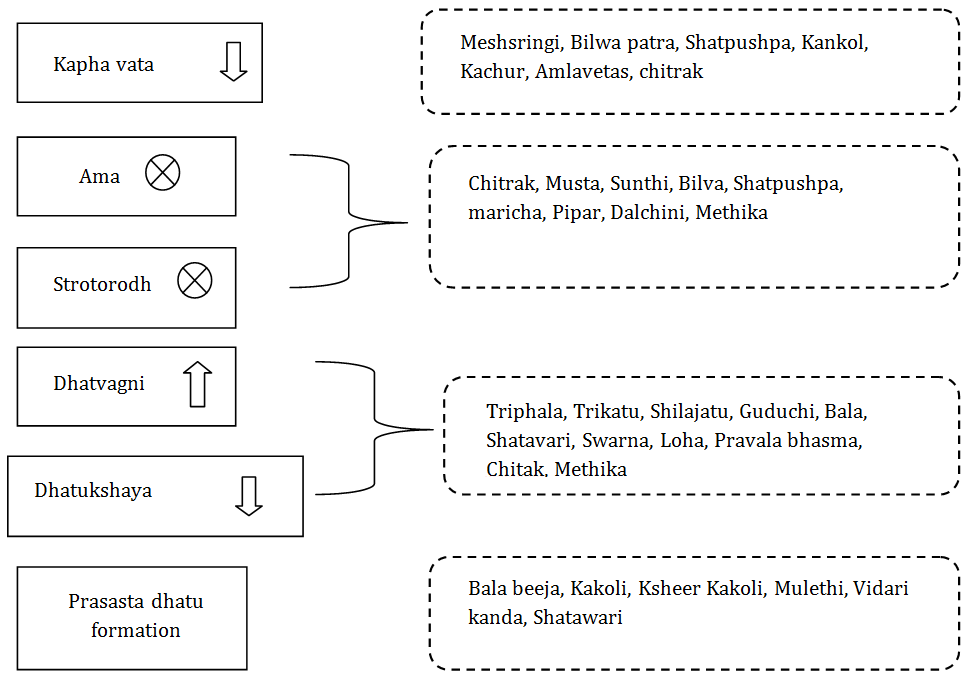
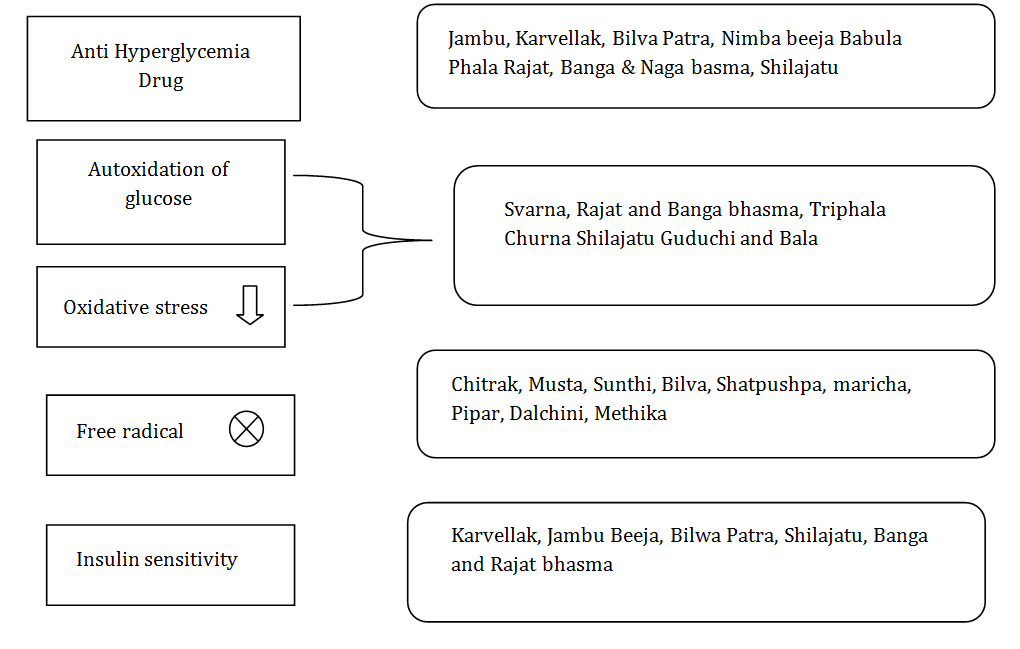
Conclusion
In this study it’s proved that Deepan-Pachan, hepato protective, Strotas shodhak (Rasa, Meda and Mutravaha strotas) and Ruksha, Ushna, Tikshna dravyas corrects the digestion and improve the metabolism. If a person follows the proper routine along with these medicines it might be safe and effective for such cases (Diabetes mellitus type 2) [15].
References
-
Davidson’s principles & practice of Medicine, Edition 20, Elsevier publication, Chapter 21 Diabetes mellitus, pp: 808.
-
Acharya TY (2007) Agnivesh; Caraka Samhita, Ayurveda Depika Commentry by Sri Chakrapanidutta, Chaukhamba Prakashan , Varanasi, Nidansthana 4/47, pp: 215.
-
Boon NA, Colledge NR, Walker BR (2018) Davidson’s principles & practice of Medicine, Edition 20, Elsevier publication, Chapter 21 Diabetes mellitus, pp: 818.
-
Acharya TY (2007) Agnivesh; Caraka Samhita, Ayurveda Depika Commentry by Sri Chakrapanidutta, Chaukhamba Prakashan , Varanasi, Chikitsasthana 6/15-17, pp: 446.
-
Paradakara HSS (2016) Vagbhat, Ashtanga Hridaya A, Sarvangasudara and Ayurveda Rasayan Commentary of Arundutta and Hemadri, Bhisagacharya, Chaukhamba Surbharati Prakashan, Varanasi, Nidansthana Chapter 10/18, pp: 504.
-
Tripathi B (2013) Shadangadhar Samhita, containing Anjannidana of Maharshi Agnivesh, a noted with Dipika hindi commentary, Chaukhamba Surbharati Prakashan, Varanasi, Purvakhanda, Chapter 4/1, pp: 33.
-
Tripathi B (2013) Shadangadhar Samhita, containing Anjannidana of Maharshi Agnivesh, a noted with Dipika hindi commentary, Chaukhamba Surbharati Prakashan, Varanasi, Purvakhanda, Chapter 4/10, pp: 34.
-
Acharya TY (2007) Agnivesh; Caraka Samhita, Ayurveda Depika Commentry by Sri Chakrapanidutta, Chaukhamba Prakashan , Varanasi, Chikitsasthana 28/217-218, pp: 626.
-
Tank B, Sharma CB, Saroj UR (2017) Clinical Evaluation of Efficacy of Madhumehari Churna with Different Kwatha in the Management of Madhumeha WSR to Diabetes mellitus Type II (NIDDM)” dissertation was submitted on April 2017 at National Institute of Ayurveda Jaipur.
-
Sharma PV (2013) Dravya Guna Vijananam, Vegetables druges, Chaukhamba Bharati Academy, Varanasi. Hridayadi varga, chapter 3, pp: 195.
-
Shah NC (2012) Bharat Bhaishjya Ratnakar, BK Jain Publishers, Shlok no- 6167.
-
Siddhinandan Mishra (2015) Bhaishajya Ratnavali of Kaviraj Govind Das Sen, Edited with ‘Siddhiprada’ Hindi Commentory. Choukhamba Surbharati Prakashan, Varanasi, Rasayanaadhikar chapter 73, Shlok no. 148-171, pp: 1120-1121.
-
Mishra S (2015) Bhaishajya Ratnavali of Kaviraj Govind Das Sen, Edited with ‘Siddhiprada’ Hindi Commentory, Choukhamba Surbharati Prakashan, Varanasi, Prameha Chikitsa chapter, Shlok no: 102- 110.
-
Tripathi B (2013) Shadangadhar Samhita, containing Anjannidana of Maharshi Agnivesh, a noted with Dipika hindi commentary Chaukhamba Surbharati Prakashan, Varanasi, Madhyakhanda, Chapter 6/9-11, pp: 117.
-
Wild S, Roglic G, Green A, King H (2004) In the year 2000, 171 million people had diabetes, and this is expected to double by 2030, Global prevalence of diabetes estimates for the year 2000 and projections for 2030. Diabetes care 27(3): 1047-1053.
- Management of Ear Keloid with Ksharsutra: A Case Study
- Yoga and Global Sustainability: A Holistic Path to One Earth, One Health
- Autoimmune Diseases in Ayurveda: A Narrative Review with Classical and Modern Perspectives
- Management of Cluster Headache Associated with Pituitary Apophysitis by CERT (Chakrasiddh Energy Release Technique): A Case Report on Energy Rebalancing
- Zygophyllum Geslini Coss : Biochemicals and Antioxidant Activity
- Observations of a Beginner Vaidya