
Persicaria Odorata as a Potential Medicinal Plant-Mini Review
Complementary and alternative medicines (CAM) is known as ‘traditional medicine’ and best described as natural health practice that is using natural sources such as plants and minerals to treat diseases. CAM has been widely used in general hospitals to overcome the illnesses such as infections and complications as well as to maintain the patient’s health. Persicaria odorata is one of the herbs that can be discovered. This potential herb is a common plant and well known locally as “daun kesumâ€. This plant commonly used in culinary and have various medicinal properties. The potential of this plant have been discovered by scientist such as antimicrobial, anti-inflammatory, antioxidant and anticancer activities. From the previous study, this plant showed good pharmacological activities which is ability to develop a good pharmaceutical product in future especially in medical field.
Introduction
According to the World Health Organization (WHO), more than 50% of populations in the developed countries such as Europe and North America have chosen CAM instead of modern medicine as part of their treatment of infection at least once in their life. It has also been reported by the organization that more than 75% of patients with human immunodeficiency virus in London, South Africa and San Francisco used traditional medicine to treat the complication of AIDS. In the United State alone, almost US $17 billion was spent on traditional remedies in the year of 2000 and in the United Kingdom; the annual expenditure on alternative medicine was about US $230 million in the same year. The global market for herbal medicines currently stands at over US $60 million annually and is growing steadily [1, 2, 3]. Furthermore, WHO enlighten the importance and value of traditional herbal medicine to the community since 1970.
Herbal medicines are available form of medicine in many developing countries, where admission to hospital and access to health centre are limited [2]. Due to the importance and the increasing number of traditional medicine users, there are many research have been conducted to discover a new drugs properties from the traditional herbs extracts by studying their compounds, properties, and chemical structures [4]. Herbs have been used for centuries to resolve health problem and to maintain human well-being. The medicinal value of these herbs lies in some chemical substances that produce a specific physiological effect on the human body. Large amount of important bioactive constituent that have been found in herbs include flavonoids, steroids, alkaloids, phenols, tannins and saponins [5]. Furthermore, conventional drugs have high adverse effects and some of them are costly making the herbal medicines as convenience alternative medicine [2].
In recent years, the occurrences of drug resistance in the clinical setting are increasing due to prolonged use and misuse of antimicrobial drugs. Some of the pathogens are resistant to multiple drugs. Because of that, the search for new antimicrobial substances is important and investigation on the biological properties of medicinal plants might provide a new insight on the natural antimicrobial agents as part of treatment regime. In Malaysia many local plants have been screened and their active compounds have been identified [5]. One of the potential plants that can be discovered is Persicaria odorata which this plant was traditionally used in various fields.
Persicaria Odorata Morphology
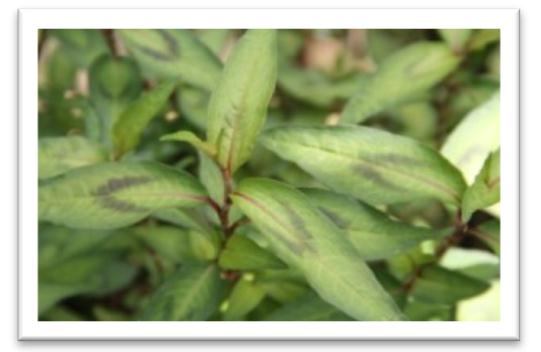
Persicaria Odorata leave is one of the natural plants that have been traditionally used worldwide in medicine, culinary, pharmacy and cosmetic. Persicaria Odorata can be classified under family of Polygonaceae and genus of Persicaria. This plant grows in tropical and subtropical zones in warm and damp area. In stable condition, they can grow up to 15 to 30 cm. Its leaf is dark green and the stem joints each of its leaf. Persicaria Odorata belongs to a group of fresh culinary herbs which known as the cilantro mimics with the ‘cilantro’ flavor. Persicaria Odorata leave usually used as a flavor in culinary and it also used as additional flavor to curries and hot soups. It has many English names which include Vietnamese cilantro, Vietnamese mint and Vietnamese coriander. However, in Vietnam it is called as “rau ram”. While in Malaysia, Brunei and Singapore it is known as “daun kesom”.
Persicaria Odorata is a herb that can be easily found in tropical and subtropical zones in warm and damp area. In stable condition, they can grow up 15 to 30 cm in height. It has dark green leaves and the stems joint each of its leaf. Persicaria Odorata is classified under the family of Polygonaceae and the genus of Persicaria. It has been classified according to its characteristics and distinguishing features [6]. Persicaria Odorata has been widely used in many fields such as cooking, medicines and culture.
Persicaria Odorata leave usually used as a flavor in culinary and it is also used as additional flavor to curries and hot soups. Besides, it use in cuisine, it also part of the malay traditional medicine. The Persicaria Odorata leaves are used widely to treat the skin infections caused by fungi or bacteria. The roots of Persicaria Odorata have been used for a variety of therapeutic purposes in Traditional Chinese Medicine [7].
Compound and Physiochemical Properties of P. odorata
Previous study has shown that Persicaria Odorata has volatile alcohols which possess aliphatic aldehyde reductase activity [8]. In the study, the compositions of the Persicaria Odorata leave were determined by different extraction methods to study the enzyme activities. The activities of the enzyme were evaluated at different buffer pH values such as at pH 8.0 in Na-phosphate and at pH 8.5-9.0 in glycine-NaOH solutions by using heptanal as a substrate. The result showed that the Persicaria Odorata has revealed that the enzyme is responsible for the formation of acid.
Study done by Sasongko, et al. [9] was about an essential oil of Persicaria Odorata leaves. Persicaria Odorata was extracted by Hydro distillation technique to produce the essential oil. Later, the Gas Chromatography- Mass Spectrometry (GC-MS analysis) was done to determine the composition of the major volatile compounds of the essential oil. Dodecanal (38.68%), caryophyllene (22.47%), alpha-caryophyllene (24.19% ), decanal (11.79%) drimenol and was found in the tested sample. After that, the antibacterial testing was conducted by disc diffusion method to investigate the antibacterial activity against the S. aureus and E. coli. It was recorded that the essential oil from dry leaves showed the highest positive result of the antibacterial activity as compared to wet leaves [9].
The other major volatile compound that was discovered from leaves of other Persicaria species were α- humulene (2.293%), cyclodecanol (5.691%), undecane (2.286%), 3-carene (1.202%). These compounds were identified in the essential oil of “kesum” species which is Polygonum minus Huds using two-dimensional gas chromatography time-of-flight mass spectrometry GC×GC-TOF MS [10].
Previous study on Persicaria Odorata
There are many studies that have been done using Persicaria Odorata regarding the antimicrobial activities, antioxidant and anticancer activities. Previous study carried out by Nanasombat and Teckchuen in 2009 has documented that Persicaria Odorata (also known as Polygonum odoratum) contained strong antibacterial activity among 20 species of the Thai local vegetables. They also reported the flavonoids found in the plant. However, in the study, only methanol extraction was employed and no clinical isolates were included [11]. Similar research approach but included several methods of extraction on two species of bacteria was done in Malaysia by Jamal, et al. in 2011 which antibacterial effect of Persicaria Odorata was found in the study [5]. The potential of the phytochemical of the plant as antibacterial have also been explored by Sasongko, Laohankunjit & Kerdchoechuen in 2011 [9].
Persicaria Odorata also has an anticancer property. This has been proven by Mohamaed, et al., in 2006 which homoisoflavone molecule from Persicaria Odorata induces apoptosis and G2/M cell cycle arrest in breast cancer cell lines by modulating Bcl-2 protein. Bcl-2 is an anti-apoptotic protein that is over-expressed in many cell cancers. Thus, stimulation of Bcl-2 phosphorylation by the homoisoflavone molecule is one of the strategies in abating the cancer progression. In the study, the structure of specific homoisoflavone was isolated and identified from Persicaria Odorata root [7]. Another study has shown that Persicaria Odorata has wide variety of pharmacological effect and some of them are tremendously beneficial such as antioxidant, antibacterial, anti-inflammatory and anticancer [11, 12, 13, 14].
Conclusion
In this present article strongly implied that Persicaria Odorata leaves extracts showed good pharmacological activities which is good to develop as natural medicine in future. However, further research need to be done to discover more other potential effects of this plant and to ensure this herb are safe to be used in clinical setting as complementary medicine.
References
-
Gerard B, Fredi K (2002) A Public Health Agenda for Traditional,Complementary, and Alternative Medicine. American Journal of Public Health 92(10): 1582-1591.
-
Daniel SF, Norman RF (2001) The Value of Plants Used in Traditional Medicine for Drug Discovery. Environmental Health Perspectives 109(1): 69-75.
-
WHO (2008) Traditional Medicine.
-
Mahady GB (2005) Medicinal Plants for the Prevention and Treatment of Bacterial Infections. Current Pharmaceutical Design 11(19): 2405-2427.
-
Parveen J, Karim IA, Raus AE, Ahmad R, Hashim YZ (2011) Phytochemical Screening for Antibacterial Activity of Potential Malaysian Medicinal Plants. African Journal of Biotechnology 10(81): 18795- 18799.
-
Judd WS, Campbell CS, Kellogg (2008) The Classification of Plants.
-
Rafi MM, Bret CV (2006) Identification of a structure specific Bcl-2 phosphorylating homoisoflavone molecule from Vietnamese coriander (polygonatum odoratum) that induces apoptosis and G2/M cell cycle arrest in breast cancer cell lines. Food Chemistry Journal 104(1): 332-340.
-
Quynh CT, Iijima Y, Morimitsu Y, Kubota K (2009) Aliphatic aldehyde reductase activity related to the formation of volatile alchohols in Vietnamese Coriander leaves. Biosci Biotechnol Biochem 73(3): 641-647.
-
Sasongko P, Laohankunjit N, Kerdchoechuen O (2011) Antibacterial activity of the essential oil from Persicaria odorata leaves. Agricultural Science Journal 42(2): 105-108.
-
Baharum SN, Hamidun B, Abd Ghani MA, Wan Mustapha WA, Noor NM (2010) Analysis of the chemical composition of the essential oil of Polygonum minus Huds. Using two-dimensional gas chromatography-time-of-flight mass spectrometry (GC-TOF MS). Molecules 15(10): 7006-7015.
-
Nanasombat S, Teckchuen N (2009) Antimicrobial, antioxidant and anticancer activities of Thai local vegetables. Journal Of Medicinal Plants Research 3(5): 443-449.
-
Wasman SQ, Abdulla MA, Chua LS, Hamdan S (2012) Potential Bioactive Property of Polygonum minus Huds (kesum) Review. Scientific Reseach and Essays 7(2): 90-93.
-
Tan KL, Charles SV (2011) Antioxidant, Antibacteria and Cytotoxic Activities of Essential Oils and Ethanol Extracts of Selected South East Asian Herbs. Journal of Medicinal Plants Research 5(1): 5284-5290.
-
Wasman SQ, Mahmood AA, Salehhuddin H, Zahra AA, Salmah I (2010) Cytoprotective activities of Polygonum Minus aquoues leaf extract on ethanol- induced gastric ulcer in rats. Journal of Medicinal Plants Research 4(24): 2658-2665.
- Management of Ear Keloid with Ksharsutra: A Case Study
- Yoga and Global Sustainability: A Holistic Path to One Earth, One Health
- Autoimmune Diseases in Ayurveda: A Narrative Review with Classical and Modern Perspectives
- Management of Cluster Headache Associated with Pituitary Apophysitis by CERT (Chakrasiddh Energy Release Technique): A Case Report on Energy Rebalancing
- Zygophyllum Geslini Coss : Biochemicals and Antioxidant Activity
- Observations of a Beginner Vaidya