
Relevance of Dhataki Flowers in Fermentation Procedure, Pharamceutico-Analytical and Microbiological Study
Asava-arishta, fermented pharmaceutical products used in Ayurveda, where dried Dhataki flowers (Woodfordia fruticosa Kurz form as fermentative initiators. The study was designed to provide scientific proof for the traditional wisdom behind the use of these flowers in fermentation procedure. Materials and Methods: Flowers of Woodfordia fruticosa Kurz (Dhataki) were collected, authenticated. Both fresh and dry flowers were used for microbiological study, through yeast cell culture, estimation. Three samples of Mustakarishta were prepared adding fresh (A), dry (B) and not adding Dhataki (C) flowers as per classical references. Observations were made, recorded during its preparations. Mustakarishta thus prepared were analyzed as per standard methodology on following factors like, total solids, specific gravity, Ph, reducing sugar, total acidity, and alchohol. Results: Microbiological study has shown that dry flowers of Dhataki have indefinite number of yeast cell colonies than that of fresh flower. Comparative analytical study of Mustakarishta has shown dry Dhataki flowers are best fermentative as compared to fresh on the basis of standard analytical parameters.
Introduction
Since ancient time man observed his surrounding and used the plants as food, roofing, medicine and so on. Keen observation as well as necessity made him expert how better one can use this biological asset. Sandhanakalpana (Asavas and Arishtas) are formulations mentioned in ayurveda, which are indicated at particular pathological condition [1]. This particular formulation depends on many factors like main ingredient, vessel, fermentative Relevance of Dhataki Flowers in Fermentation Procedure, Pharamceutico-Analytical and Microbiological Study initiators, sweetening agent etc [2]. Flowers of Woodfordia fruticosa Kurz. Known as Dhataki pushpa are fermentative initiators used in these formulations. Usually in practice dried market samples of Dhatakipushpa are used than the fresh ones [3]. Woodfordia fruticosa Kurz is a strangling bush growing in hilly regions bursting with scarlet red coloured flowers in the month of January- February [4]. Usually flowers of Woodfordia fruticosa Kurz. Will be collected during their flowering season, shade dried and kept preserved, and during formulation J Nat Ayurvedic Med
preparation, these will be added for fermentation [5, 6]. These flowers were termed as Madakari, sandaneeya ie containing natural nectar, in the treatise of Ayurveda [7]. But the exact role of dried flowers in fermentation procedure is not yet analyzed, with this background study was planned to explore the role Dhataki in fermentation procedure under the title pharmaceutico analytical and microbilogical study. Materials and Methods
Microbiological study
Plant materials: Flowers of Woodfordia fruticosa Kurz (Dhataki) were collected in the month of February, from a flowering bush, authenticated using flora. Few flowers were shade dried. Both fresh and dry flowers were used for microbiological study, through yeast cell culture, estimation [8]. Preparation of Sabouraud Dextrose Agar Medium (SDAM): Dextrose (40 g), beef extract ( 5 g), casein peptone ( 5 g) was dissolved in 990 ml of distilled water and pH was adjusted to 5.6 ± 0.2 and volume was made up to 1000 ml. Finally 15 g of agar was added to the media and autoclaved at 121˚C for 20 minutes. Preparation of Buffered Sodium Chloride Peptone Solution (BSCPS) pH 7.0: potassium dihydrogen phosphate (3.56 g), disodium hydrogen phosphate (7.23 g), Sodium Chloride (4.3 g), peptone (1.0 g) was dissolved in 990 ml distilled water and pH was adjusted to 7.0 and the volume was made up to 1000 ml. Then buffer solution was autoclaved at 121°C for 20 minutes. Total Aerobic Microbial Count by Plate Count Method: The working place was cleaned in laminar air flow using 70% ethanol and UV for 20 minutes. One gram of Woodfordia fructicosa flowers are mixed with 10 ml of sterile BSCPS to make dilution 10-1. After cooling Sabouraud dextrose agar medium, one ml of diluted sample was added into petridish containing the media. Plates were gently rotated in a circular motion to achieve uniform distribution of the sample and allow the media to solidify. All the petridishes were incubated for 5 days at 25°C in BOD incubator. Experiment was carried out in duplicate. Number of colonies was counted using digital colony counter.
Pharmaceutical Study
Three samples of Mustakarishta were prepared adding fresh (A), dry (B) and not adding Dhataki (C) flowers as per classical references [9]. The ingredients used for the preparation of Mustakarishta were displayed in Table 1. Observations were made, recorded during its preparations.
| Sl. No | Ingredients | Latin name | Part used | ||||||||
|---|---|---|---|---|---|---|---|---|---|---|---|
| 1 | Musta | CyperusrotundusLinn. | Rhizome | ||||||||
| 2 | Guda | SaccharumofficinarumL | |||||||||
| 3 | Dhataki | Woodfordiafruticosakurz | Flower | ||||||||
| 4 | Yavani | TrachyspermumammiLinn | Fruit | ||||||||
| 5 | Shunti | ZingiberofficinaleRoxb | Rhizome | ||||||||
| 6 | Maricha | Piper nigrumLinn | Fruit | ||||||||
| 7 | Lavanga | Syzygiumaromaticum Linn | Flower bud | ||||||||
| 8 | Methi | Trigonellafoenum-graecumLinn | Seed | ||||||||
| 9 | Chitraka | PlumbagozeylanicaLinn | Root | ||||||||
| 10 | Jeeraka | Cuminumcyminum, Linn | Fruit |
Table 1: Ingredients of Mustakarishta.
Analytical Study
For comparative analytical study of pharmaceutical preparation, three samples of Mustakarishta thus prepared were analyzed as per standard methodology on following factors like, total solids, specific gravity, Ph, reducing sugar, total acidity, and alcohol [10].
Results
Microbiological Study
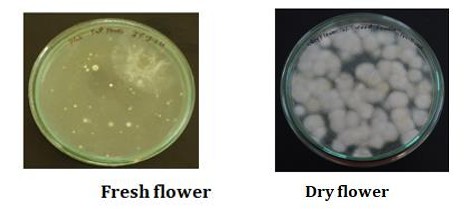
Both dried and fresh flowers where crushed and grown in Sabouraud Dextrose Aguar medium. These two petridishes were incubated for five days at 25°C in BOD incubator. Total yeast count revealed following information, dried flower have shown indefinite number of yeast colonies than that of fresh flowers, where as fresh flowers have shown few colony forming units of yeast (Table 2 & Figure 1).
| S | l. N | o | Sample name | Dilution | Number of Colonies (NOC) | CFU/g | |||||||||
|---|---|---|---|---|---|---|---|---|---|---|---|---|---|---|---|
| 1 | Fresh flower of Woodfordiafructicosa | 1/10 (10-1) | 81 | 74 | 7.7 x 10² | ||||||||||
| 2 | Dry flower of Woodfordiafructicosa | 1/10 (10-1) | INC | INC | INC |
Table 2: Total yeast count flowers of Woodfordia fructicosa. Kurz. CFU-Colony Forming Units INC-Indefinite Number of Colonies
Pharmaceutico-Analytical Study
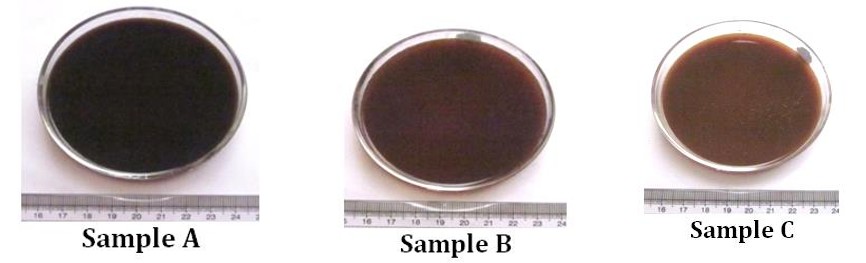
Three samples of Mustakarishta were prepared as per classical references adding fresh flowers (A), dry flowers (B) and not adding dhataki flowers (C). Colour of the sample A was dark brown, whereas that of B and C was brown and light brown respectively. Aromatic nature and appearance of all these samples were liquid in nature (Figure 2). Quantity obtained, along with organoleptic characters of three samples thus prepared have been displayed (Table 3). Analytical study of three samples has shown considerable variation among samples (Table 4).
| Samples | Quantity | Colour | Odour | Taste | Consistency | ||||||||||
|---|---|---|---|---|---|---|---|---|---|---|---|---|---|---|---|
| A | 1100 ml | Dark Brown | Strong alcoholic | Sour + Sweet | Thin | ||||||||||
| B | 950 ml | Brown | Strong alcoholic | Bitter + Sweet + sour | Thin | ||||||||||
| C | 1200 ml | Light Brown | Mild alcoholic | Sweet + Sour | Thin |
Table 3: Organoleptic Parameters of 3 samples of Mustakarishta.
| Parameter | Sample A | Sample B | Sample C | ||||||
|---|---|---|---|---|---|---|---|---|---|
| Total solids | 51.689 | 57.062 | 52.821 | ||||||
| Specific Gravity | 1.2414 | 1.2296 | 1.2211 | ||||||
| pH | 3.65 | 4.84 | 4.6 | ||||||
| Reducing Sugar | 27.019 | 26.762 | 25.317 | ||||||
| Total Sugar | 31.895 | 30.695 | 31.206 | ||||||
| Total Acidity | 2.507 | 1.62 | 0.572 | ||||||
| Total Alcohol | 4 | 9.2 | 6.4 |
Table 4: Analytical parameters of 3 samples of Mustakarishta.
Discussion
Dhataki (Woodfordia fruticosa kurz) dried flowers are used as fermentative initiator in the preparation of Asava- arishta since ages [7]. The study was designed to provide scientific proof for the traditional wisdom behind the use of these flowers in fermentation procedure. Hence as a part of study here an attempt has been done to explore microflora of fresh and dry flower of Dhataki. Both dried and fresh flowers were crushed and grown in Sabouraud Dextrose Aguar medium. These two petridishes were incubated for five days at 25°C in BOD incubator. Total yeast count revealed following information, dried flower have shown indefinite number of yeast colonies than that of fresh flowers, where as fresh flowers have shown few colony forming units of yeast.
Pharmaceutico-Analytical Study
Asava- arishta preparations involve multistep procedure with many drugs as ingredients [2]. Here in order to find out the efficacy of the flowers of Dhataki, Mustakarishata was prepared by adding fresh, dry and not adding flowers as fermentative initiators. Thus prepared three samples of pharmaceutical preparations were analyzed physically, chemically and quantitatively. Analytical study is the application of a process or a series of processor in order to identify the chemical constituent and also about quality of the preparation. Mustakarishta prepared adding fresh flowers was dark brown in colour with alcoholic odour, where as sample B prepared using dry flower had brownish with alcoholic smell.
Total solids indicate the amount of active constituents present in the sample, extractable in aqueous media [11]. After completion of fermentation the amount of suspended partials present in the preparation may have contribution to total solids. It was more in sample B (57.062%) and less in sample A (51.689%). Specific gravity is defined as the weight of a given volume of the liquid compared with the weight of an equal volume of water at the same temperature [12]. In Asavarishta the conversion of the solute and carbohydrate into lighter alcohol and carbon dioxide, occurs causing a slight fall in specific gravity. Specific gravity of sample A and B was 1.2414, 1.2296, whereas that of sample C was 1.2211, pH of any liquid measures the acidity or basicity of an aqueous solution. The solutions having pH less than 7 are said to be acidic and solutions with a pH greater than 7 are basic or alkaline [13]. Determination of pH value in alchoholic preparation is important as quality parameter. Acidic fermentation is not desirable, In Asavarishta preparations due to any reason, if alcoholic fermentation is deviated to acidic fermentation, reducing organic acid like acetic acid etc. pH will be low and the preparation should not be used. However alcohol has an acidic pH, but a fixed range is to be considered. Among samples under study there no much variation in pH values. Except in sample C which was slightly in higher side, this can be correlated with the observation that possibilities of acidic fermentation are least, when dry Dhataki flowers are used as fermentative initiator.
Most of Asava-arishta preparations are self-generated alcoholic preparations [14]. Hence it is a must to find out the amount of alcohol generated. Total alcohol percentage was more in sample B (9.2%), whereas a least in sample A (4%). Since the alcohol content is less, more sugar content and higher specific gravity is expected and the same has been reflected by the total sugar and specific gravity of test sample A. Thus in total sample B (where dried flower of Dhataki was used) has shown standard analytical parameters as compared to samples A, and C.
Conclusion
Dhataki (Woodfordia fruticosa kurz) dried flowers were used as a valuable source for fermentation procedure in Ayurveda pharmaceutical procedures. Microbiological study has shown that dry flowers of Dhataki have indefinite number of yeast cell colonies than that of fresh flower. Comparative analytical study of Mustakarishta has shown dry Dhataki flowers are best fermentative as compared to fresh on the basis of standard analytical parameters.
Acknowledgement
Authors are grateful to revered President, Dr. D Veerendra Heggade, and Secretary Prof. B Yashoverma, SDM Educational Society for constant encouragement. Authors are indebted to Dr. G Shrinivasa Acharya, Principal SDM Udupi for support.
References
-
Sreelal AM, Basavaraj GY, Reshma SM (2013) Critical analysis on pharamceutics of alchoholic preparations (Asava-arishta) in Ayurveda, Journal of Ayurveda and Holistic Medicine 1(9): 15-20.
-
Ravindra A (2016) A text book of Bhaishjay kalpana Vijnana, Chaukamba Surabharati Prakashana, Varanasi, pp: 34-35.
-
Admani M, Sunil Kumar KN, Mallya SV (2015) Pharmacognostic characterisation of flowers Woodfordia fruiticosa Kurz. (Dhataki Pushpa) used as fermentation initiators. J Ayu Herb Med 1(1): 9-12.
-
Kirtikar KR, Basu BD (1987) Indian Medicinal Plants. 2nd (Edn.), Vol II. Dehradun: International Book Distributors, pp: 15-92.
-
Sivaranjan VV, Balachandran I (1994) Ayurvedic drugs and their plant sources, New Delhi; Published by Oxford & IBH Publishing Co. Pvt. Ltd, pp: 130.
-
Warrier PK (1994) Indian Medicinal Plants, Volume 5, and Hyderabad: Orient Longman Private Ltd, pp: 412.
-
Sharma PV (2009) Dravyaguna-vijnana. Vol II. Varanasi: Chaukhambha Bharati Academy, pp: 472- 474.
-
Snyder JW, Atlas RM (2006) Hand book of Media for Clinical Microbiology, 2nd (Edn.), CRC press, 2006, Boca Raton FL, pp: 7-25.
-
Khare CP (2006) Indian Medicinal plants- An illustrated Dictionary. New Delhi; Springer (India) Pvt Ltd, pp: 720.
-
Lohar DR (2005) Protocol for testing, Ayurvedic, siddha and unani medicines, Department of Ayush, Pharmacopeal laboratory for Indian medicines, Ghaziabad, pp: 18.
-
Mohanan M (2007) Evaluation of a superior from of loha dhatu in the preparation of lohasava; Dissertation work submitted to RGUHS Bangalore, pp: 106.
-
Sudhindra AN (2005) A role of different fermentatives in kalpana wsr to balarishtam, Dissertation work submitted to RGUHS Bangalore, pp: 106.
-
Castelino Juliet (2016) Efficacy of Madhukapushpa (Madhuka indica Gmell) as sandhaneeya dravya in sandhana kalpana wsr to Madhukasava, Disseration work submitted to RGUHS Bangalore.
-
Singh (2013) Fermentation process for alcoholic beverage production from mahua (Madhuka indica J.F. Mel) flowers. African journal of biotechnology 12(39): 5771-5777.
- Management of Ear Keloid with Ksharsutra: A Case Study
- Yoga and Global Sustainability: A Holistic Path to One Earth, One Health
- Autoimmune Diseases in Ayurveda: A Narrative Review with Classical and Modern Perspectives
- Management of Cluster Headache Associated with Pituitary Apophysitis by CERT (Chakrasiddh Energy Release Technique): A Case Report on Energy Rebalancing
- Zygophyllum Geslini Coss : Biochemicals and Antioxidant Activity
- Observations of a Beginner Vaidya