
Structure and Functions of Ayurveda in Nepal
Opinion
Background
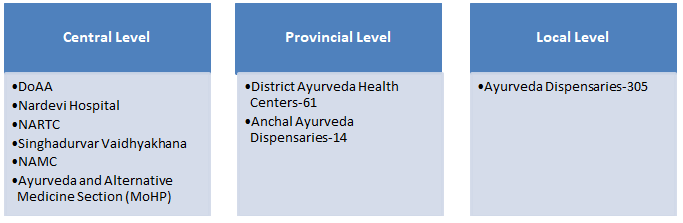
Ayurveda is an ancient medical system and indigenous to Nepal with deep roots. The sources of Ayurvedic medicine are medicinal herbs, minerals and animal products. The system works through simple and therapeutic measures along with promotive, preventive, curative and rehabilitative health of people. Ayurveda health services are being delivered through oneCentral Ayurveda Hospital (Nardevi), one Provincial Hospital (Dang), 14 Zonal Ayurveda Dispensaries, 61 District Ayurveda Health Centers and 305 Ayurveda dispensaries across the country. The Ayurveda and Alternative Medicine unit in the Ministry of Health & population (MoHP) is responsible for formulating policies and guidelines for Opinion Ayurveda and other traditional medical system.
Various national and international policies have highlighted the importance of Ayurveda services in primary health care and for prevention of NCDs. The Constitution of Nepal has called for the protection and promotion of traditional Ayurveda medicines along with naturopathy and homeopathy. The National Health Policy (2014) has called for expansion of Ayurvedic services as have the National Ayurveda Health Policy (1995) and National Urban Health policy (2015).
Fifteenth periodic plan of government of Nepal (2019/20-2023/24) has guided planned development & expansion of Ayurveda, Naturopathy, Homeopathy & other alternative medicines. More specifically, it says:
- Structural development suitable for identification, prevention, collection & promotion of locally available medicinal herbs, minerals & animal origin medicines.
- Management ®ulation of other alternative medicines based on standards & norms.
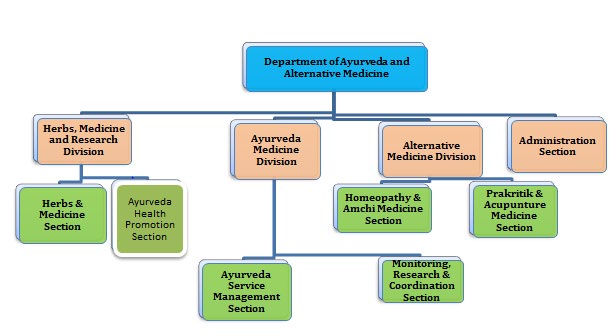
- Establishment of Ayurveda, Yoga & Naturopathy Center and utilization of Ayurveda for promotion of health tourism (Figures 1 & 2).
Objectives
- To expand and develop functional, physical Ayurveda health infrastructure.
- To improve quality control mechanism for Ayurveda health services throughout the country.
- To develop and manage the required human resources.
- To mobilize the adequate resources for medicinal plants.
- To promote community participation in the management of the health facility & utilization of local herbs.
- To promote health status & sustainable development of Ayurveda system using locally available medicinal plants.
- To promote positive attitudes towards health care & awareness of health issues.
Strategies
- Provide preventive, promotive & curative health services in the rural areas;
- Establishment & development of Ayurveda institutions;
- Strengthen & expand the Ayurveda health services;
- Develop skilled manpower required for various health facilities;
- Strengthening of monitoring & supervision activities;
- Development of information, education & communication center in the Department;
- Develop Inter sectoral co‐ordination with Education Ministry, Forestry, local development sector & other NGO’s & INGO’s;
- Establishment of regional Ayurveda Hospitals & Ayurveda Dispensaries;
- Strengthening & expansion of research & training center of international level;
- National & International level training for the capacity enhancement of its human resources
Major Activities
Central level
- Non communicable disease Prevention and Control Program.
- Celebration of National/ International Yoga Day, Dhanvantari and Arogya Diwas.
- Guidelines, Protocol, Manual development.
- TOT on Panchakarma and Yoga.
- Establishment of patient recording reporting networking system software among Ayurveda institutions.
- Establishment of National Ayurveda, Panchakarma and Yoga Center in Budhanilkantha.
- Establishment of Regional Ayurveda Hospital at Dhangadi & Jhapa
- Strengthening program of Naturopathy, Yoga, Homeopathy, Unani, Aamchi etc.
- Purvakarma, Naturopathy & Yoga Health camp.
- Yoga, Physiotherapy and Disability Training to Ayurveda Physician.
- Quality monitoring of different Ayurveda Products available in Nepalese market.
- Monitoring of services provided by private Ayurveda & Alternative Medical Systems
- Annual review meeting in with 7 provinces.
- Revision, evaluation, monitoring and update of Ayurvedic health policy and development of
- Code of ethics.
- Evaluation and monitoring and co-ordination with province and local level.
Province and Local Level
- Yoga and Lifestyle management training program.
- Strengthening of herbal garden.
- Workshop and discussion with local traditional healers.
- Preparation IEC materials on Ayurveda.
School Ayurveda health and yoga program.
Building construction of Ayurveda institutions.
Promotive Panchakarma/Rasayan/Yoga programme for Senior Citizens.
Awareness program on medicinal plants.
Program for lactating mother (Distribution of galactogogue medicine).
Procurement of treatment equipment.
Analysis of Achievement
Based on the treatment report of different Ayurveda institutions following diseases were classified as top ten diseases:
- Amlapitta (Gastritis)
- Udarrog (Abdominal diseases)
- Swasan Bikar (Respiratory diseases)
- VataVyadhi (Osteorthritis, Rheumatoid Arthritis & other neuromuscular Diseases)
- Jwar (Pyrexia)
- BalRoga (Pediatric diseases)
- Karna, Nasa, Mukha, Danta & Kantharog (ENT, Oral, Dental diseases)
- Strirog (Gynecological diseases)
- Brana (Wound, Abscess & Other Skin Diseases)
Journal of Natural & Ayurvedic Medicine
• Atisar/Grahani (Diarrheal diseases)
Way Forward
The situation is far from perfection and many issues on each level are waiting to be resolved. We look forward to:
- Executing the MASTER PLAN of National Ayurveda, Panchakarma and Yoga centre to establish health tourism.
- Establishing “Herb Collection and Processing Centre” to make use of the availability of valuable medicinal herbs in Nepal.
- Establishing Provincial Ayurveda and Alternative Medicine Hospitals.
- Linking the successfully proven ideas and treatment protocols of Ayurveda and Alternative Medicine into the general health system of the nation.
- Studying efficacy of Ayurvedic Medicines in malnutrition, pediatric health and non-communicable diseases.
- Generating quality manpower via education and training.
- Dispensing the services through each of 753 local levels.
- Incorporating the idea of GMP into Singhadurbar Vaidhyakhana Development Committee to produce higher quality Ayurvedic Medicines.
- Management of Ear Keloid with Ksharsutra: A Case Study
- Yoga and Global Sustainability: A Holistic Path to One Earth, One Health
- Autoimmune Diseases in Ayurveda: A Narrative Review with Classical and Modern Perspectives
- Management of Cluster Headache Associated with Pituitary Apophysitis by CERT (Chakrasiddh Energy Release Technique): A Case Report on Energy Rebalancing
- Zygophyllum Geslini Coss : Biochemicals and Antioxidant Activity
- Observations of a Beginner Vaidya