
Sadvritta: A Non-Pharmacological Intervention for Preventive Approach for Covid-19 Disease
Present era is the era of communicable diseases. Whole world is facing a pandemic in the form of Novel Corona Virus. Each and every country fight with corona virus through a common way of prevention. There is no treatment and no vaccine available till today for corona virus. Hit and trial technique is used by many countries. Only and only treatment available is prevention. Lockdown for maintaining social distancing is applied by many countries for its prevention and to flat the curve of this pandemic. People should be aware of its duty, behavior, and conduct to prevent the spread of pandemic and also to boost immune system. Ayurveda lucidly describes various measures to prevent Communicable as well as non-communicable disease. Sadvritta is one of them. Obeying the rules and regulation mentioned in Sadvritta play a vital role to achieve long and healthy life in terms of physical, psychological, social, moral and even spiritual aspect. So for maintaining proper health, application of Ayurvedic concepts of Sadvritta in today’s Perspective of pandemic is quiet important than anything else.
Introduction
The COVID-19 was originated in the city Wuhan of china. There are so many perceptions regarding its origination. Some say it as biological agent for war, some say it is developed in the open flesh market of china, and some say it is transmitted from animal to human because someone eat bat flesh as food. So what so ever is the cause now it is transmitted from human to human in very high rate of transmission.
Event history of Corona virus pandemic
First known case of corona virus was detected in Wuhan, china. China reported to WHO Country office in china on 31 Dec 2019 about the pneumonia of unknown cause. On 5 Jan 2020, WHO published first disease outbreak news on new virus. WHO issued a package of technical guidance online on how to detect, test and manage cases, based on what was known about the virus. On 13 Jan 2020, disease spread outside china as official confirmed a case of COVID-19 in Thailand. On 22 Jan 2020, WHO mission to china issued a statement saying that there was evidence of human to human transmission in Wuhan [1]. On 30 Jan 2020; Corona virus outbreak was declared a public health emergency of international concern. WHO announced the name of the disease as COVID-19 on 11 Feb 2020. First case of Corona virus pandemic was reported in India on 30 Jan 2020. The infection rate of COVID- 19 is reported is 1.7 in India, lower than in the worst affected country [2].
Mode of Transmission of COVID-19
Transmission of COVID-19 is occurred through three possible ways as per the data available till today. The ways of transmission are: • Droplet Transmission
- Airborne Transmission
- Contact Transmission
• Droplet Transmission COVID-19 is the respiratory infection showing mostly the symptoms of pneumonia. Respiratory infections are mainly transmitted through droplets of different size; when the size of droplets are greater than 5-10 um in diameters they are called as respiratory droplets [3]. Droplet transmission occurs from a person in close contact (within 1 m) and has respiratory symptoms (e.g., coughing or sneezing).Through potentially infective respiratory droplets, viruses are directly goes to the mucosa (mouth and nose) or conjunctiva (eyes) exposed area of infected person.
• Airborne Transmission Airborne transmission is different from droplet transmission. In airborne transmission, transmission occurs through the presence of microbes within droplet nuclei (particles <5μm in diameter). The droplet nuclei can remain in the air for long periods of time. The droplet nuclei can be transmitted to others over distances greater than 1 m. The airborne transmission may be possible in specific circumstances and settings in case of COVID-19. The setting in which procedures or support treatments that generate aerosols are performed; like endotracheal intubation, bronchoscopy, open suctioning, administration of nebulized treatment, manual ventilation before intubation, turning the patient to the prone position, disconnecting the patient from the ventilator, non- invasive positive-pressure ventilation, tracheostomy, and cardiopulmonary resuscitation.
• Contact Transmission Transmission of the COVID-19 virus can also occur by direct contact with infected people and indirect contact with surfaces in the immediate environment or with objects used on the infected person (e.g., stethoscope or thermometer) [4]. Other mode of Transmission is through fomites in the immediate environment around the infected person [5]. COVID-19 leads to intestinal infection in some cases and Corona virus may be present in feces supported by one study in which COVID-19 virus has cultured from a single stool specimen [6]. There are no reports that COVID-19 virus transmission occurs through fecal-oral route till date. Current evidence up to date supported that COVID-19 virus is primarily transmitted between people through respiratory droplets and contact routes [7, 8, 9, 10, 11, 12].
Preventive Measures for Control of COVID-19
At present, No medicine is available for the treatment of COVID-19. Many scientists all over the world try their best to formulate medicine as well as vaccine for the COVID-19 disease. Country like USA, Italy, Spain are hit worst by this pandemic. Country like India tries its best to flat the curve of this pandemic disease progression as well as to decrease the death rate as much as possible by many measures. Preventive measures which help peoples from this pandemic are:
- Frequently perform hand hygiene, especially after contact with respiratory secretions like after coughing or sneezing, before eating, and after using the toilet.
- Hand hygiene means cleaning hands with soap and water or with an alcohol-based hand rub. When hands are not visible dirty, use alcohol based rubs; when hands are visible dirty, hands should be washed with soap and water.
- Cleaning the environmental surfaces with water and detergent and use hospital level disinfectants like sodium hypochlorite for washing and cleaning the surfaces and prevention of transmission through contacts [13].
- Educate patients and families about the early recognition of symptoms, basic precautions to be used.
- Social distancing of 1 meter (approx. 3 feet) to everyone to prevent droplet transmission.
- Cover nose and mouth with tissue or elbow while sneezing or coughing.
- Don’t shake hands.
- Special care for elderly, pregnant and children’s because both are more prone to getting infected.
- Cover your nose and mouth with mask or cloth to prevent droplet and airborne transmission as much as possible.
- Always wash everything which was brought from outside home.
Impact of COVID -19 on Mental Health
As we all known, the definition of health by WHO includes mental health too. During these pandemic of COVID-19, mental health issue arises sharply. Every one of us wants to know about the recent updates of COVID-19 worldwide. COVID-19 not only impairs the physical health but also badly hampers the mental health. At this time, we all are locked in our house. The lockdown originates one new stress called as “lockdown stress”. Cases of accident, death due to cardiac arrest as well as from many chronic disease decrease now a days. Peoples have fear of death due to Corona virus. Daily updates of death due to corona virus pandemic across the world imbalance the mental status of peoples. At current scenario we all work from home, sitting in front of news channel and spend many hours of days only by watching news. Many questions arise now in our mind-whether will we survive or not, when will be the lockdown finish, whether will we have enough grocery at our home to survive if lockdown continues, what about our jobs, whether our salaries credit in our account if lockdown continue, how will we increase our immunity and so on. These entire questions which arise in our mind start a novel stress called lock down stress due to this novel corona virus. Much country took the powerful step of lock down to prevent the harmful effect of Corona on humanity and consider humanity first in respect of economy.
Ayurveda: Hope for Fight against Covid-19
The challenges to control the present pandemic of COVID-19 are more difficult for the world. No powerful drugs as well vaccine are discovered till date. Only approach is prevention; this preventive approach includes healthy lifestyle and behavioral modification which are useful for physical and mental health. Large number of scientific community accepted that lifestyle and behavioral intervention is an essential element in treatment of communicable as well as non-communicable disease that as much powerful as medication but without any side effects and any risk.
The basic principle of ayurveda, the age old science of life is “Swasthasya swasthya rakshanam” This means to maintain the health of the healthy. It is the first main objective of ayurveda rather than merely “Aaturasya vikar prashmanam” to cure the disease of the diseased individual. Ayurveda always emphasized to maintain the health and prevent the disease by following proper lifestyle and diet [7].
The concept of healthy lifestyle is described in classical text thousands of year back. Ayurvedic concepts of lifestyle include the conduct like dietary habits under the heading Ahara vidhi vidhana, general behavioral patterns under the heading Sadvritta, daily and seasonal conduct under the heading dincharya and ritucharya etc. The Lifestyle survey study showed that the violation of the rules & methods of living described in the Ayurveda leads to various diseases & disorders which if left unnoticed may lead to many diseases which may cause harmful effects sooner or later [14]. So application of ayurvedic concept in today lifestyle is essential to prevent communicable disease like COVID-19.
In Ayurveda classics, life (Ayu) is described as a four dimensional entity i.e. Sarirendriya Satvatma Samyoga [15]. Accordingly it adopts a comprehensive psychosomatic- spiritual approach to preservation of health and cure of diseases. Both are interrelated. Ayurveda defines health as the balance of three doshas, the dhatus, the mala and the agni as well as the sensorial, mental, emotional and spiritual wellbeing. Thus ayurveda defines the most complete definition of health which resembles with the definition of health by WHO (WORLD HEALTH ORGANISATION). WHO states health as a state of physical, mental, social and spiritual wellbeing and not merely the absence of disease or infirmity? Ayurveda is not only a system of medicine in the conventional sense of curing disease ,but also a way of life that teaches us how to maintain and protect mental and physical health and longevity. It describes the diet, behavior and rules and regulations that are beneficial and harmful for life. Ayurveda has given major emphasis on preventive aspect [16].
Causes of Disease According to Ayurveda
Three factors behind disease as per ayurveda are i.e.
- Asaatmendriyaartha samyoga
- Pragyaaparaadha
- Parinaama/ Kaala The Atiyoga, Ayoga and Mithyayoga of these three factors are the main cause for all the diseases [17] where as their Samyakyoga leads to health. The first one is directly related to the Indriyas (Sense organs). Factor which is related to the mind and spirituality is called as pragyaaparaadha. Ayurveda clearly explains that prajnaparadha which includes the bad deeds of Mana (mind), Kaya (body) and Vak (speech). Parinaama is directly related to kala (time).
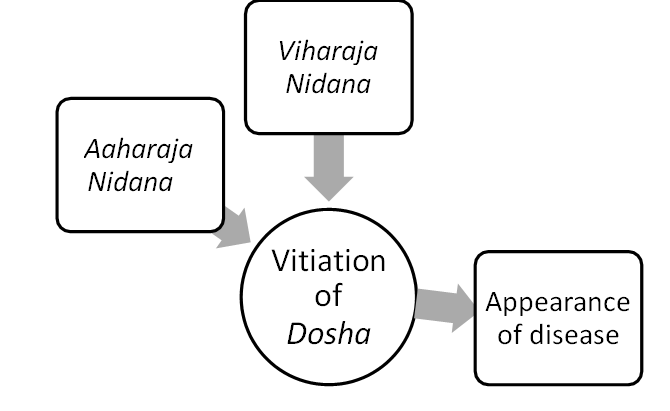
Samprapti of Disease in Ayurveda (Figure 1)
Sad Vritta
It comprises of two words. Sad means good and vritta means behavior /regimen or habits. So Sadvritta means good behavior or habits which help in maintain a healthy body, mind, sensory perceprtions and soul [18]. It includes various codes of conducts. The personality of a person is enhanced by conducts .this could be a personal conduct or social conduct following the Sadvritta increases the sattavika quality of mind which direct all action in the welfare of an individual [19]. So Sadvritta is the code of conduct which is related to social, emotional, psychological, personal, spiritual and ethical aspects of life (Figure 2).
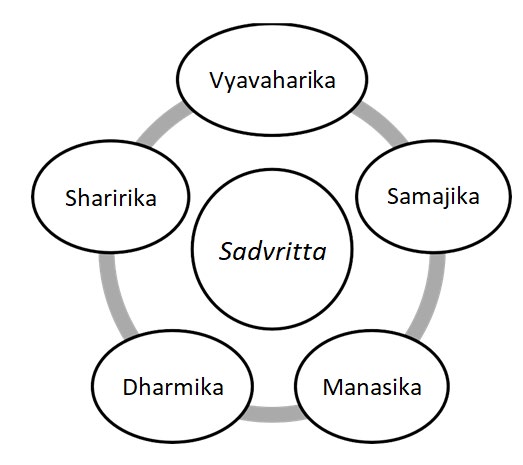
- Vyavaharika Sadvritta [20]: In includes the following code of conduct :
- Always speak the truth
- Do not get addicted to sensory pleasures.
- Take care of elderly like father, mother and teachers.
- Do not harm anyone.
- Observe self-control.
- Speak pleasant and sweet words.
- Behave according to time and place where you are residing.
- Should be devoted to teachers.
- Samajika Sadvritta [20]: It includes the following code of conducts:
- Speak softly
- Speak politely with teachers, elderly, intelligent people.
- Not insult anyone.
- Not having in habits of breaking rules.
- Not cough and sneeze without proper cover nose and mouth.
- Never insult the brahmnans and who are superior in modest, intellect and age.
- Manasika Sadvritta [20]
- Try to understand the real divine.
- One should not live under continued grief.
- One should always be confident.
- Dharmika Sadvritta [21]
- One should worship gods, cows, Brahmans, elderly people and teachers.
- One should honour fire.
- Perform religious sacrifices, donates, and offers pind to fore father.
- One should not excrete sputum, fecal and urine in front of fire, water, the moon and sun and brahmanas.
- One should not urinate on roads, in crowded places and while taking food.
- Sharirika Sadvritta [22]
- Daily Application of oil to head, ear, nose and feet.
- Use prayogika dhumpana mention in ritucharya.
- Not clean or enter finger into the nose.
- Cut nails and hair thrice a fortnight.
- Not eat food without clean hands or maintain hand hygiene.
- Not eat without indulge mentally in food.
- Not eat food which are given by infected peoples or people who not maintain hygiene.
- Always wear good clothes, use frangrance.
- Dress should be gentle.
- Do not indulge in excessive sleep, drinks and food.
- One should not perform sexual intercourse with a woman having menses or some disease.
- One should not eat without washing hand, feet and face, with unclean mouth and without taking bath, without reciting mantra and without making offering to fore father.
- One should not eat in unclean plates, in improper place, untimely and in crowded places.
Discussion
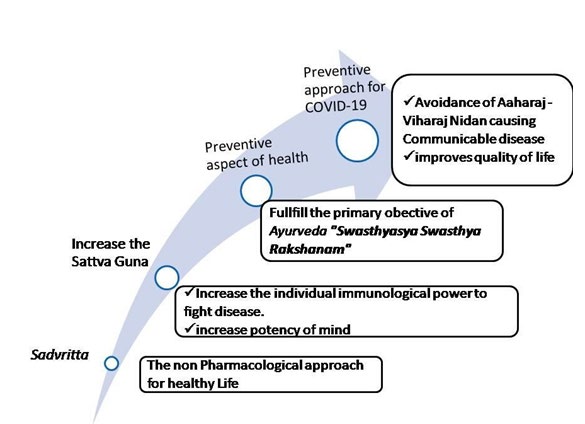
Sadvritta is the non-pharmacological preventive approach for healthy life which mentioning the good conducts for positive wellbeing (Figure 3). The code of conducts mentioning in the Sadvritta increase the sattva guna which increase the potency of body and mind. Sadvritta increase the resistance from disease and help the individual to fight with the disease mentally and physically. The main focus of Sadvritta is on the preventive aspect of life which in terms fulfills the primary objective of Ayurveda. The
application of Sadvritta is important for prevention and cure of disease. Sadvritta emphasis of cleanliness of body and mind. Adoption the conducts mention in Sadvritta bring awakening of inner soul. The conducts advocated may help to increase the immulogical status of the individual. Sadvritta helps to boosts mental health which is essential in current time of COVID-19 and lockdown stress. Sadvritta helps to decrease the level of stress and make us healthy in terms of mentaly, socially and physically.
If a person followed the practices mention in Sadvritta, he gets all rejuvenation effects like longevity, memory, free from disease, and excellent potency of the body and mind. Both the aaharaja and viharaja nidana which causes the disease are not practiced and mentioned in Sadvritta. Following the Sadvritta is the way to prevent communicable disease like COVID-19. Sadvritta is the chief cause to improve the quality of life and prevention of COVID-19.
Conclusion
The WHO definition of health mentioned the physical, social, mental and spiritual wellbeing the description of Sadvritta in ayurvedic classics clear the way to maintain physical, social, mental and spiritual wellbeing by simply following code of conduct. By practice Sadvritta code of conducts we will improve the overall well-being and prevent us from non-communicable as well as from communicable disorder.
References
-
https://www.who.int/news-room/detail/08-04-2020- who-ti, eline-covid
-
https://en.wikipedia.org/wiki/2020_coronavirus_ pandemic_in_india.
-
World Health Organization (2014) Infection prevention and control of epidemic- and pandemic-prone acute respiratory infections in health care. Geneva: World Health Organization.
-
WHO (2020) Modes of transmission of virus causing COVID-19: implications for IPC precaution recommendations; scientific brief.
-
Ong SW, Tan YK, Chia PY, Lee TH, Ng OT, et al. (2020) Air, surface environmental, and personal protective equipment contamination by severe acute respiratory syndrome coronavirus 2 (SARS-CoV- 2) from a symptomatic patient. JAMA 323(16): 1610-1612.
-
Zhang Y, Chen C, Zhu S (2020) [Isolation of 2019-nCoV from a stool specimen of a laboratory-confirmed case of the coronavirus disease 2019 (COVID-19)]. China CDC Weekly 2(8): 123-124.
-
Liu J, Liao X, Qian S, Yuan J, Wang F, et al. (2020) Community transmission of severe acute respiratory syndrome coronavirus 2, Shenzhen, China, 2020. Emerg Infect Dis 26(6): 1320-1323.
-
Chan J, Yuan S, Kok K (2020) A familial cluster of pneumonia associated with the 2019 novel coronavirus indicating person-to-person transmission: a study of a family cluster. Lancet 6736(20): 30154-30159.
-
Li Q, Guan X, Wu P, Wang X, Zhou L, et al. (2020) Early transmission dynamics in Wuhan, China, of novel coronavirus-infected pneumonia. N Engl J Med 382: 1199-1207.
-
Huang C, Wang Y, Li X, Ren L, Zhoa J, et al. (2020) Clinical features of patients infected with 2019 novel coronavirus in Wuhan, China. Lancet 395(10223): 497-506.
-
Burke RM, Midgley CM, Dratch A, Fenstersheib M, Haupt T, et al. (2020) Active monitoring of persons exposed to patients with confirmed COVID-19-United States, January-February 2020. MMWR Morb Mortal Wkly Rep 69(9): 245-246.
-
World Health Organization (2020) Report of the WHO- China Joint Mission on Coronavirus Disease 2019 (COVID-19). Geneva: World Health Organization.
-
CDC and ICAN (2019) Best Practices for Environmental Cleaning in Healthcare Facilities in Resource- Limited Settings. Atlanta, GA: US Department of Health and Human Services, CDC; Cape Town, South Africa: Infection Control Africa Network.
-
Patil PM (2014) Effect of Dinacharya (Daily Regimen) In Prevention Of Premature Aging, Int J Ayu Alt Med 2(5): 15-20.
-
Acharya VJT (2011) Charaka Samhita of Agnnivesha, revised by Charaka and Dridhabala. With commentary: Ayurveda-Deepika. Varanasi 1st (Edn.), Chaukhamba Prakashan, pp: 8, 62, 74, 76, 77, 106, 118, 238, 377, 385, 387-88.
-
Vidhyashree JT (2015) Role of Code of Conducts of Life (Sadvritta) in Prevention of Crimes. Int J Ayu Alt Med 3(4): 194-198.
-
Acharya VJT (2011) Charaka Samhita of Agnnivesha, revised by Charaka and Dridhabala. With commentary: Ayurveda-Deepika. Varanasi 1st (Edn.), Chaukhamba Prakashan, pp: 8, 62, 74, 76, 77, 106, 118, 238, 377, 385, 387-388.
-
Kashinath S, Chaturvedi G (2005) Charak samhita of agnivesh elaborated vidyotini hindi commentary, sutra sthan 8 chapter Indreupkarmniya adhyay, chaukhamba bharti sansthan, Varanasi, pp: 181.
-
Vidhyashree JT (2015) Role of code of conduct s of life (Sadvritta) in prevention of Crimes. Int J Ayu Alt Med 3(4): 194-198.
-
Ranade S (1994) Natural healing through Ayurveda. 1st (Edn.), Delhi: Motilal banarasidass publisher’s private limited; year, pp: 70.
-
Muniraju KN (2014) Social Health in Ayurveda: An Overview. Journal of biological and scientific opinion 2(1): 1-4.
-
Mamta T (2015) The tenets of mental health in ayurveda. World Journal of Pharmaceutical Research 4(9): 549- 555.
- Management of Ear Keloid with Ksharsutra: A Case Study
- Yoga and Global Sustainability: A Holistic Path to One Earth, One Health
- Autoimmune Diseases in Ayurveda: A Narrative Review with Classical and Modern Perspectives
- Management of Cluster Headache Associated with Pituitary Apophysitis by CERT (Chakrasiddh Energy Release Technique): A Case Report on Energy Rebalancing
- Zygophyllum Geslini Coss : Biochemicals and Antioxidant Activity
- Observations of a Beginner Vaidya