
Medicinal Plants used by Traditional Healers in Lohagara Upazila of Narail District, Bangladesh
Medicinal plants used by traditional healers in Lohagara Upazila of Narail district, Bangladesh was recorded from November 2018 to March 2020. The present paper deals with traditional uses of 101 medicinal plant species 89 genera and 55 families along with correct botanical identification. Semi-structured interviewees, observation and guided field walk with informants were employed to obtain medicinal data in the study area. In the area, a total of 73 human diseases were recorded and treated with various plant species and preparations. For each species, scientific name, local name, family, habit, diseases, mode of administration and part(s) used are provided. The study aims to bring awareness among the people, to save this precious knowledge and protect these plants, for the next generation.
Introduction
The plant having properties to cure the disease and have the same properties as Pharmaceutical drugs are called medicinal plants. These plants are rich in those ingredients which are used in the preparation of medicine [1]. Medicinal plants are being used for the treatment of various diseases by the tribal people for a generation. Medicinal plants are an essential part of the human health care system because of less expensive, lesser side effects and toxicity [2]. Sometimes, the medicine is also called herbal medicine due to its properties. The tribal people prefer to use medicinal plant and plant-based medicine because of the cheap price and easy availability as compared to costly pharmaceuticals’ [3]. These people have inherited indigenous knowledge of medicinal plants from their ancestors since time immemorial; and they discover the therapeutic activity of medicinal plants against diseases through their traumatic experiences [4].
The rudimental knowledge of medicinal plants is scientifically and culturally very significant to society. According to the local people, plants not only have nutritional value but also have medicinal and ritual values. These plants play a vital role in the development of drugs. World Health Organization estimates that 80% of populations from many countries are using traditional folk medicine to cure various ailments [5]. The main objective of this study is to identify and assess the indigenous knowledge of the medicinal plants present in several villages in Lohagara Upazila of Narail district, Bangladesh.
Materials and Methods
Study Area
Lohagara Upazila (Narail district) area 290.83 sq km, located in between 23°05’ and 23°19’ north latitudes and in between 89°29’ and 89°46’ east longitudes. It is bounded by Mohammadpur Upazila on the north, Kalia Upazila on the south, Alfadanga, Kashiani and Gopalganj sadar Upazilas on the east, Narail Sadar and Shalikha Upazilas on the west. The study area of Lohagara Upazila experiences a typical tropical monsoon climate, with hot wet summers from May to September and cool dry winters. The rainy season occurs approximately from May to October [6].
Methodology
The present work is the outcome of an extensive survey in Lohagara Upazila of Narail district, Bangladesh undertaken from November 2018 to March 2020 to collect information on the medicinal uses of different plant species. A total of 101 species belonging to 89 genera under 55 families were recorded. Medicinal information was obtained through semi-structured interviews with knowledgeable traditional healers. A total of 207 informants having an age range of 27-79 years were interviewed using the semi-structured interviewed method [7]. Plant parts with either flowers or fruits collected using traditional herbarium techniques to make voucher specimens for documentation and voucher specimens have been preserved at Herbarium of Rajshahi University.
Identification
Collected specimens have been critically examined, studied and identified. Identifications have been confirmed by consulting standard literature. Nomenclature has been updated following recent literature [8, 9, 10, 11, 12].
Results and Discussion
Medicinal plants survey was employed to collect information from traditional healers in Lohagara Upazila of Narail district, Bangladesh was recorded from November 2018 to March 2020. One hundred and one medicinal plant species 89 genera belonging to 55 families were reported by the traditional healers for the treatment of 73 human ailments in the study area. For each species, scientific name, local name, family, habit, diseases, mode of administration and part(s) used are provided. The result of this information showed that these traditional healers in the study area still depend on medicinal uses of plants for the treatment of asthma, anaemia, abdominal pain, alopecia, burning sensation, blood dysentery, dyspepsia, bronchitis, diuretic, constipation, cough, chronic fever, chicken fox, dog bite, dysentery, diabetes, eczema, heart disease, high blood pressure, headache, inflammation, jaundice, leprosy, mouth ulcer, malarial fever, menstrual bleeding, piles, scabies, rheumatism, skin cracks, scurvy, snake bite, stomachache, swelling, toothache, tumours, throat pain, tuberculosis, ulcers, vomiting, wound, weakness, and many types of diseases. This is the first-ever exploration of the study area which will assist the new researcher in future especially in the field of traditional medicinal plants.
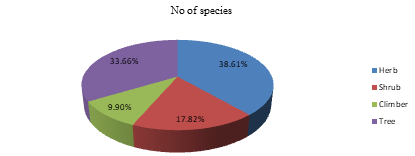
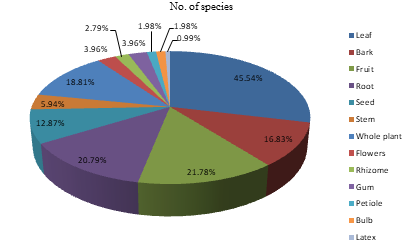
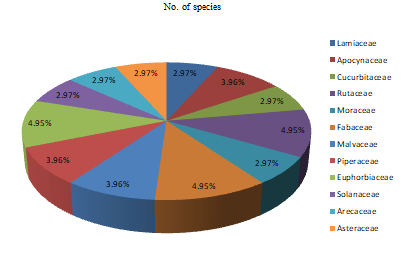
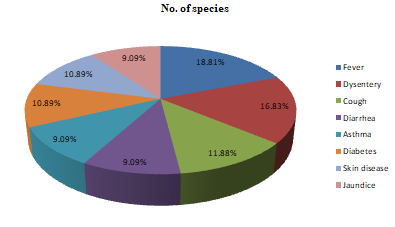
Out of 101 species, 38.61% species were herb, 17.82% species were shrub, 9.90% species were climber and 33.66% tree species were used as medicine (Table 1, Figure 1). Different plant parts of different spp. are used as medicine for treating various diseases; leaf of 45.54%, the bark of 16.83%, the fruit of 21.78%, the root of 20.79%, seed of 12.87%, stem of 5.94%, whole plant of 18.81%, flowers of 3.96%, the rhizome of 2.79%, gum of 3.96%, petiole of 1.98%, bulb of 1.98% and latex of 0.99% species were used as medicine (Figure 2). The distribution of medicinal plant species in the families shows variation. Out of 55 families, 2.97% species were used in the family Lamiaceae, followed by 3.96% Apocynaceae, 2.97% Cucurbitaceae, 4.95% Rutaceae, 2.97% Moraceae, 4.95% Fabaceae, 3.96% Malvaceae, 3.96% Piperaceae, 4.95% Euphorbiaceae, 2.97% Solanaceae, 2.97% Arecaceae and 2.97% Asteraceae (Figure 3). Out of 73 categories of diseases, fever (18.81%), dysentery (16.83%), cough (11.88%), diarrhoea (9.09%), asthma (9.09%), diabetes (10.89%), skin disease (10.89%) and jaundice (9.09%) was dominant diseases in the study area (Figure 4).
The collected medicinal information is comparable with the result of other studies in Bangladesh and foreign. In Bangladesh, a total of 70 medicinal plant species under 36 families were recorded in the Bandarban district [13]. 86 plant taxa belonged to 84 genera under 46 families were recorded in Garo ethnic community, Tangail [14]. A total of 111 species under 93 genera of 53 families have been documented which are used for the treatment of various diseases [15]. Forty medicinal plants have been documented in Paba Upazila of Rajshahi [16]. A total of 45 medicinal plants under 43 genera and 33 families have been recorded in Daulotpur Upazila of Kushtia District, Bangladesh [17]. 111 medicinal plants used to cure various diseases in Rajshahi metropolitan city [18]. A total of 52 plant species under 50 genera and 37 families have been documented in Jamalpur district [19]. A total of 93 medicinal plants were recorded in the Chapai Nawabganj district [20].
A total of 105 plant species under 97 genera belonging to 57 families were recorded in the Dinajpur district [21]. A total of 61 medicinal plants were recorded in Sadar Upazila of Joypurhat District [22]. 94 medicinal leafy vegetables were recorded in Rajshahi [23]. A total of 127 plant species under 105 genera of 66 families have been documented in Puthia Upazila of Rajshahi [24]. A total of 147 medicinal angiosperm weeds was documented in Rajshahi metropolitan city [25]. In India, a total of 40 plant species 37 genera and 28 families were recorded for medicinal purposes [26]. In Ethiopia, 47 medicinal plant species belonging to 23 families were reported by the traditional healers for the treatment of various human ailments [27]. In Pakistan, a total of 81 plants are recorded as medicinal belonging to 45 families and 75 genera [28]. In Nigeria, a total of one hundred and three (103) medicinal species belonging to fifty-two (52) families were identified [29]. In Pakistan, a total of 150 medicinal plants belonging to 98 genera and 60 families were documented [30]. In Kenya, a total of 66 plant species under 58 genera belonging to 36 families were reported as medicinal values [31]. The present findings showed that there was a high diversity of plant species used in traditional medicine by the traditional healers in Lohagara Upazila of Narail district, Bangladesh. Medicinal plants traditionally used as remedies for various illnesses and health problems were proven to have bioactivity properties due to their phytochemical compounds. Documentation of indigenous knowledge on traditional medicine generated in this research has an important role in preserving best practices on traditional medicine which serve as the basis for new drug discovery in modern medicine.
| Scientific name and family | Local name | Habit | Parts used | Diseases | Mode of administration |
|---|---|---|---|---|---|
| Abelmoschus esculentus (L.) Moench (Malvaceae) | Dherosh | Herb | Fruit | Stomachic, Hair fall,Female weakness,Constipation | Fruit juice is taken internally, Paste of fruits are taken externally, Young fruit is taken orally, Eaten raw after cooked |
| Abroma augusta L.f. (Sterculiaceae) | Ulotkomol | Shrub | Seed, Petiole | Stomach pain, Weakness | Seed paste is taken orally, Petiole is taken internally |
| Acalypha indica L. (Euphorbiaceae) | Muktha jhuri | Herb | Leaf | Snake bite, Ringworm | Leaf paste is taken externally, Leaf juice taken orally |
| Amaranthus viridis L. (Amaranthaceae) | Shaknote | Herb | Whole plant | Leprosy | Whole plant juice is taken orally |
| Amaranthus spinosus L. (Amaranthaceae) | Katanotey | Herb | Whole plant | Dysentery,Burning wound,Toothache | Leaf juice is taken internally, Leaf paste is taken externally, Whole plant decoction is used |
| Allium cepa L. (Liliaceae) | Piaj | Herb | Bulb | Cough and cold,Headache and Snake bite | Warm bulb juice is taken internally, Warm bulb juice taken externally |
| Allium sativum L. (Liliaceae ) | Roshun | Herb | Bulb | Blood pressure, Eczema, Cough and Fever | Bulb is taken orally, Paste of bulb is taken externally |
| Alstonia scholaris (L.) R.Br. (Apocynaceae) | Chatim | Tree | Bark, Gum | Gastric problem and Rheumatism, Ulcers | Bark juice is taken internally, Milky gum juice is taken orally |
| Aloe vera (L.) Burm.f. (Aloeaceae) | Ghrito kumari | Herb | Leaf | Paralysis, Viral Jaundice,Body weakness, Skin care, Hair treatment | Leaf juice taken orally, Paste of leaf is taken externally |
| Acacia nilotica (L.) Willd. Ex Del. (Fabaceae) | Babla | Tree | Leaf, Bark, Fruit | Leucoderma, Dysentery, Bronchitis andIntestinal problem | Decoction of leaf is taken orally, Fruit juice taken internally, Bark juice is taken orally |
| Aegle marmelos L. (Rutaceae) | Bel | Tree | Fruit, Root | Stomachache, Constipation, Diarrhea andHeart disease | Unripe fruit is taken internally, Ripe fruit is taken orally, Juice of root is taken internally |
| Andrographis paniculata (Burm.f.) Nees. (Acanthaceae) | Kalomegh | Herb | Leaf | Fever, Cholera, Headache and Diarrhea,Lung infection and Leprosy | Leaf juice is taken orally, Raw Leaf is taken externally |
| Areca catechu L. (Arecaceae) | Supari | Tree | Fruit, Seed, Root | Dyspepsia,Blood dysentery,Toothache | Fruit juice is taken orally, Decoction of seed is taken internally, Root power is taken externally |
| Artocarpus heterophyllus Lamk. (Moraceae) | Kathal | Tree | Root, Leaf | Diarrhea,Scabies,Weakness | Decoction of root is taken internally, Paste of young leaf is used externally, Unripe fruit is taken internally |
| Argemone mexicana L. (Papaveraceae) | Shialkata | Herb | Leaf, Root, Latex | Malarial fever, Jaundice, Skin cracks | Leaf and root juice is taken internally, Latex is used externally |
| Asparagus racemosus Willd. (Liliaceae) | Shotomuli | Climber | Whole plant, Root | Diarrhea, Rheumatism, Diabetes and DysenteryInfertility and Miscarriage | Whole plant juice is taken internally, Root juice is taken internally |
| Averrhoa carambola L. (Oxalidaceae) | Kamranga | Tree | Fruit, Leaf | Piles, Fever and DysenteryLiver pain | Fruit juice is taken orally, Leaf juice with sugar is taken internally |
| Azadirachta indica L. (Meliaceae) | Neem | Tree | Leaf | Chicken pox and Skin disease, Jaundice, Toothache | Leaf paste is taken externally, Leaf juice is taken orally, Stem is taken externally |
| Basella alba L. (Basellaceae) | Puisakh | Climber | Leaf, Root | Burning sensation,Constipation | Leaf paste taken externally,Leaf juice taken orally |
| Brassica napus L. (Brassicaceae) | Sorisa | Herb | Seed | Hair treatment and Cough, Skin crack | Oil extract from seed is taken externally |
| Bombax ceiba L. (Malvaceae) | Simultula | Tree | Gum, Root | Rheumatism,Male weakness,Burning sensation | Young root is taken internally, Gum paste is taken externally |
| Carica papaya L. (Caricaceae) | Pepa | Shrub | Bark, Root, Flower | Toothache, GonorrheaAbdominal pain and Stimulation | Bark juice is taken internally, Macerated root is used orally, Flower with milk is taken internally |
| Citrus aurantifolia (Christm. & Panzer) Swingle (Rutaceae) | Lebu | Shrub | Fruit | Balanced diet, Increase digestive power and appetite, Skin irritation and nausea | Fruit juice taken orally |
| Centella asiatica (L.) Urban (Apiaceae) | Thankuni | Herb | Whole plant | Loose motion and Dysentery, Stomach pain, Tuberculosis | Whole plant paste is taken internally |
| Calotropis procera (Aiton) W.T. Aiton (Asclepiadaceae) | Akando | Shrub | Latex, Leaf | Rheumatism andParalysis,Body pain | Latex with mustard oil is taken externally, Warm leaf is taken externally |
| Coloasia esculenta (L.) Schott (Araceae) | Kochu | Herb | Leaf, petiole | Stop bleeding, Tumor and Cancer | Leaf juice is taken externally |
| Coccinia grandis (L.) Voigt. (Cucurbitaceae) | Telakocha | Climber | Leaf | Fever, Vomiting, Hypertension | Leaf juice is taken orally |
| Clerodendrum viscosum Vent. (Verbenaceae) | Vatpata | Shrub | Leaf, Root | Asthma, TumorsSkin disease, Hair disease | Leaf paste is taken externally |
| Croton boplandianus Baill. (Euphorbiaceae) | Bonmorich | Herb | Seed | Jaundice, abdominal dropsy, internal abscess | Seed juice is taken internally |
| Coriandrum sativum L. (Apiaceae) | Dhonia | Herb | Whole plant | Asthma, Cold, Fever | Whole plant juice with salt is taken orally |
| Catharanthus roseus (L.) G. Don. (Apocynaceae) | Noyntara | Herb | Whole plant | Child Leukemia | Whole plant juice is taken internally |
| Curcuma longa L. (Zingiberaceae) | Holud | Herb | Rhizome, Flower | Eczema, Cold fever, Dysentery and Gonorrhea, Gastric problem | Rhizome paste is taken externally, Rhizome juice is taken orally, Flower paste is taken internally |
| Cinnamomum tamala (Buch.- Ham.) Nees & Eberm. (Lauraceae) | Tejpata | Tree | Leaf, Bark | Cold cough, Bronchitis, Diabetes | Leaf juice is taken orally |
| Clitoria ternatea L. (Fabaceae) | Oparajita | Climber | Root, Leaf | Headache, Throat pain, Swellings, Tuberculosis gland | Leaf paste is used externally, Decoction root is used internally |
| Cuscuta reflexa Roxb. (Cuscutaceae) | Shornolata | Parasitic Herb | Stem, Leaf | Constipation, Liver disorder, Antioxidant | Stem decoction is taken internally, Decoction leaf of juice is taken orally |
| Cissus quadrangularis L. (Vitaceae) | Harjora | Climber | Whole plant, stem, Leaf | Broken limb, Survey and irregular menstruation, Asthma, Indigestion, Piles | Whole plant juice is used in orally, Paste of stem is taken internally, Leaf juice mixed with water is taken orally |
| Cocos nucifera L. (Arecaceae) | Narkel | Tree | Fruit, Root | Kidney problems, Stomach pain | Fruit juice is taken orally, Root juice is taken internally |
| Capsicum frutescens L. (Solanaceae) | Morich | Herb | Leaf, Fruit | Night blindness, Headache, Blood dysentery | Leaf juice is taken internally, Leaf paste is taken externally, Dry fruit powder is taken internally |
| Carissa carandas L. (Apocynaceae) | Karamcha | Shrub | Fruit, Root bark | Diabetes and Wound | Ripe fruit is taken orally, Decoction of the root bark is taken internally |
| Cynodon dactylon (L.) Pers. (Poaceae) | Durba | Herb | Whole plant | Stop bleeding | Whole plant paste is taken externally |
| Datura metel L. (Solanaceae) | Dhutra | Shrub | Leaf | Rheumatic pain, Skin disease | Leaf juice is taken internally, Leaf paste with neem is applied externally |
| Dillenia indica L. (Dilleniaceae) | Chalta | Tree | Fruit | Nervous system problem | Fruit juice taken internally |
| Diospyros malabarica (Desr.) Kostel. (Ebenaceae) | Ghab | Tree | Fruit, Leaf, Stem | Dyspepsia, Cough | Fruit power juice is taken internally, Leaf juice is taken orally |
| Dalbergia sissoo Roxb. (Fabaceae) | Sisso | Tree | Leaf, Bark | Dysentery, Gonorrhea, Hemorrhage | Decoction of leaf is taken internally, Dried bark paste is taken externally |
| Elaeocarpus floribundus Bl. (Elaeocarpaceae) | Jolpai | Tree | Leaf, Fruit | Dysentery and Diarrhea, Poisoning | Fruit is taken internally, Leaf juice is taken orally |
| Enhydra fluctuans Lour. (Asteraceae) | Helencha | Herb | Whole plant | Fever | Curry made from whole plant is taken internally |
| Euphorbia hirta L. (Euphorbiaceae) | Dhudia | Herb | Whole plant | Dysentery, Bronchitis, Fungal affection | Whole plant paste is taken internally |
| Ficus hispida L.f. (Moraceae) | Dumur | Tree | Fruit | Diabetes, Jaundice | Fruit juice is taken internally |
| Ficus racemosa L. (Moraceae) | Jogdumur | Tree | Fruit | Diabetes, Dry cough, Asthma, Loose motion | Cooked vegetable is taken orally |
| Heliotropium indium L. (Boraginaceae) | Hatishur | Herb | Leaf | Dog bite and Insect bite | Leaf juice is taken externally |
| Hibiscus rosa- sinensis L. (Malvaceae) | Joba | Shrub | Flower | Hair treatment and Burning wound, Irregular menstruation | Flower paste is taken externally, Flower paste mixed with water is taken orally |
| Ipomoea aquatica Forssk. (Convolvulaceae) | Kolmi | Herb | Whole plant | Jaundice, Bronchitis, Leprosy, Fever | Whole plant paste is taken internally |
| Justicia adhatoda L. (Acanthaceae) | Basak | Shrub | Whole plant, Leaf | Bleeding piles,Cough and Fever | Whole plant paste is taken externally, Leaf juice is taken orally |
| Justicia gendarussa Burm.f. (Acanthaceae) | Bijtarop | Herb | Leaf | Headache | Leaf juice with mustard oil is taken externally |
| Kalanchoe pinnata (Lam.) Pers. (Crassulaceae) | Pathorkuci | Herb | Whole plant | Bites of insect | Whole plant paste is taken externally |
| Ocimum sanctum L. (Lamiaceae) | Ramtulsi | Herb | Leaf | Gastric disorder, Cold, Cough, Bronchitis | Leaf juice is taken orally |
| Ocimum tenuiflorum L. (Lamiaceae) | Tulsi | Herb | Leaf | Cough, Fever, Bronchitis | Leaf juice is taken orally |
| Opuntia dillenii (Ker.-Gawl.) Haw. (Cactaceae) | Fhoni monosha | Shrub | Whole plant, Leaf, Fruit | Gonorrhea, Asthma, Whooping cough, Tumour and leucoderma | Ripe fruit is taken internally, Decoction of leaf is taken orally, Whole plant juice is taken orally |
| Oxalis corniculata L. (Oxalidaceae) | Amrul | Herb | Leaf | Stomach pain, Scurvy | Decoction of leaf extracted with water is taken orally |
| Lawsonia inermis L. (Lythraceae) | Mehedi | Shrub | Leaf | Skin disease, Hair treatment | Leaf paste is taken externally |
| Limonia acidissima L. (Rutaceae) | Kodhbel | Tree | Fruit | Digestion, Heart disease, Piles | Fruit juice is taken internally |
| Litchi chinensis Sonn. (Sapindaceae) | Lichu | Tree | Fruit | Heart, Brain, Liver | Fruit juice is taken orally |
| Mikania cordata (Burm.f.) Rob. (Asteraceae) | Asamlata | Climber | Leaf | Stop bleeding | Leaf paste is taken externally |
| Momordica charantia L. (Cucurbitaceae) | Korola | Climber | Fruit, Whole plant | Diabetes, Fever | The juice of the fruit is taken internally, Whole plant juice is taken |
| Murraya koenigii (L.) Spreng. (Rutaceae) | Paharineem | Tree | Leaf | Chicken pox, Skin disease, Jaundice | Leaf paste is taken externally, Leaf juice is taken orally |
| Murraya paniculata (L.) Jack. (Rutaceae) | Kamini | Shrub | Leaf, Root Bark | Diarrhea and dysentery, Cough and rheumatism | Leaf extract is taken orally, Root bark juice is taken internally |
| Mangifera indica L. (Anacardiaceae) | Amm | Tree | Leaf,Gum | Fever and Toothache, Skin disease | Leaf juice is taken orally, Gum paste is taken externally |
| Musa sapientum L. (Musaceae) | Kola | Herb | Stem, Bark | Stop bleeding, Snake bite | Stem and bark juice is taken externally |
| Mimusops elengi L. (Sapotaceae) | Bokul | Tree | Flower, Stem Bark | Asthma, Bleeding gums, swelling | Flower smell is taken, Stem- bark decoction is popularly used internally |
| Marsilea minutia L. (Marsileaceae) | Marsilia | Herb | Leaf | Diuretic and febrifuge, Snakebite and Abscess | Leaf juice is taken internally, Leaf paste is taken externally |
| Moringa oleifera Lam. (Moringaceae) | Sogina | Tree | Leaf, Root, Fruit | Diabetes, Blood pressure, Cold-cough, Abdominal pain, Fever | Dry leaf power with water is taken internally, Eaten raw after cooked, Leaf juice is taken internally, Root extract is taken orally |
| Nigella sativa L. (Ranunculaceae) | Kalojira | Herb | Seed | Asthma, High blood pressure | Seed extract is taken internally |
| Nymphaea nouchali Burm f. (Nymphaeaceae) | Sapla | Herb | Rhizome, Leaf | Dysentery, Burning spot | Dried rhizome power is taken internally, Leaf paste is taken externally |
| Nyctanthes arbor- tritis L. (Oleaceae) | Sheuli | Tree | Bark, Leaf, Root | Chronic fever, Bronchitis, Rheumatic fever | Leaf juice mixed with honey is taken orally, Bark juice is taken internally |
| Piper betle L.(Piperaceae) | Pan | Climber | Leaf | Louse killing and cough | Leaf juice is taken externally |
| Piper chaba Trel. & Yunck.(Piperaceae) | Chui | Climber | Fruit | Swelling and pain, Mouth ulcer and inflammation | Fruit paste is taken externally, Fruit powder mixed with honey is taken internally |
| Piper longum L. (Piperaceae) | Pipul | Herb | Leaf | Fever, Dyspepsia, Asthma | Leaf paste mixed with ghee is taken internally |
| Polyalthia longifolia (Sonn.) Benth. & Hook. f. (Annonaceae) | Debdaru | Tree | Seed | Allergy treatment | Seed paste is used externally |
| Phoenix sylvestris Roxb. (Arecaceae) | Khajur | Tree | Fruit | Toothache, Heart complaints, Fever, Vomiting, Gonorrhea | Ripe fruit is taken internally |
| Peperomia pellucida Kunth. (Piperaceae) | Bonpan | Herb | Root, Whole plant | Fever and Wound, Renal problem | Root juice is taken internally, Whole plant decoction is used internally |
| Phaseolus vulgaris L. (Fabaceae) | Shim | Climber | Pod, Seed. | Diabetes, Blood cancer, Rheumatism, Arthritis | Dried pod is taken internally, Seed paste is taken orally |
| Polygonum hydropiper (L.) Del. (Polygonaceae) | Biskatali | Herb | Whole plant | Diarrhea, Dyspepsia, Menstrual bleeding | Whole plant juice is taken internally |
| Psidium guajava L. (Myrtaceae) | Peara | Tree | Leaf | Diarrhea and Dysentery, Mouth wash | Leaf decoction is taken internally, Young leaf is taken orally |
| Phyllanthus emblica L. (Phyllanthaceae) | Amloki | Tree | Fruit, Bark | Diabetes, Stomach pain, Skin disease | Young fruit is taken internally, Fruit power and bark juice is taken orally |
| Phyllanthus reticulatus Poir. (Euphorbiaceae) | Chitki | Shrub | Whole plant | Anemia and intestinal hemorrhage | Whole plant juice is taken internally |
| Rauvolfia serpentina (L.) Benth.ex Kurz. (Apocynaceae) | Sorphogondha | Herb | Root | Blood pressure and Dysentery | Extract of root is taken internally |
| Ricinus communis L. (Euphorbiaceae) | Bherena | Shrub | Leaf, Seed | Jaundice, Dysentery,Constipation | Leaf juice is taken orally, Oil extract from seed if taken internally |
| Spondias pinnata (L.f.) Kurz. (Anacardiaceae) | Amra | Tree | Bark, Root | Irregular menstruation, Dysentery, Diarrhea and vomiting | Juice of root is taken orally, Infusion of bark is taken internally |
| Solanum nigrum L. (Solanaceae) | Titbegun | Herb | Leaf, Fruit | Dropsy, Ringworm | Decoction of leaf is taken orally, Green fruit is taken internally |
| Saccharum officinarum L. (Poaceae) | Aakh | Shrub | Stem | Jaundice, Urinate problem | Stem juice is taken orally |
| Syzygium cumini (L.) Skeels. (Myrtaceae) | Jham | Tree | Bark, Seed | Asthma, Diabetes | Grinding bark decoction is taken orally, Seed power is taken internally |
| Syzygium samarangense (Blume) Merr. & Perry (Myrtaceae) | Jamrul | Tree | Fruit | Fever | Fruit juice taken internally |
| Targetes ercta L. (Asteraceae) | Gendaful | Herb | Whole plant, Leaf | Bleeding, Dysentery | Whole plant paste is taken externally, Leaf juice is taken orally |
| Terminalia arjuna (Roxb.) Wight & Arn. (Combretaceae) | Arjune | Tree | Bark | Heart disease, Blood pressure | Decoction of bark is taken |
| Terminalia catappa L. (Combretaceae) | Kathbadam | Tree | Leaf, Bark, Root | Fever, Diarrhea, Diabetes, Skin diseases, Indigestion | Bark and root juice is taken orally, Paste of bark is taken externally, Leaf juice is taken orally |
| Terminalia chebula Retz. (Combretaceae) | Horitoki | Tree | Seed, Fruit | Vomiting, Dysentery | Seed power is taken orally, Fruit power is taken internally |
| Tamarindus indica L. (Fabaceae) | Tetul | Tree | Fruit, Seed, Leaf, Stem, Bark | Mouth Disease,Blood Dysentery,Dyspepsia,Gastric and Fever | Stem and bark decoction is taken orally, Leaf juice is taken internally, Seed power is taken orally, Ripe fruit pulp is taken internally |
| Trichosanthes dioica Roxb. (Cucurbitaceae) | Potol | Climber | Leaf, Fruit | Jaundice, Diuretic, Alopecia | Leaf and fruit juice is taken internally, Leaf paste is taken externally |
| Wedelia chinensis (Osbeck) Merr. (Asteraceae) | Mohavringhoraj | Herb | Leaf | Alopecia, Hair disease,Stop vomiting | Leaf paste is taken externally |
| Ziziphus mauritiana Lam. (Ramnaceae) | Boroi | Tree | Root | Dyspepsia, Fever, Wounds and cancer | Root juice is taken internally, Paste of root is taken externally |
| Zingiber officinale Roscoe (Zingiberaceae) | Adha | Herb | Rhizome | Indigestion, Cold-cough, Catarrhal fever, Gout, Sickness | Rhizome juice is taken orally |
Table 1: Medicinal plants used by traditional healers in several villages at Lohagara Upazila of Narail District, Bangladesh.
Summary and Conclusion
The indigenous knowledge about medicinal plants of Lohagara Upazila of Narail district, Bangladesh was reported in this research. Results have shown that 101 medicinal plants used by traditional healers to treat various diseases. The most utilized plant families were Fabaceae and Euphorbiaceae followed by Asteraceae, Amaranthaceae, Apocynaceae, Arecaceae, Cucurbitaceae, Fabaceae, Lamiaceae, Malvaceae, Moraceae, Piperaceae and Rutaceae. The highest proportions of the medicinal plants (38.61%) are herbs followed by trees (33.66%), shrubs (17.82%) and climbers (9.90%). Commonly treated diseases are diabetes, dysentery, headache, eczema, heart disease, high blood pressure, piles, scabies, jaundice, asthma, bronchitis, constipation, cough, chronic fever, chicken fox, dog bite, snake bite, toothache, ulcers, vomiting and wounds. The major threats to medicinal plants and the associated knowledge on these particular plants are agricultural expansions, firewood collections grazing and drought in that order to overcome these problems traditional healers have gone far to get the plants that used for the medication. Despite this fact, traditional healers still depend to a greater extent on naturally growing species, as they believe those species in the wild vegetation are more powerful in the treatment of different ailments and health problems the scarcity of the plantation area for growing the plants in the study area. Further pharmacological and phytochemical research studies are recommended to identify active components in the recorded medicinal plants, and their efficiency to cure the different human diseases.
Acknowledgements
The authors are grateful to the local people in Lohagara upazila of Narail district, Bangladesh for their co-operation and help during the research work.
References
-
Yoganarasimhan SN, Dutta PK (1970) Medicinal plants of Orissa -plants in and around Bhubaneswar, Orissa, Nagarjun, pp: 15-20.
-
Sahu SC, Kumar S, Singh NR (2018) Agro Technology status and conservation of few threatened medicinal plants from Deogarh district, odisha, india. Journal of Biodiversity and conservation 1(2): 84-88.
-
Panda T, Padhy RN (2007) Ethnomedicinal plantsu sed by tribes of Kalahandi district, Orisa. IndianJournalof Traditional Knowledge 7(2): 242-249.
-
Dhal NK, Panda SS, Muduli SD (2015) Traditional uses of medicinal plants by native people in Nawarangpur district, Odisha, India. Asian Journal of Plant Science and Research 5(2): 27-33.
-
WHO (1991) Guideline for Assessment of Herbal Medicines Programme on Traditional. WHO, Gieneva, pp: 56-91.
-
(2011) Bangladesh Population Census (BPC), Bangladesh Bureau of Statistics; Cultural survey report of Lohagara Upazila, Narail 2007.
-
Alexiades MN (1996) Selected Guidelines for Ethno Botanical Research: A Field Manual. The New York Botanical Garden, New York 305pp.
-
Hooker JD (1877) The Flora of British India. L. Reeve & Co. Ltd. Kent, London.
-
Prain D (1903) Bengal Plants. Botanical Survey of India, Calcutta 1(2).
-
Ahmed ZU, Hassan MA, Begum ZNT, Khondker M, Kabi SMH, et al. (2008-2009) Encyclopedia of Flora and Fauna of Bangladesh, Asiat Soc Bangladesh, Dhaka, 6: 10.
-
Huq AM (1986) Plant Names of Bangladesh. Bangladesh National Herbarium, BARC, Dhaka, Bangladesh.
-
Pasha MK, Uddin SB (2013) Dictionary of Plant Names of Bangladesh. JanokalyanProkashani. Chittagong. Bangladesh pp: 1-434.
-
Mohiuddin M, Alam MK, Basak SR, Hossain MK (2012) Ethno-medico-botanical study among the four indigenous communities of Bandarban, Bangladesh. Bangladesh JPlant Taxon 19(1): 45-53.
-
Anisuzzaman M, Rahman AHMM, Rashid MH, Naderuzzaman ATM, Islam AKMR, et al. (2007) An Ethnobotanical Study of Madhupur, Tangail. Journal of Applied Sciences Research 3(7): 519-530.
-
Sajib NH, Uddin SB (2013) Medico-botanical studies of Sandwip Island in Chittagong, Bangladesh. Bangladesh J. Plant Taxon 20(1): 39-49.
-
Farhana ME, Faria LA, Rani R, Rahman AHMM (2021) Asteraceae: A Taxonomically and Medicinally Important Sunflower Family. American International Journal of Biology and Life Sciences 3(1): 1-17
-
Asha NA, Rahman AHMM (2021) A Survey of Medicinal Plants Used by Folk Medicinal Practitioners in Daulatpur Upazila of Kushtia District, Bangladesh. Research in Plant Sciences 9(1): 1-9
-
Rahman AHMM (2021) Folk Medicinal Plants Used by Local Herbalists in and around Rajshahi Metropolitan City, Bangladesh. Journal of Botanical Research 3(2): 20- 30.
-
Afrin S, Rahman AHMM (2021) Medicinal Plants Used by Local Kavirajes in Sarishabari Upazila of Jamalpur District, Bangladesh. Discovery 57(303): 198-224.
-
Rahman AHMM, Khatun MA (2020) Leafy Vegetables in Chapai Nawabganj District of Bangladesh Focusing on Medicinal Value. Bangladesh Journal of Plant Taxonomy 27(2): 359-375.
-
Khatun MR, Rahman AHMM (2019) Ethnomedicinal uses of plants by Santal Tribal peoples at Nawabganj upazila of Dinajpur district, Bangladesh. Bangladesh Journal of Plant Taxonomy 26(1): 117-126.
-
Yasmin F, Rahman AHMM (2017) Ethnomedicinal Plants Used by the Santal Tribal Practitioners at Sadar Upazila of Joypurhat District, Bangladesh. Indian Journal of Science 24(93): 435-453.
-
Mojumder P, Rahman AHMM (2018) Study of Medicinal Leafy Vegetables in the Rajshahi District of Bangladesh. Discovery 54(270): 221-230.
-
Khatun MH, Rahman AHMM (2021) Traditional Knowledge and Formulation of Medicinal Plants Used By the Herbal Practitioners in Puthia Upazila of Rajshahi District, Bangladesh. Sumerianz Journal of Biotechnology 4(1): 22-45.
-
Zahra F, Rahman AHMM (2018) Medicinal Uses of Angiosperm Weeds in and around Rajshahi Metropolitan City of Bangladesh. Science & Technology 4: 52-70.
-
Panigraphy J, Behera SK, Venugopal A, Leelaveni A (2016) Ethnomedicinal Study of some Medicinal Plants from Kandhamal District, Odisha, India. International Journal of Herbal Medicine 4(5): 36-40.
-
Alebie G, Mehamed A (2016) An Ethnobotanical study of medicinal plants in Jijiga town, capital city of Somali regional state of Ethiopia. International Journal of Herbal Medicine 4(6): 168-175.
-
Shah S, Yaseen T, Basit MF, Khan Y, Zhang T, et al. (2020) Ethnobotanical study of medicinal plants of district Charsadda, Khyber Pakhtoonkhwa, Pakistan. International Journal of Herbal Medicine 8(2): 67-75.
-
Adenuga DA, Ewekeya TS, Sharaibi DJ, Ogundele FO (2020) Inventory of Medicinal Plants diversity in Atan Okansoso Village, APA, Badagry, Lagos state, Nigeria. Journal of Medicinal Plant Studies 8(4): 176-182.
-
Amjad MS, Zahoor U, Bussamann RW, Altaf M, Gardazi SMH, et al. (2020) Ethnobotanical survey of the medicinal flora of Harighal, Azad Jannen & Kashmir, Pakistan. Journal of Ethnobiology Ethnomedicine 16(1): 65.
-
Zocchi DM, Volpato G, Chalo D, Mutiso P, Fontefrancesco MF, et al. (2020) Expanding the research: Ethnobotanical knowledge and technological intensification in beekeeping among the Ogiek on the Man Forest, Kenya. Journal of Ethnobiology and Ethnomedicine 16: 57.
- Management of Ear Keloid with Ksharsutra: A Case Study
- Yoga and Global Sustainability: A Holistic Path to One Earth, One Health
- Autoimmune Diseases in Ayurveda: A Narrative Review with Classical and Modern Perspectives
- Management of Cluster Headache Associated with Pituitary Apophysitis by CERT (Chakrasiddh Energy Release Technique): A Case Report on Energy Rebalancing
- Zygophyllum Geslini Coss : Biochemicals and Antioxidant Activity
- Observations of a Beginner Vaidya