
Role of Janu Basti and Nadi-Swedana in Janu Sandhigata Vata (Osteoarthritis of Knee Joint) - A Single Case Study
Sandhigata vata (osteoarthritis) is a common degenerative joint disorder particularly seen in elderly population. It is one of the most common Musculo -skeletal problem in the word. It is age related as well as life style disorder. Knee, hip and shoulder are major large joints usually affected by osteoarthritis. Joint pain is very much prevalent among elderly people. Janu sandhigata vata is a type of Vata vyadhi described in Ayurveda text which nearly corresponds to osteoarthritis. This case deals with a diagnosed case of osteoarthritis of the bilateral knee joint in a 55 years old female. Patient had been suffering from pain in bilateral knee joint since 2 years. Patient experience difficulty in walking with pain and crackling sound over the knee joint. She had been under allopathic conservative treatment for her complaints but symptoms aggravated rapidly since 6 months so for further management, she comes to outpatient Rishikul Panchkarma OPD where two therapy sessions (each session 7days) with 7 days gap in between two session. In this therapy bilateral Janubasti with Sahcharadi taila along with Dashmoola kwath nadi swedana was performed. After 2 sittings she got significant relief in bilateral knee joint pain in this case study assessment was done based on subjective parameters after each session.
Introduction
About 15% of people in India suffer from arthritis. The incidence of arthritis has increased despite the increase in life expectancy produced by improved sanitations and nutrition [1]. Osteoarthritis is amongst the commonest rheumatological problem and its prevalence is 22% to 39% in India [2]. Osteoarthritis is a chronic degenerative disorder which mainly affects large joints like hip knee, spine, shoulders etc. Is more common in women than man. This disease mostly affect the age of 40 years. Almost all parsons by age 40 have some pathological change in weight burring joints. Sandhigata vata (osteoarthritis) is an age related and life style related common degenerative Musculo-skeletal problem in the particularly seen in elderly. Knee and hip joint is major large joint usually affected by osteoarthritis based on the similarity in symptoms osteoarthritis can be correlated with Sandhigata vata mentioned in Vatavyadhi prakrana in all our Ayurveda text.
Sandhigata vata is as one of eighty type of Vata vyadhi. Foremost description of Sandhigata vata is given in CharkaSamhita. V_atapurandratisparsa_ (crepitation), Shotha (swelling) and Prasarnaakunchana pravarti savedna (pain during flexion and extension of knee joint) are the clinical features of Sandhigata vata. Vitiated Vata dosha Sthanshanshaya in Janu sandhi (_knee joint) result in the developed of a diseases termed as _Janusandhigata vata [3].
This condition closely similar with knee osteoarthritis. In sandhigata vata chikitsa mainly focused on the allevation of vata dosha. In vatavyadhi chikitsa Acharya charka has described Vatashamak chikitsa with the use of Vatashamk oil [4]. Use of Snehana with S_wedana karma_ over the affected part which reliving pain, swelling, stiffness and improve flexibility. Janu Basti the word has two terms Janu means knee joint, Basti means to hold (compartment which holds) thus Janu basti means treatment in which medicated oil is poured and pooled for fixed duration of time in a compartment or a cabin constructed around the knee joint. it is a specialized procedure in Ayurveda , specially indicated for Janu sandhigata vata. There is no direct reference and discretion of Janu basti in classical Ayurveda text. It is like a supportive Ayurvedic treatment. Janu basti is considered as Bhahirparimarjana chikita and it is types of Bahaya snehana and Swedana (external oil application and sudation) in different opinion Janu basti is considered as Snigdha sweda. Different type of medicated oils is used in janu basti according to the disease. Sahcharadi taila is Ayurvedic formulation has been taken for the present case study [5].
Case Study
A female patient of 55 years old having complaint of difficulty in walking with severe pain and crepitus palpable over the bilateral knee joint, which worsens with movement and reliving by rest since last 6 months. Patient has been suffering from same complaint (mild to moderate intensity) since 2 years. She has given conservative treatment from allopathic hospital for same. Lastly her symptom aggravated since 6 months hampering day to day activity. So for further management she comes to outpatient department
Some x-ray Images Bilateral Knee Joint (Figure 1)
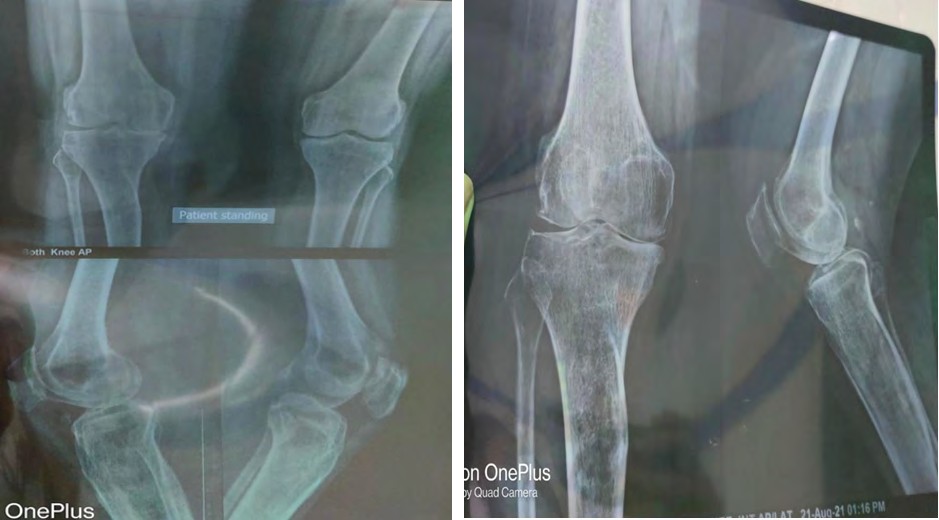
of Panchkaram, Rishikul campus. She has history of, hypertension since 5 years (on medication). There was neither history of diabetic, thyroid trauma nor other medical or surgical illness as well as no history of long use of steroids etc. for confirmative diagnosis she has advised to x-ray bilateral knee joint. His x-ray of bilateral knee joint reports marginal osteophytes, narrow joint space and degenerative changes. He was diagnosed with osteoarthritis of bilateral knee joint.
Patient has typical limping gait .on examination of bilateral knee joint skin over the knee joint normal, mild swelling visible over left knee joint which is confirm by positive patellar tap test, joint crepitation is palpable on joint movement associated with pain. Joint tenderness present over the medial side of bilateral knee joint.
During Dashavidha Aatur parikshaya examination patient was observed as, Prakruti-kapha-vata; Vikruti-vata predominant; Sara-Maas sara in pravara; Samhananna- madhyam; Pramana-madhyama; Satmya-madhyama; Satva-madhyama; Ahara Shakti-madhyama; Vyayam shakti- Avara; Vaya-madhyam[6] Samprapti ghataka-Nidana-Vata prakopaka nidan Dosha-Vata special vyanavayu shleshmak kapha; Dusya -Asthi, Majja, Meda Srotas-Asthivaha, Majjavaha Medovaha Agni-Vishmagni, Dhatwagni Manda, Rogamarga- Madhyama; Dosha marga-Marmasthinsandhi sadhyasadhyata-yapya/asadhya. After clinical and dashvidhaparikshya bhava examination patients is advised to take Janu basti with Sahcharadi taila followed by Dashmool kwath nadi swedana.
Materials and Methods
Present case study the following material is required for each therapy session (Table 1).
| Quantity | |||
|---|---|---|---|
| Mash flour | 2kg | ||
| Sahcharadi taila | 1lit. | ||
| Small piece of sponge | 1 | ||
| Patila | 1 | ||
| Dashmool kwath | 2lit. | ||
| Nadi Swedana yanta | 1 | ||
| Water | According to requirement |
Table 1: Session for Required Material.
Procedure of Janu basti
Firstly, Masha pisti (paste of masha powder) is prepared with sufficient amount of water. Than patient is asked to lie down in supine position with fully extension of knee Joint. Knee joint is properly exposed and gently abhyanga is done over the lower limbs. After this using the thick gram powder dough make a circular boundary wall with height of 4 Angula (approx.4inch) fix it firmly on the bilateral knee joints were the highest pain is present. Precaution should be taken for any oil leakage from basti yantra. Sahcharadi taila heated on warm water bowl because medicated oil not heat directly. Sahachradi taila is poured in the basti yantra up to the level of 2 Angula by using small piece of sponge. The temperature of oil to be maintained according to patient tolerance power. When oil becomes cool, remove it with cotton &again refill with warm oil. Uniform temperature should be maintained throughout the procedure. This procedure is carried out for 30 minutes than oil is drained out from basti yantra and boundary wall removed. After this gently circular massage
Observation and Results (Table 4)
will be done in bilateral knee joints. After this, Nadi swedana (10-15 min) will be done with Dashmoola kwtha over the both knee joints. In this case study two therapy session was given to the patient each therapy session of 7 days with 7 days of interval in between each therapy and assessment s was done before therapy session and end of therapy session.
Subjective Assessment criteria (Tables 2,3)
| Sandhi shoola/Pain on Walking | Crepitus | Sandhi Shotha/Swelling | |
|---|---|---|---|
| Small piece of sponge | 1 | ||
| Patila | 1 | ||
| Dashmool kwath | 2lit. | ||
| Nadi Swedana yanta | 1 | ||
| Water | According to requirement |
Table 2: Assessment of walking and swelling.
| Tenderness | Gait |
|---|---|
| No tenderness -0 | Free swinging no limp -0 |
| Patient complain pain on touch-1 | Limping gait with no additional support -1 |
| Patient withdraws joint on touch -2 | Limping gait with unilateral support -2 |
| Patient doesn't allow touching the joint -3 | Limping gait with bilateral support -3 |
Table 3: Tenderness/Gait.
| S.no. | Sub. Parameters | Before Treatment | After 1st Session | After 2nd session | |||
|---|---|---|---|---|---|---|---|
| 1 | Sandhi shool /pain | Rt. knee | Lt. knee | Rt. Knee | Lt. knee | Rt. knee | Lt. knee |
| 2 | 3 | 2 | 2 | 0 | 1 | ||
| 2 | Crepitus | 1 | 1 | 1 | 1 | 1 | 1 |
| 3 | Swelling | 0 | 1 | 0 | 0 | 0 | 0 |
| 4 | Tenderness | 1 | 1 | 0 | 1 | 0 | 0 |
| 5 | Gait | 1 | 1 | 1 | 1 | 0 | 1 |
Table 4: Parameters session.
All studied subjective parameters showed significant difference after 14days of treatment. Pain was significantly reduced whether tenderness was relieved completely. Walking performance of the patient was significant improvement. Swelling was significantly reduced in left knee joint. Crepitus and x-ray findings which are non-significant difference which may be due to short duration of the study.
In this case study not given any orally medicine in between two therapy session. After two therapy session some ayurvedic medicine prescribes to her patient (Table 5).
| S. No. | Treatment | Dose |
|---|---|---|
| 1 | Tab. Asthiposhak | 10D with milk after meal |
| 2 | Cup Shallaki | 400mg 1 BD after meal |
| 3 | Panchtikta ghrita guggul | 1 BD after meal with lukewarm water |
| 4 | Janubasti with nadi swedana | Janubasti with Sahcharadi taila Dashmool nadi Swedana |
Table 5: 15 days after completion of procedure.
Discussion
Osteoarthritis is types of chronic degenerative joint disorder which is characterized by breakdown of joint cartilage and underlying bone. The most commonly affected is the weight barring and largest joints of the body like hip joint, knee joints, shoulder joint, etc. the most common symptoms are joint pain and stiffness usually the symptoms progress slowly over years. This patient present case study, patient initially has severe joint pain with swelling and palpable crepitus. Diagnosed case of knee osteoarthritis bilateral knee joint. These clinical symptoms are closely related to janu sandhi gata vata. Sandhigata vata is a described as a Vatavyadhi in all Samhita & Sangrahagrantha. Various Aharaja, Viharaja, Mansika Sharirik Nidan are mentioned in Vatavyadi prakrana. Sandhi gata vata specially occurs in Vriddha avastha in which Dhatukshaya take place which leads to Vata prakopa. In between Vata and Asthi Ashraya Ashrayi Sambandha. That means Vata is situated in Asthi. Vitiated Vata destroy Sneha karam because Vata guna is just apposite to Snehana gunas. Due to diminished Sneha kha-vaigunya occurs in asthi which is responsible for the cause of sandhigata vata in weight barring joints especially in knee joints.
The word of Janu bati is formed by combination of two letters janu and basti this procedure unique in the sense comparing both Snehana and Swedana or it may be put this Snehyukta Swedna or Snighdha sweda. Snehana mainly act against Ruksha guna caused by vata and swedna mainly act against Sheeta guna. In Sandhigata vata mainly vitiated Vatadosha Ruksha guna. So For this we can use sahcharadi taila having Vata shamak and Vedanaasthapan properties.
Asthiposhak- Asthiposhak is a calcium supplement it is a good source of natural calcium. Calcium supplementation can play a valuable role in bone healthy throughout the life style it is work as an anti-inflammatory. Asthiposhak contain kukkutandatvak bhasma, Asthisankhrala, Arjuna, Shuddhalaksha, Amlaki, Aswagandha, Gudduchi, Shudha guggul, Bala, Babboola kwath. Shallaki possesses tikta, Madhura, and Kashaya rasa; guna of shallaki is ruksha ,laghu and tikshna ; vipaka is katu; virya is ushna; doshkarma kapha pitta shamaka. It is an herbal analgesic and anti-inflammatory and painkiller it also prevent loss of cartilage main contain Boswellia serrata extract [8]. Panchtikta ghrita guggul is a complex compound containing many herbs and guggul. Classical reference and clinical suggested. It is highly beneficial in the management of sandhivata [9].
In this case study patient initially has severe joint pain with swelling over the joint .after two session of Janu basti this symptom is significant relieved? Palpable joint crepitus also reduced after janu basti. Pain and tenderness is very extensive feature of Janu santhi gata vata. After two session of Janu basti this symptoms is significant alleviated. Nadi swedana is one among the thirteen types of Swedana indicated in the treatment of Vata vyadhi [7]. In this case study swelling and tenderness over the bilateral knee joint is completely relieved after Janu basti followed by Nadi swedana with Dashmoola kwtha. It may be due to the effect of Dashmoola because herbs included in Dashmoola Shothahara property [10].
Conclusion
Janu sandhi gata vata (knee osteoarthritis) is a debilitating affecting day to day activities. It is very prevalent musculoskeletal diseases in elderly people. It is chiefly caused by vitiated Vata dosha. This case study concludes that Sahchradi taila janu basti followed by Dashmool kwath Nadi swedana. The treatment should be cost effective, comfortable for the patient and nil or minimal side effect. The present case study sets an example in management of osteoarthritis of knee joint. It can improve quality of life of the patient.
References
-
Satyalakshmi K (2017) clinical naturopathy-yoga a manual for physician and students. 1st (Edn.), national institute of naturopathy pune, Chapter-34, pp: 385.
-
Pal CP, Singh P, Chaturvedi S, Pruthi KK (2016) Epidemiology of knee joint osteoarthritis in India and related factor. Indian J Orthop 50(5): 518-522.
-
Shastri K, Chaturvedi PG (2015) Agnivesha, dridabala charaka Samhita-vidyotani hindi commentary, part-2 chuakambha Bharati academy Varanasi, chapter chikitsa sthana 28/37, pp: 783.
-
Shastri K, Chaturvedi PG (2015) Agnivesha, dridabala charaka Samhita-vidyotani hindi commentary, part -2 chuakambha Bharati academy Varanasi, chapter chikitsa sthana 28/75, pp: 791.
-
Shastri K, Chaturvedi PG (2015) Agnivesha, dridabala charaka Samhita-vidyotani hindi commentary, part-2 chuakambha Bharati academy Varanasi, chapter chikitsa sthana 28/144, pp: 802.
-
Shastri K, Chaturvedi PG (2015) Agnivesha, dridabala charaka Samhita-vidyotani hindi commentary, part-1 chuakambha Bharati academy Varanasi, chapter Viman sthana 8/94, pp: 771.
-
Shastri K, Chaturvedi PG (2015) Agnivesha, dridabala charaka Samhita-vidyotani hindi commentary, part -2 chuakambha Bharati academy Varanasi, chapter chikitsa sthana 28/78, pp: 791.
-
Dev SA (2006) A Selection of prime Ayurveda plant drugs: ancientmodern concordance. New Delhi: Anamaya Publishers, pp: 113117.
-
Akhtar B, Mahto RR, Dave AR, Shukla VD (2010) Clinical study on sandhigata vata w.s.r. to Osteoarthritis and its management by Panchtikta Ghrita Guggulu. Ayu 31(1): 53-57.
-
Shastri K, Chaturvedi PG (2015) Agnivesha, dridabala charaka Samhita- vidyotani hindi commentary, part- 1chuakambha Bharati academy Varanasi 2015, chapter sutra sthana shadvirechanashatashriteeya adhyaya 4/38, pp: 91.
- Management of Ear Keloid with Ksharsutra: A Case Study
- Yoga and Global Sustainability: A Holistic Path to One Earth, One Health
- Autoimmune Diseases in Ayurveda: A Narrative Review with Classical and Modern Perspectives
- Management of Cluster Headache Associated with Pituitary Apophysitis by CERT (Chakrasiddh Energy Release Technique): A Case Report on Energy Rebalancing
- Zygophyllum Geslini Coss : Biochemicals and Antioxidant Activity
- Observations of a Beginner Vaidya