
Approach in Health-Forming Technologies Based on the Balancing Sensory Stimulation/Deprivation from the Environment
The Medicine of the near future will develop not only along the path of improving diagnostics, treatment, rehabilitation, but also through the development of technologies for the formation (promotion) of health, human enhancement, and work productivity. It is clear that, due to their highly specialized multimodal sensory sensitivity, living systems are flexibly and plastically remodeling, changing structure and function in a completely physiological manner. Therefore, an attempt was made to conceptually and experimentally test the possibility of balancing sensory stimulation and sensory deprivation in their close dependence on the circadian sleep-wake cycle. A group of examined individuals practiced a mandatory evening walk in the park area for 40-60 minutes for 15 days and sensory deprivation by turning off artificial lighting, television, computer, gadgets and any other sensory signaling streams in the evening, starting from 8:00 pm and until going to bed (10:00 pm). The Facial Action Coding System (FACS) was applied to classify, qualitatively and quantitatively evaluate the facial psychomotor reactions of a person in the dynamics of his emotional state and by this tool indirectly reflects the balance of the activating and rewarding systems. The results obtained suggest that after a 15-day course of “Balancing Sensory Stimulation/Deprivation” the examined individuals maintain a positive emotional state during virtual immersion in a safe environment in the morning after a night's sleep compared to baseline measurements. It is strategically important to optimize labor, work, educational activities, prevent overload and fatigue, it is necessary to ensure the formation of a balance of circadian sensory stimulation and deprivation in combination with activities that improve the architecture and quality of sleep.
Introduction
Life activity in modern technologically advanced communities is characterized by an increasing predominance of sensory and information overloads. An environment is artificially created that significantly determines the quality of life, individual and social behavior and experience, as well as morbidity and mortality.
Such a highly significant invention of mankind as urbanization, along with its advantages, gives rise to many detrimental factors affecting the body of the environment: a threat to the normal implementation of the territorial instinct and the instinct of self-preservation, excess sensory stimulation of various modalities, desynchronosis of circadian rhythms. For example, the auditory (sound) and visual (light) sensory stream perceived by the body literally bombards the analyzer (processor) centers, bringing not only informative communication signals, but also physical stimuli that create noise, which are by-products of technological development devoid of information content.
Thus, humans and animals are subject to sensory hyperstimulation or overload. Moreover, by the ingenious experiments of Donald O. Hebb and his collaborators [1, 2] it was shown that the reduction and/or monotony of sensory stimulation from the environment causes the formation of a number of symptoms, including illusions and hallucinations, mostly visual; weakening of attention, reaction and purposeful thinking; emotional disorders (anxiety; feeling of unreality; persecution mania; increased suggestibility, etc.) [3].
It is assumed that the behavioral and experiential changes that occur in states of sensory deprivation have a common neurophysiological mechanism with rearrangements provoked by sensory distortions and overloads [3]. In this state, an imbalance is established between the systems of activation, reward and motivation of the brain, accompanied by impaired emotional and cognitive activity, as well as somatic and autonomic disorders. According to Lindsley’s hypothesis, in order to protect against sensory overload and central fatigue, mental functioning should be optimal at moderate levels of external stimulation and balanced activation of the central nervous system, emotional, somatic and autonomic functional activity. Confirmation of this was obtained by application in experiments with sensory deprivation. Moreover, the exact mechanisms of cross-modal neuronal plasticity are still largely unknown. Obviously, the higher neuro-regulatory functions of the neocortex structures depend on the patterns of innervation of the thalamic nuclei, since most of the sensory information passes through the thalamus [4].
With central fatigue caused by labor, service, training and educational activities, it is necessary to eliminate the monotony and compulsion of the sensory influx and/or perform sensory deprivation. Sensory stimulation that induces the novelty effect has the potential to activate the reward system and increase motivation by changing the plasticity of mesolimbic and mesocortical interneuronal circuits. The physical nature of such rewarding and motivating stimulation can range from the most abstract cognitive imaginations to specific sensory signaling patterns [5].
To achieve a high level of professionalism, athletic performance or academic achievement, the individual is forced to exert as much effort and spend more time during the wakefulness period, contributing to an imbalance of sensory stimulation/deprivation. Therefore, there is a growing need for adequate recovery, for example, sports (athletic) recovery, which has become a mandatory part of any fitness program. Among the methods, recovery techniques, along with reflexology (massage), there are ice therapy (cryotherapy), compression, and also floating therapy. Floating therapy (REST – Restricted Environmental Stimulation Therapy; therapy based on the restriction of stimulation from the environment) is a technological innovation based on sensory deprivation [6].
Sensory deprivation radically restructures synaptic plasticity and reorganizes processing cortical and subcortical centers. Activity-dependent or experience- dependent neuroplasticity is especially pronounced in the somatosensory, visual and auditory sensory systems [7]. It is known that the existing competition between centripetal sensory streams plays an important role, especially in the visual cortex. Such competition between sensory inputs is necessary to induce large-scale changes in synaptic dynamics following sensory deprivation. The neuroplasticity of many topographic maps in the cerebral cortex, developed in childhood, persists in a mature organism, and competition between sensory inputs, accompanied by long-term potentiation (LTP) and/or long-term depression (LTD), continues to ensure the reorganization of cortical maps and in aging process [7].
The floating therapy technique is a unique experimental model for disconnecting sensory inputs, primarily from the gravity and tactility analyzer, by increasing the salinity of the water, saturating it with magnesium and thus creating zero buoyancy of the body. Gravity-tactile deprivation is especially beneficial for the musculoskeletal system. For the completeness of sensory deprivation, it is important to minimize or cancel the streams of visual and auditory, olfactory and temperature signaling. Flotation therapy can alleviate depression and reduce or alleviate chronic stress [8].
However, the “limited environmental stimulation method” can also lead to a variety of perceptual, cognitive and emotional symptoms, including hallucinations. Before being sent to the orbital station, astronauts are tested in such floating chambers. Complete sensory deprivation can make a person more susceptible to suggestion and is a serious mental harm [8].
In health-forming and health-saving technologies, it is important to take into account that in order to ensure a high degree of concentration of attention, focus, motivation, sensory perception and signal processing from the environment, short-term and long-term memory, and, in general, mental health, high-quality sleep of sufficient duration, continuity, intensity, characterized by completeness and completeness of cycles. However, the maintenance of adequate adaptogenic somatic and autonomic (homeostatic) functionality during the period of daily activity also depends on the quality of previous sleep. The reduced duration of the sleep period, the discontinuity and incompleteness of its cycles, desynchronization of the circadian biorhythm cause a failure in the high-precision coordination of the nervous and neuroendocrine regulatory mechanisms. Excessive work, work or educational activity against the background of chronic qualitative and quantitative sleep insufficiency is primarily based on an imbalance between sensory stimulation and sensory deprivation. Moreover, a lifestyle associated with chronic partial sleep loss is often combined with chronic stimulant use (eg. caffeine).
The main goal is to conceptually outline an approach in health-forming technologies based on balancing sensory stimulation/deprivation and to test it experimentally.
Method
Experimental testing of the conceptual approach was carried out on volunteers, practically healthy individuals (15 people in total) aged 19-22 years. A group of examined individuals practiced a mandatory evening walk in the park area for 40-60 minutes for 15 days and sensory deprivation by turning off artificial lighting, television, computer, gadgets and any other sensory signaling streams in the evening, starting from 8:00 pm and until going to bed (10:00 pm). Thus, we tested the experimental model “Balancing sensory stimulation/deprivation” in terms of its health-forming effect on individuals. All subjects voluntarily agreed to conduct tests for the qualitative and quantitative assessment of the expression of emotions during their virtual immersion in the surrounding space, simulating a conditionally safe environment. Video monitoring was carried out shortly after waking up from sleep in the morning hours (7:30 - 8:30 am), followed by image framing and the use of image series for The Facial Action Coding System (FACS) application. We obtained a quantitative result by measuring certain movements in areas of facial muscles (psychomotor reactions) and its comparison with background measurements in the afternoon and evening of the previous day. Statistical analysis was realized by use of ANOVA method with Student’s t-criterion utilization.
Results
The analyzed nature of psychomotor facial reactions of individuals demonstrates the predominance of facial movements in the area of muscle localization: m. zygomaticus major and m. buccinator (Figure 1) compared to background measurements.
The results obtained suggest that after a 15-day course of “Balancing Sensory Stimulation/Deprivation”, the examined individuals maintain a positive emotional state during virtual immersion in a safe environment in the morning after a night’s sleep.
Whereas, in the background measurements, the prevailing psychomotor reactions were manifested in the area of muscle localization: corrugator supercilii and orbicularis oculi.
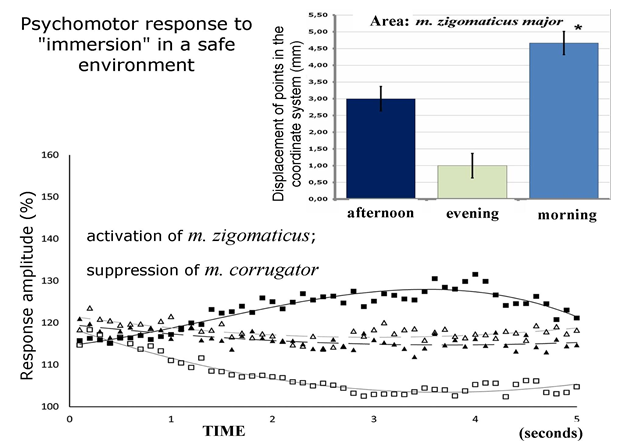
- m. zigomaticus major;
- m. buccinator;
- m. orbicularis oculi;
- m. corrugator supercilii (* - P < 0,05).
Conclusion
We postulate that it is strategically important to optimize labor, work, educational activities, prevent overload and fatigue, it is necessary to ensure the formation of a balance of circadian sensory stimulation and deprivation in combination with activities that improve the architecture and quality of sleep.
By adjusting the mode of daily activity and balancing sensory stimulation/deprivation, we can purposefully form the structural and functional architecture of the processing centers of the brain in an absolutely physiologically determined way. This neuro-modulatory technique is based on highly specialized sensitivity of regulatory centers to multimodal sensory signaling.
The FACS technique has significant potential to classify, qualitatively and quantitatively evaluate the facial psychomotor reactions of a person in the dynamics of his emotional state and by this tool indirectly reflects the balance of the activating and rewarding systems in a relaxed and non- invasive manner.
References
-
Hebb DO (1955) Drives and the C. N. S. (conceptual nervous system). Psychological Review 62(4): 243-254.
-
Hebb DO (1958) The motivating effects of exteroceptive stimulation. American Psychologist 13(3): 109-113.
-
Lipowski ZJ (1975) Sensory and Information Overload Behavioral Effects. Compr Psychiatry 16(3): 199-221.
-
Moreno-Juan V, Aníbal-Martínez M, Herrero-Navarro Á, Valdeolmillos M, Martini FJ, et al. (2023) Spontaneous Thalamic Activity Modulates the Cortical Innervation of the Primary Visual Nucleus of the Thalamus. Neuroscience 508: 87-97.
-
Komisaruk BR, Whipple B (1998) Love as sensory stimulation: physiological consequences of its deprivation and expression. Psychoneuroendocrinology 23(8): 927-944.
-
True Rest Float Spa (2022) Athletic Recovery Tool to Help Athletes Recover Faster. Flotation Therapy (aka sensory deprivation).
-
Finnerty GT, Connors BW (2000) Sensory deprivation without competition yields modest alterations of short- term synaptic dynamics. Proc Natl Acad Sci USA 97(23): 12864-12868.
-
Vessel EA, Russo S (2015) Effects of Reduced Sensory Stimulation and Assessment of Countermeasures for Sensory Stimulation Augmentation. NASA Center for Aero Space Information. National Technical Information Service, pp: 189.
- Management of Ear Keloid with Ksharsutra: A Case Study
- Yoga and Global Sustainability: A Holistic Path to One Earth, One Health
- Autoimmune Diseases in Ayurveda: A Narrative Review with Classical and Modern Perspectives
- Management of Cluster Headache Associated with Pituitary Apophysitis by CERT (Chakrasiddh Energy Release Technique): A Case Report on Energy Rebalancing
- Zygophyllum Geslini Coss : Biochemicals and Antioxidant Activity
- Observations of a Beginner Vaidya