
‘Nagori Ashwagandha’ (Withania Somnifera L. Dunal) A Miracle Root Herb for Arid Region of India: A Mini Review
Ashwagandha is an important hardy and drought-tolerant root medicinal herb. It is very important in terms of their immense health-promoting effects as well as from an economic point of view. It is a profitable venture for growing in sandy soils even in culturable wasteland and not preferred as a feed by wild animals. If appropriate region-specific cultivation of this plant can be done, that will have a huge impact on the quality and quantity of the raw materials. Nagori Ashwagandha (N.A.) can ensure a supply of good quality raw (long, thick, brittle and starchy roots) as well as formulated materials in both national and overseas markets. Integration of this selection into existing farming systems could be considered remunerative and will generate employment for local nomads involved in the collection and harvesting of Ashwagandha.
Introduction
Withania somnifera L. also known as Ashvagandha and Winter Cherry [1]. Withania refers to the ‘plants primary extract’ and somnifera means ‘sleep-inducing’. The name ashwagandha is derived due to two reasons. The root of the ashwagandha smell like a horse and person consuming extract of herb (root) may develop strength and vitality similar to horse. It is widely used as a tonic and a sedative in several countries due to its adaptogenic properties [2]. The part used is the dried root, traditionally used as a powder and dry extract [3]. It is an herb used in Ayurvedic medicine in the traditional system from a long back and the first time mentioned by learned Punarvasu Atreya over 4000 years ago [4]. Subsequently, the medicinal properties of this plant were mentioned in Ayurvedic treatises such as Charaka Samhita, Sushruta Samhita, Astanga Hridaya and Bhava Prakasha Nighantu [5]. Consumption of Ashvagandha root extract may develop strength and vitality similar to the horse [1]. Roots slow down the aging process and increase longevity, and mental as well as physical strength [6]. The root extract and powder has been traditionally used to promote youthful vigor, endurance, strength, health, and increasing the production of vital fluids, muscle fat, blood, lymph, semen and increasing sperm count [1]. Ashwagandha root extracts having active constituents and starch, reducing sugar, glycosides and dulcitol as neutral compounds [7]. The extract contains steroidal lactones called withanolides in concentrations between 1.5-5.0% [8]. Overall, my objective is to promote this particular local variety for commercial cultivation in fallow or unutilized land of central to western Rajasthan.
Crop Requirement
‘Nagori Ashgandha’ is a drought-hardy medicinal herb growing in semi-arid tropical areas receiving 500-750 mm rainfall [9]. Vast areas remain underutilized in western Rajasthan due to low fertility of the soil, water availability and scarcity of other resources. This crop is hardy, and least preferred by insect-pest and wild animals [10]. It requires a dry season during its growing period. One or two late winter rains are conducive for the proper development of roots [11]. Light textured, rich in organic carbon, 6-8 pH, soils with good drainage are preferred for its cultivation. Poor soils of central Rajasthan should be following proper Good Agricultural Practices (GAP) for improved crop harvest year after year. It grows better at 1000 m altitude. Temperature between 20°C to 35°C is most suitable for cultivation [12]. Ashwagandha is a late rainy season crop. The region lies in the desert, having extreme heat in summer and cold in winter. It requires late winter in the crop cycle for proper root development [11]. Soils of central Rajasthan are light textured like sandy to loamy type. Plants are naturally grown in this region as a weed with Gram, Wheat, Onion and Mustard in the Rabi season.
Phyto-Geographic Region and Crop Performance
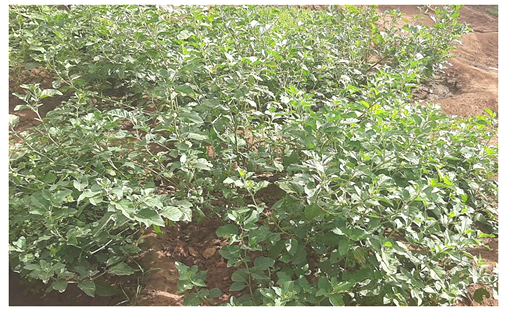
This species is widely distributed in north-western states of India particularly Rajasthan [3, 4, 5, 6, 7, 8, 9, 10, 11, 12, 13]. ‘Nagori Ashwagandha’’ roots have been of high value in comparison to the rest [14]. This ‘Nagori Ashwagandha’ naturally grows in Nagaur district and the boundary areas (Sikar, Jhunjhnu, Jodhpur, Bikaner and Churu) [15, 16]. It is a local variety/ landrace that dwells in a particular phytogeographic region differing from others in climate and edaphic characteristics [14]. It is a dense, hairy, erect, grayish-tomentose herb that grows up to a height of 1.5 meters (Figure 1).
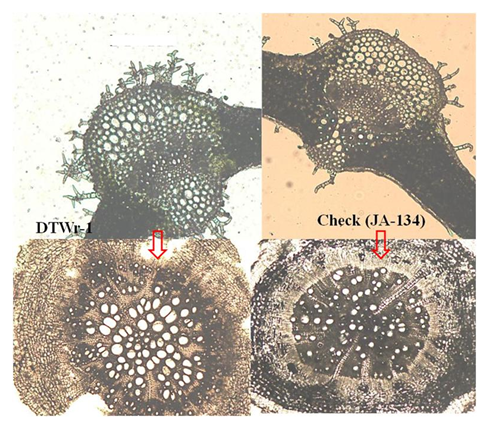
DTWr-1 was selected from the western Rajasthan (Nokha) could be a good option of Nagori type. All parts are covered with whitish, stellate trichomes as shown (Figure 2).
Leaves are simple and big, alternate or sub-opposite, ovate, entire, and bear on extensive branches. The flowers are greenish-yellow and found in a few flowered clusters in axils. Yellow Paper Wasp is a very useful pollinator in Ashwagandha. The first time was reported that during foraging for food supplies, especially nectar, the yellow paper wasps can simultaneously pollinate flowers (Figure 3). In case of N.A. root thickness are very high (5.1cm) under central Rajasthan due to edaphic and micro-climatic factors.
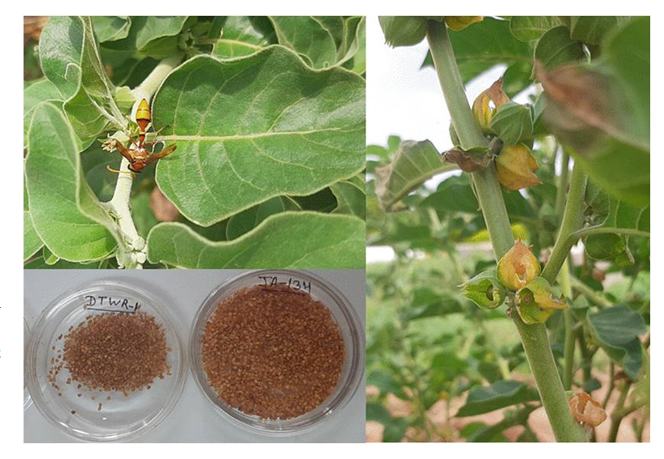
Figure 3: Pollinator Yellow Paper Wasps and damaged berries by Red vented Bulbul in DTWr-1 The fruit/berry of DTWr-1 is red in color at full maturity (Figure 4), smooth, and small (5-6 mm in diameter), enclosed in the inflated calyx which reaches more than 14-17 mm diameter, globose and slightly 5-angled. ‘DTWr-1’ generally has four to six berries set at one node and maximum of six to seven berries per node. Seeds are 2.0-2.5 mm in diameter.
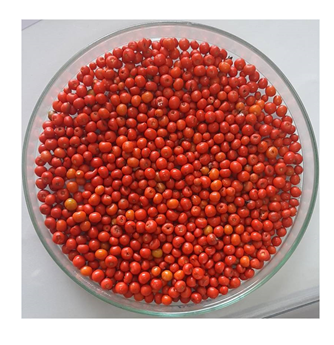
No. of seeds per berry is 19-25 as compared to the check (32- 35g). The herb grows indeterminately; therefore, mature berries from lower side to upward. The first time observed that these fully mature colored berries were eaten by the birds (Red-vented Bulbul) locally known as Goliya or Pincha (Figure 4).
The commercial value of the root depends on morphology or physical quality. Accession DTWr-1 has straight, thick (3-4 cm), un-branched, stout/fleshy, long tuberous (35-50 cm), fusiform and brittle roots especially in sandy soils of central to western Rajasthan [17] (Figure 5).
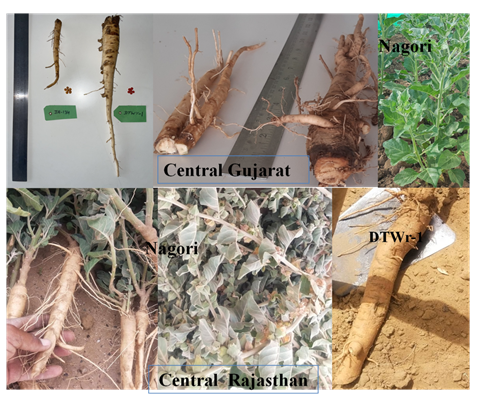
The N.A. has about 44-67 cm root length as compared to check (16-18cm). The morphology and physical quality of local variety was also supported [16, 18]. Superior quality of produce is obtained in this particular region. One of the most accepted quality parameters is long, thick, brittle and, starchy roots even at the crop maturity stage [18, 19]. The root weight of DTWr-1 was reported to vary from 440 g/ plant to 135 g/plant and in Nagori 448g to 129g/plant under central Rajasthan and central Gujarat, respectively [19] (Figures 5 and 6).
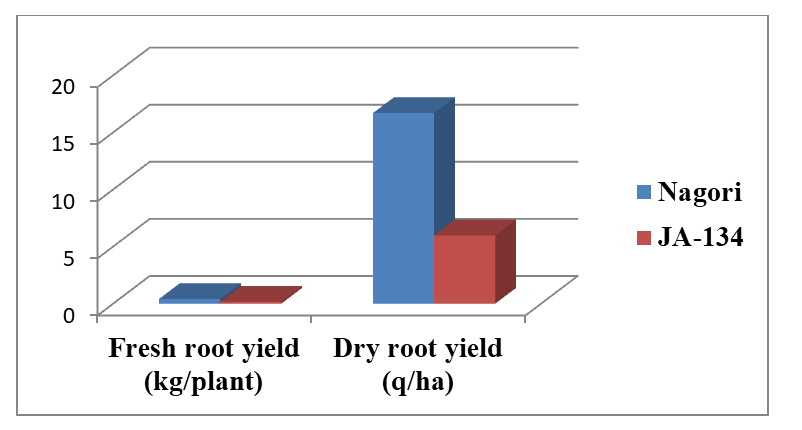
Therefore, region-specific cultivation of this accession has a huge impact on the quality and quantity of the raw materials. Over all the ‘Nagori Ashwagandha’ is supreme among all Ashwagandha varieties [20, 21].
Conclusion
A root plant with region-specific significant history is ‘Nagori Ashwagandha’ in central Rajasthan. All around the Globe, this root quality is prescribed as medicine for several health issues. New accession DTWr-1 has a high standard for physical root quality parameters even under Gujarat conditions at crop maturity. Besides this the first reports of preferred by pollinators to berry eating birds evident for quality of accession. The accession has unique berry size, seed weight and root traits as compared to the check. Overall, ‘Nagori Ashwagandha’ is potential local variety (farmer variety) for large scale cultivation in fallow or unutilized land of central to western Rajasthan for farmers’ sustainability. Still, there is room for further quality and agro-technological improvement in this crop.
References
-
Singh N, Bhalla M, Jager P, Gilca M (2011) An Overview on Ashwagandha: A Rasayana Rejuvenator of Ayurveda. Afr J Tradit Complement Altern Med 8(5): 208-213.
-
Verma PPS, Singh A (2014) Scientific Cultivation of Ashwagandha (Withania somnifera). Conference JIGYASA-2014 India.
-
Siddha Pharmacopoeia Committee (2008) Amukkara (Root). In: Siddha Pharmacopoeia of India, 1st (Edn), Department of Ayurveda, Yoga & Naturopathy, Unani, Siddha and Homoeopathy (AYUSH) 1(1): 1-3.
-
Rajeswara Rao BR, Rajput DK, Nagaraju G, Adinarayana G (2012) Opportunities and Challenges in the Cultivation of Ashwagandha (Withania somnifera L). Journal of Pharmacognosy 3(2): 88-91.
-
Charak Samhita (1949) Charaka. Shree Gulabkunverba Ayurvedic Society, Jamnagar, India.
-
Meena RP, Kalariya KA, Saran PL, Manivel P (2019) Evaluation of Ashwagandha (Withania Somnifera L.) Dunal Accessions and Breeding Lines against Leaf Spot Disease caused by Alternaria Alternate under Subtropical Condition of India. Journal of Applied Research on Medicinal and Aromatic Plants 14.
-
United States Pharmacopeia Convention (2013) Ashwagandha Root; Powdered Ashwagandha Root and Powdered Ashwagandha Root Extract. United States Pharmacopeia, 36th Revision (USP 36), Rockville, United States Pharmacopeial Convention, pp: 1336-1341.
-
Bone K, Mills S (2000) Principles and Practice of Phytotherapy: Modern Herbal Medicine. Churchill Livingstone, Edinburgh, pp: 643.
-
Kumar RR , Reddy LPA, Kumar AN, Komaraiah K, Purnanand S, et al (2011) Root Textural Quality in Ashwagandha (Withania somnifera) as Influenced by Crop Growth Periods and Morphotypes. Industrial Crops and Products 34(1): 1231-1234.
-
Meena RP, Kalariya KA, Saran PL, Roy S (2019) Efficacy of Fungicides and Biocontrol agents against Pythium Aphanidermatum causes damping off disease in Ashwagandha (Withania somnifera L. Dunal). Medicinal Plants 11(4): 404-409.
-
Meena LK, Gupta AK, Patel J, Khan MY, Kumar S (2020) Ashwagandha (Withania somnifera L.). Medicinal Plants in India: Importance and Cultivation. 1st (Edn.), Jaya publishing house, Delhi, India.
-
Anonymous (2022) Withania Somnifera Linn. Dunal Syn. Physalis Somnifera Linn.
-
Indian Drug Manufacturers Association (2002) Indian Herbal Pharmacopoeia. Revised New Edn Mumbai, India, pp: 467-478.
-
Bhandari MM (2005) Shrubs-The Saviours of Desert Ecosystem. Arid Agro-ecosystem Directorate Central Arid Zone Research Institute Jodhpur, India.
-
Ved DK, Goraya GS (2008) Demand and Supply of Medicinal plants in India. Bishen Singh Mahendra Pal Singh, Dehra Dun, India.
-
Khare CP, Naharwar AV (2020) Ashwagandha (Withania somnifera (L.) Dunal): A Scientific Review with respect to Ayurvedic perspectives. Annals of Phytomedicine 9(2): 134-141.
-
E Annual Report (2022) Research Achievements, ICAR- DMAPR, New Ashwagandha accessions.
-
Singh RS (1983) Ashwagandha. Vanaushadhi Nidharsika (Ayurvedic Pharmacopeia) UP Sansthan, pp: 30-31.
-
Saran PL (2023) Real Quality of Starch Rich Brittle Ashwagandha for Aphrodisiac purpose.
-
Misra HO, Sharma JR, Lal RK, Sharma S (1998) Genetic variability and path analysis in Ashwagandha (Withania somnifera). Journal of Medicinal and Aromatic Plant Science, 20: 753-756.
-
Saran PL (2023) Ashwagandha miracle Nagori having high root yield.
- Management of Ear Keloid with Ksharsutra: A Case Study
- Yoga and Global Sustainability: A Holistic Path to One Earth, One Health
- Autoimmune Diseases in Ayurveda: A Narrative Review with Classical and Modern Perspectives
- Management of Cluster Headache Associated with Pituitary Apophysitis by CERT (Chakrasiddh Energy Release Technique): A Case Report on Energy Rebalancing
- Zygophyllum Geslini Coss : Biochemicals and Antioxidant Activity
- Observations of a Beginner Vaidya