
Quality of Sleep and the Ayurvedic Concept
All humans require sleep for their physical, physiological and psychological needs. Additionally, it is a necessary daily activity for maintaining good health. In preparation for the next phase of alertness, sleep gives the body’s systems time to repair and heal. sleep is more than just a period of physiological quiescence; it is complicated, regular, repeated and easily reversible condition. Lack of sleep can cause a variety of medical and mental issues because it directly affects the activities of the heart, lungs, digestive system and muscles. Defects in sleep quality can lead to emotional, cognitive and motivational dysfunction. Tiredness, lack of focus, exhaustion, a low pain tolerance, anxiety, anxiousness, irritational thoughts, hallucinations, loss of appetite constipation and being more accident prone are physical and cognitive signs of poor sleep quality. According to Ayurveda a person’s life is based on the three pillars of Aahara, Nidra and Brahmacharya. Adults need between seven to eight hours of sleep per night to feel rested. it is vitally necessary to get a restful night’s sleep. In actually, it is equally crucial to our bodies as food. According to research, prolonged sleep deprivation or poor-quality sleep increases the risk of illnesses such as high blood pressure, cardiovascular disease, diabetes, depression, and obesity.
Introduction
Sleep occupies one quarter to one third of human lifespan. Prior to the 1950s, the majority of people thought sleep was a passive activity in which the body and brain remained inert. “But it turns out that sleep is a period during, which the brain is engaged in a number of activities necessary to life—which are closely linked to quality of life,” explains a sleep researcher at Johns Hopkins University [1]. Quality sleep, and receiving enough of it at the correct times, is just as important for life as food and water. Without sleep, your brain cannot establish or maintain the neural pathways that allow you to learn and generate new memories, and it is more difficult to focus and respond swiftly.
When Tamas Guna, one of the Trigunas of mind that creates ignorance, predominates with Kapha, the seat of Chetana is covered and sleep occurs [2]. When the mind and soul are fatigued or cease to operate, as well as the sensory and motor systems, the individual falls asleep. Tamas is a term used to describe sleep [3]. When Tama naturally predominates at night and the mind and intellect are thoroughly relaxed, sleep occurs. Sleep happens when the mind loses contact with the sense organs due to exhaustion and Srotas build up in the Kapha [2].
Definition of Sleep
Acharya Sushruta described the sleep occurs when the Hridaya, the seat of Chetana is covered by Tamas [4].
Sushruta’s commentator Acharya Dalhan says that - Sleep is that state of the union of mind and intellect in which a person experiences happiness [5]. According to Astanga Sangraha commentary, which states that when an individual fall asleep, Manovaha Srotas become accumulated with Sleshma, and the mind is devoid of sense organs because of fatigue [6].
Regulation of Sleep
Sleep is regulated by two basic mechanisms, according to Wu: circadian rhythms and sleep drive. A biological clock housed in the brain regulates circadian rhythms. One important function of this clock is to respond to light signals by increasing the synthesis of the hormone melatonin at night and then turning it off when it detects light. People who are completely blind typically have difficulty sleeping because they are unable to notice and respond to these light signals.
Sleep drive is also important: our body desires sleep, just like it craves food. During the day, urge for sleep increases, and person fall asleep when it reaches a particular point. Rapid Eye Movement (REM) sleep, which is a naturally occurring repeating state of mind and body, is characterized by altered consciousness, somewhat inhibited sensory activity, decreased muscle activity, and fewer interactions with the environment [7]. When the mind is exhausted and the exhausted sense organs detract from their objects, the man sleeps said by Acharya Charaka [8]. According to Ayurveda, the three constitutional types, or Doshas, govern sleep and other physical functions. Vata, Pitta, and Kapha the three Sharirik Doshas, and Raja,Tama as Mansik dosha. Kapha governs sleep, which results in the heaviness of exhaustion. Nidra is dominated due to Kapha (Sharirik Dosha) and Tama (Mansik Dosha) [9].
According to Bhela samhita - As a mood of dullness (Tamasi) overcomes the mind (Satva) at the decline of the day, the sense organs of the individual start then to take rest, heavily . And, as the food eaten starts getting digested and approaches the heart because of the (ensuing, increased Dosha of) Slesma and the channels for the eyes and the ears get blocked from being open, the day gets cut off from the creatures and so are their actions and the various activities (Karma Kriya) because of the feet (i.e. the rays) of the sun cut off withdrawn removed away from the respective the body and the mind and activities as well as consciousness become lost or over, a mood of languidity (Tandra) enters [10].
It is in this way that what is called sleep gets generated in all creatures, that removes brooding over, grief and tiredness and that was ordained by Brahma (the God of creation) in the olden days. For this man who is sleeping, in his body the (breath) Prāna and Apana along with the body heat are active and he is accompanied with life . What he experiences of them (i.e., the senses and the mind, mentioned below) as being visible when his senses have ceased to function and the mind has gone to rest. Know that as being what is called a dream. he gets into conversation with manes, gods and persons and by changes in dreams he also secures to himself whatever great things he desires [10].
Physiology of Sleep
Sleep itself is not a homogeneous process. There exist two fundamentally distinct types of sleep: rapid eye movement (REM) sleep,which is associated with active dreaming and non -rapid eye movement(NREM) Sleep. Switches between NREM and REM sleep appear to be controlled by reciprocal inhibition between monoaminergic neurons within the brainstem. These “ REM-on” cholinergic neurons exhibit reciprocal inhibitory connections to nonadrenergic and serotonergic neurons. When REM sleep is triggered, REM- on cholinergic neurons become maximally active, while noradrenergic and serotonergic neurons become virtually silent. The switching between activity and inhibition of these neurons results in a characteristic cycling between NREM and REM during the sleep period [11].
Sleep Inducing Factors
Massage, anointing, bath, meat soup of domestic, marshy and aquatic animals, rice with curd, milk, fat, wine, mental ease, pleasant smell and sound, gentle rubbing saturating drops and paste on eyes, head and face, well-covered bed, comfortable room and proper time- these bring shortly the sleep which is disturbed by some factor [12].
Sleep Reducing Factors
Purgation, evacuation of head, emesis, fear, anxiety, anger, smoking, exercise, blood- letting, fasting, uncomfortable bed, predominance of Satva and subduing Tamas- these check the unwholesome and excessive occurrence of sleep. These very factors may be taken of insomnia, along with (over) work, time, old age disorder (Vatika) and aggravation of Vata itself [13].
Types of Sleep According to Ayurveda
Different opinions of various Acharya’s- According to Acharya Charaka there are 6 types of Nidra- Tamobhava, Shleshma-samudbhava, Manah-sharir-shrama-
sambhava, Aagantuki, Vyadhyanuvartini, Ratrisvabhava- prabhava [12]. According to Acharya Sushruta there are 5 types of Nidra- Vaishnavi Nidra, Tamsi Nidra, Tamobhuyishtha Nidra, Satvabhuyishtha Nidra, Vaikariki Nidra [4]. According to Acharya Vagbhatta there are 6 types of Nidra- Kalasvabhawajanya Nidra, Aamayjanya Nidra, Chitta- khedajanya Nidra, Kaphajanya Nidra, Aagantu Nidra, Tamobhava Nidra [14].
Effect of Dosha on Sleep (Nidra)
During the period of sleep, each individual will not experience the same type or pattern of sleep. As each individual is different and can experience similar yet non- identical type of sleep [15].
Vata
Inconsistent and brief sleep cycles. A Vata person would, nevertheless, benefit from getting more sleep. Sleep chatting, sleep walking, and teeth grinding are all common symptoms, dreams frequently have an airy quality; he may imagine himself soaring, Vata personality types tend to sleep lightly, so they can easily wake up in the middle of the night and have trouble falling back to sleep. Vata dominant people frequently require 6-7 hrs. of sleep .
Pitta
Pitta prakriti people will have restful yet mild sleep. Although they typically get a moderate quantity of sleep,they frequently skip out on it when they are busy. dreams are frequently ferocious, vivid and wild. It is not difficult to go back to sleep after awakening during the night. However, it will be challenging to fall back asleep if the mind is hyperactive and agitated. People that are Pitta dominant frequently need 7-8 hours of sleep.
Kapha
Person will have restful sleep yet feel weighty and unyielding. Meaning that even if they don’t need to sleep for lengthy stretches of time,if they are not disturbed or awakened, they have a tendency to oversleep. Kapha individuals require 8 to 9 hours of sleep.
Requirement of sleep in Sattvika, Rajasika and Tamasika persons are [16]
| Sattvika Person | 4-6 hrs sleep |
|---|---|
| Rajasika Person | 8 hrs of sleep |
| Tamasika Person | 10-12 hrs of sleep |
Circadian Cycle
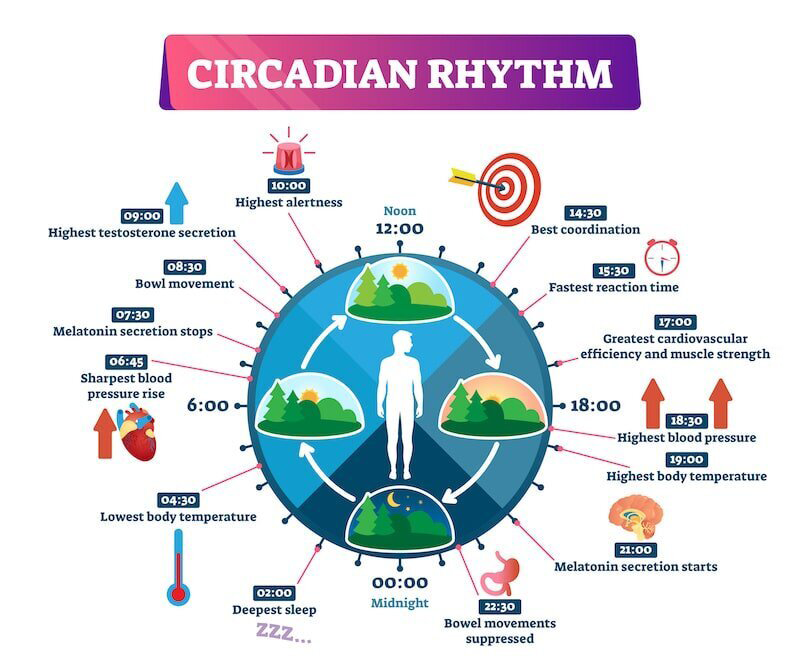
A circadian rhythm is a natural process that takes place throughout every day. In humans, circadian rhythms are the approximate 24 - hour pattern the body and brain go through, allowing for changes in the body’s physical and mental states, along with mood and behavioral changes [17].
The phrase circadian is derived from two Latin words, circa (approximate) and dies (day), and denotes “one day” approximately. Circadian rhythm, also known as the biological/circadian clock, refers to behavioral, physiological, and biochemical changes that occur every 24 hours. The circadian clock is divided into two parts: the central clock, which is located in the hypothalamic suprachiasmatic nucleus (SCN) and receives light cues, and the peripheral clocks, which are located in numerous tissues throughout the body. Peripheral clocks perform an important and distinct role in each of their different tissues, directing the circadian expression of specific genes involved in a wide range of physiological tasks.
The circadian timing system, often known as the circadian clock, is important in a variety of biological activities, including the sleep-wake cycle, hormone secretion, cardiovascular health, glucose homeostasis, and body temperature regulation. Energy balance is also one of the most critical pillars of metabolic processes, and it has been linked to a variety of disorders (including obesity, diabetes, and cardiovascular disease). The major regulator of metabolism is the circadian clock, and this analysis gives an overview of the bidirectional effect of circadian rhythm on metabolic processes and energy balance.
The circadian timing system, also known as the circadian clock, is important in many biological processes, but the rise in activities that run around the clock, as well as the widespread use of television, the internet, and mobile phones virtually 24 hours a day, has resulted in a disruption. According to recent research, long-term circadian disruptions are associated with many pathological conditions such as premature mortality, obesity, impaired glucose tolerance, diabetes, psychiatric disorders, anxiety, depression, and cancer progression, whereas short-term disruptions are associated with impaired wellness, fatigue, and loss of concentration. In this review, the circadian rhythm in metabolic processes and their effect on energy balance were examined. The pineal gland receives adrenergic innervation, which activates a cascade of circadian events that leads to nightly formation of melatonin from serotonin. Serotonin is present at high levels in the pineal gland during the day and increases further at night in the absence of melatonin formation.
Guidelines For Better Sleep (According to AASM American Academy of Sleep Medicine) [18]
- Age 4-12 months : 12-16 hrs (including naps).
- Age 1-2 years : 11-14 hrs (including naps).
- Age 3-5 years : 10-13 hrs (including naps).
- Age 6-12 years : 9-12 hrs.
- Age 13-18 years : 8-10 hrs
According to Ayurveda Guidelines to Enhance Good Sleeping: (According to Kaiyadeva Nighantu) [19]
- Use a soft, cozy bed that is at least as wide as you knee. Turn right, Padavakuvarno, and proceed eastward in the direction of the gurus. The heart should resemble like a lotus and facing downwards. It develops while awake and stops while sleeping. The subtle state of memory is deep sleep of mind, speech, senses and soul. It is the source of the origin of the worlds and the origin of darkness and is full of darkness.
- Sleep at night comes almost due to excess of darkness. when we are fatigued and in mucus covered springs, sleep enters the body through the senses. The place of consciousness of bodies, Sushruta ! has liberated the heart. When the sun rises, Sleep takes over. It is said to be cause of darkness, the cause of Satva, the cause of awakening. Or perhaps nature itself is significant, because when night fell, the quality of deeds improved. The soul is believed to be asleep even when it is not. When the intellect and all senses are gone, he then sees his dream in various ways. Those who have had sleeping experiences of the prior body are under the control of their body soul .with a mind full of dust he takes the meaning of good and bad.
- Lying down in an easy posture on a comfortable bed removes the fatigue, pacifies or soothes Vata Dosha, brings sleep and Dhriti (lost recollection to the mind ), and is much aphrodisiac and conductive for the growth of the body, conversely, if lying down in a contrary manner leads to contrary results. Sleeping at cot mitigates all the three Doshas ( Vata, Pitta, Kapha ) at swing mitigates the two Doshas, Kapha and Vata, at the ground makes the body stout and works as an aphrodisiac, while at wooden planks aggravate Vata Dosha. In general sleeping on the ground is preferred, and some authors opine that it causes great increase of Vata and dryness, but mitigates aggravation of Pitta and Rakta (blood).
- Samvahana (mild massage) is tranquilizing, pleasant and aphrodisiac. It destroys the bodily Kapha and Vata Doshas, removes the fatigue and soothes the skin, blood and muscles.
Benefits of Good Sleep [20]
- Happiness and unhappiness, corpulence and leanness, strength and weakness, potency and impotency, intellect and non-intellect, life and death all depend on getting enough sleep.
- sleep deprives happiness and life like any other death night when it is noticed too late, excessively or negatively.
- When correctly noticed, the same brings satisfaction and vitality, much like the realization of pure wisdom that grants accomplishment to a yogin.
- As wholesome diet is needed for maintenance of body so is the sleep. Obesity and leanness are particularly caused by sleep and diet
Health Consequenses of Anidra [21]
Due to lack of quality and quantity of sleep symptoms that usually appear in a person are
- Angamarda.
- Shirogaurava.
- Jrambhika.
- Bhrama.
- Glani.
- Tandra.
- Vataj roga.
Discussion
By day-sleep in seasons other than summer, Kapha and Pitta are vitiated, hence day-sleep is not indicated in those seasons. The obese, those having regular fatty diet, plenty of Kapha, Kaphaja disorder and suffering from latent poisons should never sleep during day [22]. Halimaka, headache, cold sensation, heaviness in body parts, body ache, loss of appetite and digestion, plastering of heart, edema, anorexia, nausea, rhinitis, migraine, urticarial patches, pustules, boils, itching, drowsiness, cough, disorder of throat, derangement of memory and intelligence, obstruction of channels, fever, incapability of sense organs, intensity in effect of poisons – these occur by indulgence in unwholesome day-sleep, hence, the wise after knowing the wholesomeness and unwholesomeness of sleep, should sleep happily [23]. Night -vigil is rough while day-sleep is unctuous; sitting is non- rough while movement is non-blocking.
The activities of Agni, or the digestive process, are also closely tied to appropriate Nidra, and bowel and bladder evacuation are normal and timely in a person who sleeps well, which helps to sustain a long Ayu. Bad habits, on the other hand, such as Diva-Swapana, or midday slumber, and Ratri Jagarana, or night time awakening, excite and vitiate all three Doshas, resulting in a variety of diseases.
Those who are emaciated on account of singing, reading, drinking, evacuative therapy, sexual intercourse, weight-carrying and travelling on foot, having indigestion are injured, old, children and women suffering from thirst, diarrhoea, colic pain, dyspnoea and hiccup; are lean, fallen, wounded and insane, exhausted by journey and vigils and also by anger, grief and fear and are equilibrium of Dhatus and strength, Kapha nourishes their body parts and their life-span becomes stable. In the summer season, because of roughness due to Adana, aggravation of Vayu and shortness of nights, day-sleep is recommended [24].
Conclusion
Sleep is very much essential for maintenance of good health. The scope and importance are so greatly attached with an individual’s entire life span that it can either lift the life to the sky or make it unhappy. To maintain our health and cure diseases, we must get enough sleep at the right times. Sleep quantity and quality are both important.
Nidra is the state where our body and mind both are at rest condition. Good health, long life, wellness, strength, virility, wisdom depends on Nidra. Apla Nidra or Nidranasha manifests so many diseases. Nidra is considered as one among Troyoupastambha, which gives support to the body like pillars.
Sound sleep nourishes the body it doses Brumhana of the body. It rejuvenates the body, it is Vrushya, it gives Bala, Pusti and Tusti [Bala means strength, Pusti means nourishment of the body and Tusti means satisfaction of the mind.] For maintaining the health and to cure the diseases we have to take proper sleep at proper time. Quantity and quality of sleep both are important.
References
-
Johns Hopkins Medicine Health. Wealth & Prevention.
-
Shastri KN, Chaturvedi GN (2004) Agnivesha’s Charaka Samhita, Vidyotini Commentary. In: Chikitsasthana, Chaukhamba Bharati Academy, Sutrasthan, Varanasi, India, 21.
-
Shastri KN, Chaturvedi GN (2004) Agnivesha’s Charaka Samhita, Vidyotini Commentary. In: Chikitsasthana, Chaukhamba Bharati Academy, Sutrasthan, Varanasi, India, 21/35.
-
Jadavji T, Samhita S (1994) Dalhana Nibandha Sangraha. Chaukhambha Subharati. Varanasi, India, 4/33.
-
Jadavji T, Samhita S (1994) Dalhana Nibandha Sangraha. Chaukhambha Subharati, Varanasi, India, S1/25:6.
-
Trippathi R (1996) Astanga Sangraha. Choukhambha Sanskrit Pratishthan.,Varanasi, India, 9/39:197.
-
Reddy S, Reddy V, Sharma S (2023) Physiology, Circadian Rhythm. Stat Pearls Publishing, Treasure Island.
-
Shastri KN, Chaturvedi GN (2004) Agnivesha’s Charaka Samhita, Vidyotini Commentary. In: Chikitsasthana, Chaukhamba Bharati Academy, Sutrasthan, Varanasi, India, 21.
-
Shastri KN, Chaturvedi GN (2004) Agnivesha’s Charaka Samhita, Vidyotini Commentary. In: Chikitsasthana, Chaukhamba Bharati Academy, Sutrasthan, Varanasi, India, 1/57.
-
Bhela C (2000) Bhela Samhita. Translated by Krishnamurthy KH, In: Sharma PV (Ed.), Chikitsa Sthana Chowkhamba Vishwwa Bharati, Varanasi, India, 13/3.
-
Brinkman JE, Reddy V, Sharma S Physiology of Sleep. Stat Pearls.
-
Shastri KN, Chaturvedi GN (2004) Agnivesha’s Charaka Samhita, Vidyotini Commentary. In: Chikitsasthana, Chaukhamba Bharati Academy, Sutrasthan, Varanasi, India, 21/52-53.
-
Shastri KN, Chaturvedi GN (2004) Agnivesha’s Charaka Samhita, Vidyotini Commentary. In: Chikitsasthana, Chaukhamba Bharati Academy, Sutrasthan, Varanasi, India, 21/55-57.
-
Atridev KG, Rajvaidya (2002) Vagbhata; Astanga Samgraha with hindi commentary. In: Sutrasthan, Pandit Sri Nanda Kishor Sharma Bhisagacarya (Edn.), Krishnadas Academy, Varanasi, Vol 1, Krishnadas ayurveda series-31.
-
Shastri KN, Chaturvedi GN (2004) Agnivesha’s Charaka Samhita, Vidyotini Commentary. In: Chikitsasthana, Chaukhamba Bharati Academy, Sutrasthan, Varanasi, India.
-
Ranade S, Deshpande RR, Bobade RB (2009) A textbook of Swathavritta. Chaukhamba Sanskrit Pratishthan, Delhi, India, pp: 40-41.
-
Circadian Rhythms.
-
Sateia MJ, Buysse DJ, Krystal AD, Neubauer DN, Heald JL (2017) Clinical Practice Guideline for the Pharmacologic Treatment of Chronic Insomnia in Adults: An American Academy of Sleep Medicine Clinical Practice Guideline. J Clin Sleep Med 13(2): 307-349.
-
Sharmaand P, Sharma G (2009) Kaiyadeva Nighantu, Viharavarga, Sutra (Pathyapathya-vibodhaka). Chaukhamba orientalia, Varanasi, India, 340-345.
-
Shastri KN, Chaturvedi GN (2004) Agnivesha’s Charaka Samhita, Vidyotini Commentary. In: Chikitsasthana, Chaukhamba Bharati Academy, Sutrasthan, Varanasi, India, 21/36-38.
-
Murthy KR, Srikantha (2013) Vagbhatt’s Ashtanga Hridayam. Sutrasthan (Edn.), Chowkhamba Krishnadas Academy, Varanasi, India, 7/64, pp: 121.
-
Shastri KN, Chaturvedi GN (2004) Agnivesha’s Charaka Samhita, Vidyotini Commentary. In: Chikitsasthana, Chaukhamba Bharati Academy, Sutrasthan, Varanasi, India, 21/44-45.
-
Shastri KN, Chaturvedi GN (2004) Agnivesha’s Charaka Samhita, Vidyotini Commentary. In: Chikitsasthana, Chaukhamba Bharati Academy, Sutrasthan, Varanasi, India, 21/46-49.
-
Shastri KN, Chaturvedi GN (2004) Agnivesha’s Charaka Samhita, Vidyotini Commentary. In: Chikitsasthana, Chaukhamba Bharati Academy, Sutrasthan, Varanasi, India, 21/39-43.
- Management of Ear Keloid with Ksharsutra: A Case Study
- Yoga and Global Sustainability: A Holistic Path to One Earth, One Health
- Autoimmune Diseases in Ayurveda: A Narrative Review with Classical and Modern Perspectives
- Management of Cluster Headache Associated with Pituitary Apophysitis by CERT (Chakrasiddh Energy Release Technique): A Case Report on Energy Rebalancing
- Zygophyllum Geslini Coss : Biochemicals and Antioxidant Activity
- Observations of a Beginner Vaidya