
A Comparative Study of Dashmoola Taila Nasya and Shirodhara in Vatika Shiroroga (Tension Headache)
Introduction: The modern man must cope with a variety of difficulties, strains, stressors and anxieties. Irregular and unnatural eating habits, repressing natural cravings, inadequate sleep and a lack of downtime are inseparable components of our routine that drain the body's energy and eventually result in disease. Excessive crying, anguish, fear and terror have all been linked to its aetiopathogeneses. One such psycho-somatic illness that is comparable to Vatika Shiroroga as mentioned in Ayurvedic writings is tension headache. The most typical form of chronic, recurrent head discomfort is a tension headache. Episodic TTH and Chronic TTH are its two types. It is one of the ailments for which patients most regularly seek medical advice. Since the beginning of time, countless analgesics have been introduced to the armoury of the contemporary doctor only to demonstrate their worthlessness. Thus, with the intention of identifying and creating an alternative, safer, effective and long-lasting therapy, the study titled. Objectives: A Comparative Study of Dashmoola Taila Nasya and Shirodhara in Vatika Shiroroga (Tension Headache). Methods: Trial was carried out on 60 patients. They were divided randomly into two groups of 30 patients each. The treatments were successfully completed by 29 patients in Group A (Nasya Karma with Dashmoola Taila) and 27 patients in Group B (Shirodhara with Dashmoola Taila). The treatment lasted a total of 27 days. Follow-up was conducted one month after the trial's conclusion. Result: Although both therapies were approximately equally beneficial, "Group B" performed better than "Group A" on the basis of percentage relief.
Introduction
One of the most prevalent ailments of the nervous system is recurrent headache. It can be due to disease like migraine, TTH (tension-type headache) and cluster headache which are characterized by the presence of painful and incapacitating headache [1]. The modern man must cope with a variety of difficulties, strains, stressors and anxieties. Regular and unnatural eating habits, repressing natural cravings, inadequate sleep and a lack of downtime are inseparable components of our routine that drain the body’s energy and eventually result in disease. Most psychosomatic disorders are caused by a combination of these physical elements and persistently stressful psychological states. Excessive crying, anguish, fear and terror have all been linked to its etiopathogenes [2]. One such psycho-somatic illness that is comparable to Vatika Shiroroga as mentioned in Ayurvedic classics is tension headache. Episodic TTH
(tension-type-headache) and Chronic TTH are its two types. TTH refers to frequent headache, that can linger for days or weeks. The discomfort is often mild to moderate in intensity, bilateral, and pressing or tightening in nature. It does not get worse with regular physical exercise. In most cases, nausea and vomiting are absent, but there may be phonophobia or photophobia. Adults often get headaches and females are more common than man [3]. Young people above the age of 20 are more likely to experience it. Onset rarely occur at or after the age of 50.
In Ayurveda, Acharya Charaka identified five different varieties of Shiroroga, including Vataja, Pittaja, Kaphaja, Tridoshaja and Krimija in Sutra Sthana and four different types of Shiroroga, namely Suryavarta, Anantavata, Ardhavabhedaka and Shankhaka, are found in Sidhhi Sthana [4]. Acharya Sharanagadhara and Vagbhatta have classified ten types of Shiroroga, in contrast to eleven types of Shiroroga mentioned by Acharya Sushruta, Bhaishajyaratnavali, Yogaratnakara [5, 6, 7, 8, 9]. Acharya Bhavamishra had mentioned 11 types and its management in the 60th chapter of Uttrardha [10]. According to the International Headache Society, 46% of the global population has an active headache disorder, 11% has migraine, 42% has tension type headache and 3% has chronic daily headache [11].
Though modern therapeutics offers a wide range of medications, including tricyclic antidepressants (citalopram, escitalopram, paroxetine etc.), non-steroidal anti- inflammatory (NSAIDs) drugs (ibuprofen, naproxen sodium, diclofenac etc.) for the treatment of this disease, their side effects are severe.
Nasya
Almost all Acharyas recommend Nasya for the management of Vatika Shiroroga (Tension headache). A medication injected through the nose enters the body and goes into the Shirah and expels out the vitiated Doshas. The Nasika is thought to be the Shirah’s entryway [4]. Hence it is the finest approach to eradicate Shirah Doshas. As a result, Nasya therapy plays a crucial role in the treatment of Shiroroga.
Shirodhara
It is a Panchakarma process that calms the mind and relaxes the entire physique [12]. Shirodhara has been shown to be effective in the treatment of Vatika Shiroroga. Shirodhara is an extremely powerful Panchakarma treatment for balancing the Vata Dosha and improving brain function.
As indicated in the Bhaishjayratnawali the efficacy of the “Dashmoola Taila” in every Shiroroga is widely established.
Pain (Shoola) is caused by Vata Dosha [13]. The Taila preparation “Dashmoola Taila” is the most potent Sneha for the Vata Dosha. As a result, Dashmoola Taila is chosen for Shirodhara to assess its involvement in Vatika Shiroroga (tension headache). To compare the effects of Nasya karma and Shirodhara on tension headache. Patients were followed up on a regular basis between sittings and one month after the all-treatment procedure was completed. Both therapies were statistically almost equally successful, but Shirodhara performed better on the basis of percentage, in terms of pain alleviation and overall improvement than Nasya.
Aims and Objectives
- To evaluate the efficacy of Dashmoola Taila Nasya in Vatika Shiroroga (Tension Headache).
- To evaluate the efficacy of Dashmoola Taila Shirodhara in Vatika Shiroroga (Tension Headache).
- To compare the efficacy of Dashmoola Taila Nasya and Dashmoola Taila Shirodhara in Vatik Shiroroga (Tension Headache).
Plan of Study
Selection of Patients
Total 90 patients of headache were screened from the OPD/IPD of P.G. Dept. of Panchakarma, Kayachikitsa & Shalakya, Rishikul Campus, Haridwar, Uttarakhand Ayurveda University. From these 90 pts., 70 patients of Vatika Shiroroga were selected. Out of them, 60 patients were registered on the basis of inclusion and exclusion criteria. These 60 patients were divided into 2 groups, depending on their history, physical examination and investigations irrespective of their sex, religion, occupation. The cases were recorded with the help of special proforma prepared for this purpose.
- Screened Patients- 90
- Registered Patients- 60
- Participated Patients- 60
- Drop Out Patients- 4
- Completed Patients-56
Criteria for Selection of Patients
Inclusion Criteria
- Patients having signs and symptoms and diagnosed cases of Vatika Shiroroga (Tension Headache).
- Patient of age between 20-50 years.
- Shankhanistoda (pain in bitemporal region), Ghatasambheda (pain in occipital region) Bhrumadhya Lalatatapana Evam Ativedna (pain and burning sensation in frontal region), Shrotranishkashanvat Peeda (severe pain in ears), Akshinishkashanvat Peeda (pain in eyes as if eyes are coming out), Shiroghurna (giddiness), Sandhimokshanvat Peeda (pain as joint are being laxed), Sirajalsphuran (pulsation), Nishakala- Ativedna (more pain in night time), frequency (>once in a week) and duration of headache (>1hour in a day).
- Patients Yogya for Nasya and Shirodhara.
Exclusion Criteria
- Known case of sinusitis
- Any other types of infections associated with fever.
- Any pathology involving the eyes.
- Uncontrolled hypertension
- Uncontrolled diabetes mellitus
- Migraine, cluster headache and trigeminal neuralgia
- Known case of seizures
- Any other serious systemic illness.
- Secondary headache arising due to meningitis, tumor and cervical spondylosis etc.
- Nasya and Shirodhara Ayogya patients as per classical text were excluded.
Investigations
These investigations were carried out before the initiation of treatment to rule out other diseases.
- Routine hematological, urine and stool examinations.
- F.B.S/R.B.S.
- X-ray was only for any symptoms suggesting of cervical pathology.
- Eye examination.
- MRI for recognized any cerebral lesion.
- The necessary steps were taken to exclude other conditions as per facilities available in the institute.
Criteria for Withdrawal
- Personal Matters
- Inter current Illness
- Any other difficulties
- Aggravation of symptoms
- Leave against medical advice (LAMA)
Treatment Protocol
60 patients were randomly divided into two groups of 30 patients each, according to computerized randomization plan and were assigned the respective treatments.
Study Methodology
- Methods of Data Collection: Pre-treatment and clinical observational data were collected from the registered patients.
- Sample Size: 60 patients. Larger sample sizes offer more precise mean values and a narrower error range. However, due to time and location constraints, a minimum of 60 patients were enrolled in the study.
- Informed Consent: An informed written consent in the prescribed format was obtained from all included subjects before commencement of treatment. The importance of them for adherence to the treatment, Pathya-Apathya associated with the disease, schedule for follow up, dates for visits to hospital were issued to the patients before commitment of the trial.
- Duration of Treatment: 27 days
- Assessment: 0day, 7th, 17th, 27th day
- Post-Treatment Follow-up: Following up with patients was done one month after the end of the complete treatment process to check for recurrence (if any), after stopping the therapy.
Grouping Pattern
Group A In 30 patients Nasya Karma with Dashmoola Taila was administered in 3 sittings. This procedure was done for 7-7 days with 3 days interval for consecutive 3 sittings.
Methodology of Nasya Karma
Poorva karma
- Collection of necessary material.
- Abhyanga was done on the face with Dashmoola Taila for 10-15 minute.
- Tapa Swedana on face.
Pradhana karma • Nasya with Dashmoola Taila 8 Bindu (4 ml) administered into each nostril [1].
Pashchata karma
- Kavala with lukewarm water was done.
- After that Dhoompana was given which was made by cotton_, Haridra_ and Goghrita.
- Patients were advised to follow all conducts of Pathya- Apathya post Nasya procedure. All the patients, irrespective of the group, were given few common instructions to follow from the date of initiation of treatment till completion of the follow-up period.
Group B In 30 patients Shirodhara with Dashmoola Taila was administered in 3 sittings of 7-7 days with 3 days interval between them.
Poorva karma
- Massage was done over head with Dashmoola Taila.
- Both the eyes of the patient were covered with cotton or gauge piece.
- Dhara Patra was hang of Varti 4 inches above the forehead.
Pradhana karma • Lukewarm Dhara Drava poured into Dhara Patra and allowed to move on the forehead in an oscillatory manner for 45 minutes.
Pashchata karma • Patient were advised to cover the head and don’t let it expose to direct contact of air.
Assessment Criteria
Subjective Parameters
- Shankhanistoda (pain in bitemporal region)
- Ghatasambheda (pain in occipital region)
- Bhrumadhya Lalatapanam Evam Ativedna (pain and burning sensation in frontal region)
- Shrotranishkashanvat Peeda (severe pain in ears)
- Akshinishkashanvat Peeda (pain in eyes as if eyes are coming out)
- Shiroghurna (giddiness)
- Sandhimokshanvat Peeda (pain as joint are being laxed)
- Disturbed sleep
- Sirajalsphuran
- Nishakala-Ativedna
- Frequency of headache (>once in a week)
- Duration of headache (>1 hour in a day)
Criteria for the Assessment of the Total Effect of the Therapy
To assess the effect of therapy objectively, all the signs and symptoms were be observed on the basis of percentile.
- Complete remission - 100%
- Marked improvement - >75-99%
- Moderate improvement - >50-75%
- Mild improvement: - >25-50%
- No improvement: - Up to 25 %
Observations
In this study, all the patients were in the age group of 20-50years. However, majority of the patients (36.67%) 20-30 years of age. Majority of the patients were female i.e.; 58.33%, 90% of patients were Hindu religion, 48.33% patients were having Vata-Kapha Prakriti. 56.67% were married, 98.33% were having absent family history, 31.66% were having house wife and 45% were belonged to upper middle class. 68.33% were resided in the urban habitat, 75% were vegetarian, 76.67% were habituated to Samshana dietary habit. Patients of this series were having Madhyama Koshtha i.e.; 76.67%, 71. 67% were having disturbed sleep, 61.67% were having addiction of tea/coffee followed by 38.33% of patients not having any kind of addiction. 77.14% were having regular menstrual history, 98.33% were chronic onset of disease, 73.34 % were having continue of disease followed by 23.33% were intermittent character, 61.67% were having headache in night time followed by 38.33% patients were having headache in evening time and 85% were having moderate intensity of headache, 61.67% were having stressed psychological condition and 70% were treated with allopathic medicine.
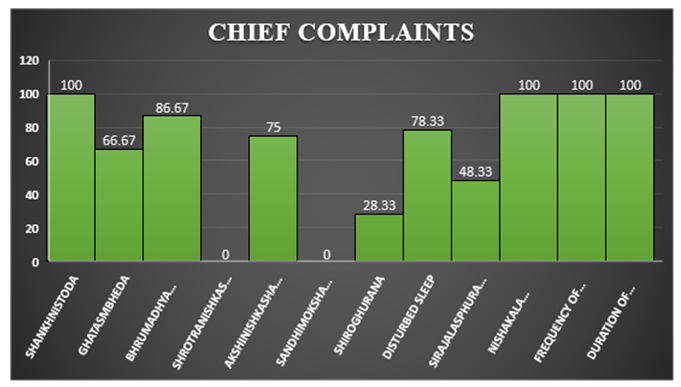
As indicated, routine laboratory investigations (Haematological CBC, blood sugar, ESR and urine, stool examinations) were performed before initiation of treatment just to rule out other diseases. So, they were not considered
Results
to effect of treatment. Thus, assessment of efficacy of treatment intervention was done on the basis of: Subjective parameters- Wilcoxon Signed Rank test in Intra group & Mann Whitney U test in Inter group
| Subjective Parameters | Sample Size | Mean | Mean Difference | % Change | W | SD | P | Result | |
|---|---|---|---|---|---|---|---|---|---|
| BT | AT | (BT-AT) | |||||||
| Shankhanistoda | 29 | 7.27 | 2 | 5.275 | 72.51% | -435 | 1.81 | <0.001 | H.S. |
| Bhrumadhya Lalatatapna Evam Ativedna | 25 | 7.32 | 2 | 5.32 | 72.68% | -325 | 1.77 | <0.001 | H.S. |
| Shrotranishkashanvat Peeda | 0 | 0 | 0 | 0 | 0% | 0 | 0 | 0 | |
| Akshinishkashanvat Peeda | 23 | 7.39 | 1.43 | 5.96 | 80.59% | -276 | 1.69 | <0.001 | H.S. |
| Sandhimokshanvat Peeda | 0 | 0 | 0 | 0 | 0 | 0 | 0 | 0 | |
| Shiroghurana | 7 | 1.86 | 0.14 | 1.71 | 92.31% | -21 | 1.6 | <0.05 | S |
| Disturbed Sleep | 23 | 1.87 | 0.52 | 1.35 | 72.09% | -171 | 1.07 | <0.001 | H. S |
| Sirajalasphurana | 12 | 2 | 0.25 | 1.75 | 87.50% | -66 | 0.75 | <0.001 | H. S |
| Nishakala-Ativedna | 29 | 1.69 | 0.72 | 0.96 | 57.14% | -210 | 0.77 | <0.001 | H. S |
| Frequency of Headache | 29 | 2.83 | 1 | 1.83 | 64.63% | -276 | 1.33 | <0.001 | H. S |
| Duration of Headache | 29 | 2.51 | 0.96 | 1.55 | 61.64% | -276 | 1.18 | <0.001 | H. S |
Table 1: Effect of Nasya (Group A) on Subjective Parameters (Wilcoxon Signed Rank Test).
| Subjective Parameters | Sample Size | Mean | Mean Difference | % Change | W | SD | P | Result | |
|---|---|---|---|---|---|---|---|---|---|
| BT | AT | (BT-AT) | |||||||
| Shankhanistoda | 27 | 7.41 | 1.11 | 6.29 | 85% | -378 | 1.32 | <0.001 | H.S. |
| Ghatasambheda | 19 | 7.37 | 0.95 | 6.42 | 87.14% | -190 | 1.35 | <0.001 | H.S. |
| Bhrumadhya Lalat-tapna Evam Ativedna | 25 | 7.2 | 0.76 | 6.44 | 89.44% | -325 | 1.16 | <0.001 | H.S. |
| Shrotranishkashanvat Peeda | 0 | 0 | 0 | 0 | 0% | 0 | 0 | 0 | |
| Akshinishkashanvat Peeda | 19 | 7.31 | 0.68 | 6.63 | 90.65% | -190 | 1.38 | <0.001 | H.S. |
| Sandhimokshanvat Peeda | 0 | 0 | 0 | 0 | 0 | 0 | 0 | 0 | |
| Shiroghurana | 8 | 1.5 | 0 | 1.5 | 100% | -36 | 0.75 | <0.05 | S |
| Disturbed Sleep | 22 | 1.82 | 0.09 | 1.73 | 95% | -253 | 0.88 | <0.001 | H. S |
| Sirajalasphurana | 15 | 1.73 | 0 | 1.73 | 100% | -120 | 0.88 | <0.001 | H. S |
| Nishakala-Ativedna | 27 | 1.89 | 0.44 | 1.44 | 76.47% | -300 | 0.75 | <0.001 | H. S |
| Frequency of Headache | 27 | 2.89 | 0.85 | 2.04 | 70.51% | -300 | 1.16 | <0.001 | H. S |
| Duration of Headache | 27 | 2.52 | 0.85 | 1.67 | 66.18% | -300 | 1.03 | <0.001 | H. S |
Table 2: Effect of Shirodhara (Group B) on Subjective Parameters (Wilcoxon Signed Rank Test).
| Group | N | Mean | % Change | Mann Whitney U | P | Result | |
|---|---|---|---|---|---|---|---|
| Shankhanistoda | Group A | 29 | 5.27 | 72.51% | 927.5 | <0.05 | S |
| Shankhanistoda | Group B | 27 | 6.29 | 85% | 927.5 | <0.05 | S |
| Shankhanistoda | Total | 56 | 927.5 | <0.05 | S | ||
| Ghatasambheda | Group A | 19 | 5.47 | 72.73% | 312.5 | >0.05 | N. S |
| Ghatasambheda | Group B | 19 | 6.42 | 87.14% | 312.5 | >0.05 | N. S |
| Ghatasambheda | Total | 38 | 312.5 | >0.05 | N. S | ||
| Bhrumadhya Lalat-tapna Evam Ativedna | Group A | 25 | 5.4 | 73.78% | 487.5 | <0.05 | S |
| Bhrumadhya Lalat-tapna Evam Ativedna | Group B | 25 | 6.44 | 89.44% | 487.5 | <0.05 | S |
| Bhrumadhya Lalat-tapna Evam Ativedna | Total | 50 | 487.5 | <0.05 | S | ||
| Shrotranishkashanvat Peeda | Group A | 0 | 0 | 0 | |||
| Shrotranishkashanvat Peeda | Group B | 0 | 0 | 0 | |||
| Shrotranishkashanvat Peeda | Total | 0 | |||||
| Akshinishkashanvat Peeda | Group A | 23 | 5.96 | 80.59% | 472 | >0.05 | N. S |
| Akshinishkashanvat Peeda | Group B | 19 | 6.63 | 90.65% | 472 | >0.05 | N. S |
| Akshinishkashanvat Peeda | Total | 42 | 472 | >0.05 | N. S | ||
| Sandhimokshanvat Peeda | Group A | 0 | 0 | 0 | |||
| Sandhimokshanvat Peeda | Group B | 0 | 0 | 0 | |||
| Sandhimokshanvat Peeda | Total | 0 | |||||
| Shiroghurana | Group A | 7 | 1.71 | 92.31% | 55.5 | >0.05 | N.S. |
| Shiroghurana | Group B | 8 | 1.5 | 100% | 55.5 | >0.05 | N.S. |
| Shiroghurana | Total | 15 | 55.5 | >0.05 | N.S. | ||
| Disturbed Sleep | Group A | 23 | 1.35 | 72.09% | 565.5 | >0.05 | N.S. |
| Disturbed Sleep | Group B | 22 | 1.73 | 100% | 565.5 | >0.05 | N.S. |
| Disturbed Sleep | Total | 45 | 565.5 | >0.05 | N.S. | ||
| Sirajalasphurana | Group A | 12 | 1.75 | 87.50% | 178.5 | >0.05 | N.S. |
| Sirajalasphurana | Group B | 15 | 1.73 | 100% | 178.5 | >0.05 | N.S. |
| Sirajalasphurana | Total | 27 | 178.5 | >0.05 | N.S. | ||
| Nishakala-Ativedna | Group A | 29 | 0.96 | 57.14% | 895.5 | <0.05 | S |
| Nishakala-Ativedna | Group B | 27 | 1.44 | 76.47% | 895.5 | <0.05 | S |
| Nishakala-Ativedna | Total | 56 | 895.5 | <0.05 | S | ||
| Frequency of Headache(>once in a week) | Group A | 29 | 1.83 | 64.63% | 809.5 | >0.05 | N.S. |
| Frequency of Headache(>once in a week) | Group B | 27 | 2.04 | 70.51% | 809.5 | >0.05 | N.S. |
| Frequency of Headache(>once in a week) | Total | 56 | 809.5 | >0.05 | N.S. | ||
| Duration of Headache(>1hour per day) | Group A | 29 | 1.55 | 61.64% | 797 | >0.05 | N.S. |
| Duration of Headache(>1hour per day) | Group B | 27 | 1.67 | 66.18% | 797 | >0.05 | N.S. |
| Duration of Headache(>1hour per day) | Total | 56 | 797 | >0.05 | N.S. |
Table 3: Cumulative table of Inter Group Comparison of Subjective Parameters (Mann Whitney U Test).
Assessment of Overall Response to Treatment
The overall assessment of management was decided on the basis of improvement in Subjective parameters. The percentage improvement of these symptoms was calculated for assessment.
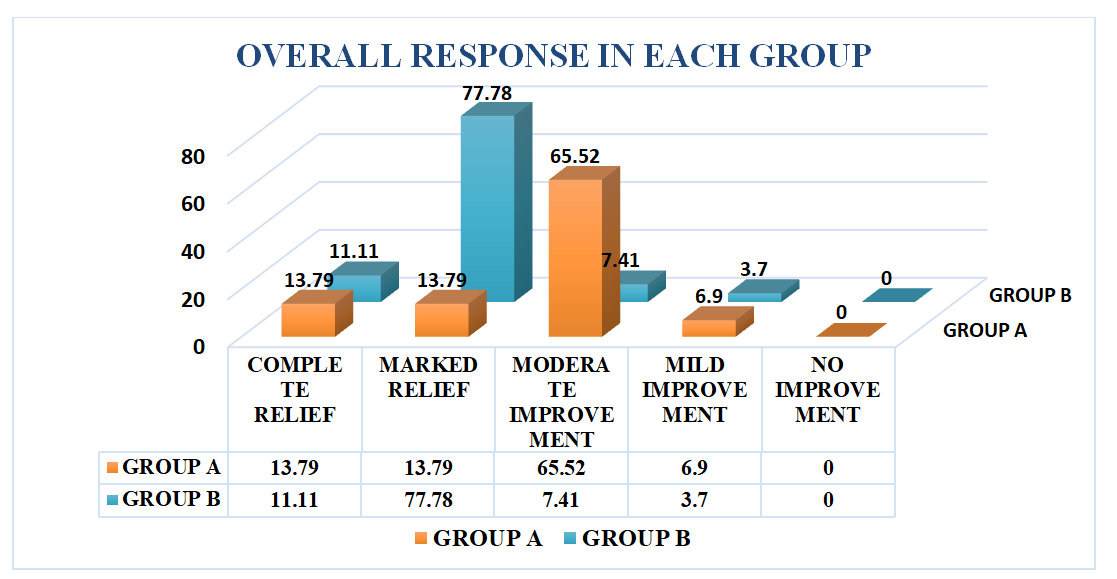
Post- Treatment Effect on Follow-Up
Follow-up was done after one month of completion of the treatment in both groups. Both in Group A & B, signs and symptoms were improved, which means that all the patients of Vatika Shiroroga (Tension Headache) showed statistically highly significant improvement in all the parameters. Better results were found in Group-B in comparison to Group A in most of the symptoms. There was no adverse effect observed during or after the treatment in both the groups.
Discussion
The trial medicine, Dashmoola Taila, was administered for Vatika Shiroroga (Tension Headache) in the form of Nasya (Group-A) and Shirodhara (Group-B) in this study. Dashmoola Taila is made up of equal parts of stem bark or whole plant from 10 different species. Only roots were mentioned in the first edition of AFI (Ayurvedic Formulary of India) for all ten plant entities that comprise the Dashmoola group. The usage of stem bark as substitutes for Brihata Panchmoola roots and whole plant for Laghu Panchmoola has been stated in the second edition of Part-1 of AFI [14]. Bilva, Gambhari, Agnimantha, Patala and Shyonaka are found in Brihat Panchmoola, whereas Brihati, Gokshura, Kantkari, Prishaniparni and Shalaparni are found in Laghu Panchmoola. The combination of these drugs is commonly utilized in Ayurveda because it acts on Vata Dosha and lowers its aggregation on nerves, muscles, bones and joints, all of which are associated to a wide variety of ailments. It has powerful anti-inflammatory, antioxidant and analgesic properties [15].
Effect on Subjective Parameters
Shankhanistoda (pain in bitemporal region): Group-B provided 85% relief and Group-A provided 72.51% relief in Shankhanistoda. Both had statistically highly significant (p <0.001). In this symptom, Vata was the main causative factor of the pain. Nasya and Shirodhara both therapies with Dashmoola Taila help in reducing pain. Presence of flavonoids and triterpenoid are the chemical properties of Dashmoola Taila drugs. They display various pharmacological activities includes such as anti-inflammatory, analgesic, antioxidant and antipyretic as well as Ushna Veerya, Tridoshahara, Shothahara and Vedanasthapaka properties. So, Dashmoola Taila Nasya and Shirodhara was highly effective [13, 16, 17, 18, 19, 20, 21].
Ghatasambheda (pain in back of neck): Group-B showed 87.14% improvement and Group-A showed 72.73% improvement in Ghatasambheda. Both effects had statistically highly significant (p <0.001).
Bhrumadhya Lalatatapana Evam Ativedana (pain and burning sensation in forehead): Group-B provided 89.44% improvement and Group-A provided 72.68% improvement with statistically highly significant (p <0.001) between them.
Shrotranishkasanvat peeda (severe pain in ears): This symptom was not found in Group-B and Group-A.
Sandhimokshanvat peeda (pain as joint are being laxed): This symptom was not found in both groups.
Akshinishkasanavat peeda (pain in eyes as if eyes are coming out): Group-B provided 90.65% improvement and Group-A provided 80.59% improvement. Both of these effects were statistically having highly significant (p <0.001).
On the basis of foregoing, in the symptoms of Ghatasambheda, Bhrumadhya Lalatatapana Evam Ativedna, Akshinishkasanvat Peeda, Sirajalasphuran, Nishakala -Ativedana (more pain in night time) is mainly due to Vata Dosha. The findings of Dashmoola Taila Nasya and Shirodhara were of great significance because Tila Taila and contents in Dashmoola Taila have Tridoshahara and Vatahara property, which lowers pain in Vatika Shiroroga [22].
Shiroghurna (Giddiness)
Group-B provided 100% relief in Shiroghurna and Group-A provided 92.31% improvement and both groups had statistically significant p value (p<0.05). Though vitiated Vata-Pitta and Rajododsha are responsible for Shiroghurana/ Bhrama (_giddiness) but specifically in _Vatika Shiroroga, Shiroghurana (_giddiness) is mainly due to _Vata Dosha [23, 24]. Brihat Panchmoola in Dashamoola Taila has Vata-Kaphahara property and Laghupanchmoola has Vata-Pittahara property [25, 26]. As a result_, Dashamoola Taila_ possesses Tridoshahar properties and it lowers giddiness [13]. So, it can be said that based on percentage and effectiveness, Dashmoola Taila Shirodhara was highly effective in this symptom.
Disturbed sleep: Group-B which provided 100% relief in disturbed sleep and Group-A provided 72.09% improvement, were statistically highly significant with (p<0.001) between them. In Vatika Shiroroga (tension headache) more pain in night time resulted in disturbed sleep. Dashmoola Taila having Vatahara property and reduces pain by their Vednasthapaka property. Shirodhara (in group-B) continue pouring with Dashmoola Taila increase the level of serotonin chemical in the brain [27]. Serotonin play a key role in such body functions like regulation of mood, sleep, digestion and Nasya stimulates the hypothalamus, which releases the dopamine hormone, which aids in mood control, sleep and stress reduction [28, 29]. Shirodhara causes the frontalis muscle to relax. It causes sleep by synchronizing the alpha waves in the brain [30]. Based on percentage, Shirodhara (in group B) was found to be more effective than Nasya (in Group A) for regulating the sleep.
Sirajalsphuran: In the symptom of Sirajalasphurana, Group B provided 100% relief, while Group-A provided 87.50% improvement and both groups had statistically highly significant (p <0.001). In Sirajalasphurana (pulsation) main vitiated Dosha is Vata Dosha. Dashmoola Taila having Ushna Veerya, Snigadha Guna, Guru Guna, Madhura Rasa and Madhura Vipaka properties which helps in destroying the vitiated Vata. Brihta Panchmoola reduces Vata Dosha because of its astringent juice, pungent Anuras and Ushan Veerya [31]. As a result_, Nasya_ and Shirodhara are both outstanding therapies for Sirajalasphurana reduction, but Shirodhara was found to be more effective therapy on the base of percentage.
Nishakala-Ativedna (more pain in nighttime): In the symptom of Nishakala-Ativedna, Group-B provided 76.47% relief and Group-A provided 57.14% relief and both groups had statistically highly Significant (p <0.001). According to Acharya Sushruta Vatika Shiroroga (tension headache) is more in night time which is said to be provocation time for Vayu [32]. Nirgundi in Dashmoola Taila has Tikta, Laghu, Ruksha, Vata-Kaphahara and Vednasthapana properties. Nirgundi causes reduction of prostaglandin synthesis which is related to its anti-inflammatory and analgesic effects [33, 34]. As a result, Dashmoola Taila Shirodhara was extremely beneficial in Vatika Shiroroga (tension headache).
Frequency (>once in a week) & Duration of Headache (>1 hours/day)
Group-B provided 70.51% improvement and Group-A provided 64.63% improvement and both groups had statistically highly significant (p <0.001). The frequency of headache was reduced by using both Nasya and Shirodhara therapy with Dashmoola Taila. The hypothalamus is stimulated by both Shirodhara and Nasya therapies, which aid in the control of mood, sleep and stress. Shirodhara stimulates the release of brain chemicals including dopamine, oxytocin, endorphins and serotonin that assist to regulate mood, sleep and decrease stress, depression and anxiety [35]. The body naturally produces endorphins to relieve pain [36]. In Vatika Shiroroga, Shirodhara has therefore achieved higher results. So, Nasya and Shirodhara both therapies help reducing the frequency & duration of headache.
Conclusion
- Dashmoola Taila Nasya (Group-A) was found highly significant (P<0.001) in Vatika Shiroroga (Tension Headache).
- Dashmoola Taila Shirodhara (Group-B) was found highly significant (P<0.001) in Vatika Shiroroga (Tension Headache).
- Though both therapies were equally effective, but percentage wise Dashmoola Taila Shirodhara (Group-B) was found to be more effective (statistically) than Dashmoola Taila Nasya(Group-A).
References
-
World Health Organization (2016) Headache disorders.
-
Agnivesha (2014) Charaka Samhita. In: Shukla AV, et al. (Eds.), Vidyotini Hindi Commentary, Sutra Sthana, Chaukhambha Sanskrit Pratishthan, Delhi, India, 17/6: 332.
-
Braunwald F, Kasper H, Longo DL, Jameson JL (2008) Harrison’s-Principles of Internal Medicine. 15th(Edn.), McGraw Hill, New York, 1: 73.
-
Agnivesha (2012) Charaka Samhita. In: Shukla AV, et al. (Eds.), Vidyotini Hindi Commentary. Sidhhi Sthana, Chaukhambha Sanskrit Pratishthan, Delhi, India, 9/70: 955.
-
Acharya S (2017) Sharanagadhara Samhita. In: Shailja S (Ed.), “Jiwanprada” Hindi Commentary. Chaukhambha Orientalia, Varanasi, India: 526.
-
Kaviraj AG (2016) Vagbhatta, Ashtangahridyam with Vidyotini Hindi Commentary. Uttar Sthanam Chaukhambha Prakashan, Varanasi, India, 23/3-6: 726.
-
Ambika DS Sushruta Samhita, Ayurved Tattav Sandipika Hindi Commentary. Uttar Tantra, Chaukhambha Oriental, Varanasi, India, Part 1, 25/3: 159.
-
Govind D (1997) Bhaishajya Ratnavali with Chandraprabha Commentary. In: Vaidya L, et al. (Eds.), 2016th (Edn.), Shirorogchikitsaprakaran, 65: 1017.
-
Laxmipati S (2015) Yogratanakara, Vidyotini Hindi Commentary. Uttrardh Shirorognidanam, Chaukhambha Prakashan, Varanasi, India, pp: 331.
-
Yadunandana U (2019) Madhava Nidana of Madhavkara, Madhukosh Hindi Teeka. Uttrardha, Shiroroganidanam, Chaukhambha Prakashan, Varanasi, India, 60/1: 392.
-
Stovner Lj, Hagen K, Jensen R, Katsarava Z, Lipton R, et al. (2007) The global burden of headache: a documentation of headache prevalence and disability worldwide. Cephalalgia 27(3): 193-210.
-
Dhara kalp (Prachina Keraliya Panchkarma Chikitsa Vigyana) Sampadika Doctor S. Sharma and Vyakhyakar evam Teekakaar Doctor H.L. Sharma, Chaukhambha Orientalia, Varanasi, Reprint 2012, pp: 33
-
Govind D (1997) Bhaishajya Ratnavali with Chandraprabha Commentary. In: Vaidya L (Ed.), 8th(Edn.), Motilal Banarasidas, Shirorog Chikitsaprakaran, 65/94- 98: 1024.
-
The Ayurvedic Formulary of India. Part 1, 2nd Edition, New Delhi, pp: 307-330.
-
Taru PP, Sayed S, Kute P, Shikalgar M, Kad D, et al. (2022) Dashmoola: A Systematic Overview. GIS science journal 9(4): 1334-1345.
-
Joshi BR, Hakim MM, Patel IC (2023) The biological active compounds and biological activities of _Desmodium_ species from Indian region: a review. Beni-Suef University Journal of Basic and Applied Sciences 12(1): 1-12.
-
Gupta RA (1986) International conference on traditional medicine. Madras, India, pp: 23-25.
-
Ambika DS, Sushruta Samhita, Ayurved Tattava Sandipika Hindi Commentary. Sutra Sthana, Chaukhambha Oriental, Varanasi, India, Part 1, 40/5: 195.
-
Ambika DS Sushruta Samhita, Ayurved Tattava Sandipika Hindi Commentary. Sutra Sthana, Chaukhambha Oriental, Varanasi, India, Part 1, 38/68: 188.
-
Agnivesha, Charaka Samhita, Vidyotini Hindi Commentary by Achary Vidyadhar Shukla and Prof. Ravidatt Tripathi, Sutra Sthana 4/38, Chaukhambha Sanskrit Pratishthan, Delhi, Edition: Reprint 2010, pp: 76.
-
International Journal of Creative Research Thoughts 10(9): 2022.
-
Ambika DS Sushruta Samhita, Ayurved Tattava Sandipika Hindi Commentary. Sutra Sthana, Chaukhambha Oriental, Varanasi, India, Part 1, 38/78: 189.
-
Ambika DS Sushruta Samhita, Ayurved Tattava Sandipika Hindi Commentary. Sutra Sthana, Chaukhambha Oriental, Varanasi, India, Part 1, 4/55: 48.
-
Agnivesha (2015) Charaka Samhita. Revised by Charaka and Dridhabala. In: Vaidya J (Ed.), Ayurveda Deepika Commentary of Chakrapanidatta, Sutra Sthana, Chaukhambha Oriental, Varanasi, India, 17/15: 100.
-
Ambika DS Sushruta Samhita, Ayurved Tattava Sandipika Hindi Commentary. Sutra Sthana, Chaukhambha Oriental, Varanasi, India, Part 1, 38/68: 189.
-
Ambika DS Sushruta Samhita, Ayurved Tattava Sandipika Hindi Commentary. Sutra Sthana, Chaukhambha Oriental, Varanasi, India, Part 1, 38/70: 189.
-
Sony S, Rachna N (2021) Probable mode of action of Shirodhara- Review Article WJPMR 7(9): 240-242.
-
Ambika DS Sushruta Samhita, Ayurved Tattava Sandipika Hindi Commentary. Sutra Sthana, Chaukhambha Oriental, Varanasi, India, Part 1, 40/5: 195.
-
Clevel and Clinic Health Library.
-
Dhuri KD, Bodhe VP, Vaidhya AB (2013) Shirodhara: A psycho-physiological profile in healthy volunteers. J Ayurveda Integr Med 4(1): 40-44.
-
Ambika DS Sushruta Samhita, Ayurved Tattava Sandipika Hindi Commentary. Uttar Tantra Chaukhambha Oriental, Varanasi, India, Part 1, 25/3: 159.
-
Ambika DS Sushruta Samhita, Ayurved Tattava Sandipika Hindi Commentary. Uttar Tantra Chaukhambha Oriental, Varanasi, India, Part 1, 25/5: 161.
-
Acharya PS Dravyaguna Vigyana, (Audbhida Aushadha- Dravy), Chaukhambha Bharti Acadami, India, Part-2: 67.
-
Yogendra S, Pankaj M, Pushpendra K (2020) Morphology, Phytochemistry and Pharmacological Activity of Vitex Negundo: An Overview. Journal of Drug Delivery & Therapeutics 10(3S): 280-285.
-
Vinutha T, Gopenath TS, Kaginelli SB, Karthikeyan M, Kantesh MB, et al. (2020) Medicinal Values and Pharmacological Activities of Vitex Negundo Linn. Journal of Global Trends in Pharmaceutical Sciences 11(1): 7579-7589.
-
“Dopamine” vs. “Serotonin”: The Difference Between These Happy Hormones.
- Management of Ear Keloid with Ksharsutra: A Case Study
- Yoga and Global Sustainability: A Holistic Path to One Earth, One Health
- Autoimmune Diseases in Ayurveda: A Narrative Review with Classical and Modern Perspectives
- Management of Cluster Headache Associated with Pituitary Apophysitis by CERT (Chakrasiddh Energy Release Technique): A Case Report on Energy Rebalancing
- Zygophyllum Geslini Coss : Biochemicals and Antioxidant Activity
- Observations of a Beginner Vaidya