
Structural Equations Model of the Transport Habitus in Mexico City during the COVID-19 Era
Habitus involves four dimensions; ethos, eidos, hexis and aisthesis considered as factors years, logical s, gestural and is ethical s. These are provisions that, through mobility, socialize your transportation choices. In this sense, an exploratory and crosssectional study was carried out with a non-probabilistic sample of 100 students to explore their dispositions before the use of minibuses, combis, taxis, motorcycle taxis, pedicabs, scooters or bicycles transportation to school. The results indicate that the mobility habitus is indicated by the practical conscience of agglomeration. Based on a structural model, the decision was made to accept the null hypothesis regarding the multidimensionality of the peri-urban mobility habitus. Involves the design policy from the possibilities that opens technology around peri - urban mobility, comfort of transport and satisfaction of the user which could combine with subsidies units zero emissions of carbon dioxide to the atmosphere, or alternative transport subsidies that use eco-routes, cycle tracks or pedestrian routes as well as electrified public transport.
Introduction
In the context of climate change and sustainable development, public transport turns out to be an extremely important factor when evaluating cities in terms of mobility and carbon emissions. In this sense, public policies have been aimed at strengthening green spaces, transport efficiency and ecological culture [1]. In this way, the subsidy programs have become essential to pay for the upgrade of the units or at least their conversion in order to reduce their carbon emissions into the atmosphere. Regarding ecological culture, urban governments have promoted the use of ecological or zero-emission transport in order to reduce car use and generate mobility spaces that deconcentrate emissions at peak traffic hours [2]. A third strategy is to create living spaces and rescue and leisure where pedestrians take ownership of bikeways or Ecovías in order to contribute to the reduction of air pollution and generate an environmental culture.
However, the interrelation between users and authorities, pedestrians and motorists, seems to show that there is a deep socio-political complexity which would be a barrier to the implementation of policies and programs aimed at the sustainability of public transport. This is so because the distrust of citizens towards their authorities is embedded in perceptions of risk, insecurity and defenselessness that later translate into practical mobility actions accompanied by stress; depersonalization, fatigue, frustration, anger, fear or anger [3].
These are mobility habits which emerge as responses to a public transport system perceived as inefficient, insecure and uncertain by users who perceive themselves as vulnerable, excluded or marginalized when they move from the periphery to the centrality urban [4]. The habitus mobility only explain the emergence of emotions, perceptions and actions of dissatisfaction that users develop to a certain system for public policies that although conform to international standards of quality of service, do not consider the needs, expectative and user demands and that instead of a habitus of sustainability indicated by civility, courtesy or optimization, conflicts arise from which it is possible to observe habitus of mobility indicated by accidents, aggressions, insults or abuse [5].
For this reason, it is essential to make explicit the mobility habits that users in the periphery manifest on their journey towards centrality [6]. In this sense, the objective of this work is to contrast the hypothesis according to which users who move from the metropolitan area and / or conurbation to the center of cities interrelate with obstacles and barriers that prevent them from developing a habitus of sustainability according to the Sustainable Development guidelines, their rights to the city and socio-political culture with civic values.
The ecocity is multidimensional. It has been understood as an economic, political and social system to reduce the ecological footprint of previous generations in reference to the capacities of previous generations, a space limited to one million inhabitants [7], whose activities are agriculture and industry depending on the availability of resources [8], although conflict scenario [9] recycling is seen as its main development tool [10].
The concept of eco-city is related to others of a socio- historical nature. In addition to the categories of freedoms, capacities, responsibilities, habitus, capitals, fields and spatialities, the concepts of governance [11], segregation [12], sustainability [13], centrality [14], inclusion [15], periphery [16] and surplus value [17] will allow conceptualizing the problem of scarcity, marketcracy and shortage in the study area [12].
If the concepts put forward are considered, an eco- city- oriented governance system is opposed to segregation via the relocation of social sectors from the naturalization of their exclusion, but is closer to local development since the term sustainability incorporates the system of government as the rector of ecocity resources and services [12].
Rather, a system of governance is developed in small localities such as the neighborhood or the periphery until it extends to the center of the city. This is how the eco- city indicators would be those related to sustainability and inclusion. In this sense, studies on sustainability and eco-city projects seem to demonstrate the viability of the terms based on heterogeneous indicators [8].
The State of Mexico’s fundamental principle is to move a social labor sector from the preferred to the capital of the country. This implies the emergence of speeches about the quality of the service that are the subject of public debate given the increase in accidents and rates. In this sense, the symbols and meanings disseminated in the users of the public network are reinterpreted and observable in lifestyles (mobility) that differentiate them from other labor sectors. These are inherited and learned provisions from which the use of transport is decided and with it its impact on the environment and the health of the inhabitants of the metropolis [16, 17].
It is estimated that in the megaurban the 2.5 micrometer particle norm is exceeded by up to 30% during a period of 24 continuous hours. This implies effects on respiratory and visual health that impact the discourses around concessioned transport, however the use of units could be influenced by their cost, speed or safety [18].
For this reason, it is necessary to analyze the provisions around the public transport service to later understand the logic of mobility among users of the State of Mexico in reference to the spaces where they are concentrated in the federal capital [14].
However, habitus are dimensions of daily practices that define them, but not directly, but from the generation of freedoms and opportunities is that practical or discursive skills make it possible for us to observe such dispositions [19]. This means that the fields of interaction are building habitus as if they were empty areas that will be filled by the mobility of those who participate in concessional public transport and by their private position. In this regard, the recognition of the agents in this case users, diversifies the inexorable symbols peri - urban transport use the difference n from other latitudes where deprives depersonalization of the greeting and customs of solidarity [20].
Theory argues that society is divided into sectors from which develop actions that encourage differences and asymmetrical relations between groups. In this sense, unlike the notion of conflict and social change, social reproduction is observed from actions that follow established patterns of behavior such as distrust of authorities and the use of public transport. The theory of social reproduction maintains that habitus, fields and capitals explain, as a practical consciousness, the actions that groups carry out to maintain their differences and asymmetric relationships [21].
In this way, conscience objectified in dispositions is carried out in symbolic scenarios where discourses are developed that reflect the resources that an individual has in reference to a group [22]. The objectified consciousness or habitus when exercised in symbolic spaces or discursive fields of power materializes the ideas around skills, values and knowledge which make up social capital since they are organized in collaborative networks [23]. Social reproduction is performed in provisions, scenarios and symbolic resources that justify and legitimize the differences between those who belong to a group with respect rulers who governed are assigned to groups [24].
In its socio-political dimension, social reproduction is observed in discourses about the relationship between State and citizenship. In this same sense, habitus are the result of a socialization of power, whether authoritarian or democratic [25]. This is how the users of public services internalized these discursive patterns and materialize them in actions when interacting with a public system, government institutions or political actors [26]. If this is the case, then the users of public services internalized the responses of their groups to systems, in this case of public transport, that move them from their place of residence to their place of work, vocational training or recreation [27]. That is why the differences between the periphery users regarding the city center on observable s from indicators of their habitus mobility [21].
Now, in the framework of Sustainable Development, mainly from the context of the right to the city and its public services, public transport is subject to international standards of carbon emissions, efficiency, satisfaction and user comfort [24].
However, the Mexican political system, having built asymmetric and authoritarian relations with the social sectors, implements public policies adjusted to the requirements of environmental quality, but ignores the needs, demands and expectations of users [27]. Faced with the increase in fees, public services would be obliged to improve their quality in terms of efficiency, but this does not necessarily correspond to the perceptions of the public, since risk, uncertainty and defenselessness seem to indicate dissatisfaction [26]. This would be observable from the speeches of the users, but their opinions are also influenced by their experiences of use. Therefore, observe their responses in situations where their habitus mobility emerge as concrete actions involves surveys and / or interviews related to the authorities responsible for public services.
However, when transporting users from the periphery to centrality, public transport is subject to a series of internalized perceptions and emotions that would allow differentiating the same users according to their mobility trajectories, places of departure, stay and return [24]. Therefore, it is necessary to address this social differentiation that involves the use of public transport in relation to the peripheral and central areas of the cities, which are materialized in speeches and actions. Habitus of mobility explains social reproduction in four levels using public transport as two points to consider: periphery and centrality. The theory of the habitus of mobility argues that the interaction between agents will not only be symbolic and discursive, but practical and supportive as they are not rules or beliefs that affect a rational process, but rather are areas in which the agents They insert without being aware of it, but at the same time they are enriched by participating in a conglomeration of opinions, actions and intentions that can, at a given moment, delimit the practical world of their daily life [28].
The periurban habitus, unlike the city- dweller or campiral, comes from marginality, vulnerability and exclusion, it is against the comfort system that transport practitioners are motivated to seek employment or to replace the one they have for another that will change as long as the salary persists as a policy of control. This structure defines the practices and discourses at the same time that the latter give meaning to the mobility and fare system [11]. The structure of the periurban habitus consists of eight dimensions from which it is possible to anticipate the improvisation of actions, however it is more feasible to understand the strongholds through which inherited schemes pass that are disseminated in the users of public transport. Only eight are retaken, but they are immeasurable since new discursive structures around rates and security generate practices and symbols associated with the defense of the territory, identity or roots that are further diversified with the discrepancies between users and operators, authorities and concessionaires, transporters and drivers [29].
In sum, the habitus is the conservation of structures of the past that activate the present while interacting with other new forms of existence that allow them to build other systems of practical schemes which will follow the process of reproduction and production, structuring and destructuring of dispositions [13].
As an art of invention, the habitus finds its symbolic production no longer in personal history but in the discrepancies that determined the present state. The debate of what is inherited versus what has been learned hangs over the first years of existence, although it is not entirely certain that discursive practice is forged from experiences related to affect, the innovation of responses is a form of management that can be related to the past However, its impact is greater if it is linked to future actions since the habitus would be a kind of strategies that, although they are not instruments, fulfill the function of locating and positioning the actors in a public system such as collective transport [30].
Peri-urban actors are often excluded from the hegemonic central system and from their own subjectivity since the habitus built prevents them from positioning themselves on the periphery of their follies and prevents them from entering the centrality of the dominant logics. Peri-urban users are outside the public system and of their own desires to be incorporated into the productive dynamics of symbols and meanings inherent to transition zones [31]. The peri- urban habitus would unfold in eight areas of mobility and passivity that involve the inclusion and exclusion of symbols associated with discursive practices related to accidents, traffic, traffic, demonstrations, transfer courtesies or added values [32].
However, it is unavoidable to assume that habitus as an innovative response to the distribution of resources is only practical awareness that does not pretend to transform what is established by social structures, rather it is an automatic reflex action from which the actors do not even know that they are, but they intuit that they could be inserted into certain spheres or dimensions to incorporate some of their aspects without trying to do something less than occupy a void. That is, the past does not influence more than the future in the present of the peri-urban habitus. Sociological studies of the habitus related to public transport note eight observation and analysis factors from which it is possible to infer the prevalence of a practical action of users who approach units in the periphery and go to a point of centrality. Sociological studies of mobility habitus have established eight dimensions around which the emphasis on conflict anticipates probable scenarios of change [33]. It is about an appropriation of space through the intensive and / or daily use of public transport [34]. In this sense, the purchase of products not only indicates that the system is an outpatient shopping center but is also a scenario of consumer protection in terms of their satisfaction and comfort [35].
Public transport is also used as an instrument for citizen mobilization and collective action [36] in which the emotions of the users contrast with the planning of the authorities [37]. This aspect has been approached from the gender perspective since public transport is confined to the particular use of the female gender in a crowded schedule [38].
However, the adjustment of the system and quality of the service is guided by principles of sustainability measured by efficiency, optimization of resources, respect for green or pedestrian spaces [39], although the subjective or social imaginary part emerges as an indicator of satisfaction and environmental quality from which public policy, subsidies and service charges are legitimized [40].
From the peri-urban habitus, traffic would be assumed as a circumstance of journeys that are of imprecise origin and therefore dispersed, or it is about emerging styles of driving that tend to an imposed and conventional regularity. It is also the case of the manifestations which we consider as an accumulation of discourses that operate in practice, although more than any other it brings with it symbols at least of anarchy [15]. That is why traffic session courtesies are another symptom of peri-urban habitus that seems to show solidarity with those who travel from one direction to another, but disagree with those who only block or cross without preventing or taking responsibility for their actions [9]. Another indicator is the movement around the wheel as part of the repertoire of responses to the objective conditions of urban everyday life [7]. In the case of accidents, as established by the urban habitus, it is an improvised response to the safety structures that operate under the logic of prevention. The added value of peri - urban mobility is you relate or with peak times and for practical innovation to build discourses on social networks, but by the construction of peri - urban styles in which everyday life not to be missed. Although it is true that the periurban habitus is irreducible to the proposed dimensions, it is essential to observe its emergence since the design of a mobility policy would be carried out from the reactivation of the objectified sense without excluding subjective desires, but including discourses intersubjective that are gestated in the interrelation of peri- urbanity with centrality.
In short, public transport has been approached from two objective and subjective dimensions, although predominantly the questioning of public policies is built from the increase in rates and the opinions of citizens about the quality of the service. From the sociological studies of public transport, it is possible to anticipate an eight-dimensional reflective structure from which the mobility habitus can be explained. Courtesy deriving from the appropriation of space through the use of public transport, since if there is a set of actions that seek to relativize the identity of pedestrians with respect to a mobility route, then it is logical to think that coexistence is developed from norms of civility within which courtesy is a central element.
In contrast, reading supposes a rational action unmarked from a practical conscience in the particular because civility, in general, is a social dimension that contrasts with the attention of an even superfluous reading, but that for some users is a mode of appropriation of space no longer as a stage of expression of subjectivity, but as a manifestation of habitus mobility and individual literacy of users who run an educational institution.
A consequence of the collective action that uses public transport as an instrument of mobility is agglomeration, although the labor and educational offer seem to be the causes, the agglomeration is due to a situation external to the dynamics of public transport that through filters seek to regulate flows mobility. Information policies regarding the use of the Internet and access to new technologies cause cyber use as an indicator of the mobility habitus that paradoxically adjusts the stay and trajectory of the user in the computer centers of the subway or shopping malls. Civility, already related to the appropriation of space, is a consequence of the common resources that the spaces through which public transport pass. Courtesy is a form of coexistence, but so are garbage collection, efficient transfer advice or the use of ecological transport. On the other hand, the transfer is indicative of a mobility habitus that develops from one end of the city to the other since it implies hours of transfer that imply constant transfers and the ability to perform the minimum of them or at least the cheapest are symptoms of a practical conscience.
In contrast, when transshipment skills have not been developed, waiting emerges as another indicator of those who only know a limited path of transfer. Lastly, food reflects a habitus of mobility that supposes trajectories that are higher than the average and reflects consumption styles by those who comply with a saturated work or training schedule. Courtesy, reading, agglomeration, cyberuse, civility, transshipment, waiting and food are indicators of the habitus mobility because they are responses to programs and policies limiting public transport consisting of subsidies, confinements and filters.
Method
Design
A non-experimental, exploratory and cross- sectional study was carried out Sample.
Is one performed nonprobability lesson 100 students (M = 20 years old, DE = 0.36). The inclusion criterion dealt with the journey in hours from home to school (M = 2.46 hrs and SD = 0.30 minutes). Return from the campus to the house (M = 2.00 hrs and SD = 0.70 minutes).
Instrument
Inventory of Habitus Mobility Periurbano of Rivera, et al. [39] which contains 3 2 All indicators have five response options ranging from “not similar my situation” until “is very similar to my situation”.
Procedure
Through a telephone contact with the selected sample in which an interview was requested and whose purposes would be merely academic and institutional follow-up to the graduates, whether they were graduates or not. Once the appointment was established, a questionnaire was provided that included the sociodemographic, economic and organizational psychological questions. In the cases in which there was a tendency towards the same answer option or the absence of answer, they were asked to write down on the back the reasons why they answered with the same answer option or, where appropriate, the absence of them. . The data were captured in the Statistical Program for Social Sciences (SPSS) and the analysis of structural equations was estimated with the help of the Analysis of Structural Moments (AMOS) program and the Relationships program. Linear Structural (LISREL).
Analysis
The establishment of the structural model of reflective rela- tionships was carried out considering the normality, reliabil- ity and validity of the scale that measured the psychologi- cal construct. The kurtosis parameter was used to establish the normality of the distribution of responses to the level of compromise questioned. The results show that the kur- tosis parameter had a value less than eight, which is the minimum, suggested to assume the normality of the distri- bution. In the case of reliability, Cronbach’s alpha value al- lowed establishing the relationship between each question and the scale. A value greater than 0.7 0 was considered as evidence of internal consistency. Finally, the exploratory fac- tor analysis of main axes and pro max rotation in which fac- torial weights greater than 0.300 allowed the emergence of commitment to be deduced from eight indicators [40].
Results
The normal distribution, requirement for the establishment of construct validity and internal consistency, obtained a value of 1,294 close to unity and significant (Bootstrap = 0.000).
Construct validity was established with five factors, of which only three explained more than 20% of the variance as a requirement for hypothesis testing.
The first factor related to agglomeration included items 1 to 4 explaining 28% of the variance. For its part, the feeding factor was made up of items 5 to 8, explaining 25% of the variance. While the factor allusive to civility was configured by items 9 to 16 explaining 23% of the variance.
Finally, the cyberuse and engagement factors were configured by items 17 to 32%, explaining 14% and 10% of the variance, respectively (Tables 1 & 2).
| R | Indicator | M | SD | K | α | F1 | F2 | F3 | F4 | F5 |
|---|---|---|---|---|---|---|---|---|---|---|
| r1 | I often get caught up in so many people on the subway | 3.45 | 0.95 | 1.03 | 0.7 | 0.374 | ||||
| r2 | I try to get on the minibus, even if it reaches its maximum capacity | 3.47 | 0.83 | 1.06 | 0.73 | 0.384 | ||||
| r3 | I use zero-emission transport, even if it circulates at maximum capacity | 3.29 | 0.81 | 1.46 | 0.71 | 0.389 | ||||
| r4 | I share the taxi with the people who can fit | 3.05 | 0.96 | 1.36 | 0.79 | 0.301 | ||||
| r5 | I often go eating on my way to my destination | 3.85 | 0.74 | 1.67 | 0.74 | 0.304 | ||||
| r6 | I try to buy a product to eat on the minibus | 307 | 0.95 | 1.38 | 0.71 | 0.394 | ||||
| r7 | I eat food while sitting on the bus | 3.71 | 0.85 | 1.06 | 0.74 | 0.312 | ||||
| r8 | When transport allows sale, I usually buy something to eat | 3.72 | 0.96 | 1.36 | 0.75 | 0.385 | ||||
| r9 | I usually respect spaces confined to people with different capacities | 3 | 0.39 | 1.25 | 0.75 | 0.391 | ||||
| r10 | I avoid invading senior citizens’ seats | 3.08 | 0.84 | 1.22 | 0.73 | 0.384 | ||||
| r11 | I collaborate in the identification of missing people in the subway | 3.04 | 0.59 | 1.25 | 0.72 | 0.336 | ||||
| r12 | I help people who ask me for help to reach their destination | 3.01 | 0.51 | 1.63 | 0.7 | 0.316 | ||||
| r13 | When I observe that someone of the third age is standing, I usually offer them my seat | 3.49 | 0.48 | 1.68 | 0.74 | 0.388 | ||||
| r14 | In the subway I usually make sure that the seats for the elderly are respected | 3.36 | 0.36 | 1.47 | 0.73 | 0.345 | ||||
| r15 | I avoid boarding the transport confined to women | 3.14 | 0.85 | 1.49 | 0.7 | 0.315 | ||||
| r16 | I usually pay for transportation to people who ask for help | 3.26 | 0.94 | 1.07 | 0.77 | 0.367 | ||||
| r17 | I check my email while I arrive at my destination | 3.15 | 0.25 | 1.77 | 0.71 | 0.376 | ||||
| r18 | I use the metro network to check my emails | 3.04 | 0.36 | 1.68 | 0.74 | 0.366 | ||||
| r19 | I participate as an Internet user advisor in the metro | 3.72 | 0.46 | 1.49 | 0.79 | 0.341 | ||||
| r20 | I make sure that the cyber users of the subway respect the allotted time | 3.26 | 0.61 | 1.99 | 0.79 | 0.346 | ||||
| r21 | I’ve waited for the subway until I find a free seat | 3.49 | 0.58 | 1.08 | 0.73 | 0.342 |
r22 I’ve taken the bus from your base to your destination 3.05 0.84 1.32 0.72 0.326 r23 I have ridden the minibus late into the night 3.84 0.91 1.64 0.73 0.346 r24 I have waited for public transport before it starts to circulate 3.31 0.88 1.57 0.73 0.332 r25 While I ride the subway, I review my class notes 3.2 0.95 1.42 0.75 0.326 r26 I prepare for exams on the way to school 3.22 0.89 1.55 0.78 0.384 r27 I do my homework while on the subway 3.04 0.97 1.23 0.79 0.331 r28 I do schoolwork during my ride on the minibus 3.64 0.95 1.25 0.74 0.368 r29 My sense of punctuality forces me to take different routes to be on time 3.46 0.89 1.36 0.72 0.346 r30 My schedule of activities allows me to travel on different routes 3.15 0.88 1.35 0.78 0.306
- Source: Elaborated with data study; M = Mean, SD = Standard Deviation, A = Alpha value excluded value item, K = 1.294; Bootstrap =
- 0.000; F1 = Agglomeration (28% of the variance , alpha = 0.721), F2 = Food (25% of the variance , alpha = 0.739 ), F3 = Civility (23% of the variance , alpha = 0.758 ), F4 = Cyberuse ( 14% of the variance , alpha = 0.794 ), F5 = Commitments (10% of the variance , alpha = 0.745 ). KMO = 0.682; [X 2 = 14.25 (12gl) p = 0.000]
Table 2: Reliability and construct validity.
The periurban habitus seems to be interwoven between traffic and demonstrations (Φ = 0.555) as opposing elements that involve road safety with urban mobility and the innovations that emerge from them. Such a contradiction is also observed in the relationship between demonstrations and traffic courtesies (Φ = 0.676) as well as with wheel turn travel (Φ = 0.328). These are provisions that coexist in response to mobility problems, but their belonging to other areas suggests that the urban habitus passes through them.
Only in the case of accidents with pedestrian movement (Φ = 0.388) is there a kind of causality, although the peri- urban habitus moves away from all prevention in this relationship, it seems that it activates a logic of self-care on the part of the actors. Finally, the added value in peak hours (Φ = 0.710) also suggests that there are concomitant dimensions to the improve of peri-urban mobility.
| M | SD | F1 | F2 | F3 | F4 | F5 | F1 | F2 | F3 | F4 | F5 | |
|---|---|---|---|---|---|---|---|---|---|---|---|---|
| F1 | 24,32 | 13,24 | 1,000 | 0.916 | ||||||||
| F2 | 22,45 | 15,46 | ,432* | 1,000 | 0.555 | 0.906 | ||||||
| F3 | 21,26 | 18,43 | ,325** | ,431*** | 1,000 | 0 | 0.676 | 0.991 | ||||
| F4 | 20,43 | 14,35 | ,542* | ,326* | ,438* | 1,000 | 0.098 | 0.104 | 0.17 | 0.995 | ||
| F5 | 25,47 | 16,20 | ,439*** | ,437* | ,541* | ,631* | 1,000 | 0.125 | 0.252 | 0.328 | 0.005 | 0.9 |
Table 3: Covariance relationships between factors.
Source: Elaborated with data study; F1 = Agglomeration, F2 = Food, F3 = Civility, F4 = Cyberuse, F5 = Commitments; * p < ,01; p < ,001; * p < ,0001 Table 2: Covariance relationships between factors.
The structure of relationships suggests axes and trajectories that can be explained from the technique of structural equations for the case of reflective relationship models. That is, each factor being related to each indicator forms an explanatory structure of the transport habitus (Figure 1).
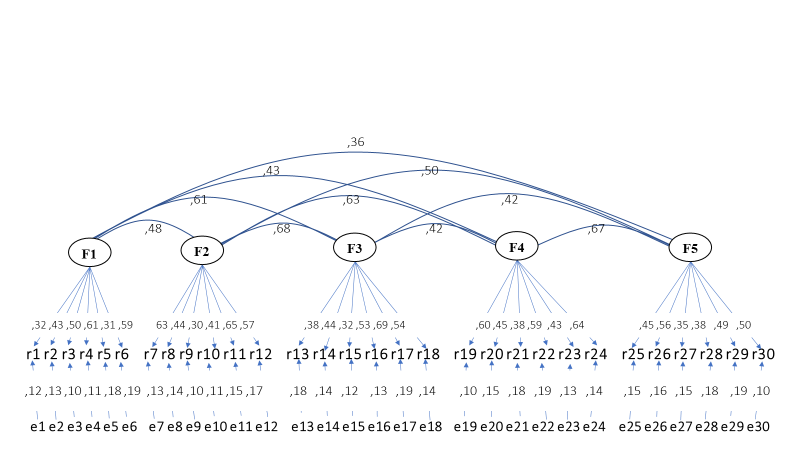
Source: elaborated with data study; F1 = Agglomeration, F2 = Food, F3 = Civility, F4 = Cyberuse, F5 = Commitments; R = Indicator, e = Error measurement indicator, relation between error and indicator, relation between factor and indicator, relation between factor. Figure 1: Structural equation modelling.
The results show that around public transport, a structure of reflective relationships is configured between five factors with respect to 30 indicators. It is an explanatory model of the subjective dimensions that transport users generate from their transfer experience and depending on the image of the destination. The adjustment and residual values ( ) 2
12,23 13 df p > ,05; GFI = ,990; CFI = ,997; RMSEA = ,007
$$ \int \chi^ {2} = 1 2, 2 3 (1 3 \mathrm {d f}) \mathrm {p} >, 0 5; \mathrm {G F I} =, 9 9 0; \mathrm {C F I} =, 9 9 7; \mathrm {R M S E A} =, 0 0 7 $$ suggest the non-rejection of the null hypothesis regarding the significant differences between the theoretical dimensions with respect to the established factors.
Discussion
Agglomeration is the indicator of peri-urban habitus however it contrasts with food, which suggests that provisions or innovations may be part of improvised practical norms and styles. It also implies the convergence of discourses with daily practices that can be translated into innovations from which a response system is generated in the face of increased rates or accidents. A good part of the transfer is consumed in traffic and therefore finding added values diversifies the daily responses that the actors construct in the face of their subjective needs and objective work structures. In this sense, the peri-urban habitus implies discursive and practical spaces of power in which user appropriate public services as a refuge from insecurity, a resource for economic income or dissemination of emotions. The periurban habitus seems to be a latent disposition that emerges when its intersubjective structures are related to the objective structures of transfer and the subjective desires for mobility.
However, the peri-urban habitus , unlike the discursive one, supposes the improvisation of derived emotions, although the process is discussed, from the past since marginality, exclusion and vulnerability are historical antecedents of mobility styles and are materialized in discourses in situations risk and uncertainty. This is how the peri-urban habitus brings with it the collective history of the actors who move to the capital to work study or simply diversify their daily activities. Despite the fact that this does not directly affect the innovative responses of the actors, the added value of mobility (listening to music, messaging or chatting) are symptoms of a habitus that seeks to separate actors from objective structures while bringing the actors closer together. They to their subjective desires, even if the preferences are the result of intersubjectivity.
In reference to the study by Carreón, et al. [41] in which they found community participation in terms of internal transport in the study locality, the present work has found that the periurban habitus crosses spaces and times of movement without leaving a trace that is not ecological but symbolic in the daily life of the communities. That is to say, for the study location, public transport is only an instrument or means to achieve the purpose of moving, although this implies some practices such as those of added value that, due to their degree of innovation, are more acquired than inherited provisions because they would contrast with those symbols and meanings that previous generations built around their locality and comparison to the capital.
Study also agrees with the finding Hernandez, et al. [34] in which they were established agendas of public discussion about security and billing system. In this work, accidents are considered as an emergent response to drunk drivers or those who have the lack of skill to cause them.
However, the work of Mejía, et al. [35] warns that public transport is subject to client public policies in which the peri-urban mobility habitus interrelates with authorities based on subsidies. In other words, as the public transport rate increases, users develop low-intensity strategies that gradually increase as the cost of the service increases. In this same sense, the present study has established that as long as technology is introduced into the quality of service and an environmental awareness is generated, users will not only accept, but will promote the public transport service.
Indeed, Morales, et al. [37] support the positive relationship between subsidy, technologization and sustainability, but warn that once a certain level of increase has arrived, the relationship turns negative since the user›s ecological behavior ends when they develop a perception of injustice that, together with their perception of risk and perceived utility, make up a rational system of aversion to the future which translates into emotions of insecurity, discomfort and indignation at the opacity, discretion or negligence of the authorities. In the present research we have shown that technology, in terms of public safety, reduces the perception of risk and emotions such as fear or anger, but given the spread of negative propaganda towards the system and its administrators, users seem to form a series of discursive field from which a practical awareness develops that leads not only to inaction, but also increases their depersonalization of the problems related to the use of public transport.
If the public transport system is related to mobility habitus, then it would be possible to anticipate public policies that are in harmony with safety, efficiency and sustainability, however Rosas, et al. [41] suggest that the mobility habitus is limited to the resources of the public transport system more than to the demands and expectations of users. In this sense, the mobility habitus could not develop into a sustainability habitus indicated by a planning of the movement in the system or its deliberate use, inhibiting the obstacles that impede its efficiency. Rather, the peri-urban mobility habitus is sustained by a series of practical actions in which comfort and personal satisfaction are strengthened based on the subsidy.
Or , as the work of Montes, et al. [36] points out, the competition for passage is the scenario where the civility of the user is gestated and not so much from his needs except in the female user as a factor of formality and identity such as Pereira, et al. [38] points it out, or, as a reaction strategy to events that show the system vulnerable from the perspective of Rodríguez, et al. [40] who warns about the increase in criminal cases within the system , although Torres, et al. [42] has demonstrated that the quality of the service has a subjective factor that determines customer satisfaction [43].
Conclusion
The relations of appropriation, transformation and distribution of resources and spaces in their development process, encouraged the differentiation of social classes. As the differences were exacerbated, the segregation of the spaces protected the appropriative and transformative differences while heightened the distributive differences of resources, mainly public transport. This process confronted public policies against privileged lifestyles and market demands.
In summary, the present study has as its main contribution to open the discussion about public transport as a coercive system in which the habitus mobility of users who move from the periphery to the central fits the s powers for resources and intransigence in the face of the demands, needs and expectations of users.
Thus, an investigation into the s powers for resources, passage and space travel might suggest that the system is vulnerable to conflicts between users and authorities against risks such as accidents, assaults, crowds, street trading, kidnapping and abuse of power.
The habitus mobility could explain this dynamic in which subjectivities interact with the administrative structure and public safety.
However, s must address the problem from the speeches of the users as they have been excluded from management decisions within the framework of political public of climate change and subsidy programs for zero emission transportation.
References
-
García C, Carreón J, Hernández J, Rivera B, Aguilar, et al. (2015) Perceptual differences in view of the risk of crowds in public and concessioned transport. Iberoforum 10(19): 112-131.
-
Carreón J, Hernández J, Morales ML, García C (2014) Sociopolitical complexity of public transport. Tlatemoani 15: 1-22.
-
Hernández J, Bustos J, Rivera B (2014) Fare sustainability of public transport. Implications for local governance. IV Regional Colloquium of Social Sciences “The contours and vicissitudes of urban development: planning and social construction of space in the face of the emergence of new actors pp: 12-14.
-
Bustos JM, Juárez M, García C (2020) Validity if habitus model of coffee entrepreneurship. Summa, 3 (1): 1-21.
-
Carreón J, Hernández J, García C (2014) Risk perceptions in public transport agglomerations. Delos 7(23): 1-17.
-
Quiroz CY, Bustos JM, Juárez M, Bolivar E, García C (2020) Exploratory factorial structural model of the perception of mobility in bikeways. Propòsitos and Representaciones 8(1): 1-14.
-
Pérez G (2010) Financing of urban-ecological projects through the exchange of carbon credits. Urbano 22: 7-21.
-
Guillén A (2010) Environmental perspectives in Venezuela. UCAB Notebooks 10: 29-55.
-
Paniagua L (2012) Urban disputes: space and differentiation in the neighborhood. In: Bolivar T, Jaime E, et al. (Eds.), Dimensions of the Mexican popular habitat pp: 245-266.
-
Santamaría R (2012) The accreditation of a housing need as a requirement for the transformation of rural land. Redur 10: 193-206.
-
Iglesias Á (2010) Strategic planning as a public management instrument in local government: case analysis. Management Notebooks 10: 101-120.
-
Gissi N, Soto P (2010) From stigmatization to neighborhood pride: Appropriation of space and social integration of the Mixtec population in a neighborhood in Mexico City. INVI 68: 99-118.
-
Loyola C, Rivas J (2010) Analysis of sustainability indicators for their application in the city. Time and Space 25: 1-15.
-
Cravino M (2012) Inhabiting new neighborhoods of social interest in the metropolitan area of Buenos Aires: the space built by the State and lived by the neighbors. In: Bolivar T, Jaime E, et al. (Eds.), Dimensions of the Mexican popular habitat pp: 101-120.
-
Pallares G (2012) Right to the city: homeless people in the city of Buenos Aires. In: Bolivar T, Jaime E, et al. (Eds.), Dimensions of the Mexican popular habitat pp: 171-186.
-
Brites W (2012) The adversities of the habitat in housing complexes of relocated population. In: Bolivar T, Jaime E, et al. (Eds.), Dimensions of the Mexican popular habitat pp: 121-142.
-
Verissimo A (2012) Program for the regulation and formation of capital gains in informal urbanizations. In: Bolivar T, Jaime E, et al. (Eds.), Dimensions of the Mexican popular habitat pp: 45-68.
-
Cavero M (2012) The need to consolidate the right to the city by rethinking the paradigms of the degree. In: Bolivar T, Jaime E, et al. (Eds.), Dimensions of the Mexican popular habitat pp: 423-440.
-
Urquieta M, Campillo C (2012) Female representations of urban space. New demands for the democratic and inclusive construction of the city. In: Bolivar T, Jaime E, et al. (Eds.), Dimensions of the Mexican popular habitat pp: 311-330.
-
Cuevas S (2012) Public space as a right to the city. A tour of the heritage of the historic center of Quito. In: Bolivar T, Jaime E, et al. (Eds.), Dimensions of the Mexican popular habitat pp: 267-294.
-
Capdevielle J (2011) The concept of _habitus_. Anduli. Andalusian Journal of Social Science_,_ 10: 31-45.
-
Castro M (2011) Linguistic _habit_ and right to information in the medical field. Mexican Journal of Sociology 73: 231-259.
-
Cerón A (2012) _Habitus_ and capitals: provisions or social devices? Theoretical methodological notes for social research. Latin American Journal of Social Research Methodology 4: 68-82.
-
Fortich M, Moreno Á (2012) Elements of field theory. Verba Iuris 27: 47-62.
-
García A (2011) Micro spatial conflicts and political _habitus_ of anti-hegemonic groups. Nomads 3: 1-20.
-
Joignant A (2012) _Habitus_, field and capital. Elements for a general theory of political capital. Mexican Journal of Sociology 74: 587-618.
-
Martínez E (2013) Kabylia: the problematic genesis of the concept of _habitus_. Mexican Journal of Sociology 75: 125-131.
-
Cedrés L (2012) Citizen participation in the construction of an inclusive and sustainable habitat: towards the realization of the right to the city. In: Bolivar T, Jaime E, et al. (Eds.), Dimensions of the Mexican popular habitat pp: 187-208.
-
Nozica G (2011) Plan for territorial integration. The desirable scenarios for the insertion of the province of San Juan into Mercosur. Ibero-American Journal of Urbanism 6: 43-54.
-
Machado C (2012) Approaches for the physical and social restructuring of popular housing in Caracas. In: Bolivar T, Jaime E, et al. (Eds.), Dimensions of the Mexican popular habitat pp: 337-352.
-
Malmod A (2011) Occupation logics in the conformation of the territory. Land use planning as a planning tool. Ibero-American Journal of Urbanism 6: 18-30.
-
Molini F, Salgado M (2010) Artificial surface and single- family homes in Spain, within the debate between compact and dispersed city. Bulletin of the Association of Spanish Geographers 54: 125-147.
-
Carreón J, Morales M, Rosas F (2013) Sustainability of public transport. First Academic Meeting on Sustainability and Planning of Public Transport.
-
Hernández J, Carreón J, Morales ML, Aguilar JA, García C (2014) Sociopolitical complexity of public transport. Implications for Sustainable Local Development. Reason and Word 86: 1-27.
-
Mejia S, Hernandez J, Lemon G (2014) Sociopolitical complexity of public transport. Implications for sustainable development. IV Regional Colloquium of Social Sciences “The contours and vicissitudes of urban development: planning and social construction of space in the face of the emergence of new actors.
-
Montes A (2013) Pathologies in public transport drivers in the Metropolitan Area of the Valley of Mexico. First Academic Meeting on Sustainability and Planning of Public Transport.
-
Morales M, Carreón J, Aguilar A (2013) _Habitus_ of public transport in Edimex. First Academic Meeting on Sustainability and Planning of Public Transport.
-
Pereira C (2013) The gender perspective in public transport: a theoretical reflection on pink transport in Mexico City. First Academic Meeting on Sustainability and Planning of Public Transport.
-
Rivera B, Mendez A, Hernandez J (2014) _Habits_ of mobility around public transport. Implications for sustainable local governance. IV Regional Colloquium of Social Sciences “The contours and vicissitudes of urban development: planning and social construction of space in the face of the emergence of new actors.
-
Rodríguez S (2013) Public transport security in Ciudad Nezahualcóyotl. First Academic Meeting on Sustainability and Planning of Public Transport.
-
Rosas F, Carreón J, Morales M (2013) Sociopolitical complexity of public transport in the State of Mexico. First Academic Meeting on Sustainability and Planning of Public Transport.
-
Torres J (2013) Subjective assessment of the main factors that make up the vector of quality of service in public transport. First Academic Meeting on Sustainability and Planning of Public Transport.
-
Salvatore K (2020) _Habitus_ mobility in the transport of zero carbon dioxide emission into the atmosphere. International Journal of Advances Engineering Research & Science 7(2): 1-4.
- Capacity Constraints in Pediatric Inpatient Psychiatric Care: A Cross-Sectional Analysis of Bed Availability and Geographic Access in North Carolina
- Why Healthcare Analytics Still Optimizes the Wrong Things
- Coding, Coverage, and Care: The Infrastructure of Transgender Health Inequities
- The Effect of Classroom Attendance on Academic Achievement of Management and Leadership Discipline of Nursing Students at Instituto Superior Cristal and Universidade de Dili, Timor-Leste, 2024: A Case Study
- The Role of Social Bonds in Facilitating Shared Investments and Resource Allocation: Addressing the “Wrong Pocket Problem” in Public Health and Healthcare
- Social-Cultural Factors Contributing to Antimicrobial Resistance in Livestock Farmers and Community Households in Kayonza District, Rwanda