
Glucose a Contaminant in Sweeteners Such as the Diabetogenic Agent
Sweeteners are a sugar substitute widely used in our time for the ability to sweeten foods or beverages under the concept of not providing calories, for which their consumption is increasing in recent years. This same capacity that presumes not to provide calories is what has led patients with chronic degenerative diseases, such as diabetes mellitus, to find a sweet source and thus stop consuming table sugar entirely. Glucose measurement tests, by Glucose-oxidase, enzymatic method and conventional spectrophotometer, were carried out in different samples of natural and artificial sweeteners of greater consumption. Natural sugar: honey, 255mg/dL, maple syrup, 238 mg/dL and table sugar, 315 mg/dL, , have very high glucose values, sweeteners have concentrations: sucralose, 281 mg/dL, stevia, 60 mg/dL, aspartame, 0 mg/dL. The sweeteners that have glycosidic bonds and of greater time of storage in handbags were positive to the test of glucose-oxidase, similar to that present in honey and table sugar. The aim to verify if consuming this type of sweetener is beneficial for the patient, or on the contrary, consumption directly influences the development of the disease.
Introduction
The common sugar, sucrose, is a sugar whose intake provides a certain amount of calories. Its excessive consumption can lead to health problems, such as overweight, obesity, diabetes, among other complications, such as tooth decay. References indicate that sucralose is a non-cariogenic sweetener; it does not produce cavities, as it does not ferment in the mouth. Sweeteners have found various applications, especially in the elaboration of low calorie products. However, addiction occurs very easily, and over time health consequences can lead to overweight in the consumer population. Worldwide artificial sweeteners are the most common food additives.
A traditional practice to use active principles isolated from medicinal plants for treatment of diabetes mellitus by this clinical studies have suggested that stevioside and rebaudioside A are antihyperglycaemic, and insulinotropic, offering so therapeutic benefits for subjects with type 2 diabetes mellitus and have a direct effect on the β-cells of the islets of Langerhans of pancreas to produce insulin, and aids in the control of weight, and is an effective sugar substitute of commercial value in a number of countries [1, 2, 3]. However Pezzuto, et al. [4] reported the potential importance that steviol is mutagenic toward S. typhimurium strain TM677, in the presence of a supernatant fraction obtained from the liver of pretreated rats in relation to the human ingestion of stevioside. In this regard, subsequent studies indicated that stevioside is not mutagenic in any of the in vivo and in vitro assays examined but steviol with metabolic activation is mutagenic in the forward mutation assay using S.typhimurium TM677 [5].
Currently in Mexico, one of every three people is overweight and obese, being able to develop hyperglycemia and or diabetes mellitus, a condition that affects both men and women. Is it possible that sweeteners used by the population influence the increase in hyperglycemia?.
The aim of determine the concentration of glucose in sweeteners natural and synthetic mostly used in the region.
Consumption of sugars, mainly sucrose, glucose and fructose syrups, has increased dramatically around the world and growing concern about its adverse health effects and metabolic diseases, metabolic syndrome, cardiovascular diseases, and type 2 diabetes has motivated people to reduce the consumption of free sugars. Sweeteners are sugar substitutes that mimic the sweet taste of sugar but have a negligible impact on energy intake. Nonnutritive sweeteners, NNSs, are defined as sweetening agents with a higher sweetening intensity and lower calorie compared with sweeteners such as sucrose or corn syrup [6]. Sugar alcohols are slightly lower in calories than sugar and do not promote tooth decay or cause a sudden increase in blood glucose. Both of them, NNSs and sugar alcohols are consumed not only by people with diabetes but also by the general population, because they are used as ingredients in many reduced-calorie foods, additionally, they are used as tabletop sweeteners at home, in cafeterias, in restaurants and in diabetic patients.
Food and Drug Administration, FDA [7] and European Food Safety Authority, EFSA [8] have confirmed that NNSs are safe for human consumption and do not cause cancer or other health-related problems as long as they are consumed within the Acceptable Daily Intake. In 2014, Bray, et al. [9] concluded that sugar-sweetened beverages, SSB play a role in the epidemics of obesity, metabolic syndrome, and fatty liver disease. Another authors Scientifics and experts continue to conclude that sugars intake is not a causative factor in any disease, including obesity and the majority of nutrition experts agree that high fructose corn syrup, HFCS, is safe [10] while Stanhope, et al. [11] refers that there is also little data to determine whether the form in which added sugar is consumed, as beverage or as solid food, affects its potential to promote weight gain. Hoffman in 2018 observed in rats that replacing the sugar with non-caloric artificial sweeteners, leads to negative changes in fat and energy metabolism [12] in the same year, Stephen-Camacho, et al. [13] showed there seems to be a relationship with the increase in the synthesis of adipose tissue that causes obesity and related diseases. Synthetic sweeteners were the ones presented more cytotoxic alterations, while natural sweeteners, with the exception of the steviosides, did not present adverse effects.
There are various causes for developing diabetes like genetic factor, feeding habits, life style, environmental pollutant, and others. A pollutant causes at long or short time damage by changing by interfering with growth rate, health, comfort and nutritional properties. Conventional pollutants such as biological toxins and heavy metals and newly synthesized chemicals are increasingly becoming Diabetogenic agents [14]. Risks to humans and the environment are often studied long after they are placed on the market like pesticides, metals such as arsenic, cadmium, mercury, carbon dioxide, sulfur dioxide, nitrate, phtalate, bisphenols, and naphthalenes) [15], under this idea if the external becomes a diabetogenic agent, it is not surprising that intake it can affect even more such as foods with high calorie content, excessive intake of carbohydrates, natural sugars or artificial and nonnutritive sweeteners, toxins, antibiotics.
In 2021, Pang, et al, [16] with clinical studies performed no significant effects or beneficial effects of artificial sweeteners on body weight and glycemic control, but they emphasized that the study duration was limited. They discussed about to the most common artificial sweeteners such as saccharin, aspartame, sucralose, and steviol glycoside.
There is mechanistic evidence that artificial sweeteners may alter the gut microbiota composition and function by inducing gut microbiota dysbiosis. The gut microbiota, play a major role in the physiological effects of artificial sweeteners on body weight regulation and glucose homeostasis [17].
Materials and Methods
Instrumentation
Analysis was performed with a Mindray MR 96A plate reader UV-Visible spectrophotometer, light source of Tungsten Halogen with wavelength accuracy of + 2 nm and reading range of 0.0001-3.500 Abs. Corning Inc., 96 well cell culture plate, flat bottom, sterile.
Reagents and Chemicals
Commercial natural sweeteners honey, table sugar, maple syrup, commercial and individual presentation of artificial sweeteners: saccharin®, sucralose®, aspartame®, and stevia®. Enzymatic method Glucose oxidase (GO) and GLUCOSE CAL, Glucose aqueous primary standard 100 mg/ dL is ready to use, and is spinreact brand.
Preparation of Stock Solutions and Standard Solutions
A solution of each one of sweeteners was been prepared with distillated water at final concentration of 100 mg/dL.
Selection of Critical Parameters
Adjust the Mindray MR 96A plate reader to zero with blank of reagent. Pipette into 96 well plate, 300uL of a reagent glucose-oxidase and 3 uL of standar and 30 uL of each sample dissolution. Mix and incubate for 10 min at 37ºC or 20 min at room temperature (15-25ºC).
At long wave of 450-630 nm, read the absorbance (A) of the standard and samples, against the Blank. The colour is stable for at least 30 minutes.
Results and Discussion
In each one of the sweeteners solutions was determined three times the concentration of free glucose present by the enzymatic method of glucose oxidase (GO) the spinreact brand, and read them on a Mindray MR 96A plate reader.
Figure 1 shows the glucose determination in each sweetener by the glucose oxidase method is observed that stored sucralose. Table 1 indicates the average value of sucralose (4), honey (5), maple syrup (8), and common sugar or table sugar (9), present very high glucose values a situation that should be considered to avoid hyperglycemia in glycemic control, in patients suffering from diabetes (Figure 1 & Table 1).
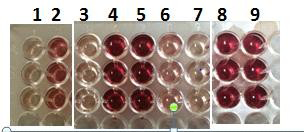
| File | Sweetener | Glucose (mg/dL) |
|---|---|---|
| 1 | GO reagent blank | 0 |
| 2 | Glucose standard | 100 |
| 3 | Saccharin | 0 |
| 4 | Sucralose | 281 |
| 5 | Bee Honey | 255 |
| 6 | Stevia. | 60 |
| 7 | Aspartame | 0 |
| 8 | Maple syrup | 238 |
| 9 | Table sugar | 315 |
Table1: Glucose concentration in the solutions of the different sweeteners by Glucose oxidase method.
Natural sugar: honey, 255mg/dL, maple syrup, 238 mg/ dL and table sugar, 315 mg/dL, have very high glucose values, sweeteners have concentrations: sucralose, 281 mg/ dL, stevia, 60 mg/dL, aspartame, 0 mg/dL. Sucralose its sweetening power is approximately 600 times sweeter than sucrose. At some point the intake of saccharin was associated with the appearance of cancer, which was not can be used in foods that have been cooked, because it decomposes at high temperatures, the sucralose is 3.3 times sweeter than aspartame, it is not suitable for foods that have been cooked, because loses its sweetness when heated. Stevia is 250-300 times sweeter than sucrose. Are sweeteners really an alternative in the control and management of a diabetic patient? Can they influence the natural history of the disease in patients with diabetes? Are sweeteners a reality for calorie consumption and glycemic control in diabetes? Sucralose has values equal to natural sugars, so its consumption should be regulated or avoided as it could influence the increase glycemia, or overweight or obesity and affect glycemic control in patients with diabetes mellitus. It is important to inform the community about the use of sucralose due to its caloric and energetic value or it should be discreetly consumed due to their caloric content is low.
Conclusion
People with obesity and a diagnosis of Diabetes should avoid consuming more glucose to prevent hyperglycemia. In the same way, they should monitor the stability, storage free of moisture and above all not ingest sweeteners preserved in their handbag, since these give positive results to the glucose-oxidase test indicating the presence of free glucose. Therefore, strict biotechnological techniques must be implemented to cover a broad spectrum of applications for understanding the potential benefits offered by sweeteners.
Conflict of Interest
All Authors declared there is no conflict of interest
References
-
Kujur RS, Singh V, Ram M, Yadava HN, Singh KK, et al. (2010) Antidiabetic activity and phytochemical screening of crude extract of Stevia rebaudiana in alloxan-induced diabetic rats. Pharmacognosy Research (2): 258-263.
-
Holvoet P, Rull A, Heredia AG, Lopez-Sanromà S, Geeraert B, Joven J, Camps J. et al. (2015) Stevia-derived compounds attenuate the toxic effects of ectopic lipid accumulation in the liver of obese mice: A transcriptomic and metabolomics study. Food and Chemical Toxicology 77: 22-33.
-
Ena G, Shalini P, Shanthy S, Prashasti T, Gyanendra G (2016) Stevioside and Rebaudioside A Predominant Ent-Kaurene Diterpene Glycosides of Therapeutic Potential–a Review. Czech Food Sci 34(4): 28-299.
-
Pezzuto John M, Compadre Cesar M, Swanson Steven M, Dhammika Nanayakkara NP, Douglas Kinghorn A (1985) Metabolically activated steviol, the aglycone of stevioside, is mutagenic. Proc Nati Acad Sci USA (82): 2478-2482.
-
Matsui M, Matsui K, Kawasaki Y, Oda Y, Noguchi T, et al. (1996) Evaluation of the genotoxicity of stevioside and steviol using six in vitro and one in vivo mutagenicity assays. Mutagenesis 11(6): 573-579.
-
Chattopadhyay S, Raychaudhuri U, Chakraborty R (2014) Artificial sweetener: a review. J Food Sci Technol 51(4): 611-621.
-
Food Drug Administration (1998) Food Additives Permitted for Direct Addition to Food for Human Consumption; Sucralose Federal Register 63(64): 21.
-
(2011) European Food Safety Authority. Statement of EFSA on the scientific evaluation of two studies related to the safety of artificial sweeteners.
-
Bray George A, Popkin Barry (2014) Dietary Sugar and Body Weight: Have We Reached a Crisis in the Epidemic of Obesity and Diabetes?. Health Be Damned! Pour on the Sugar Diabetes Care 37(4): 950-956.
-
Rippe, JM, Angelopoulos TJ (2015) Sugars and Health Controversies: What Does the Science Say?. Adv Nutr 6: 493S-503S.
-
Stanhope Kimber L (2016) Sugar consumption, metabolic disease and obesity: The state of the controversy. Crit Rev Clin Lab Sci 53(1): 52-67.
-
Brian Robert H, George R, Dhanush H (2018) The Influence of Sugar and Artificial Sweeteners on Vascular Health during the Onset and Progression of Diabetes. FEBS Journa 32(S1): 603.20-603.20.
-
Stephens-Camacho NA, Valdez-Hurtado S, Lastra-Zavala G, Félix-Ibarra LI (2018) Consumption of Non- nutritive Sweeteners: Cellular and Metabolic Effects. Perspect Nutr Humana (20): 185-202.
-
Shokat S, Iqbal R, Yaqub A, Shahid A, Riaz S (2021) Analysis of Environmental Pollutants as Diabetogenic Agent in the Patient Suffering from Diabetes Mellitus. Diabetes Obes Int J 2021: 6(1).
-
Dong S, Liu G, Zhang B, Gao L, Zheng M (2013) Formation of polychlorinated naphthalenes during the heating of cooking oil in the presence of high amounts of sucralose. Food Control 32(1): 1-5.
-
Pang MD, Goossens GH, Blaak EE (2021) The Impact of Artificial Sweeteners on Body Weight Control and Glucose Homeostasis. Front Nutr (7): 598340.
-
Francisco Javier RO, Julio PD, Maria Jose SL, Angel G (2019) Effects of Sweeteners on the Gut Microbiota: A Review of Experimental Studies and Clinical Trials. Adv Nutr 10(S1): S31-S48.
- Capacity Constraints in Pediatric Inpatient Psychiatric Care: A Cross-Sectional Analysis of Bed Availability and Geographic Access in North Carolina
- Why Healthcare Analytics Still Optimizes the Wrong Things
- Coding, Coverage, and Care: The Infrastructure of Transgender Health Inequities
- The Effect of Classroom Attendance on Academic Achievement of Management and Leadership Discipline of Nursing Students at Instituto Superior Cristal and Universidade de Dili, Timor-Leste, 2024: A Case Study
- The Role of Social Bonds in Facilitating Shared Investments and Resource Allocation: Addressing the “Wrong Pocket Problem” in Public Health and Healthcare
- Social-Cultural Factors Contributing to Antimicrobial Resistance in Livestock Farmers and Community Households in Kayonza District, Rwanda