
Advancing Quality in Health Economics and Dentistry: A Comprehensive Review
This review delves into the intersection of precision-driven healthcare and economic considerations within dentistry. Emphasizing meticulous care and resource allocation, it draws on seminal literature to present qualitative narratives of resilience and transformative experiences. Technology is highlighted as a promising catalyst, but challenges underscore the need for a universal lexicon in healthcare quality evaluation. Beyond scholarly discourse, the exposition becomes a chronicle of the human spirit, navigating the complex healthcare landscape. It encapsulates triumphs, reflecting not just metrics but the shared humanity in dental interventions and economic decisions. In the pursuit of quality, it portrays a scientific account marked by resilience, innovation, and commitment, shaping a healthcare environment where each individual's journey unfolds with enduring well-being and joyous smiles.
Introduction
Quality in healthcare is a multifaceted construct that goes beyond clinical aspects, extending into the economic dimension of healthcare delivery. In the specialized field of dentistry, the intersection of quality and economics shapes the scope of dental care in a nuanced manner. The quest for quality in healthcare is intricately tied to the effectiveness of services and patient satisfaction [1]. This review aims to delve deeply into the multiverse of quality within the realms of health economics and dentistry, analyzing recent literature to elucidate the challenges and opportunities that define the progression of quality in these crucial fields.
The literature review for this manuscript was conducted using a systematic approach to ensure a comprehensive and rigorous analysis of relevant scholarly works. The research question guiding the review focused on understanding the multifaceted nature of quality in health economics and dentistry. A systematic search strategy was employed, utilizing major academic databases such as PubMed, Scopus, and Web of Science. The search terms included variations of “quality in health economics,” “quality in dentistry,” and related keywords. The inclusion criteria encompassed peer-reviewed articles published within the last decade, written in English, and directly addressing the intersection of quality, health economics, and dentistry. To ensure the relevance and validity of the selected literature, exclusion criteria were applied, excluding studies not directly related to the core themes or lacking empirical evidence. Additionally, efforts were made to include diverse perspectives and encompass various study designs, such as systematic reviews, meta-analyses, and primary research articles.
Quality in Health Economics
Quality in health economics is a versatile concept that extends beyond financial considerations, encompassing a holistic approach to healthcare. This involves factors such as efficiency, accessibility, and effectiveness [2]. In health economics, quality entails optimizing resource allocation to achieve the best possible health outcomes. This includes considerations of cost-effectiveness, aiming to maximize health benefits from available resources. Equitable distribution of healthcare services to all segments of the population is an essential component of quality in health economics [3].
Furthermore, healthcare quality is extensively linked to patient outcomes and satisfaction. Effectiveness in health economics means not only delivering medical interventions but also achieving positive health results and patient well- being. Emphasizing individual preferences, needs, and values, plays a pivotal role in determining healthcare quality. Ongoing research and evaluation are essential to maintain quality in health economics, involving the analysis of health policies, interventions, and healthcare delivery models for continuous improvement and adaptation to evolving societal needs. This process also includes developing metrics and indicators to assess and monitor the performance of healthcare systems, assuring that they meet the highest quality standards.
Quality in Dentistry
Dentistry, as a specialized branch of healthcare, emphasizes delivering high-quality services that go beyond technical prowess. This involves establishing effective, safe, and patient-centered dental care. High-quality dental services consider clinical expertise, patient contentment, and adherence to ethical standards [4].
Clinical excellence is fundamental to quality in dentistry, covering the proficiency of dental practitioners in various procedures, from routine preventive care to intricate treatments. Maintaining elevated clinical benchmark requires continuous education and training to stay updated on advancements in dental techniques and technologies [5, 6, 7, 8, 9, 10]. Embracing evidence-based practices enhances overall dental care quality.
Another dimension of quality in dentistry involves the integration of the latest technological advancements. Incorporating digital technologies, diagnostic tools, and treatment modalities enhances precision, efficiency, and overall patient care [4]. Staying current with technological innovations is pivotal for dental practitioners to offer high- quality, state-of-the-art services. Quality assurance in dentistry requires continuous monitoring and improvement, involving regular audits, feedback mechanisms, and peer reviews [11]. Moreover, following infection control protocols and prioritizing patient safety are important for upholding quality in dental practice.
Need for High-Quality Economic Evaluations in Dentistry
Dentistry, a cornerstone of overall health and well-being, places substantial emphasis on oral health within the broader healthcare spectrum. In recent years, high-quality economic evaluations in dentistry have gained prominence. Economic evaluations are indispensable for systematically assessing the efficiency, cost-effectiveness, and overall impact of dental interventions and practices [3].
Similar to other branches of healthcare, dentistry faces resource constraints, necessitating judicious resource allocation to maximize health outcomes. High-quality economic evaluations offer a systematic framework for scrutinizing the economic implications of various dental interventions, from regular prophylactic care to complex treatments [12]. Understanding the economic aspects of dentistry is necessary for stakeholders and practitioners to make informed decisions that strike a balance between cost considerations and the delivery of quality oral healthcare services [10].
In the contemporary era of value-based healthcare, where the focus is on achieving the best possible outcomes for patients relative to the resources invested, high- quality economic evaluation plays a central role [13]. These evaluations establish the value of different dental interventions by considering not only their clinical efficacy but also their economic efficiency. This shift towards value- based care aligns with the broader goals of promoting patient-centered and sustainable healthcare practices within dentistry.
Technology: Catalyst for Transformation
Bayramzadeh, et al. [4] exploration of technology integration in complex healthcare environments serves as a catalyst for transformation in dentistry. The digital era brings forth myriad opportunities to enhance precision, efficiency, and accessibility in dental care. From teledentistry to digital diagnostics, technology integration offers solutions to traditional challenges and opens new frontiers for improving the quality of care. Understanding the economic impact of these technologies and securing their seamless integration into the existing fabric of dental practice is critical for improving the quality of care.
Tonmukayakul, et al. [14] systematic review highlighted the economic evaluations in dentistry, providing a methodological lens for understanding the existing body of literature that offered insights into key findings and acknowledged the gaps in the current research. The synthesis of publications on economic evaluation underscores the diverse approaches employed to assess the economic aspects of dental care. From cost-effectiveness analyses to broader economic evaluations, the literature reflects growing awareness of the economic implications of dental interventions [15].
The economic implications of technology adoption, the need for training and upskilling of dental professionals, and ethical considerations surrounding data security and patient privacy are pressing facets that require thoughtful navigation. By acknowledging these complexities, dental practitioners, decision-makers, and researchers can harness technology as a tool for quality enhancement, rather than viewing it as a panacea.
Quality Measures for Dental Care
Quality measures in dental care enclose a diverse set of fundamentals designed to assess and enhance various aspects of oral health. These measures go beyond clinical proficiency, extending to factors such as patient experience, safety, and the effectiveness of preventive and therapeutic interventions [12, 16, 17]. By establishing quantifiable benchmarks, quality measures can provide a framework for evaluating the performance of dental practices and facilitating continuous quality improvement.
Components of Dental Care Quality Measures
1. Clinical Effectiveness: Assessing the clinical outcomes of dental interventions, including treatment success, disease prevention, and overall oral health improvement.
2. Patient Satisfaction: Gauging the experiences and contentment of patients in their interactions with dental practitioners, from appointment scheduling to post- treatment follow-up.
3. Preventive Care: Evaluating the effectiveness of preventive measures, such as routine check-ups, cleanings, and patient education, in averting oral health issues.
4. Safety Protocols: Ensuring compliance with infection control procedures, ethical standards, and patient safety protocols during dental procedures.
5. Timeliness and Accessibility: Measuring the accessibility and promptness of dental services, including appointment availability and timely delivery of care.
Economic evaluations serve as a pillar in the enhancement of dental-care quality, providing a systematic framework for assessing the cost-effectiveness of interventions. By integrating economic considerations into decision-making processes, practitioners and policymakers can optimize resource allocation, confirming that limited resources are directed towards interventions that yield the maximum benefit [18].
Systematic reviews and quality appraisals of economic evaluations not only shed light on the methodological rigor of existing studies but also guide future research. By emphasizing the need for transparency, consistency, and relevance in economic evaluations, Tonmukayakul, et al. [10] laid the groundwork for a robust evidence base that informs both the clinical and economic dimensions of dental care. Shariati, et al. [2] findings serve as a catalyst for elevating the dialogue around the economics of dentistry, emphasizing its integral role in the domain of high-quality care. Also, insights from previous literature advocate for a more equitable distribution of resources, assuring that economic barriers do not compromise access to quality dental care. By addressing these economic considerations, stakeholders can collectively work towards progression in healthcare, where quality is not only defined by clinical excellence but is also measured by its accessibility and affordability.
Challenges and Opportunities
Although strides have been made to understand and enhance quality in health economics and dentistry, challenges persist, and opportunities for improvement continually emerge (Figure 1).
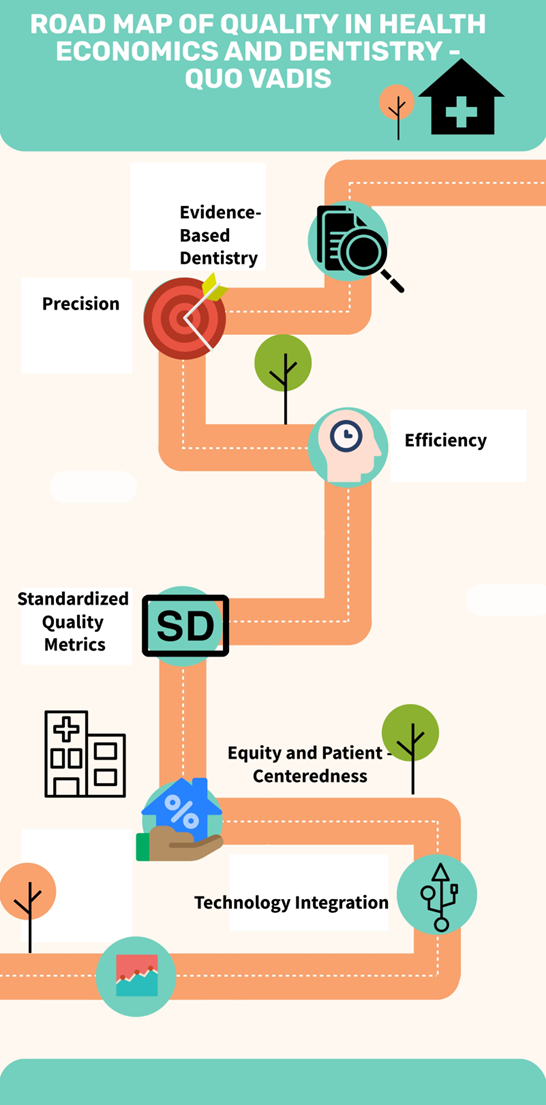
Standardizing Quality Metrics: A Unified Framework
One persistent challenge is the need for standardized metrics that capture diverse aspects of care in both health economics and dentistry. Previous studies shed light on ongoing efforts to develop comprehensive quality indicators, aiming to provide a unified framework for assessing and improving quality in these domains.
As we explore this challenge, human stories amalgamated with the development of these metrics come to the forefront. Experts working collaboratively endeavor to close knowledge gaps and address the practical implications for healthcare providers who face the challenge of navigating and adhering to continually evolving standards.
One notable challenge highlighted by Righolt, et al. [12] and Tonmukayakul, et al. [14] is the need for standardized metrics to capture diverse aspects of care in dentistry. The absence of a unified framework hinders benchmarking and comparative analyses.
Technology Integration
Technological advancements hold promise for enhancing precision, efficiency, and accessibility in healthcare delivery [4, 5]. However, the implementation of technology requires careful consideration to avoid potential pitfalls and align with the principles of patient-centered care.
As we navigate the complexities of standardized metrics and technology integration, it becomes evident that these are not abstract challenges but tangible hurdles that individuals in the healthcare ecosystem must confront.
The challenges in technology integration include issues related to data security, privacy, and the potential for depersonalization of patient care [19]. Protecting the confidentiality of patient information and maintaining essential human connections in dental practice are paramount. The learning curve associated with adopting new technologies, particularly for older practitioners, presents additional challenges that require targeted training and support strategies.
Precision and Efficiency in Healthcare Delivery
While promising, the integration of technology poses challenges related to responsible adoption and implementation. Previous literatures underscore the importance of imbalance between technology and human- centric care. The integration of technology requires ongoing evaluation, adaptation, and a commitment to ensure that technology enhances, rather than replaces, the essential human connection in dental care [20].
Human-Centric Care in The Era of Technology
The human-centric approach to technology integration involves not just adopting innovations for the sake of progress but carefully considering how these technologies impact the overall patient experience [21].
Opportunities for Improvement
Although challenges exist, opportunities for improvement through technology integration are immense. Digital diagnostics, teledentistry, and electronic health records can streamline workflows, enhance communication, and improve the overall efficiency of dental practice. The integration of technology has become a tool for optimizing resource utilization, reducing administrative burden, and ultimately contributing to the delivery of high-quality patient- centered care. Striking the right balance between efficiency and humanity requires ongoing evaluation, adaptation, and a commitment to prioritize the needs and preferences of patients.
Conclusion
In conclusion, the concept of quality in health economics and dentistry is dynamic, intertwined with the experiences of practitioners, researchers, policymakers, and, most significantly, patients. The development of comprehensive quality indicators and the use of technology have become integral components in shaping the healthcare that prioritizes excellence in both health economics and dentistry. It involves collaboration, adaptability, and shared dedication to warrant that every facet of dental care aligns with the principles of effectiveness, efficiency, equity, and patient-centeredness.
• Future Recommendations Ongoing efforts to standardize quality metrics and leverage technology responsibly provide a roadmap for the future. This roadmap envisions a healthcare landscape that continues to evolve, prioritizing excellence in both health economics and dentistry. This serves as a reminder that the pursuit of quality is not an endpoint but a continual process of adaptation, learning, and collaboration.
References
-
Listl S, Weyant R (2019) For Careful Consideration: The Reporting of Health Economic Evaluations in Dentistry. J Public Health Dent 79(4): 273-274.
-
Shariati B, MacEntee MI, Yazdizadeh M (2013) The Economics of Dentistry: A Neglected Concern. Community Dent Oral Epidemiol 41(5): 385-394.
-
Beck N, Choi SE, Barrow J (2022) The Need for High- Quality Economic Evaluations in Dentistry. Int Dent J 72(3): 266-268.
-
Bayramzadeh S, Aghaei P (2021) Technology Integration in Complex Healthcare Environments: A Systematic Literature Review. Appl Ergon 92: 103351.
-
Christell H, Birch S, Horner K, Lindh C, Rohlin M (2014) Economic Evaluation Of Diagnostic Methods Used in Dentistry. A systematic review. J Dent 42(11): 1361- 1371.
-
Tay JRH, Ng E, Nair R, Tan ZS, Tan SHX (2021) Economic Evaluations in the Treatment and Evaluation of Patients with Periodontal Disease: A Critical Review. J Clin Periodontol 48(5): 679-694.
-
Ko L, Thiessen KM (2015) A Critique of Recent Economic Evaluations of Community Water Fluoridation. Int J Occup Environ Health 21(2): 91-120.
-
Nguyen TM, Tonmukayakul U, Le LK, Calache H, Mihalopoulos C (2023) Economic Evaluations of Preventive Interventions for Dental Caries and Periodontitis: A Systematic Review. Appl Health Econ Health Policy 21(1): 53-70.
-
Mariño R, Zaror C (2020) Economic Evaluations in Water-Fluoridation: A Scoping Review. BMC Oral Health 20(1): 115.
-
Tonmukayakul U, Sia KL, Gold L, Hegde S, de Silva AM, Moodie M (2015) Economic Models of Preventive Dentistry for Australian Children and Adolescents: A Systematic Review. Oral Health Prev Dent 13(6): 481-94.
-
Stoumpos AI, Kitsios F, Talias MA (2023) Digital Transformation in Healthcare: Technology Acceptance and Its Applications. Int J Environ Res Public Health 20(4): 3407.
-
Righolt AJ, Sidorenkov G, Faggion CM, Listl S, Duijster D (2019) Quality Measures for Dental Care: A Systematic Review. Community Dent Oral Epidemiol 47(1): 12-23.
-
Obadan-Udoh EM, Calvo JM, Panwar S, Simmons K, White JM, et al. (2019) Unintended Consequences and Challenges of Quality Measurements in Dentistry. BMC Oral Health 19(1): 38.
-
Tonmukayakul U, Calache H, Clark R, Wasiak J, Faggion CM (2015) Systematic Review and Quality Appraisal of Economic Evaluation Publications in Dentistry. J Dent Res 94(10): 1348-1354.
-
Ramsay CR, Clarkson JE, Duncan A, Lamont TJ, Heasman PA, et al. (2018) Improving the Quality of Dentistry (IQuaD): a cluster factorial randomised controlled trial comparing the effectiveness and cost-benefit of oral hygiene advice and/or periodontal instrumentation with routine care for the prevention and management of periodontal disease in dentate adults attending dental primary care. Health Technol Assess 22(38): 1-144.
-
Roberts MB (2013) Dental Quality Alliance: measuring quality in dentistry. Tex Dent J 130(10): 1006-1009.
-
Listl S (2019) Value-Based Oral Health Care: Moving Forward with Dental Patient-Reported Outcomes. J Evid Based Dent Pract 19(3): 255-259.
-
Fransson H, Davidson T, Rohlin M, Consortium FR, Christell H (2021) There is a Paucity of Economic Evaluations of Prediction Methods of Caries and Periodontitis-A Systematic Review. Clin Exp Dent Res 7(3): 385-398.
-
Estai M, Kanagasingam Y, Tennant M, Bunt S (2018) A Systematic Review of the Research Evidence for the Benefits of Teledentistry. J Telemed Telecare 24(3): 147- 156.
-
Bell LB (1973) Reciprocity vs Quality Dentistry. Fla Dent J 44(3): 1.
-
Tan SHX, Vernazza CR, Nair R (2017) Critical Review of Willingness to Pay for Clinical Oral Health Interventions. J Dent 64: 1-12.
- Capacity Constraints in Pediatric Inpatient Psychiatric Care: A Cross-Sectional Analysis of Bed Availability and Geographic Access in North Carolina
- Why Healthcare Analytics Still Optimizes the Wrong Things
- Coding, Coverage, and Care: The Infrastructure of Transgender Health Inequities
- The Effect of Classroom Attendance on Academic Achievement of Management and Leadership Discipline of Nursing Students at Instituto Superior Cristal and Universidade de Dili, Timor-Leste, 2024: A Case Study
- The Role of Social Bonds in Facilitating Shared Investments and Resource Allocation: Addressing the “Wrong Pocket Problem” in Public Health and Healthcare
- Social-Cultural Factors Contributing to Antimicrobial Resistance in Livestock Farmers and Community Households in Kayonza District, Rwanda