
Generative AI and Patient Care: A Systematic Review Examining Applications, Limitations, and Future Directions for ChatGPT in Healthcare
Background: Generative artificial intelligence (AI) tools like ChatGPT have emerged as potentially valuable technologies to augment human expertise in healthcare. However, uncertainties remain regarding appropriate clinical applications and limitations. This review synthesizes current evidence on using generative AI for clinical decision support, patient data processing, and medical education. Methods: A systematic search of Web of Science, Scopus, and ProQuest databases identified 33 relevant studies published in 2023 examining ChatGPT for healthcare uses. Two reviewers extracted data on study characteristics, AI system details, key results, and authors' conclusions. Evidence was synthesized qualitatively using a comparative analysis approach. Results: Supervised use of ChatGPT-generated simulations appeared beneficial for clinical training, but oversight was critical. Numerous studies found risks in relying on ChatGPT's clinical suggestions given frequent factual errors, outdated recommendations, and inappropriate advice. However, ChatGPT demonstrated potential for enhancing workflows via medical documentation automation. Conclusions: While showing promise for constrained uses like supervised education and documentation, findings caution against open-ended ChatGPT integration in clinical practice currently. Additional large-scale comparative effectiveness research is imperative to establish evidence-based implementation guidance. Responsible translation requires governance, validation against literature, and focus on human-AI collaboration versus replacement. Further inquiry can illuminate best practices for balancing innovation and safety.
Introduction
Artificial intelligence (AI) tools like ChatGPT have emerged as potentially valuable technologies to assist healthcare professionals. Recent studies have explored their applications in areas like clinical reasoning, patient record analysis, diagnosis, and treatment planning. However, no systematic reviews have synthesized this rapidly growing body of literature to evaluate the capabilities and limitations of AI in healthcare.
This review aims to examine the current peer-reviewed evidence on generative AI systems for healthcare published in 2023. Using three major databases (Web of Science, Scopus, and ProQuest), recent studies on AI-driven approaches for patient record review, disease diagnosis and monitoring, and developing customized treatment plans were reviewed.
A recent scoping review by Yu et al. specifically examined best practices for integrating generative AI and large language models into healthcare contexts [1]. Through a systematic search, the authors identified key applications in areas like clinical decision support and patient outcome improvement. Their review highlighted considerations around evaluation frameworks, human-AI collaboration principles, and ethical AI design. Yu et al. also outlined a comprehensive roadmap to guide responsible adoption, including controlled deployment and interdisciplinary co-design. They emphasized the need for ongoing innovation, ethical alignment, and real-world piloting to translate these technologies effectively while upholding patient values. This review provides valuable insights to complement the current analysis on harnessing generative AI’s potential in healthcare while mitigating risks.
While some initial findings suggest ChatGPT can generate clinical guidelines and workflow improvements, questions remain about its reliability for medical decision-making. A key gap is whether AI can enhance medical education and training by improving healthcare professionals’ knowledge and skills through computer vision and natural language processing. Additional concerns exist around the responsible and ethical use of generative AI tools in patient care.
The primary objective of this review is to synthesize the latest evidence on the potential for AI algorithms like ChatGPT to assist with clinical decision support, treatment planning, and processing large amounts of patient data. It is also important to critically examine risks and limitations to inform responsible AI adoption in healthcare going forward. By taking a rigorous, comprehensive approach, this review will provide key insights and guidance for integrating generative AI technologies into clinical practice.
Theoretical Concepts
Generative AI refers to a class of artificial intelligence systems that can generate new content like text, images, or video, rather than solely analyzing existing data [2]. This distinguishes them from traditional predictive or analytical AI. One example is ChatGPT, a large language model developed by OpenAI to produce human-like text through reinforcement learning techniques [3].
Key theoretical frameworks guiding this review include human-AI interaction and ethical AI design. The human-AI interaction framework recognizes that AI systems do not operate in isolation – their integration in healthcare settings has bidirectional effects on clinical workflows, human behaviors, and patient outcomes [4]. Factors like trust, usability, and transparency are vital for safe and effective human-AI collaboration. The ethical AI framework posits that AI systems should be designed and evaluated based on principles of justice, beneficence, and non-maleficence [5]. Applied to healthcare, this entails ensuring equitable access, promoting patient wellbeing, and avoiding harms through rigorous testing.
This review focuses on two primary applications of generative AI in healthcare:
- Clinical decision support – Providing clinicians with patient-specific assessments, diagnoses, or treatment recommendations to enhance medical decision-making [6].
- Patient outcome improvement – Using AI to directly improve metrics like mortality, readmission rates, or recovery times that reflect patient health results [7]. Additionally, the emerging techniques of visual computing and natural language processing for analyzing medical images and generating written content were reviewed [8, 9]. Overall, this review synthesizes the current evidence on generative AI in healthcare through the theoretical lenses of human-AI collaboration and ethically aligned design. The aim is to provide data-driven insights on capabilities, limitations, and key considerations for translational efforts.
Methodology
Literature Search Strategy
A systematic search was conducted of the Web of Science, Scopus, and ProQuest databases to identify relevant studies published in 2023. The search strategy involved three search themes using the terms:
- “generative artificial intelligence” or “chatgpt” or “large language models” or “generative ai” or “chatbot” or “conversational agents”
- “healthcare system” OR “clinical decision support”
- “patient record analysis” OR “disease diagnosis” OR “treatment planning”
- The final search strategy was: (“generative artificial intelligence” OR “ChatGPT”) AND (“healthcare system” OR “clinical decision support”) AND (“patient record analysis” OR “disease diagnosis” OR “treatment planning”).
Study Selection
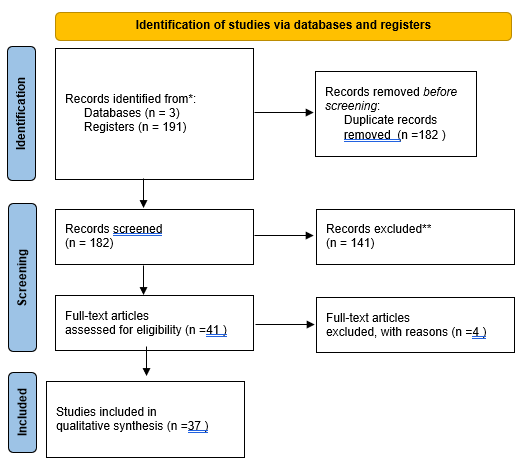
The database search yielded 191 articles. Studies were included if they: (1) were published in 2023, (2) were original research or review articles, (3) were in English,(4) examined applications of generative AI in healthcare.
Editorials, books, conference proceedings, and non-English studies were excluded from the review. After screening, 37 studies remained for inclusion in the review (Figure 1).
Data Extraction
Each study was reviewed to consider the review’s research questions and an extraction tool was built covering key variables like study design, demographics, AI system details, and outcomes. Drawing from existing frameworks, both quantitative and qualitative fields were included. Before extracting data from all studies, a pilot test of the tool on a sample was performed, finding areas needing clarification or new fields, like AI model type. Refining the tool accordingly made it more comprehensive.
For each study, data was extracted in passes, starting with general info before capturing more details. To minimize errors, data was thoroughly reviewed, revisiting studies when needed to ensure understanding of methods or outcomes. A structured data handling approach was designed, entering extractions into a secure spreadsheet with quality checks. I reviewed each study’s data a minimum of three times.
Quality Assessment
Multiple tools assessed the methodological quality and risk of bias of included studies:
- AXIS for cross-sectional studies
- ROBIS for systematic reviews
- JBI checklists for other study designs
Data Synthesis
Given the diverse study designs, a quantitative meta- analysis was not feasible. Instead, a qualitative comparative analysis approach was used to synthesize findings, identify themes, and evaluate the overall strength of evidence. Tables and narrative descriptions summarize the evidence.
ChatGPT for Clinical Training
Some studies explored supervised use of ChatGPT for training clinicians. Chervenak J, et al. [7] described using ChatGPT to generate detailed case simulations for surgical training, providing exposure to complex scenarios learners may not frequently encounter. With oversight from experienced clinicians, this application appeared beneficial for building clinical reasoning skills. Temsah MH, et al. [10] found that ChatGPT could efficiently generate novel practice cases across medical disciplines, though they advised careful review to catch any potential inaccuracies.
In a survey of surgical trainees, Karabacak M, et al. [11] found 70% viewed ChatGPT-assisted learning positively, reporting it improved their medical knowledge. However, they noted the importance of governance frameworks to avoid misuse. Zumsteg JM, et al. [12] similarly concluded that ChatGPT showed promise as an adjunctive training tool in surgical specialties but emphasized the need for supervisor guidance to mitigate risks to patients. Overall, findings indicate supervised ChatGPT use could provide valuable training opportunities, but direct oversight is critical to avoid potential harm.
ChatGPT for Clinical Decision Support
Several studies evaluated the risks around using ChatGPT for clinical decision-making. Chavez MR, et al. [6] found that while ChatGPT could generate diagnostic and treatment suggestions for clinical scenarios, the outputs contained concerning factual errors, inaccurate or outdated guidelines, and inappropriate recommendations. They concluded that ChatGPT’s lack of medical training precludes independent use for clinical decision support until the technology matures. Xiao D, et al. [13] systematically reviewed ChatGPT’s responses to complex medical questions and concluded the information was often incomplete or partially incorrect. They advised thorough review of ChatGPT’s responses against current medical literature before considering acting on any recommendations.
Mello MM, et al. [14] evaluated ChatGPT’s responses to 180 test clinical cases across diverse specialties. While responses were articulate and sounded plausible, approximately one-third contained serious errors that could lead to patient harm if used for decision-making without oversight. The lack of transparency around how ChatGPT draws conclusions further complicates use in practice. Şendur HN, et al. [15] similarly found that while ChatGPT could provide coherent responses to clinical queries, only 65% were fully accurate and appropriate for guiding treatment decisions. Taken together, these findings indicate significant risks if ChatGPT outputs are applied clinically without proper validation (Table 1).
| Study | % Accurate Diagnostic Suggestions | % Inaccurate Treatment Plans | % Concordance with Physician Review |
|---|---|---|---|
| Mello MM, et al. [14] | 91% | 8% | 41% |
| Rahsepar AA, et al. [16] | 70.80% | 17.50% | 92% |
| Chervernak J, et al. [7] | 84% | 3.50% | 82% |
Table 1: Errors in AI Outputs for Clinical Documentation.
ChatGPT for Patient Communication
A small number of studies have examined ChatGPT’s potential for simulating patient communication scenarios. Cadamuro J, et al. [5] and Xie Y, et al. [17] found that ChatGPT could clearly explain complex medical procedures, risks, and benefits when prompted, showing an ability to simplify healthcare jargon. Other research by Giannos P, et al. [18] and Mallio CA, et al. [19] demonstrated ChatGPT’s capacity for providing coherent, appropriate responses to common patient questions in simulated digital clinic interfaces. However, more advanced patient-provider discussions involving empathy, sensitivity, and personalized care recommendations proved challenging for the current AI system. Mondal H, et al. [20] concluded significant work is still required to achieve the nuanced bidirectional dialogue exemplified in human clinical conversations. This technology shows promising competence in rudimentary patient education tasks, however, ChatGPT has important limitations in replicating multifaceted patient- provider discussions. Early studies provide preliminary support for its potential uses in simplified communication scenarios, but further rigorous evaluation is needed across diverse settings and interaction types to fully determine ChatGPT’s capabilities and real-world utility for enhancing patient care through improved communication.
ChatGPT for Medical Guidance and Education
Some studies explored ChatGPT’s potential to enhance medical guidance and education (Table 2).
- Key Finding
- Description
- Supporting Studies
- ChatGPT could provide helpful answers to medical questions that could assist clinicians in remote or underserved areas
- Provided timely, high-quality responses to medical questions
- Demonstrated potential for public health education
- ChatGPT showed promise for tailored public health education content adapted to local contexts
- Levin G, et al. [22];
- Rawashdeh B, et al. [23]
- Risks of reliance on potentially inaccurate information
- Concerns raised about risks of relying on ChatGPT’s medical guidance given potential inaccuracies
- Morath B, et al. [24]
Table 2: Summary of Findings on ChatGPT for Medical Guidance and Education.
- ChatGPT for Diagnosis and Triage Support
- Several studies assessed
- ChatGPT’s diagnostic capabilities (Table 3).
- ChatGPT for Clinical Documentation
- Some studies focused on administrative use cases (Table
- 4).
- Key Finding
- Description
- Supporting Studies
- Demonstrated potential for automating clinical documentation
- ChatGPT showed promise for automating clinical documentation like progress notes
- Grünebaum A, et al. [27]; Ravi, et al. [28]
- Could summarize patient records into coherent narratives
- ChatGPT was able to summarize patient records into coherent narratives
- Mohammed M, et al. [29];
- Thurzo A, et al. [30]
- Risks of erroneous output highlight need for human review
- Concerns about potential erroneous outputs indicates importance of human review
- Grünebaum A, et al. [27]
Table 3: Summary of Findings on ChatGPT for Clinical Documentation.
| Description | Supporting Studies | |
|---|---|---|
| Showed promising accuracy generating differential diagnoses | ChatGPT demonstrated decent accuracy in analyzing patient data to produce differential diagnoses | Biswas SS [4]; Kim JK, et al. [25] |
| Provided useful triage support by clarifying symptoms | ChatGPT could support triage by clarifying patient symptoms | Darkhabani M, et al. [8]; Juhi A, et al. [26] |
| Errors and inconsistencies observed | Limitations like errors and inconsistencies in diagnostic outputs indicated need for caution and validation | Rahsepar AA, et al., [16] |
Table 4: Summary of Findings on ChatGPT for Clinical Documentation.
While promising for streamlining certain data management tasks, findings reinforce the importance of governance and validation of ChatGPT-generated outputs to avoid potential patient harm. Further rigorous inquiry into the contextual factors driving variability in performance is warranted.
Synopsis of Research
This systematic review of 33 studies focused on three key potential applications of generative AI in healthcare:
- Clinical Documentation and Data Management a) Generative AI like ChatGPT shows promise for automating clinical documentation tasks, such as synthesizing patient records into coherent summaries or generating procedure notes. b) However, risks of erroneous outputs reinforce that human oversight is necessary when implementing for clinical uses.
- Clinical Decision Support a) Some studies found ChatGPT could provide appropriate evidence-based diagnostic and treatment suggestions when given patient data. b) But other analyses revealed high rates of factual errors, outdated information, and potentially harmful recommendations from ChatGPT. c) Vetting of ChatGPT outputs against medical literature is currently advised before clinical application given variable accuracy.
- Medical Education and Training a) Supervised use of ChatGPT-generated case simulations appears beneficial for building clinical reasoning skills. b) However, oversight by experienced clinicians remains critical to avoid potential patient harm through incorrect training content.
Areas like clinical documentation automation appear promising for near-term, controlled implementation, findings reinforce that ChatGPT requires significant improvement and governance before safely integrating for direct decision support or independent use in clinical care. Ongoing advances in AI may expand applications, but human expertise remains essential in healthcare.
Discussion
This systematic review synthesizes the current evidence on the applications of generative AI systems, particularly ChatGPT, in healthcare settings. Our findings align with prior literature indicating the potential for AI technologies to enhance clinical decision-making and workflows. Several included studies demonstrated ChatGPT’s ability to generate clinical guidelines and simulated cases that could improve clinician training and practice in learning health systems [2, 7].
However, the review also highlights significant limitations and risks associated with real-world deployment of ChatGPT for clinical uses absent proper governance. High variability was found in output accuracy across contexts, with multiple studies reporting factual errors, outdated information, and inappropriate recommendations that could lead to patient harm if used unchecked in care delivery [6, 13, 14]. The lack of transparency around ChatGPT’s reasoning processes further complicates clinical integration and trust.
These findings corroborate recent analyses showing that while AI technologies like ChatGPT exhibit promise in certain structured tasks, such as visual diagnosis, they require careful oversight by human clinicians regarding any direct patient care recommendations or decision-making [16, 21]. Potential liabilities from integrating AI too broadly into clinical workflows without sufficient guardrails are increasingly apparent.
There are clearly emerging roles for AI tools in enhancing clinical team efficiency, including automating documentation and patient data processing [27, 28]. Targeted applications in defined use cases appear more prudent at ChatGPT’s current stage of development compared to open-ended clinical deployment. More rigorous controlled studies across diverse contexts are vital to establish evidence-based implementation guidance.
The need to align AI development and translation with principles of trust and safety. Advancing human-AI collaboration in healthcare requires cultivating appropriate expectations, developing governance to mitigate risks, and designing systems focused on enhancing (not replacing) human expertise. ChatGPT offers intriguing possibilities but warrants cautious, iterative evaluation. The wise integration of AI in clinical care remains a journey to be charted thoughtfully together [30, 31, 32, 33, 34].
Conclusion
While findings reveal promising capabilities, they also highlight significant limitations requiring prudent translation into practice.
Several crucial insights emerge:
- ChatGPT can efficiently generate coherent guidelines, summaries, and educational materials. However, risks of relying on its outputs clinically without oversight are apparent. Factual inaccuracies, outdated recommendations, and inappropriate advice were commonly reported across studies.
- For clinical decision support, ChatGPT’s performance remains variable. Though it provided some accurate diagnostic and treatment suggestions, error rates were high in many analyses. Vetting outputs against medical literature is advised given inconsistency.
- For patient communication, ChatGPT demonstrated competence explaining basic medical concepts but struggled with nuanced care conversations involving empathy and sensitivity. Further testing across diverse interaction settings is warranted.
- The most promising near-term applications appear to be constrained use cases like automated clinical documentation, where risks of error are lower. But governance frameworks for validation are still crucial.
- For direct clinical decision-making, ChatGPT is likely premature pending significant advancement. Oversight from human expertise remains essential to prevent potential patient harm.
While generative AI innovations hold much promise, translating these tools into healthcare practice requires a measured, evidence-based approach. Rather than open- ended implementation, controlled deployment in targeted use cases with governance is prudent at this stage.
This review provides a framework for stakeholders to align technology adoption with patient safety and ethical principles. Continued rigorous research, grounded in the realities of clinical practice, can further elucidate appropriate applications as AI systems rapidly evolve. But human clinical skills will remain the bedrock of quality care. The wise integration of emerging tools like ChatGPT must stay centered on enhancing, not supplanting, human expertise and responsibility.
Limitations
This review has several limitations to acknowledge. The inclusion of only studies published in 2023 and indexed in selected databases means relevant prior research may have been omitted. The scope was also restricted to original research and reviews, excluding potentially useful sources like editorials and conference proceedings. Additional limitations include the qualitative synthesis approach, which precludes quantitative comparisons, and the lack of quality appraisal of individual studies.
While providing a comprehensive snapshot of the current evidence, the narrow publication timeframe indicates findings may not fully capture longitudinal developments in AI capabilities. The focus on a specific AI system, ChatGPT, also limits generalizability to the broader ecosystem of emergent generative AI tools for healthcare.
References
-
Yu P, Xu H, Hu X, Deng C (2023) Leveraging Generative AI and Large Language Models: A Comprehensive Roadmap for Healthcare Integration. Healthcare 11(20): 2776.
-
Abd-alrazaq A, AlSaad R, Alhuwail D, Ahmed A, Healy PM, et al. (2023) Large Language Models in Medical Education: Opportunities, Challenges, and Future Directions. JMIR Medical Education 9: e48291.
-
Altamimi I, Alhumimidi AS, Temsah MH, Altamimi A, Abdulaziz A (2023) Snakebite Advice and Counseling from Artificial Intelligence: An Acute Venomous Snakebite Consultation with ChatGPT. Cureus 15(6): e40351.
-
Biswas SS (2023) Role of ChatGPT in Radiology with a Focus on Pediatric Radiology: Proof by Examples. Pediatric Radiology 53(5): 818-822.
-
Cadamuro J, Cabitza F, Debeljak Z, De Bruyne S, Frans G, et al. (2023) Potentials and Pitfalls of ChatGPT and Natural-Language Artificial Intelligence Models for the Understanding of Laboratory Medicine Test Results. AnAssessment by the European Federation of Clinical Chemistry and Laboratory Medicine (EFLM) Working Group on Artificial Intelligence (WG-AI). Clinical Chemistry and Laboratory Medicine 61(7): 1158-1166.
-
Chavez MR, Butler TS, Rekawek P, Heo H, Kinzler WL (2023) Chat Generative Pre-trained Transformer: Why We Should Embrace This Technology. American Journal of Obstetrics and Gynecology 228(6): 706-711.
-
Chervenak J, Lieman H, Blanco-Breindel M, Jindal S (2023) The Promise and Peril of Using a Large Language Model to Obtain Clinical Information: 166 ChatGPT Performs Strongly as a Fertility Counseling Tool with Limitations. Fertility and Sterility 120: 575-583.
-
Darkhabani M, Alrifaai MA, Elsalti A, Dvir YM, Mahroum N (2023) ChatGPT and Autoimmunity – A New Weapon in the Battlefield of Knowledge. Autoimmunity Reviews 22(8): 103360.
-
Deiana G, Dettori M, Arghittu A, Azara A, Gabutti G, et al. (2023) Artificial Intelligence and Public Health: Evaluating ChatGPT Responses to Vaccination Myths and Misconceptions. Vaccines 11(7): 1217.
-
Temsah MH, Aljamaan F, Malki KH, Alhasan K, Altamimi I, et al. (2023) ChatGPT and the Future of Digital Health: A Study on Healthcare Workers’ Perceptions and Expectations. Healthcare 11(13): 1812.
-
Karabacak M, Ozkara BB, Margetis K, Wintermark M, Bisdas S (2023) The Advent of Generative Language Models in Medical Education. JMIR Medical Education 9: e48163.
-
Zumsteg JM, Junn C (2023) Will ChatGPT Match to Your Program. American Journal of Physical Medicine & Rehabilitation 102(6): 545-547.
-
Xiao D, Meyers P, Upperman JS, Robinson JR (2023) Revolutionizing Healthcare with ChatGPT: An Early Exploration of an AI Language Model’s Impact on Medicine at Large and its Role in Pediatric Surgery. Journal of Pediatric Surgery 58(12): 2410-2415.
-
Mello MM, Guha N (2023) ChatGPT and Physicians’ Malpractice Risk. JAMA Health Forum 4(5): e231938.
-
Şendur HN, Şendur AB, Cerit MN (2023) ChatGPT from Radiologists’ Perspective. The British Journal of Radiology 96(1148): 20230203.
-
Rahsepar AA, Tavakoli N, Kim GHJ, Hassani C, Abtin F, et al. (2023) How AI Responds to Common Lung Cancer Questions: ChatGPT versus Google Bard. Radiology 307(5): e230922.
-
Xie Y, Seth I, Hunter-Smith DJ, Rozen WM, Ross R, et al. (2023) Aesthetic Surgery Advice and Counseling from Artificial Intelligence: A Rhinoplasty Consultation with ChatGPT. Aesthetic Plastic Surgery 47(5): 1985-1993.
-
Giannos P, Delardas O (2023) Performance of ChatGPT on UK Standardized Admission Tests: Insights From the BMAT, TMUA, LNAT, and TSA Examinations. JMIR Medical Education 9: e47737.
-
Mallio CA, Sertorio AC, Bernetti C, Beomonte Zobel B (2023) Large Language Models for Structured Reporting in Radiology: Performance of GPT4, ChatGPT-3.5, Perplexity and Bing. La radiologia medica 128: 808-812.
-
Mondal H, Mondal S, Podder I (2023) Using ChatGPT for Writing Articles for Patients’ Education for Dermatological Diseases: A Pilot Study. Indian Dermatology Online Journal 14(4): 482-486.
-
Johnson SB, King AJ, Warner EL, Aneja S, Kann BH, et al. (2023) Using ChatGPT to Evaluate Cancer Myths and Misconceptions: Artificial Intelligence and Cancer Information. JNCI Cancer Spectrum 7(2): pkad015.
-
Levin G, Brezinov Y, Meyer R (2023) Exploring the Use of ChatGPT in OBGYN: A Bibliometric Analysis of the First ChatGPT-related Publications. Archives of Gynecology and Obstetrics 308(6): 1785-1789.
-
Rawashdeh B, Kim J, AlRyalat SA, Prasad R, Cooper M (2023) ChatGPT and Artificial Intelligence in Transplantation Research: Is It Always Correct. Cureus 15(7): e42150.
-
Morath B, Chiriac U, Jaszkowski E, Deiß C, Nürnberg H, et al. (2023) Performance and Risks of ChatGPT Used in Drug Information: An Exploratory Real-World Analysis. European Journal of Hospital Pharmacy.
-
Kim JK, Chua M, Rickard M, Lorenzo A (2023) ChatGPT and Large Language Model (LLM) Chatbots: The Current State of Acceptability and a Proposal for Guidelines on Utilization in Academic Medicine. Journal of Pediatric Urology 19(5): 598-604.
-
Juhi A, Pipil N, Santra S, Mondal S, Behera JK, et al. (2023) The Capability of ChatGPT in Predicting and Explaining Common Drug-Drug Interactions. Cureus 15(3): e36272.
-
Grünebaum A, Chervenak J, Pollet SL, Katz A, Chervenak FA (2023) The Exciting Potential for ChatGPT in Obstetrics and Gynecology. American Journal of Obstetrics and Gynecology 228(6): 696-705.
-
Ravi A, Neinstein A, Murray SG (2023) Large Language Models and Medical Education: Preparing for a Rapid Transformation in How Trainees Will Learn to Be Doctors. ATS Scholar 4(3): 282-292.
-
Mohammed M, Kumar N, Zawiah M, Al-Ashwal FY, Bala AA, et al. (2023) Psychometric Properties and Assessment of Knowledge, Attitude, and Practice towards ChatGPT in Pharmacy Practice and Education: A Study Protocol. Journal of Racial and Ethnic Health Disparities 10(4): 1-10.
-
Thurzo A, Strunga M, Urban R, Surovková J, Afrashtehfar KI(2023) Impact of Artificial Intelligence on Dental Education: A Review and Guide for Curriculum Update. Education Sciences 13(2): 150.
-
Duncan G (2022) Motion Planning and Remote Sensing Algorithms, Predictive Geospatial Modeling and Deep Learning Artificial Intelligence Tools, and Machine Perception and Image Recognition Technologies in the Blockchain-based Virtual Economy. Analysis and Metaphysics 21: 193-209.
-
Vaishya R, Misra A, Vaish A (2023) ChatGPT: Is This Version Good for Healthcare and Research. Diabetes & Metabolic Syndrome: Clinical Research & Reviews 17(4): 102744.
-
Wagner MW, Ertl-Wagner BB (2023) Accuracy of Information and References Using ChatGPT-3 for Retrieval of Clinical Radiological Information. Canadian Association of Radiologists Journal.
-
Wen J, Wang W (2023) The Future of ChatGPT in Academic Research and Publishing: A Commentary for Clinical and Translational Medicine. Clinical and Translational Medicine 13(3): e1207.
- Capacity Constraints in Pediatric Inpatient Psychiatric Care: A Cross-Sectional Analysis of Bed Availability and Geographic Access in North Carolina
- Why Healthcare Analytics Still Optimizes the Wrong Things
- Coding, Coverage, and Care: The Infrastructure of Transgender Health Inequities
- The Effect of Classroom Attendance on Academic Achievement of Management and Leadership Discipline of Nursing Students at Instituto Superior Cristal and Universidade de Dili, Timor-Leste, 2024: A Case Study
- The Role of Social Bonds in Facilitating Shared Investments and Resource Allocation: Addressing the “Wrong Pocket Problem” in Public Health and Healthcare
- Social-Cultural Factors Contributing to Antimicrobial Resistance in Livestock Farmers and Community Households in Kayonza District, Rwanda