
Save Lives – CUT Healthcare Spending
U.S. healthcare is facing intractable financial, medical, and legal problems. For individual Americans, medical care is both unaffordable and inaccessible. For the nation, spending is out of control, leading the country toward insolvency. Some patients die waiting in line: death-by-queue. Federal control of healthcare is both unconstitutional and illegal. The solution is to follow the law: remove control of healthcare from the federal government and place it in the hands of We the People. Return decision-making authority to patients, taking it away from third-parties. Allow free market forces to make health care affordable, available, and legal.
Introduction
Regarding healthcare, Americans tend to focus on its money problems, even though saving money is not the top priority – restoring health/saving lives IS. Interestingly, by cutting spending (erroneously called “costs”) healthcare can achieve its primary goal: good health.
To assure clear communication, healthcare can be one word or two, with very different meanings. As one word, healthcare refers to the system, a massive Byzantine structure of third-party payment and government regulation employing tens of millions of people. Health care as two words means the intimate, legally protected, confidential one-to-one fiduciary relationship between a medical care provider and a patient.
Methodology
Published literature was searched for articles, reports, and scientific data regarding function and dysfunction in healthcare systems globally with primary focus on the U.S. As there was evidence of political censorship of medical data [1, 2, 3, 4, 5, 6, 7, 8, 9, 10], in addition to traditional sources such as peer-reviewed publications, newspapers, official releases, and legacy media, alternate sources were searched such as substacks, podcasts, social media such as X (formerly Twitter), and non-legacy news outlets.
A systems theory approach was used to determine the root cause of healthcare system dysfunction.
Fiscal Concerns
Prices for medical services and goods are very high and keep rising. Care is unaffordable for most Americans. The nation is spending more than it can afford on its healthcare system. Healthcare is pushing the U.S. toward insolvency with a current national debt of $36 trillion, one third of the combined GDP of all nations on earth ($111 trillion) [11]. The U.S. is not only over-spending absolutely but relative to other nations. Last year, the United Kingdom healthcare system spent $3,918 per person while the U.S. spent $14,423 per person [12].
In 1960, Americans expended 5 percent of GDP on healthcare. In 2023, that cost was 17.5 percent [13]. As former President Obama said in 2009, the U.S. cannot sustain its upward spending curve on healthcare. The U.S. needs to cut spending on healthcare.
Not only is U.S. spending more than any other nation, and spending more than it can afford, but that spending is highly dollar inefficient. Efficient spending in healthcare is that amount that produces patient care, goods and/or services. Inefficient healthcare spending is for activities that do not produce medical care such as BARRCOME – bureaucracy, administration, rules, regulations, compliance, oversight, mandates, and enforcement [14].
In 2023, the U.S. spent $4.8 trillion (tr) on its healthcare system, an amount greater than the entire GDP of Japan. Estimates of the cost of BARRCOME in the U.S. range from 31 percent to more than fifty percent [15, 16]. Thus, federal government took $1.5tr to $2.4tr worth of medical care for American patients and paid those monies to bureaucrats, labelled “bureaucratic diversion” [16].
Seesaw Effect
An inverse relationship has been shown between health insurance and medical care [17]. Called the seesaw effect, as the number of government-insured individuals goes up, access to medical care goes down. When the ACA expanded Medicaid giving no- charge coverage to an additional 17 million uninsured Americans, enrollment expanded to include more than 25 percent of the country. At the same time, maximum wait times to see a primary care doctor increased to 132 days [18]. Furthermore, as enrollment expanded, fewer physicians were willing care for Medicaid patients. For instance, in Texas less than half of licensed doctors accept new Medicaid patients [19].
As the number of government-insured patients goes up, access to medical care declines (Figure 1) [20, 21].
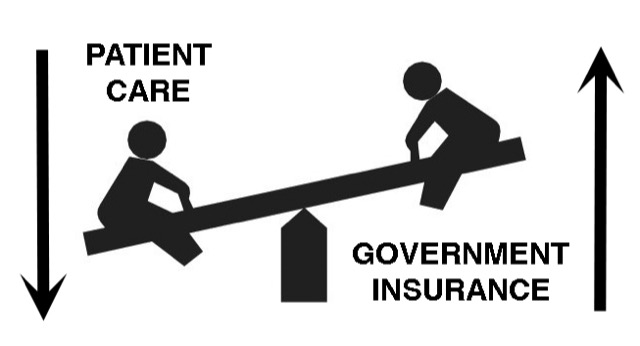
The connection between medical care and insurance enrollment – what makes the healthcare seesaw go up and down – is financial. As more money pays for insurance and BARRCOME, less money is available to pay for patient care. Such “bureaucratic diversion” [22] became obvious with the Affordable Care Act (ACA). To defray some of the $1.76 trillion cost of ACA infrastructure, President Obama withdrew $716 billion from the Medicare Trust [23]. That money had been earmarked to pay for seniors’ in- hospital care but was diverted to pay for BARRCOME.
When bureaucratic diversion –money taken from care to pay for BARRCOME – is combined with the inherent inefficiency of government regulation of healthcare, the ultimate result is death-by-queue [17] or as a recent article was dramatically titled, “Healthcare BARRCOME Kills Patients” [14].
The phrase death-by-queue began in Great Britain’s single payer NHS (National Health Service) referring to people who die while waiting in line (a queue) for care that is technically possible but not available in time to save them. These avoidable deaths can be attributed to system failure.
Death-by-queue has been documented in U.S. government programs such as Medicaid and Tricare [24, 25]. Because the number of physicians willing to care for these patients goes down, wait times for care go up, and death-by- queue ensues.
Illegality
Unconstitutional: Government control with its attendant BARRCOME is both unconstitutional and illegal. This is not true in single payer nations such United Kingdom and Spain where the government’s medical authority can supersede patient autonomy [26].
Article I, Section 8 of the U.S. Constitution lists those areas that the federal government has “power” (control) such as borrowing money, commerce with foreign nations, army and navy, post roads, naturalization rules, “Tribunals inferior to the supreme Court,” and interstate relationships. The Tenth Amendment specifies where the federal government is prohibited from involvement: “The powers not delegated to the United States [the federal government] by the Constitution, ... are reserved to the states respectively, or to the people.” Healthcare is not one of the 18 “powers” – areas of responsibility – authorized for federal control. Therefore, by the Constitution, healthcare is “reserved to the states respectively, or to the people.” Federal government should have no authority.
Medicaid Law: Not only does the Constitution exclude Washington from power over healthcare, so does statutory law. Section 1801 of the 1965 enabling Medicaid law reads as follows. Note the Section’s title and Congress’ numerous explicit prohibitions.
SEC. 1801. PROHIBITION AGAINST ANY FEDERAL INTERFERENCE “Nothing in this title [the law] shall be construed to authorize any Federal officer or employee to exercise any supervision or control over the practice of medicine or the manner in which medical services are provided, or over the selection, tenure, or compensation of any officer or employee of any institution, agency, or person providing health services; or to exercise any supervision or control over the administration or operation of any such institution, agency, or person” [27].
Despite the clear intent of the law, over many decades, CMS (Centers for Medicare and Medicaid Services) has incrementally taken near-total control of eligibility standards, benefits, i.e., medical care provided, and the payments allowed. Despite the legal prohibitions, Washington has “interfered” with all state Medicaid programs.
Medical Autonomy: In the U.S., patients have complete medical autonomy: ultimate decision-maker authority over his or her medical care [28]. However, backed by federal regulatory authority, a third party – government, insurance, or pharmacy benefits manager –makes decisions regarding care: who, where, what, when, and even if care is provided. The current U.S. healthcare system illegally denies Americans their medical autonomy.
Return to Rule of Law: Removing federal control of healthcare would be a return to rule of law, not sedition.
Cut BARRCOME, Save lives
The federal government should be removed from healthcare for legal, fiscal, and medical reasons. If Washington were no longer in control of healthcare, who would be? We the People, or more precisely, We the Patients. All people, regardless of race, religion, ethnic origin, sexual preference, or political affiliation, have the same need: to optimize health and longevity. Without exception, every American will eventually be We the Patients.
For We the Patients to control healthcare means a free market for health care (two words.) People control their own health care dollars, choose their providers, and decide their care. Providers compete for patients’ dollars.
How does a patient know if a doctor is good or bad? The same way to learn if a lawyer is good or bad: prior results, direct service experience, word-of-mouth, as well as indirect objective metrics such as schools attended and where trained? Consider how an insurance company currently chooses the best care for a patient – it doesn’t! Third parties sign contracts with doctors and hospitals that offer the cheapest prices.
A second concern for free market healthcare is affordability. First, employees should be paid the $25,784 that employers are currently giving to insurance companies [29]. Employees should be able to contribute those funds into an unlimited HSA and use that money to shop for care and to pay for catastrophic health insurance. Between cessation of spending on BARRCOME and competition among care sellers, prices for both services and goods will plummet. The cure for healthcare is the restoration of free market forces currently suppressed by government control and third-party payment structure, While the devil is truly in the details, health care (two words) controlled by We the People will provide Americans with timely, affordable, compassion, quality medical care. As a bonus, the U.S. may avoid insolvency.
A similar withdrawal of government control and restoration of medical and financial freedom to their residents will work equally well in single payer nations that are currently failing to provide timely, quality medical care to their residents [30, 31, 32, 33, 34].
References
-
Coleman P (2024) The Global Winds of Censorship. Real Clear Policy.
-
Schlott R (2023) The Biden administration tried to censor this Stanford doctor, but he won in court. NYPost.
-
Redshaw M (2023) Secret Letter to CDC: Top Epidemiologist Suggests Agency Misrepresented Scientific Data to Support Mask Narrative. Epoch Times.
-
Leake J (2023) Italian Pathologist Punished For Sounding Alarm about Sudden Deaths. Courageous Discourse.
-
Redshaw M (2023) Significant COVID-19 Vaccine Study Censored by Medical Journal within 24 Hours. Epoch Times.
-
McCullough PA (2024) Systematic Review of Autopsy Findings in Deaths after COVID-19 Vaccination. Courageous Discourse.
-
Kepp KP, Cristea IA, Muka T, Ioannidis JPA (2024) COVID-19 advocacy bias in the BMJ: meta-research evaluation. medRxiv preprint.
-
Svab P (2022) Researcher Calls Out Censorship After Journal Pulls COVID-19 Vaccine Adverse Events Analysis. Epoch Times.
-
Hoeg TB (2023) Dr. Tracy Beth Hoeg: 10 Types of Misinformation in Peer-Reviewed COVID-19 Paper Decrying Misinformation. American Thought Leaders.
-
Stieber Z (2024) Pfizer Board Member Pressured Twitter to Censor Posts on Natural Immunity, Low COVID Risk to Children: Emails. Epoch Times.
-
Fox J (2024) Health-care is sinking the federal budget. Bloomberg.com.
-
Wager E, McGough M, Rakshit S, Amin k, Cox c (2024) How does healthcare spending in the U.S. compare to other countries?. Petersen-KFF.
-
(2024) Healthcare Spending Will be One-Fifth of the Economy within a Decade. Peter G. Petersen Foundation.
-
Waldman D (2023) Healthcare BARRCOME Kills Patients. Amer J Biomed Sci & Res 20(1): AJBSR.MS.ID.002667.
-
Woolhandler S, Campbell T, Himmelstein DU (2003) New Eng J Med 349: 768-775.
-
Waldman D (2019) Curing the Cancer in U.S. Healthcare: StatesCare and Market-Based Medicine. Albuquerque, NM: ADM Books.
-
Waldman D (2023) The Unheralded Pandemic: Death- by-Queue. Clinics in Nursing 2(3).
-
(2022) AMN Healthcare Survey: Physician Appointment Wait Times Up 8% from 2017, Up 24% from 2004. AMN Healthcare.
-
(2016) Survey of Texas Physicians March 2016. TMA (Texas Medical Association).
-
Waldman D (2017) More coverage doesn’t necessarily translate into better patient care. The Hill.
-
Waldman D (2020) Seesaw effect overturns false health care ‘wisdom’. American Thinker.
-
Waldman D (2016) The Root Cause that Washington Conceals. Tampa, FL, Gatekeeper Press.
-
Kliff S (2012) Romney’s right: Obamacare cuts Medicare by $716 billion. Here’s how.
-
Horton, N (2016) Hundreds on Medicaid waiting list in Illinois die while waiting for care. Illinois Policy.
-
(2016) Review of Alleged Mismanagement at the Health Eligibility Center. VA Office of Inspector General, Office of Audits and Evaluations. VHA (Veterans’ Health Administration).
-
Waldman D (2018) Great Britain offers cautionary tale on single payer. Real Clear Health.
-
Public Law 89-97–July 30, 1965. Section 1801: Prohibition against any Federal interference.
-
Bernstein C (2018) Take control of your health care (exert your medical autonomy). Harvard Health Publishing.
-
Walker E (2024) What percent of health insurance is paid by employers?. PeopleKeep.
-
Rudy M (2024) Amid growing UK health care crisis, nearly 8 million patients are waiting for care, data shows. Fox News.
-
Gregory A (2023) NHS faces exodus of surgeons and doctors to foreign healthcare systems. The Guardian.
-
Vitkine B (2012) Inside the Dramatic Collapse of Greece’s Healthcare System. LeMonde.
-
Heckle H (2012) Thousands protest Spain’s health care austerity. Associated Press.
-
Avanzas P, Pasqual I, Moris C (2017) The great challenge of the public health system in Spain. J Thorac Dis 9(6): S430-S433.
- Capacity Constraints in Pediatric Inpatient Psychiatric Care: A Cross-Sectional Analysis of Bed Availability and Geographic Access in North Carolina
- Why Healthcare Analytics Still Optimizes the Wrong Things
- Coding, Coverage, and Care: The Infrastructure of Transgender Health Inequities
- The Effect of Classroom Attendance on Academic Achievement of Management and Leadership Discipline of Nursing Students at Instituto Superior Cristal and Universidade de Dili, Timor-Leste, 2024: A Case Study
- The Role of Social Bonds in Facilitating Shared Investments and Resource Allocation: Addressing the “Wrong Pocket Problem” in Public Health and Healthcare
- Social-Cultural Factors Contributing to Antimicrobial Resistance in Livestock Farmers and Community Households in Kayonza District, Rwanda