
Phosphine- and Isatin-Copper Complexes: Anticancer Activity, Mechanisms of Action and Structure-Activity Relationship Examples from the Last Ten Years
Platinum-based metallodrugs candidates are extensively evaluated as antineoplastic agents against several tumoral cell lines, representing a considerable advance in cancer treatment. On the other hand, the hostile off-site toxicity has been limited their potential uses in clinical step. Thus, the search for novel active and selective antitumor drugs is a leading issue in the medicinal inorganic chemistry. As follow, the research focused on less toxic metals has strategic importance and several copper complexes have revealed promising activity. In addition, copper is an essential metal, which can increase the chances of reduced side effects. This review brings some copper complexes that showed highlighted anticancer activity as drug prototypes from the last ten years (2010-2019), involving phosphine and isatin ligands, different redox states, modes of action and the study of structure-activity relationship (SAR).
Introduction
Copper is an essential element with vital roles in several biological processes in the body. This metal can be found in metalloenzymes acting as cofactor. The two more suitable redox states, Cu(I) and Cu(II), as well as the tetrahedral, square-planar and octahedral geometries around the metal center, make copper an attractive metal for design of novel metallodrugs [1, 2]. Even though this metal possesses two accessible redox states, the cell uptake of copper species into eukaryotic cells occurs by members of the Ctr copper transporter family (Figure 1) [3].
Medicinal & Analytical Chemistry International Journal
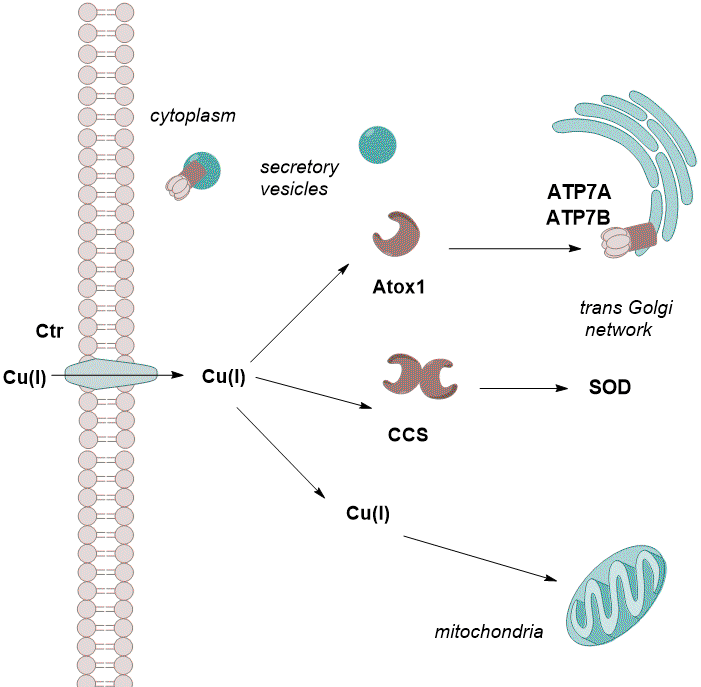
Copper transporter (Ctr) proteins comprise the cell cooper absorption system in eukaryotes. They are identified in yeast, plants and humans (hCtr1), containing three transmembrane segments with carboxyl and amino terminal located on opposite site of the plasma membrane. As represented in Figure 1, the delivery of copper to the Cu, Zn-superoxide dismutase 1 (SOD1) is by the copper chaperones for superoxide dismutase (CCS). Primarily, in the cytosol, occurs the metalation of SOD1, however, a minor quantity of SOD1 is also restricted to the mitochondrial intermembrane space, when superoxide dismutase is present.
The SOD1 catalyzes the conversion of superoxide ion to molecular oxygen and hydrogen peroxide (Equations 1 and 2). Superoxide dismutase’s (SODs), for example, belong to the family of isoenzymes connected in the scavenging of free O2 radicals occurred in respiratory chain. One of the cellular protection systems from oxidative damages is the SOD1 [4].
Vieira MA, et al. Phosphine- and Isatin-Copper Complexes: Anticancer Activity, Mechanisms of Action and Structure-Activity Relationship Examples from the Last Ten Years. Med & Analy Chem Int J 2019, 3(3): 000142.
The proper function of important metalloproteins can be affected by redox activity of copper (Cu). The Cu is bound to albumin, ceruloplasmin (glycoprotein produced in liver) and transcuprein (a macroglobulin), all in the blood. The genetic disorders can be reflective of unappropriated Cu homeostasis. In humans, the copper concentration is controlled at the cell and organ levels. The cooper distribution occurs in the liver via ceruloplasmin and albumin proteins when it is earlier absorbed in the small intestine and stomach. The human Cu dietary is recommended between 1.5 and 3.0 mg Cu/day [5]. Regarding to the redox states, the Cu(II) ion is typically found in the blood, while the cell uptake mechanism involves the reduced Cu(I) form.
Copper is important for antioxidant activity, collagen synthesis, iron transport (the both metabolisms are tightly linked) and lipid peroxidation. The lack or overload of copper concentration can be responsible by declining hematopoiesis by means of anemia and leukopenia (neutropenia), bone abnormalities, myelopathy, optic neuropathy, growth and progression of cardiovascular diseases, among others. Likewise, the reduction of Cu absorption in the blood causes genetic disease, for instance, Menkes syndrome (mutation in the gene encoding ATP7A). On the other hand, the excess of Cu on liver and brain tissues can origin to Wilson disease (mutation in the gene ATP7B 2). Including other human diseases associated to no regulation of Cu concentration are Alzheimer, Parkinson (both neurodegenerative disorders), ulcers, diabetes and cancer.
Concerning cancer, the Fenton reaction with formation of reactive oxygen species (ROS) is also linked to excess of free Cu ions [6]. Breast and prostate tumoral cells contain higher concentrations of Cu than normal cells. The level amounts to 1.67μg Cu/ mL in serum of tumor breast cells line and 0.98μg Cu/ mL in healthy breast cells control. However, the molecular mechanisms of Cu increasing of tumor cells are not totally elucidated yet. One hypothesis can be associated with the process of copper in angiogenesis.
Copper and Production of Reactive Oxygen Species (ROS)
Living aerobic species have molecular oxygen as fundamental molecule in cell breathing. The breathing sequence affords photo-sensible peroxides, superoxide, singlet oxygen, and hydroxyl radical active species (Fenton reaction). In the presence of UV light, an electron Copyright© Vieira MA, et al.
Medicinal & Analytical Chemistry International Journal
is promoted from fundamental state (S0) to excited empty state (S1) (also, to an excited triplet state), generating an unstable and energetic chemical compound contain oxygen [7].
The copper can bring oxidative stress in Fenton reaction, since Cu(II) ion can suffer reduction in presence of superoxide radical to form a Cu(I) ion and a molecular oxygen. In sequence, the production of hydroxyl radical species can be catalyzed by Cu(I) ions. Thus, the ROS level can significantly increase. There are critical biological processes that are affected by abnormal production of ROS, mainly the programmed cell death (apoptosis), mutation in the biomolecular structure of DNA (AT-GC and GC-AT), changes in cell motility, and disturbs in cell signaling by irreversible oxidation of key proteins. In addition, endogenous cooper complexes play vital role in biological processes, mainly oxygen and electron transfer and oxidative DNA damage, both related with elderly and cancer [7, 8].
Cancer
Cancer can be defined as a group of diseases where mutant cells undergo excessive proliferation. After disruption of basal membrane, the tumor cells access the blood system and can extent to other tissues of the body (metastasis) [9]. Cancer has been increasingly investigated for being considered the second cause of death in the world. The WHO reported that occurs at least 14 million of new cases/year being 8.8 million of deaths, which have represented US$ 1.16 trillion of costs in public health and loss of productivity [10, 11].
The most important landmark for therapeutic of cancer in the 20th century was the discovery of the neoplastic activity for cisplatin. The free Pt(II) ion is high toxic for human cells, but when further coordinated to ammine and chloride ligands, [PtCl2(NH3)2], became to an extremely effective metallodrug to treat a diversity of cancers, for instance, testicular cancer. Unfortunately, the administration of this platinum metallodrug is still limited by its aggressive adverse effects, due to its low selectivity index [10, 11, 12].
The variety of coordination numbers, redox states, geometries, and intrinsic properties of cationic metal ions are great features for the design of therapeutic agents. Metals, such as Ru(II), Pt(II), Pd(II) and Cu(I) and Cu(II) have been extensively studied for the development of metal-based complexes over last decades [13]. Among Vieira MA, et al. Phosphine- and Isatin-Copper Complexes: Anticancer Activity, Mechanisms of Action and Structure-Activity Relationship Examples from the Last Ten Years. Med & Analy Chem Int J 2019, 3(3): 000142.
them, copper-based complexes have aroused much attention since many of them have exerted their anticancer activities with promising selectivity index.
Copper Complexes as Anticancer Agents
Copper-based complexes have been investigated because endogenous metals may promote less side effects in comparison with cisplatin. The mechanisms of action of copper complexes can occur by degradation of DNA, topoisomerase and/or proteasome inhibition. The biological activities of these complexes have been attributed to the synergism between the Cu(I) or Cu(II) metal ions and their ligands. Thus, several ligands for various copper complexes can be explored to find candidates for cancer treatment. As follows, an important feature concerns the oxidation state of copper metal center. Even if Cu(I) species are found in Ctr proteins to active internalization of biological copper in mammalian cells, this same Cu(I) as antitumor agent is rarely found because it is difficulty to stabilize, especially in aqueous environment. So, Cu(I) is easily oxidized to Cu(II) in most part of applications. Therefore, when Cu(I) ions are handled for design of new active complexes, where ligands able to establish robust metal-ligand bond with Cu(I) are mandatory. In this context, the phosphines have been used to prevent the hydrolysis and degradation of the complexes. In addition, soft donor base, such as S-, P-, C-atoms and aromatic amines have preference to bond soft Pearson acids, such as Cu(I). These complexes are frequently four-fold coordinated assuming generally tetrahedral geometry. This spatial orientation is preferred by means of its [Ar] 3_d_10 electronic configuration.
Instead, there are much more Cu(II)-based complexes as anticancer agents in literature, because Cu(II) is chemically more stable in aqueous environment. Then, in different Cu(I)-based complexes, a high number of ligands can be exploited [14]. Others types of Cu(II) complexes, with general formula Cu[(N-N)(A-A)]NO3, where N-N represents a diamine donor-like (phen or bipy) and A-A stands for amino acid, have showed both in vitro and in vivo antineoplastic activity [15]. Moreover, Cu(II)-based complexes containing aromatic heterocyclic ligands have aroused particular attention for the detection of their genotoxic activity. Herein, the ion complex [Cu(phen)2]2+, with planar geometry ligand, exhibited strong interactions to DNA double-helix by intercalation [16].
In view of that, this review explores some copper complexes in two different oxidations states, including Copyright© Vieira MA, et al.
Medicinal & Analytical Chemistry International Journal
phosphine and isatin moieties, as examples of promising ligands to reach anticancer activity.
Phosphine (Derived) Ligands
In vitro cytotoxic activities of Cu(I) and Cu(II) complexes containing phosphine fluoroquinolone derivatives as ligands were performed by Bykowska and Komarnicka [20]. In this study, the Cu(I) cations are four- fold coordinated in a tetrahedral geometry by one P atom from phosphine ligand, one iodide anion and two N-atoms from dmp ligand, resulting in a five-membered metallaring, Figure 2 (1,2). Instead, the Cu(II) cations are coordinated by the quinolone fragment in OPCp or OPNr ligands, that are acting as k2O,O-donors, forming six- membered metallarings and two N-atoms from phenanthroline (phen). Each Cu(II) cation is four-fold coordinated in a square-planar environment, Figure 3 (3, 4).
Taking into account the π-acid profile, the phosphine ligands strongly bind to electron-rich _d_10 metal ions, such as Zn(II), Ag(I) and Cu(I). As follows, regarding to the drug response in tumor cells and normal ones, the structure-activity relationship studies have shown direct association between hydrophilic/lipophilic properties of phosphine ligands and the magnitude of selectivity index (SI) for these complexes. Accordingly, different range of solubility can be acquired by the choice of an appropriated phosphine ligand [1, 17]. Among a plethora of suitable ligands that are able to stabilize a specific redox state of metal ions, phosphines are the most attractive category of ligands. As follows, these P-donor ligands may stabilize Cu(I) complexes, which have been explored as antitumor agents as well as to form other hydrophilic soluble complexes [18]. The use of phosphine-derived ligands in medicinal inorganic chemistry has given metal-based complexes with promising anti-arthritic, anti-inflammatory and anticancer activities [19].
![Figure 2: Chemical structures of Cu(I) complexes: [CuI(PCp)dmpI] and [CuI(PNr)dmpI]. (1) Modified with cyclopropane substituent. (2) Modified with ethyl substituent. Structure-activity relationship (SAR) of Cu(I) complexes, with logP and IC50 values.](/fulltextimages/4197/fig_2.png)
Vieira MA, et al. Phosphine- and Isatin-Copper Complexes: Anticancer Activity, Mechanisms of Action and Structure-Activity Relationship Examples from the Last Ten Years. Med & Analy Chem Int J 2019, 3(3): 000142.
Copyright© Vieira MA, et al.
Medicinal & Analytical Chemistry International Journal
![Figure 3: Chemical structures of Cu(II) complexes [CuII(OPCp)phen]+ and [CuII(OPNr)phen]+. (3) Modified with cyclopropane substituent. (4) Modified with ethyl substituent. Structure-activity relationship (SAR) of Cu(II) complexes, with logP and IC50 values.](/fulltextimages/4197/fig_3.png)
Vieira MA, et al. Phosphine- and Isatin-Copper Complexes: Anticancer Activity, Mechanisms of Action and Structure-Activity Relationship Examples from the Last Ten Years. Med & Analy Chem Int J 2019, 3(3): 000142.
Cu(I) complexes had efficient uptake through lipid cell membrane than Cu(II) derivatives [20]. Therefore, the structure-activity relationship (SAR) analysis disclosed that cytotoxic profile of the Cu(I) compounds is dependent on the lipophilic property of the fluoroquinolone ligand [21].
Still concerning the SAR analysis, the absence of ethyl group and fluorine atoms on piperidone and fluoroquinolone rings, respectively, can be the reason of increasing activity. The ethyl group has established prospective metabolic availability due to oxidative N- demethylation pathway [22]. Likewise, cyclopropyl group on piperidone ring appear as an auxophore moiety, as observed in 1 and 3. The enhanced π-characteristic regarding to the coplanarity, decreased C-C bonds distances, and increased polarity of C-H bonds rather than in alkane derivatives (2 and 4), result on increased bioavailability. The fluorine atoms have strong electron- Copyright© Vieira MA, et al.
Medicinal & Analytical Chemistry International Journal
withdrawing properties, so they exert influence on special orientation, pKa, membrane permeability, and pharmacokinetic properties [23]. In addition, each hydrogen bonding-donor/acceptor O-atom supports the water solubility and increases the molecule hydrophilicity [24, 25].
The Cu(II) complexes, 3 (IC50 = 8.3 ± 1.7 μΜ) and 4 (IC50 = 15.9 ± 2.1 μΜ), are less active than Cu(I) complexes 1 (IC50 = 2.9 ± 0.3 μΜ) and 2 (IC50 = 5.0 ± 0.3 μΜ). For the Cu (I)-based complexes, the mechanism is related with breaks of the backbone and DNA interactions, through redox reactivity involving ROS generation. In Cu(II) complexes, the mechanism can be associated with ROS amount inside the cells.
Villarreal and collaborators synthesized a Cu (I)- phosphine polypyridyl metal complex, where the Cu(I)- metal center is four-fold coordinated by two P-atoms from PPh3 ligand and two N-atoms of the dppz ligand. The complex display a general formula [Cu (PPh3)2 (dppz)]NO3 (5) (Figure 4) [26].
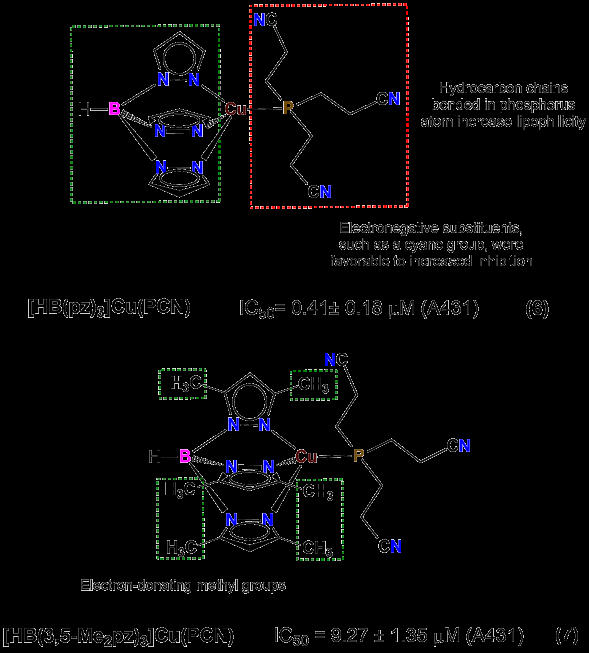
In this work, the binding constant (k_b) of complex 9 with _Calf thymus DNA (ct-DNA) measured 1.80 ± 0.17 (x 104mol L-1). This data supported a reversible interaction concerning the complex 9 and ct-DNA allied to intercalative mode. This similar intermolecular contact was observed during crystal packing analysis for dppz ligand (blue-square in Figure 4). Moreover, the PPh3 groups (red-square in Figure 4) were chosen to avoid the kinetic instability [27].
Thus, the cytotoxicity of the complexes was evaluated by MTT assays in different types of tumoral cells, such as A549 (human lung), DU-145 (human prostate), MCF-7 Vieira MA, et al. Phosphine- and Isatin-Copper Complexes: Anticancer Activity, Mechanisms of Action and Structure-Activity Relationship Examples from the Last Ten Years. Med & Analy Chem Int J 2019, 3(3): 000142.
(human breast) and the non-tumor cells lines V79-4 (Chinese hamster lung), as well as MRC-5 (human lung). The complex 9 showed IC50 (µM) values: 0.36 ± 0.01 (A549); 2.63 ± 0.25 (MCF7); 0.78 ± 0.04 (DU-145); 0.34 ± 0.04 (V79-4) and 0.52 ± 0.02 (MRC-5), which supported its powerful cytotoxicity. In all tested cell lines, the ligands showed no drug response at IC50 >50μM, therefore considered inactives.
In another study of Marzano and collaborators, Cu(I)- based complexes (Figure 5) containing tridentate tris(pyrazolyl)borate and tertiary phosphine ligands: [HB(pz)3]-Cu(PCN) (6), and [HB(3,5-Me2pz)3]Cu(PCN) (7), where HB means tris(pyrazol-1-yl) borate, were founded out as promising drug candidates [28]. The poly (pyrazolyl) borates (HB), presented in green square in 6, were chosen for the chemical stabilization of metal complexes [29]. The alkyl chain bonded in phosphine atom (represented in red square in 6) increased lipophilicity, while the CN substituents increased inhibition [30].
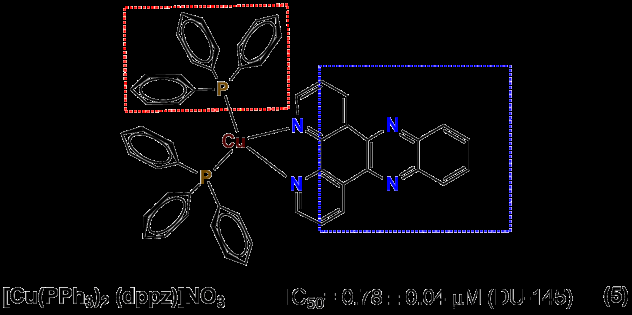
The electron-donating methyl groups in the pyrazolyl moieties of the [HB(3,5-Me2pz)3]Cu(PCN) (green squares in 7) resulted in significant reduction of the in vitro antitumor activity. The antiproliferative activity for the Copyright© Vieira MA, et al.
Medicinal & Analytical Chemistry International Journal
Cu(I) complexes were tested against human tumor cell lines of, colon (HCT-15), breast (MCF-7), melanoma (A375), cervical (A431), pancreatic (BxPC3), lung (A549), and neuroblastoma (SHSY5Y). The IC50 values were calculated by MTT assay after 72 hours of incubation with the complexes. The values obtained for 6 (in μM) are: 0.73 ± 0.17 (MCF7); 0.41 ± 0.18 (A431); 0.99 ± 0.54 (HCT-15); 0.65 ± 0.23 (A375); 0.62 ± 0.46 (BxPC3); 0.77 ± 0.83 (SHSY5Y) and 0.84 ± 0.25 (A549). In the same context, for 7 the values of IC50 are: 8.02 ± 2.36; 9.27 ± 1.35; 10.15 ± 1.57; 5.63 ± 1.25; 5.74 ± 2.15; 5.36 ± 1.19 and 10.08 ± 2.54, respectively. In addition, 6 were more effective against tumor the cell lines than cisplatin. A similar behavior is observed for phosphine-copper (I) complexes, where a different modus operandi from cisplatin can be observed. In addition, the use of phosphine donors can stabilize reduced copper (I) species, which are commonly incorporated by eukaryotic cells.
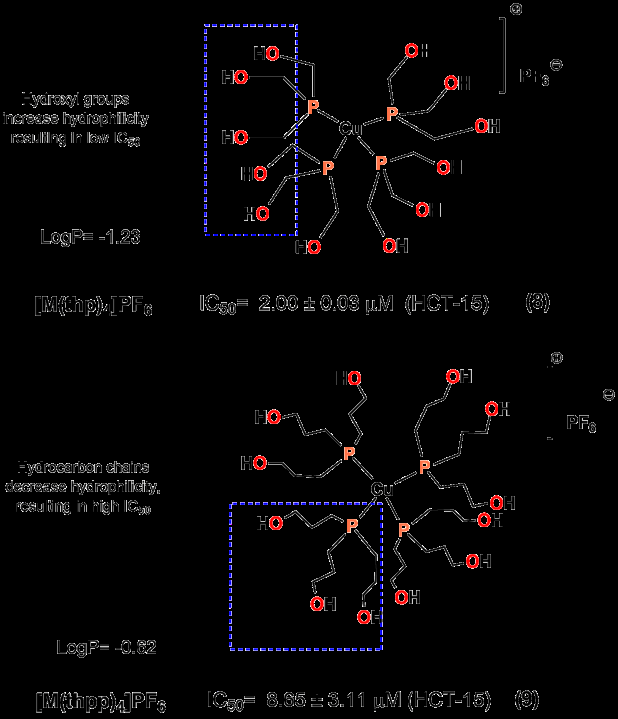
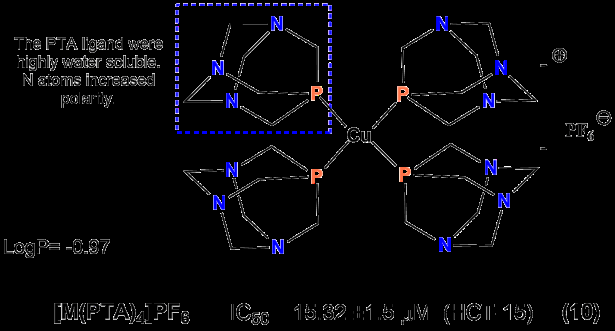
In the work by Santini and collaborators, three sequence of water soluble complexes with tetrahedral geometry (Figures 6 & 7), named [M(thp)4]+ (THP: tris(hydroxypropyl)phosphine), [M(thpp)4]+ (THPP: tris(hydroxypropyl)phosphine) and [M(PTA)4]+ (PTA: 1,3,5-Triaza-7-phosphaadamantane), where M = Cu(I), Ag(I) and Au(I), were tested. The Cu(I) complexes were always found to be the most effective against human breast (MCF-7), lung (A549), colon (HCT-15), cervix (HeLa) and melanoma (A375) cell lines. The IC50 (µM) for [Cu(thp)4]PF6 (8) was 9.11 ± 2.71 (A549), [Cu(thhp)4]PF6 (9) was 18.22 ± 2.11 (A549) and [Cu(PTA)4]PF6 (10) was 17.40 ± 1.76 (A549). The best value found to colon cells (HCT-15) for 8 (IC50 = 2.00 ± 0.03). Among the tested compounds, metal-THP species present better cytotoxic activity than metal-PTA and metal-THPP. The calculated logP specified that all tried complexes were hydrophilic in nature sorted as 8 (logP= -1.23) > 10 (logP= - 0.97) > 9 (logP= - 0.62), which can be related with antiproliferative activity of the complexes.
The SAR (Figures 6 and 7) revealed that the presence hydroxyl groups in 8 and 9 increased hydrophilicity. In a more acid cancer tissue, the most active aqua-form of PTA would be predominant through introduction of electron- withdrawing groups [31]. Herein the absence of these in PTA complexes could explain no significant IC50 values. Thus, the decreasing lipophilicity of a molecule is an effective approach to design active Cu (I) complexes with hydrophilic tertiary phosphine ligands. In this context, the copper complexes are promising when compared with other metal complexes with phosphine derived ligands.
Vieira MA, et al. Phosphine- and Isatin-Copper Complexes: Anticancer Activity, Mechanisms of Action and Structure-Activity Relationship Examples from the Last Ten Years. Med & Analy Chem Int J 2019, 3(3): 000142.
Furthermore, the cytotoxic effects of these copper complexes have proven to induce damage in ubiquitin- proteasome system (UPS). The UPS is a key mechanism in which eukaryotic cells degrades proteins to preserve the protein homeostasis. In normal cells, the natural load of degraded substrates is in equilibrium with the cell UPS. Instead, regarding the cancer cells this load is amplified for the reason of the overexpression of modified proteins [32, 33, 34].
Copyright© Vieira MA, et al.
Medicinal & Analytical Chemistry International Journal
Isatin Derived Ligands
Isatin (2,3-dioxindole) is an important heterocyclic moiety, structurally related with the indole privileged structure. In addition, isatin is also a privileged substructure for the design of novel molecules [35]. Some biological activities for derived compounds found in literature are antitumor, antimicrobial, anti-inflammatory, analgesic, anti-mycobacterial, anticonvulsant, antiviral, anthelmintic, antioxidant, and CNS depressant effects [36]. Among these, undoubtedly the antitumor activity has been defined as more evident, mainly for halogenated isatin-derivatives [37]. Then, complexes containing these worthy biologically active scaffolds cover a remarkable class of compounds for design of novel target-specific drugs. In fact, many copper complexes of isatin Schiff-base ligands exhibit a wide range of pharmacologic properties, such as antimicrobial, antibacterial, antifungal and antitumor [38, 39, 40, 41, 42]. Complexes formed by N_1-substituted- isatin-3-thiosemicarbazone and Cu(I) halides were reported by Sharma and collaborators, as represented in Figure 8 [43]. Isatin-thiosemicarbazone ligands are described as _k2N,S- or k3O,N,S-donors. The isatin-β- thiosemicarbazone has been recognized to be more selective to promote selective cell death to overexpressing P-glycoprotein cells. The P-glycoprotein is a key carrier in multidrug resistance cells (MDR) [44].
In the complex 11, Cu(I) ion is four-fold coordinated in a distorted tetrahedral environment. The metal center is connected by one bromide, one P atom from triphenylphosphine and one neutral isatin-N_1-methyl- thiosemicarbazone that act as _k2N,S-donor. The complex 12 differs from the former only by the halide ligand. These Cu(I)-compounds were screened in human tumor cell lines L123 (lung) and HepG2 (liver) to check their cytotoxicity profile. The IC50 values for complexes 11 and 12 ranged at 8.31-25.50 μM (L123) and 18.65–25.50 μM (HepG2), respectively. These data showed the influence of the electron-withdrawing effect from halide ligand, i.e., the higher electron-withdrawing properties of bromine atom than chloride one influence in cytotoxic efficiency.
The Cu (I)-complexes [CuBr(N3,S-H2itsc-N1-Me)(Ph3P)] (11) and [CuCl(N3,S-H2itsc-N1-Me)(Ph3P)] (12) are shown in Figure 8. In addition, chlorine atom presents an electron-withdrawing property higher than bromine atom, resulting in changes of pKa, membrane permeability, preferential orientation, potency and pharmacokinetic properties, as well as in better inhibition, with the lowest IC50 value.
Vieira MA, et al. Phosphine- and Isatin-Copper Complexes: Anticancer Activity, Mechanisms of Action and Structure-Activity Relationship Examples from the Last Ten Years. Med & Analy Chem Int J 2019, 3(3): 000142.
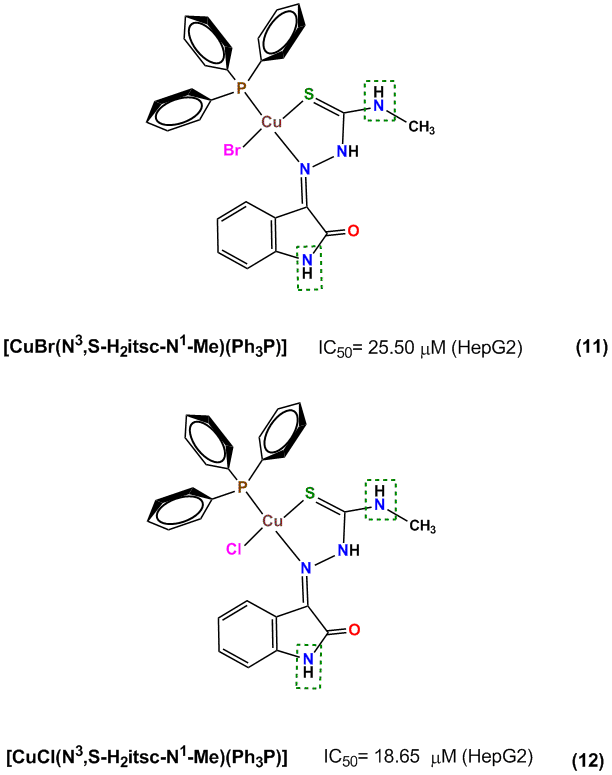
Molecular modeling (MM) studies are extremely useful for better understanding of the correlation between drug candidates and their biological interactions [45]. The docking studies of the complexes to MFE-23 (anti- carcinoembryonic antigen, PDB ID 1QOK) indicated the promising anticancer activity for them. The MFE-23 is an important antibody used as biomarker of carcinoembryonic antigen (CEA). Thus, several research groups have put efforts to design antitumor drugs with MFE-23-affinity. Based on MM studies, it was observed that H-donor group NH (green squares in Figure 8) forms hydrogen bonding interactions with O atom from side chains of glutamine (Q249) and tyrosine (Y247) residues. Likewise, NH group, showed hydrogen bonding contacts with S atom of cysteines (C248 and C184) and N atom of tryptophan (W195) residue.
On the other hand, the Cu(II) complexes can be used to cleave the DNA via oxidative pathway. In this case, in the work of Teoh and contributors, Cu(II) complexes of isatin thiosemicarbazone derivatives demonstrated this capacity [46]. Each Cu(II) metal center is bonded by one tridentate k3O,N,S-donor ligand, one chloride anion and Copyright© Vieira MA, et al.
Medicinal & Analytical Chemistry International Journal
the metals are linked each other through two sulfide bridges comprising a binuclear complex. Each metal center is embedded in a distorted square pyramidal environment. Their activity in the human colorectal carcinoma cell line (HCT116) is represented in Figure 9.
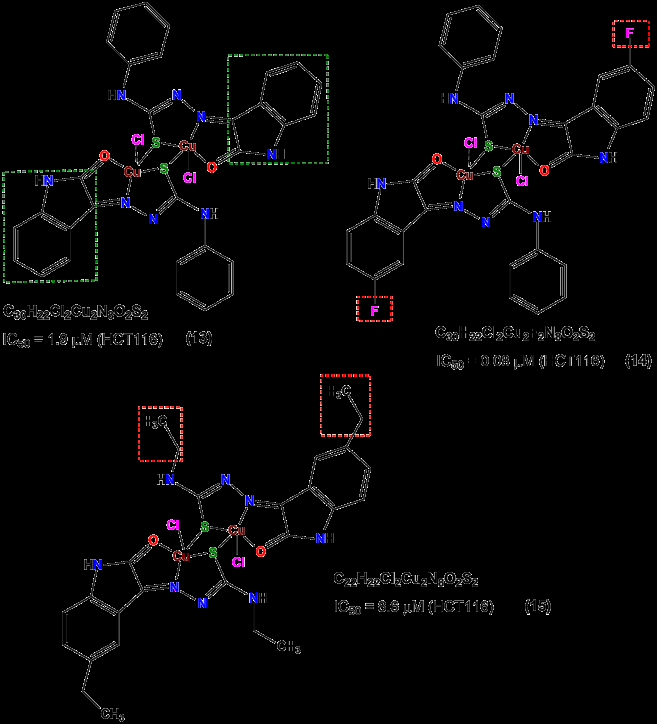
Furthermore, the cleavage DNA via oxidative pathway is observed. The complexes were incubated with H2O2 and DNA was degraded. These results support that Cu(II) complexes can cleavage plasmid DNA (pBR322 DNA) via ROS formation. The reduction of H2O2 into hydroxyl radical by the oxidation of transition metal complexes can damage DNA structure by strand-chain breakage. In this case, this process occurs through the redox conversion into Cu(II)/Cu(I) species [48, 49, 50, 51].
In different analysis about targets, Bulatov and collaborators, reported the pharmacological evaluation of Vieira MA, et al. Phosphine- and Isatin-Copper Complexes: Anticancer Activity, Mechanisms of Action and Structure-Activity Relationship Examples from the Last Ten Years. Med & Analy Chem Int J 2019, 3(3): 000142.
isatin-Schiff base analogues and its Cu(II) complex in different tumor cell lines by assessing their effects on cellular metabolism, real-time cell proliferation and toward p53-positive in MCF7 cells. Also, it was promoted p53-dependent gene expression inducing apoptosis. The tumor suppressor of p53 normally reduces the efficiency to arrest damaged cells from perpetrating their genetic errors into future generations. In fact, p53 is the most altered gene in cancer. The inactivation of tumors suppressors occurs in most types of human cancers [52, 53].
Thus, the work, as represented in Figure 10, explored potential antitumor properties of Cu(II) complex 17 in p53-positive tumors, such as breast cancer (MCF7) cell line. To validate p53 associated effects of Cu(II) complex on tumor cells, a comparison between cells lines in different p53 status was performed, (p53 positive versus p53 negative).
Copyright© Vieira MA, et al.
Medicinal & Analytical Chemistry International Journal
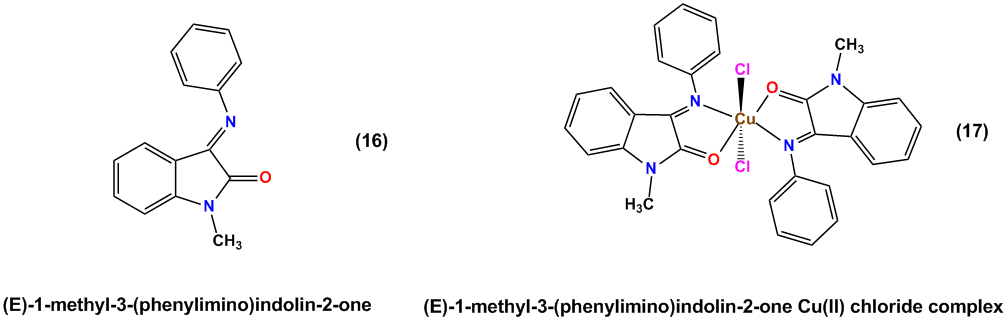
In this context, the treatment of MCF7 p53WT cells with 17 increased the p53-protein levels. However, ligand 16 did not have effect on p53 activation. These findings suggested the higher cytotoxicity and more reduced proliferation of tumor cells from the complexes than free ligands [54].
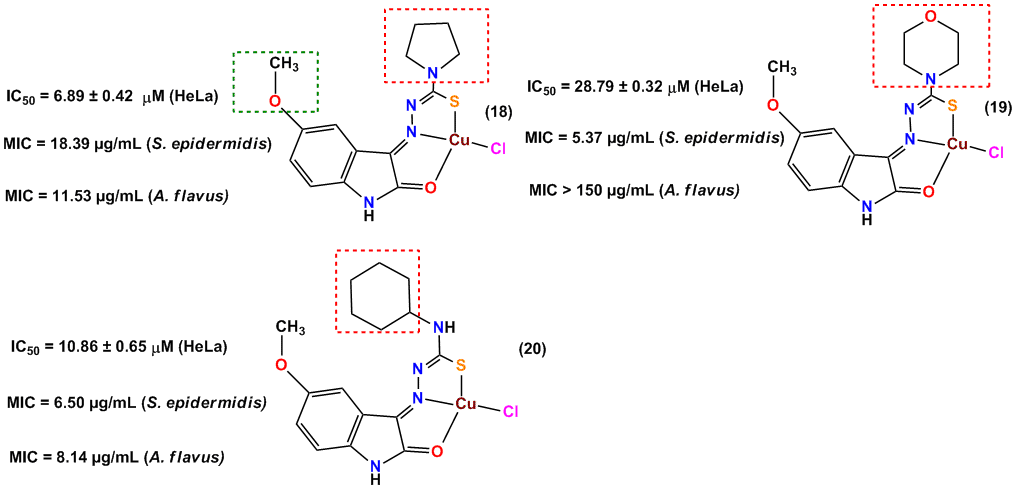
As a way to exemplify other applications of copper complexes on inorganic medicinal chemistry, Sreekanth and collaborators, studied 5-methoxyisatin thiosemicarbazones with different N-terminal substituents and their Cu(II) complexes, as represented in Figure 11 [57]. The isatin-derivative ligand acts as a tridentate k_3_O,N,S-donor to Cu(II). Chloride anion completes a square-planar geometry around the metal center. Three different terminal substituents were chosen: pyrrolidine (18), morpholine (19) and cyclohexyl ammine (20).
The studies with p53 are extremely important in cancer research because this protein family works as tumors suppressor. Since inactivation of tumors suppressors occurs, the apoptosis mechanism is affected. Mutant p53 are expressed by p53-positve and p53- negative. They are performed to act into several important cell pathway, such as regulating cell division and metabolism. Thus, disturbs related with p53 can result in cancer promoting. Because of the loss function of p53, the over-expression of mutant p53 is generally considered as a bad prognosis factor, associated with nodal metastasis [51, 55, 56]. The Cu(II) complex 22 exhibited improved cytotoxicity toward p53-positive and p53-negative MCF7 cells and induced apoptosis signaling in both p53 MCF7 cells.
Vieira MA, et al. Phosphine- and Isatin-Copper Complexes: Anticancer Activity, Mechanisms of Action and Structure-Activity Relationship Examples from the Last Ten Years. Med & Analy Chem Int J 2019, 3(3): 000142.
Copyright© Vieira MA, et al.
Medicinal & Analytical Chemistry International Journal
The complexes 18 and 19 were evaluated for their antifungal, antibacterial, and antitumor activities in S. aureus, B. subtilis and S. epidermidis (Gram-positive), E. Coli, P. aeruginosa and P. Vulgaris (Gram-negative), A. niger, A. flavus, F. solani, C. albicans and C. lunata and HeLa (cervical), A549 (lung), MCF-7 (breast) and HEK293 (normal embryonic kidney).
The Cu(II) complex 18 was the most active against tumors cells. It exhibited wide range of wide range of activity in MCF-7, A549 and HeLa cells, presenting IC50 = 14.83 ± 0.45 µM, 17.88 ± 0.16 µM and 6.89 ± 0.42 µM, respectively. Doxorubicin was used as control. For Cu(II) complex 19 the IC50 values obtained was 49.38 ± 0.16 µM, 55.52 ± 0.63 µM and 28.79 ± 0.32 µM, respectively in MCF-7, A549 and HeLa. As highlighted in red square for complex 18, the pyrrolidine substituent is more hydrophobic than cyclohexyl substituent from complex 20 (MCF-7, A549 and HeLa, with IC50 values 25.02 ± 0.51 µM, 64.97 ± 1.06 µM and 10.86 ± 0.65 µM, respectively), due to the absence of the protic hydrogen (NH). Additionally, the authors concluded that the highest activity against tumor cells of complex 18 can be explained because of its greater hydrophobic nature in comparison with complexes 19 and 10. The compound 18 can interact with the hydrophobic center of DNA more effectivelly.46 On the other hand, the complex 20 showed promising potency as antimicrobial drug against B. subtilis (MIC: 10.35 µg/mL), S. aureus (MIC: 8.56 µg/mL), P. aeruginosa (MIC: 21.36 µg/mL), S. epidermidis (MIC: 6.50 µg/mL), and P. vulgaris (MIC: 17.64 µg/mL) in comparison with ciprofloxacin. The presence of H atom at N4-position makes the complex less lipophilic. Additionally, possible H-bonding contacts from this moiety (red square, in 20) can be the reason of activity against bacteria. Regarding the antifungal activity data, the complex 20 had better results against A. niger (MIC: 11.67 µg/mL), average activity in C. albicans, A. flavus, and C. lunata (MIC: 17.56 µg/mL, 8.14 µg/mL, and 14.38 µg/mL, respectively), compared to standard Nystatin and the other complexes 18 and 19. It is also important to highlight that the methoxy group (in green square, Figure 11), as an electron-donating group, can increase the electron density on aromatic ring, resulting on important properties for biological activity [58].
Conclusion
Some copper complexes with phosphine and isatin derivates as ligands, studied through 2010-2019 were reported in this review. We have to consider that copper Vieira MA, et al. Phosphine- and Isatin-Copper Complexes: Anticancer Activity, Mechanisms of Action and Structure-Activity Relationship Examples from the Last Ten Years. Med & Analy Chem Int J 2019, 3(3): 000142.
allows different oxidation states, ligands and geometries of the metal center, leading to drug design versatility. In addition, as copper is an essential metal, it increases the chances for obtaining complexes with less side effects.
Copper complexes have different mechanisms of action to induce apoptosis in tumoral cells. For Cu(I)- based complexes the mechanism is related with the break of DNA backbone without redox activity. On the other hand, for the Cu(II)-based complexes, the mechanism can be linked to ROS production inside the cells. In addition, Cu(II)-complex can also bound to DNA by intercalation when planar ligands are used. Some copper complexes can show their cytotoxic effects through ubiquitin- proteasome system (UPS) and inducing mutant p53 for apoptosis. These aspects, combined with SAR information were explored in this review, furnishing suitable features for the design of novel bioactive copper complexes targeting anticancer activity.
Acknowledgments
The authors would like to thank São Paulo Research Foundation (FAPESP, process number: 2018/00187-7), for the financial support. In addition, this study was financed in part by the Coordenação de Aperfeiçoamento de Pessoal de Nível Superior - Brasil (CAPES) - Finance Code 001.
References
-
Santini C, Pellei M, Gandin V, Porchia M, Tisato F, et al. (2014) Advances in Copper Complexes as Anticancer Agents. Chem Rev 114(1): 815-862.
-
Englinger B, Pirker C, Heffeter P, Terenzi A, Kowol CR, et al. (2019) Metal Drugs and the Anticancer Immune Response. Chem Rev 119(2): 1519-1624.
-
Boal AK, Rosenzweig AC (2009) Structural Biology of Copper Trafficking. Chem Rev 109(10): 4760-4779.
-
Paolo M, Simona D, Anna S, Mariarosaria S (2016) The Cu, Zn Superoxide Dismutase: Not Only a Dismutase Enzyme. Front Physiol 7: 594.
-
Festa RA, Thiele DJ (2011) Copper: an essential metal in biology. Curr Biol 21(21): 877-883.
-
Ayoglu H, Sezer U, Akin M, Okyay D, Ayoglu F, et al. (2016) Selenium, copper, zinc, iron levels and mortality in patients with sepsis and systemic Copyright© Vieira MA, et al. Medicinal & Analytical Chemistry International Journal inflammatory response syndrome in Western Black Sea Region, Turkey. J Pak Med Assoc 66(4): 447-452.
-
Shobha D, Thulasiram B, Aerva RR, Nagababu P (2018) Recent Advances in Copper Intercalators as Anticancer Agents. J Fluoresc 28(5): 1195-1205.
-
Fu PP, Xia Q, Hwang HM, Ray PC, Yu H (2014) Mechanisms of nanotoxicity: Generation of reactive oxygen species. J Food and Drug Anal 22(1): 64-75.
-
https://www.who.int/gho/ncd/mortality_morbidity/ en/
-
Lavanya M, Jagadeesh M, Haribabu M, Karvembu R, Rashmi HK, et al. (2018) Synthesis, crystal structure, DNA binding and antitumor studies of β-diketonate complexes of divalent copper, zinc and palladium. Inorg Chim Acta 469: 76-86.
-
Muralisankar M, Sujith S, Nattamai S, Bhuvanesh P, Sreekanth A (2016) Synthesis and crystal structure of new monometallic and bimetallic copper (II) complexes with N-substituted isatin thiosemicarbazone ligands: Effects of the complexes on DNA/protein-binding property, DNA cleavage study and _in vitro_ anticancer activity. Polyhedron 118: 103-117.
-
Rashid S (2017) Molecular Mechanism of Carcinogenesis. In: Cancer and Chemoprevention: An Overview, Springer, Singapore, pp: 27-29.
-
Medici S, Peana M, Nurchi VM, Lachowicz JI, Crisponi G, et al. (2015) Noble metals in medicine: Latest advances. Coord Chem Rev 284: 329-350.
-
Kr i avova , Vanc o J, Tra vn c e , ucht , Dvor a Z (2016) Copper (II) quinolinonato-7-carboxamido complexes as potent antitumor agents with broad spectra and selective effects. RSC Adv 6: 3899-3909.
-
Ruiz-Azuara L, Bravo-Gómez ME (2010) Copper Compounds in Cancer Chemotherapy. Curr Med Chem 17(31): 3606-3615.
-
Himasekar Ch, Mustafa S, Manabolu SB (2019) Synthesis, Characterization of Mixed Cu(II) Pyridyl Tetrazoles and 1,10-Phenanthroline Complexes - DFT and Biological Activity. Open Chem J 6: 1-7.
-
Santini C, Pellei M, Papini G, Morresi B, Galassi R, et al. (2011) In vitro antitumor activity of water soluble Vieira MA, et al. Phosphine- and Isatin-Copper Complexes: Anticancer Activity, Mechanisms of Action and Structure-Activity Relationship Examples from the Last Ten Years. Med & Analy Chem Int J 2019, 3(3): 000142. Cu(I), Ag(I) and Au(I) complexes supported by hydrophilic alkyl phosphine ligands. J Inorg Biochem 105(2): 232-240.
-
Kattesh VK, Hariprasad J, Charles JS, Douglas B (1999) Design and Development of Functionalized Water- Soluble Phosphines: Catalytic and Biomedical Implications. Acc Chem Res 32(1): 9-17.
-
Alessio Enzo (2011) Bioinorganic Medicinal Chemistry. 1st(Edn.), Wiley‐VCH Verlag GmbH & Co. KGaA, Boschstr, Weinheim, Germany, 1: 21.
-
y ows aa A, Komarnic aa KU, Jeżows a-Bojczuka M, Kyziołb A (2018) CuI and CuII complexes with phosphine derivatives of fluoroquinolone antibiotics- A comparative study on the cytotoxic mode of action. J Inorg Biochem 181: 1-10.
-
Magalhaes L, Ferreira L, Andricopulo A (2018) Recent Advances and Perspectives in Cancer Drug Design. An Acad Bras Cienc 90(1): 1233-1250.
-
Talele TT (2016) The “Cyclopropyl Fragment” is a Versatile Player that Frequently Appears in Preclinical/Clinical Drug Molecules. J Med Chem 59(19): 8712-8756.
-
Gillis E, Eastman K, Hill M, Donnelly D, Meanwell N (2015) Applications of Fluorine in Medicinal Chemistry. J Med Chem 58(21): 8315-8359.
-
Williams DA, & Lemke TL (2008) Chapter 2/Drug Design and Relationship of Functional Groups to Pharmacologic Activity. In: Zavod R, Knittel J (Eds.), Foye's principles of medicinal chemistry 6th (Edn.), Lippincott Williams & Wilkins, Philadelphia, United States 2: 26-53.
-
Lesiów M, Komarnicka K, Stokowa-Sołtys K, ol a K, Lęgows a A, et al. (2018) Relationship between copper(II) complexes with FomA adhesin fragments of F. nucleatum and colorectal cancer. Coordination pattern and ability to promote ROS production. Dalton Trans 47(15): 5445-5458.
-
Villarreal W, Colina-Vegas L, Visbal G, Corona O, Corre a , et al. (2017) Copper(I) Phosphine Polypyridyl Complexes: Synthesis, Characterization, DNA/HSA Binding Study, and Antiproliferative Activity. Inorg Chem 56(7): 3781-3793. Copyright© Vieira MA, et al. Medicinal & Analytical Chemistry International Journal
-
Lima J, Rodríguez L (2011) Phosphine-Gold(I) Compounds as Anticancer Agents: General Description and Mechanisms of Action. Anticancer Agents Med Chem 11(10): 921-928.
-
Marzano C, Santini C, Pellei M, Gandin V, Porchia M, et al. (2014) In Vitro and in Vivo Anticancer Activity of Copper(I) Complexes with Homoscorpionate Tridentate Tris(pyrazolyl)borate and Auxiliary Monodentate Phosphine Ligands. J Med Chem 57(11): 4745-4760.
-
Rasika H, Lobbia G, Papini G, Pellei M, Santini C (2009) Copper(I) Isocyanide and Phosphane Complexes of Fluorinated Mono- and Bis(pyrazolyl)borates. Eur J Inorg Chem 2009(26): 3935-3941.
-
Uhrig U, Höltje H, Mannholdb R, Weber H, Lemoine H (2002) Molecular modeling and QSAR studies on KATP channel openers of the benzopyran type. J Mol Graph Model 21(1): 37-45.
-
Murray BS, Babak MV, Hartinger CG, Dyson PJ (2016) The development of RAPTA compounds for the treatment of tumors. Coord Chem Rev 306(1): 86- 114.
-
Deshaies RJ (2014) Proteotoxic crisis, the ubiquitin- proteasome system, and cancer therapy. BMC Biol 12: 94.
-
Mani A, Gelmann EP (2005) The ubiquitin- proteasome pathway and its role in cancer. J Clin Oncol 23(21): 4776-4789.
-
Weaver B, Cleveland D (2006) Does aneuploidy cause cancer?. Curr Opin Cell Biol 18(6): 658-667.
-
Bulatov E, Sayarova R, Mingaleeva R, Miftakhova R, Gomzikova M, et al. (2018) Isatin-Schiff base-copper (II) complex induces cell death in p53-positive tumors. Cell Death Discov 4(1): 103.
-
Raj V (2012) Review on CNS activity of isatin derivatives. Int J Curr Pharm Res 4(4): 1-9.
-
Sabet R, Mohammadpour M, Sadeghi A, Fassihi A (2010) QSAR study of isatin analogues as in vitro anti-cancer agents. Eur J Med Chem 45(3): 1113- 1118. Vieira MA, et al. Phosphine- and Isatin-Copper Complexes: Anticancer Activity, Mechanisms of Action and Structure-Activity Relationship Examples from the Last Ten Years. Med & Analy Chem Int J 2019, 3(3): 000142.
-
Nitha LP, Aswathy R, Mathews NE, Kumari BS, Mohanan K (2014) Synthesis, spectroscopic characterization, DNA cleavage, superoxidase dismutase activity and antibacterial properties of some transition metal complexes of a novel bidentate Schiff base derived from isatin and 2- aminopyrimidine. Spectrochim Acta A Mol Biomol Spectrosc 118: 154-161.
-
Melo MCA, Teixeira LR, Pol-Fachin L, Rodrigues CG (2016) Inhibition of the hemolytic activity caused by Staphylococcus aureus alpha-hemolysin through Isatin-Schiff copper(II) complexes. FEMS Microbiol Rev 363(1): 207.
-
Shebl M (2014) Synthesis, spectroscopic characterization and antimicrobial activity of binuclear metal complexes of a new asymmetrical Schiff base ligand: DNA binding affinity of copper(II) complexes. Spectrochim Acta A Mol Biomol Spectrosc 117: 127-137.
-
Raman N, Pothiraj K, Baskaran T (2011) DNA-binding, oxidative DNA cleavage, and coordination mode of later 3d transition metal complexes of a Schiff base derived from isatin as antimicrobial agents. J Coord Chem 64(22): 3900-3917.
-
Devi J & Batra N (2015) Synthesis, characterization and antimicrobial activities of mixed ligand transition metal complexes with isatin monohydrazone Schiff base ligands and heterocyclic nitrogen base. Spectrochim Acta A Mol Biomol Spectrosc 135: 710- 719.
-
Khan A, Jasinski JP, Smoleaski VA, Paul K, Singh G, et al. (2016) Synthesis, structure and cytotoxicity evaluation of complexes of N1-substituted-isatin-3- thiosemicarbazone with copper (I) halides. Inorg Chim Acta 449: 119-126.
-
Dilworth JR, Hueting R (2012) Metal complexes of thiosemicarbazones for imaging and therapy. Inorg Chim Acta 389: 3-15.
-
Haribabu J, Jeyalakshmi K, Arun Y, Bhuvanesh NS, Perumal PT, et al. (2015) Synthesis, DNA/protein binding, molecular docking, DNA cleavage and in vitro anticancer activity of nickel (II) bis (thiosemicarbazone) complexes. RSC Adv 5(57): 46031-46049. Copyright© Vieira MA, et al. Medicinal & Analytical Chemistry International Journal
-
Ali AQ, Teoh SG, Eltayeb NE, Ahamed MBK, Majid AA (2014) Synthesis of copper (II) complexes of isatin thiosemicarbazone derivatives: In vitro anti-cancer, DNA binding, and cleavage activities. Polyhedron 74: 6-15.
-
Öz ay Y, Tunali Y, Karaca H, Iş dağ İ (2010) Antimicrobial activity and a SAR study of some novel benzimidazole derivatives bearing hydrazone moiety. Eur J Med Chem 45(8): 3293-3298.
-
Gupta T, Patra AK, Dhar S, Nethaji M, Chakravarty AR (2005) Effect of copper-sulphur bond on the DNA photo-cleavage activity of 2-(methylthio) ethylpyridine-2-carbaldimine copper (II) complexes. J Chem Sci 117(2): 123-132.
-
Tardito S, Marchio L (2009) Copper compounds in anticancer strategies. Curr Med Chem 16(11): 1325- 1348.
-
Wang M, Zhang H, Zhang W, Zhao Y, Yasmeen A, et al. (2014) In vitro selection of DNA-cleaving deoxyribozyme with site-specific thymidine excision activity. Nucleic Acids Res 42(14): 9262-9269.
-
Li DD, Huang FP, Chen GJ, Gao CY, Tian JL, et al. (2010) Four new copper (II) complexes with 1, 3- tpbd ligand: Synthesis, crystal structures, magnetism, oxidative and hydrolytic cleavage of pBR322 DNA. J Inorg Biochem 104(4): 431-441. Kalia K, et al. (2010) Reinvestigation of structure– activity relationship of methoxylated chalcones as antimalarials: Synthesis and evaluation of 2,4,5- trimethoxy substituted patterns as lead candidates derived from abundantly available natural β-asarone. Eur J Med Chem 45(11): 5292-5301.
-
Dedon PC (2007) The chemical toxicology of 2- deoxyribose oxidation in DNA. Chem Res Toxicol 21(1): 206-219. Vieira MA, et al. Phosphine- and Isatin-Copper Complexes: Anticancer Activity, Mechanisms of Action and Structure-Activity Relationship Examples from the Last Ten Years. Med & Analy Chem Int J 2019, 3(3): 000142.
-
Kovács D, Igaz N, Keskeny C, Bélteky P, Tóth T, et al. (2016) Silver nanoparticles defeat p53-positive and p53-negative osteosarcoma cells by triggering mitochondrial stress and apoptosis. Sci Rep 6: 27902.
-
Shakir M, Hanif S, Sherwani MA, Mohammad O, Azam M, et al. (2016) Pharmacophore hybrid approach of new modulated bis diamine CuII/ZnII complexes based on 5-chloro Isatin Schiff base derivatives: synthesis, spectral studies and comparative biological assessment. J Photochem Photobiol B 157: 39-56.
-
Lu W, Cheng F, Yan W, Li X, Yao X, et al. (2017) Selective targeting p53WT lung cancer cells harboring homozygous p53 Arg72 by an inhibitor of CypA. Oncogene 36(33): 4719-4731.
-
Fradique C, Silva GD, Quaresma L, Silva G, Pupo A, et al. (2015) Mutant p53 can support decision making in the treatment of gastric cancer. Rev Port Cir 34: 13- 26.
-
Aneesrahman KN, Ramaiah K, Rohini G, Stefy GP, Bhuvanesh N, et al. (2019) Synthesis and characterizations of copper (II) complexes of 5- methoxyisatin thiosemicarbazones: Effect of N- terminal substitution on DNA/protein binding and biological activities. Inorg Chim Acta 492: 131-141.
-
Kumar R, Mohanakrishnan D, Sharma A, Kaushik NK, Copyright© Vieira MA, et al.
- Spectrophotometric Determination of Lanthanum (III) and Some Rare Earths with Xylenol Orange
- Introduction and Sources of Molluscicides
- Trimetazidine: An Antianginal Drug and Not Only!
- Nature Inspired Discovery and Development of Antibacterials: An Update
- Fungal Biodegradation of Polycyclic Aromatic Hydrocarbons (PAHs)
- Recent Approaches of Impurity Profiling in Pharmaceutical Analysis: A Concise Review