
All the Roles of School Bullying and Empathy in an Experimental Intervention Approach
The writing presents an experiential intervention approach, focusing on all the roles of school bullying, and empathy”. In an incident of school bullying, the attitude of all those present towards the protagonists determines the development and outcome of the incident. Cognitive and emotional empathy is the mediating factor in bullying and victimization behaviors. Through the experiential approach, it is sought to educate the public, students, pupils, teachers, and parents to understand with empathy all the roles of those present in school bullying and to actively transform their attitude. The method applied is Forum Theater and Storytelling techniques, role play and frozen image and Transformation of History in Forum Theater. Dramatized scenes and frozen images facilitate the Recognition, Understanding, Labeling, Expression, and Resilience (RULER) of thoughts, and feelings, through these develops empathy and resilience. The facilitator prompts the participants to talk in a supportive and complementary way to the victimized student and the bully. It is expected the development of psychosocial skills and conflict coping strategies.
School Bullying, Roles and Empathy
A widely recognized problem of aggressive behavior is school bullying. The school bullying is distinguished by the individual characteristics, intentional harm, repetition and power asymmetry [1]. The adverse multilevel effects, on physical and psychosocial health and behavior are thoroughly reported in the literature [2, 3, 4, 5]. Many factors are recognized by research as being linked to the problem, one of which is empathy. Low or absent cognitive and emotional empathy is recognized as a mediating factor of bullying behavior [6, 7, 8, 9, 10, 11].
In an incident of school bullying there are usually more people involved than the bully and the victim. Up to eight different roles of bystanders and actively involved in the bullying event are recognized: the bully - the follower of bully-the active supporter of bully - the passive supporter of bully, the neutral, the victim - the passive supporter of victim - the active supporter of victim [12]. In detail, the Bully, the “follower” of the bully, who actively participates in the act, without initiating it. The “Supporter” of the bully, without an active role, the “Passive Supporter” agrees with the bullying act, but does not openly express his support, the “Neutral” spectator, does not take a stand simply watches, the Victim, the ‘ ‘Positive defender’’ dissatisfied with bullying, the victim’s ‘Defender’ who disagrees with the bullying and actually supports the victim (Figure 1) [12].
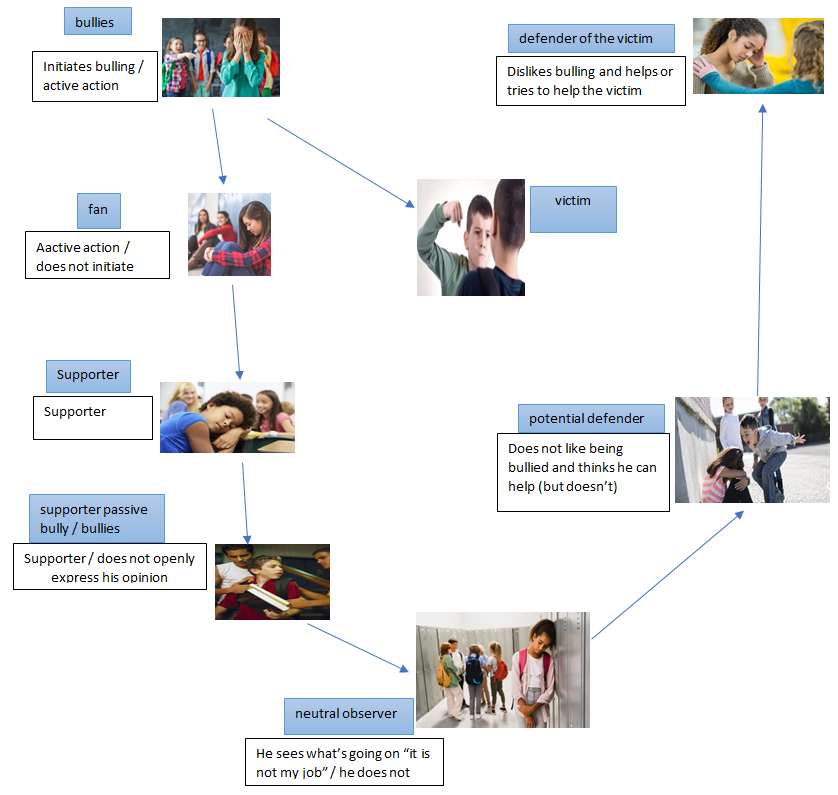
The experiential approach is an effective way to understand all the roles of those involved in school bullying. Recognition and understanding of the roles is facilitated through the Forum theater method and the frozen image technique. Dramatized scenes and frozen images facilitate the analysis and deepening of thoughts, feelings, recognizing emotions develops empathy.
Among the techniques applied in anti-bullying interventions at school are recommended experiential approach, role-play in the script of a story, the Storytelling and Transformation of History. The Storytelling and Transformation of History is part of the forum theater technique. Students can, within the Forum, write and retrieve from their saved stories, their own experience of bullies and victims. By writing their story they reveal personal hidden experiences. Then, as they listen to all the stories presented in the forum, they try different approaches to understanding.
In a second stage, they are asked to transform the stories they wrote and write strategies to deal with the points in the story related to rejection. This gives them the opportunity to act differently and consolidate the change. Original and transformed stories can be performed as theatrical scenes [13, 14].
The purpose of the experiential approach is to train professional teachers, students, parents to effectively manage incidents of school bullying and victimization. Specific goals are the strengthening of cognitive-emotional understanding and training in the management of incidents of school bullying. The development of empathy is a key component of social and emotional skills that promotes communication, social relationships and psychosocial wellbeing and behavior.
The experiential approach utilizes the theory that describes the relational environment in school bullying, the influence of all bystanders with all roles. According to Olweus D [1] in every incident of school bullying apart from the protagonists of the bully and the victim, bystanders participate directly or indirectly and influence the attitude of the protagonists and can play a decisive role in the outcome of the incident. The experiential approach included a short oral, theoretical introduction about the Forum Theater experiential technique and applied counseling guidance.
Experimental Approach
Storytelling-Script of Story
Elli (victim) is reading a book during the break. Just before the end of the break, Noa (active supporter of the bully), Yannis (passive supporter of the bully) and Mari (the bully) come in and start bothering Elli, leaving bad comments about the fact that she is reading a book during the break. At this point, it should be noted that Giannis who is the passive supporter of the bully while enjoying the act of bullying does not express open support. Suddenly, Stave (active victim supporter) and Kate (passive victim supporter) enter the class. Stave, after finding out about the bad behavior of her classmates towards Elli, tried to intervene and defend the victim, explaining to the bully and his supporters that this behavior might hurt the girl. At the same time, he tried to make the bullies reflect on their behavior and understand that what they are doing is not expressing their strength but reducing them and clearly harming a person’s psychology. On the other hand, Kate (passive supporter of the victim) although she is dissatisfied with the act of bullying and wants to help, she does not seek it. In fact, while the events are taking place, Theo, as a neutral spectator, simply watches what is happening but does not take a position [15, 16].
Script of story
- Activity: Role-Playing story
- Τheater scene 1st
- Bully (Mari): Look here the nerd is reading again. - Active supporter of Bully (Nahum): He suddenly grabs the book and starts laughing. - Passive Supporter of Bully: Elli is reading a self- improvement book! - Bully (Mari): What is this? self-improvement book? - Active supporter of Bully (Noa): are the plants improving? Frozen image (1th): The moderator invites people from the theater audience (forum) by touching the shoulder of the victim and the perpetrator to step into his place and say at least one thought and one feeling as if they were in his place.
• Τheater scene 2nd ** The victim’s advocate enters the classroom - Active supporter of the victim (Stave): Hey guys, stop!
It’s not funny what you’re doing! Would you like to feel like this every day? Mari have you ever felt like this? if you were in his shoes, wouldn’t you want someone to help you stop it? - Bully (Mari): Now what do you care? Go away! - Active supporter of Bully (Noa): We missed you now! (Addressed to Stave) - Passive supporter of the victim (Kate): expressions of dissatisfaction without seeking to help the victim. - Active supporter of the victim (Stave): Guys, do you think you show your strength like this? you’re just belittling yourself and hurting a girl. Can’t handle your insecurities? finally, face them! - Active supporter of the victim (Stave): Ah! Mari, know that there are other ways you can feel strong, without hurting others! - Neutral spectator (Theo): He observes the events but does not take a position. - (Mari): Now what do you care? Go away! - Active supporter of the bully (Noa): We missed you now! (Addressed to Stave) - Passive supporter of the victim (Kate): expressions of dissatisfaction without seeking to help the victim. - Active supporter of the victim (Stave): Guys, do you think you show your strength like this? you’re just belittling yourself and hurting a girl. Can’t handle your insecurities? finally, face them! - Active supporter of the victim (Stave): Ah! Mari, know that there are other ways you can feel strong, without hurting others! - Neutral spectator (Theo): He observes the events but does not take a position. Frozen image (2nd): The moderator addresses the question to individuals from the theater audience (forum): ‘’What the bystanders would say to the victimized student and what to the bully?’’
- Activity
- Transformation of History: Reproduced, Corrective Script from the theater audience (forum): the moderator invites audience members to reproduce and correct the script and act it out.
- Activity
- Coordinator (Educator): Analysis of all the roles of Students -Shape of a horseshoe (Appendix, Diagram: The Roles of Students in a bullying situation)
Victim-student intervention, focusing on the following axes
- Empathy/ - it’s not his fault (guilt)/ - Supporters-he’s not alone (fear) - Coping of bully: 1st step: Ignore/2nd step: Walk away/3rd step: Talk friendly/4th step: Speak firmly/5th step: Report it. - Training in active reaction: expressions, sentences, ready-made scenarios - Rights information intervention
Bully-Student Intervention: Dialogue And Discussion on the Following Axes
- Kids who bully have power. And strength makes them feel good - But how does the person who is the victim feel? (May feel scared, embarrassed, sad and angry) - Would you like it to feel like this every day? - Have you ever felt like this? If you were in his shoes, wouldn’t you want someone to help you stop it? - There are other ways you can feel powerful, without hurting others?
References
-
Olweus D (1993) Bullying at school: What we know and what we can do. Wiley-Blackwell, Oxford, pp: 1-160.
-
Gkatsa T (2022) A Review on the Influence of Parental Style and Socioeconomic Circumstances on School Bullying. Research Highlights in Language, Literature and Education 2: 37-47.
-
Schoeler T, Duncan L, Cecil CM, Ploubidis GB, Pingault JB (2018) Quasi-experimental evidence on short-and long- term consequences of bullying victimization: A meta- analysis. Psychological Bulletin 144(12): 1229-1246. 4. Skapinakis P, Bellos S, Gkatsa T, Magklara K, Lewis G, et al. (2011) The association between bullying and early stages of suicidal ideation in late adolescents in Greece. BMC Psychiatry 11(1): 1-9.
-
Wolke D, Lereya ST (2015) Long-term effects of bullying. Arch Dis Child 100(9): 879-885.
-
Gini G, Albiero P, Benelli B, Altoe G (2007) Does empathy predict adolescents’ bullying and defending behavior?. Aggressive Behavior 33(5): 467-476.
-
Jolliffe D, Farrington DP (2006) Examining the relationship between low empathy and bullying. Aggressive Behavior 32(6): 540-550.
-
Mitsopoulou E, Giovazolias T (2015) Personality traits, empathy and bullying behavior: A meta-analytic approach. Aggression and Violent Behavior 21: 61-72.
-
Muñoz LC, Qualter P, Padgett G (2011) Empathy and bullying: Exploring the influence of callous-unemotional traits. Child Psychiatry & Human Development 42(2): 183-196.
-
Nasti C, Intra FS, Palmiero M, Brighi A (2023) The relationship between personality and bullying among primary school children: the mediation role of trait emotion intelligence and empathy. International Journal of Clinical and Health Psychology 23(2): 100359.
-
Van Noorden TH, Haselager GJ, Cillessen AH, Bukowski WM (2015) Empathy and involvement in bullying in children and adolescents: A systematic review. J Youth Adolesc 44(3): 637-657.
-
Olweus D (2001). Bullying at school: Tackling the problem. OECD Observer, pp: 24-24.
-
Bell LA (2009) The story of the storytelling project: An arts-based race and social curriculum. Storytelling, Self, Society 5(2): 107-118.
-
Bell L (2017) Social justice and the arts. Routledge.
-
Bell LA, Roberts RA (2010) The storytelling project model: A theoretical of racism through the arts. Teachers College Record 112(9): 2319.
-
Zhao Y, Chu X, Rong K (2023) Cyberbullying experience and bystander behavior in cyberbullying incidents: The serial mediating roles of perceived incident severity and empathy. Computers in Human Behavior 138: 107484.
- Systematic Review and Meta-analysis Investigating the Prevalence of Depression, Anxiety, Loneliness and Help seeking among International Students
- Family Experiences and their Interpretations as a Source of Adaptive Behaviour in Young Adults: A Qualitative Model of Adaptive Behaviour
- The Development of Responsibility in Teenage Mothers: A Qualitative Model
- Post-Truth Reality: Worldwide Infodemia and Mental Health Concerns during and Post COVID-19 Pandemic Scenarios
- Psycho-Emotional Rehabilitating Means of Overcoming Extreme and Stressful Impact
- The Paradox of Humbleness, Arrogance and the Concept of Fluid Individuality