
School Bullying Rates Directed Against Students with Special Needs in Special Education and Public Schools of Qatar
Objective: Based on researches that have done bullying is a serious issue and if no effective action is taken to prevent bullying behaviour, this phenomenon will become a general norm in schools. The aim of this study was to investigate the rate of bullying, victimization and fighting in schools in Qatar. Methods: 100 early adolescence girl and boy who were enrolled in 2022-2023 academic year in special education and general schools in different areas of Qatar, were volunteer to participate. Based on their health status, students placed into two different groups (students with disabilities and students without disabilities). Participants completed the University of Illinois Scale. This scale consists of 3 subscales that assess victimization from peers, bullying, and fighting at school. Data were analyzed using Multivariate Analysis of Variance. Results: The results showed disabled pupils reported high rates in victimization and fighting behaviors but were in same rate with their peers in bullying preparation. Conclusion: Educators, parents, are crucial in stopping in the emergence of the problem of bullying in schools.
Introduction
Bullying at schools is one of the problematic behaviours of early adolescence which recently attracted the attention of researchers and experts in the field of psychological education and it has been the central subject of many studies [1, 2]. Bullying at school currently considered as a major Investigation Paper social and public health problem that can lead to severe and permanent hurts [3]. Leading researchers in this field, define bullying as any aggressive behaviour that includes three main elements:
- Deliberate injury
- Repetitive behaviour and
- Clear imbalance power between the bully and the victim [4].
The prevalence of conflict in the phenomenon of bullying (bully-victim) in different countries is variable from 15% to
50% [5]. A meta-analysis that analyzed eighty international studies has reported the prevalence of bullying 34.5 % and victimization is 36% [6]. Victimized children have significantly lower self-esteem than non-victims, in the sense that they have negative attitudes towards themselves and they do not consider themselves capable of controlling life and often experience a feeling of helplessness and powerlessness [7]. Bullying has been studied extensively around the world [8, 9, 10]. The pioneering researcher and founding father to study this issue deeply is Dr. Dan Olweus [11], who is a Norwegian/ Scandinavian researcher; he originally defined bullying as a mental or physical aggressive act by one or more children against one or more of their peers. his book Bullying at School: What We Know and What We Can Do (1993) is considered the basis for any study which tackles the concept of bullying/victimizing. According to the Olweus theory, bullying behaviour includes a wide range of destructive behaviours that regularly and over a period of time cause people to become victims in three ways: physical, verbal and emotional or psychological.
Bullying is about making fun of people for different reason including the following: how they look which is about appearance; how they act which is about behaviour; about their religion or race; and social statues about the popularity and richness of others [12].
In an article written by Gordon S [13], the author stated bullying happens among teens out of confirming control over each other which is due to lack of power in their family life. In addition to seeking power, popularity is the second reason for bullying. When some teens are popular more than their peers, they try to make fun of the less popular by gossiping and spreading rumours. Moreover, they might resort to bully others to decline the social status of their peers. Payback is the third reason for bullying; this type is referred to as bully- victims. When teens have been victims of bullying, they think that they have the right to bully and get revenge! Problems at home constitutes another reason for bullying; abusive homes often lead teens to bully as a cover of lack of self-esteem. Pleasure is a cause of bully for other teens; some of them find relive and excitement while bully others which is due to lack of supervision and attention from their parents at home.
As bullying has become a critical issue in schools, researchers have expressed their concerns about students with disabilities who are at an even higher risk of being bullied than students without disabilities. In a qualitative study entitled as the following: The experiences of learning, friendship and bullying of boys with autism in mainstream and special settings: a qualitative study, done by Cook J, et al. [14], thematic analysis in semi-structured interviews was used for generating codes and defining themes from the collected data. The participants were 11 boys with autism attending mainstream and specialist schools; their age ranges from 11 to 17. The results showed that five out of eleven had been exposed to bullying specially in main stream schools.
Another research has tackled the concept of bullying with the following tittle: Educating the Educators: Facilitating Bullying Education with in service Special Education Teachers; two cooperative authors, Lee Y, et al. [8] did the research in the USA. Thirty novice special education teachers formed the informants of this study; they were surveyed to probe the level of bullying prevention training and intervention that they have exposed to during their teacher education training programmes, school districts, and school sites. The findings indicated that the informants developed their readiness and confidence for bullying prevention and intervention techniques.
Rose CA, et al. [10] conducted a comparative study which entitled as the following: Bullying and Victimization among Students in Special Education and General Education Curricula; although the title has nothing to do with disable students, the content has! In this study, the rate of bullying, fighting, and victimization have been examined in respect to student with and without disabilities. The results showed that students with disability are exposed to victimization and engaged in aggressive: such as fighting and bullying behaviours even more than their peers who are without disabilities. Moreover, the findings of this study demonstrated that schoolchildren with disabilities are at more risk of fighting and victimization, but when it comes to bullying, they have similar rates of they compared to their peers in a general education curriculum. However, students with disabilities have reported higher rates/proportion of aggressive behaviours than students without disabilities when exposed to victimization.
Literature Review
Bullying is a frequent phenomenon in and is increasingly receiving widespread attention. Unfortunately, peer-on- peer bullying commonly targets kids with disabilities. This article looks at the legal repercussions of bullying of kids with disabilities in educational settings. Bullying may be a violation of Section 504 of the Rehabilitation Act of 1973 and the Individuals with Disabilities Education Act, according to court cases, decisions made by state educational agencies, Office of Special Education Programs (OSEP) recommendations, and Office of Civil Rights (OCR) judgements. In this article, we discuss these rulings. Bullying of students with disabilities must be quickly and effectively addressed by school staff. These rulings actually demonstrate that school district staff and officials may be putting their schools at danger of legal trouble if bullying is not prevented. We conclude by offering suggestions on how school district administrators can create policies that are compliant with the law for locating, looking into, and handling incidents of bullying of children with disabilities [15].
Bullying is a form of purposeful aggression characterized by a disparity in strength or power. It happens frequently over time. Bullying can take many different forms, including hitting, kicking, or shoving (physical bullying), taunting or calling names (verbal bullying), intimidating others with gestures or by excluding them from social situations (nonverbal bullying or emotional bullying), and sending offensive text or email messages (cyberbullying) [16].
Bullying, a form of violence among peers, manifests as physical, psychological, or relational abuse, all of which are clearly intentional acts on the part of the bully. Bullies take advantage of the uneven power relations they have with their victims, who endure this mistreatment for a long time. It is a complicated, morally repugnant issue that affects kids [17].
When a student is subjected to unfavourable behaviour by one or more other pupils on a regular basis and over time, this is referred to as bullying or victimization. Consequently, bullying fits the following three definitions: In an interpersonal relationship marked by a power imbalance, it is (a) an aggressive conduct or intentional “harmdoing” (b) that is done “repeatedly and over time.” It could be added that bullying frequently happens with no apparent cause. Olweus distinguishes between “teasing” and bullying in the game. Typically, “teasing” occurs between friends and does not involve causing bodily harm to other people. On the other hand, school bullying occurs amongst strangers. Because some kids are bigger, more popular, or even because they can work together to harm someone else, there is a typical imbalance of power. If the youngster believes that others’ activities go beyond the scope of the game and, more crucially, if they persist for a very long time, “teasing” could easily develop into bullying. Bullying is the deliberate, intentional goal to harm another person and cause them anguish. We see that this description includes intentional behaviour on the part of the offender. He is aware of the harm he will bring about, and that very well may make him happy. The Scottish Council for Research in Education defines school bullying as the intentional and conscious desire of the offender to injure, threaten, or intimidate someone, which offers a comparable understanding of the perpetrator’s mentality. Different types of bullying at school may occur. It is divided into many categories based on how it manifests itself and how the criminal chooses to commit the crime [18].
Consequently, we notice the following forms:
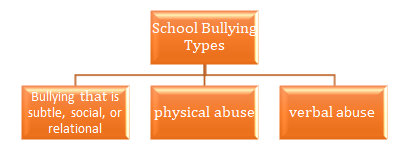
Physical Abuse
It is a common type of school bullying that includes a variety of behaviours such punches, kicks, jerks, slaps, strokes, hair pulling, harnessing, and/or property damage [18].
Verbal Abuse
It is the most typical type of bullying at schools. Some of the most well-known methods of this type of intimidation include chirping, insults, arguments, as well as sarcasm, scorn, irony, and false propaganda. The child’s confidence is frequently undermined through verbal intimidation [19].
Bullying that is Subtle, Social, or Relational
This kind of bullying entails actions like spreading rumours, excluding the victim from social groups or activities, and not accepting the victim. The goal of indirect intimidation is to undermine the victim’s sense of self-worth. They employ strategies like solitary behaviour, aggressive nonverbal communication, gestures, and nodding. In contrast to direct intimidation, which is marked by rather obvious attacks on the victim, indirect intimidation is said to be the most difficult type of emotional abuse to identify [16].
Special needs Students Bullying Involvement
Disability status has become a significant risk factor for bullying in recent years. According to the Centres for Disease Control, bullying is “any unwelcome hostile behaviour(s) by another young person or group of young people who are not siblings or romantically involved, involves an apparent or perceived power imbalance, and is repeated or is highly likely to be repeated.” contrasted children with disabilities to their peers without disabilities, and found that rates of victimization among students with disabilities ranged from 24.5% in elementary school to 34.1% in middle school. In an extension of these findings, Rose CA, et al. [10] contend that, in addition to victimization, students with disabilities also participate in higher rates of proactive behaviour (i.e., bullying) and defensive aggression (i.e., fighting). In contrast to their counterparts without disabilities, kids with disabilities may unfortunately experience worse outcomes as a result of this unbalanced representation because higher victimization rates are linked to greater physical, emotional, and psychological suffering [15].
Schoolchildren with disabilities are particularly affected by bullying, which is a severe issue. Studies in this category, however, have used smaller cohorts, making the outcomes less representative and occasionally inconclusive. The goal of this research is to conduct a comprehensive evaluation of the work done in recent years, including the examination of many sample-related variables, methodology-related variables, and bullying-related variables. Three steps were taken to adhere to the PRISMA (Preferred Reporting Items for Systematic Reviews and Meta-Analysis) statement’s rules. A total of 55 kids who met the requirements for inclusion made up the sample. The findings show that half of the studies did not distinguish between different forms of disability and were carried out in cohorts of less than 250 pupils. Additionally, there is no agreement on the methodology employed, and no specialist tools were used. There haven’t been many targeted therapies for the kind of bullying that has been studied, where victimization is the main tactic. We came to the conclusion that more studies, involving more participants and utilizing more sophisticated tools, are urgently needed to produce more reliable results. We will be able to develop targeted preventative and intervention strategies to combat bullying of schoolchildren with disabilities thanks to such studies [17].
In its World Report on Disability, the World Health Organization states that more than 5% of children between the ages of 0 and 14 have a disability. Among the issues cited are learning challenges, behavioural disorders, developmental delays, and autism spectrum disorders. Schoolchildren with impairments are more susceptible to power imbalances, which may be a risk factor for bullying; however there are fewer research on this population than on students without disabilities. There may be a number of causes for this: First, in order for them to fulfill academic goals and have a higher chance of inclusion, it is important to prioritise providing them with the support they need to satisfy their educational needs. Second, the lack of researchers with expertise in bullying in the field of disability. Thirdly, the peculiar traits of the pupils’ disabilities, such as their inability to fully articulate their own behaviour and that of others. This component might be the primary factor influencing the research’s choice of additional topics. According to studies, students without disabilities are less likely than students with disabilities to experience bullying. Additionally, the research demonstrates that the stress they endure is just as emotionally, mentally, and socially devastating as that endured by those without disabilities. As they age, they may also lose friends and exhibit externalising behaviours like attacking their peers as a coping mechanism for maltreatment [17].
Researchers are starting to identify the diagnostic correlations linked to this disproportionate representation. In particular, it has been proposed that a handicap may not act as a risk factor when used as a static indication. According to Rose CA, et al. [10], bullying involvement among students with disabilities may be related to traits connected to particular disability. For instance, students with behaviour- oriented difficulties frequently engage in more aggressive behaviour, both proactive and reactive, which may meet the diagnostic criteria for behavioural disorders (Individuals with Disabilities Education Act [IDEA], 2004). Deficits in social and communication skills, which are a frequent feature of ASD, may be linked to the increased victimisation rates among adolescents with autism spectrum disorders (ASD), on the other hand. As a result, and frequently as a result of their disability, this population of pupils is at increased risk of being involved in bullying, which justifies urgent intervention and assistance. Although there is widespread agreement that bullying is wrong and cannot be tolerated in our schools, the Office of Civil Rights (OCR) in the U.S. Department of Education reports that the sad reality is that bullying persists in our schools today, particularly for students with disabilities who are frequently the targets of bullying. United States Department of Education [15].
The goal of the current study is to provide a investigate the problem of bullying in schools among both children with and without special educational needs. First, the terms “violence” and “school bullying” are distinguished from one another, with the latter term referring to a specific type of violence. Following that, a few of the most significant definitions of “school bullying” are provided. It should be mentioned that there is no agreed definition that applies universally because it is difficult to define a phenomenon that is so complicated and multidimensional. The primary types of bullying in schools are then discussed, along with their main causes. Finally, research data on the prevalence of bullying in schools based on special educational requirements is presented, with recommendations for how to address it coming primarily from [20].
Definitions
School Bullying
It is conduct or deliberate harmdoing that occurs in a relationship when there is an imbalance of power and it is done repeatedly and over time. One further thing to mention is that bullying frequently happens with no apparent reason [18].
Disability
A disability is any physical or mental condition (impairment) that makes it harder for the person with the condition to conduct specific tasks (activity limitation) and engage in social interactions with others (participation restrictions) [21].
Disabled
Lacking one or more physical abilities, such as the capacity to walk or coordinate one’s motions, due to a sickness, an injury, a mental illness, or another factor [22]. Disabled students also known as SEN. This concept refers to a broad variety of demands. These include autism, a speech, language, and communication issues, hearing loss, vision loss, multisensory loss, behavioural, emotional, and social difficulties [9].
Research Problem
Disability status has recently emerged as a significant risk factor in bullying dynamics. Bullying is a negative behaviour, according to the Centres for Disease Control and Prevention. Numerous disabled pupils already face unique challenges in the classroom. A person’s capacity to learn and grow may be negatively impacted by bullying. Bullying can hinder a child’s capacity to receive an education, cause them to miss class, make it difficult for them to concentrate, and lower their academic performance. Then problem of bullying and harassment of pupils who have impairments is particularly significant. In the case that bullying occurs or when school personnel suspects bullying, they should initiate an inquiry right away. If bullying does occur, they should then take action to address the issue and stop it from happening again.
Research Aim
This study’s objective is to identify bullying at schools that targets students with special needs. Both in conventional and private schools figuring out the causes and effects of bullying in schools, as well as the harms that bullying does to special needs students academically, socially, and psychologically. Understanding the difficulties schools experience in preventing bullying of kids with special needs and the successful strategies schools can use to stop and address the phenomena of bullying.
Research Importance
This study aimed to identify the individual differences between students with special needs and normal students as victims of school bullying. To reveal the differences between children with special needs as victims of school bullying according to the type of disability. Detecting differences between students with special needs as victims of school bullying according to the age group. And also knowing the challenges faced by schools in preventing bullying of children with special needs.
Research Hypotheses
Based on the previous studies concerning bullying against students with special needs, it is hypothesized that
- The rates of Bullying, Victimization, and fighting between normal students and students with special needs is differ.
- Students with disabilities are more likely to be bullied and victimized by their peers who are without disabilities.
Methodology
Cases’ Selection
Based on the high rate of school bullying, the sample size of current study was one-hundred students from different schools (public and private) in various cities of Qatar, including: grade 4 (n=9), grade 5 (n=11), grade 6 (n=17), grade 7 (n=16), grade 8 (n=5), grade 9 (n=6), grade 10 (n=6), grade 11(n=18), grade 12 (n=12). The sample of study population consisted of 48% male and 52% female. The overall age mean of the study population was 13.75 years. The average age for students with disabilities was 13.46 years (SD = 2.73) and for students without disabilities 13.96 years (SD = 2.65) (Table 1).
| Male | Female | ||
|---|---|---|---|
| with disability | 18 | 21 | 39 |
| without disability | 29 | 31 | 60 |
| Total | 48 | 52 | 100 |
Table 1: students with disabilities and students without disabilities * sex of students Cross tabulation.
Participants were asked if they had a disability and if they knew about it (if applicable, then we’re asked to explain it), students were also asked if they knew what their disability was called. and then they were asked whether they are enrolled in part-time or full-time special needs coursework at school. Among 100 students, (n=39) signified that they are disabled, and (n=60) doesn’t enrolled in any special education classes. Students with disabilities were18 % male and 21% female. Based on students’ answers, most disabilities were Hyperactivity Disorder (ADHD), Intelligence Disabilities (Mental Retardation), Asperger Syndrome and Autism, Learning difficulties, Dawn syndrome, and physical disabilities.
University of Illinois Bully Scale
Bullying Subscale
Illinois 9-Point Bullying Scale [1] was used to evaluate the occurrence of teasing, verbal abuse, social exclusion, and gossip distribution. Participants were asked how often they have made fun of other students in the last 30 days, excluded other students for fun, excluded other students from their circle of friends, and encouraged harassment other students. Response options included 7-point Likert Scale. For the measuring the reliability of scale, a Cronbach alpha coefficient of .72 was found.
Victimization Subscale
Peers’ victimization was evaluated by University of Illinois Victim subscale [1]. Participants were asked by a 7-point Likert Scale, how often they experienced the following things in the last thirty days: “I got hit and pushed by other students”, “other students called me names”, “other students made fun of me”, and “Other students picked on me” a Cronbach alpha coefficient of .84 was found for this study.
Fighting Subscale
The 4-items University of Illinois Fight Scale [1], was used to assess physical fighting. This scale measures aggression behaviours (e.g., “I got into a physical fight because I was angry”, “I threatened to hurt or hit another student”, and “I hit back when someone hit me first”. For current research a Cronbach alpha coefficient of .85 was found.
Ethical Consideration
In this research, participants were explained about their freedom to participate before the implementation of the research. Also, we provided enough information about the study. Questionnaires were distributed among students in collaboration with school teachers. A consent form with phone number and email address was sent by school administrators to the parents to assign if they’re willing their son/daughter participate the study.
Results
General descriptive statistics were used to calculate the differences in rates between students (with and without) disabilities in bullying perpetration, peer victimization, and fighting. At first, overall group means and standard deviations assessed, [bully = (7.28), 5.55, Fight (4.11), 4.77, victim = (5.33) 4.79,]. Then we assessed individually for students without disability [bully = (9.00), 6.35, Fight (5.26), 5.6, victim = (2.25), 1.97] and students with disability [bully = (4.71), 2.47, Fight = (2.15), 1.7, victim = (10.12), 3.90]. The implication of descriptive statistics analyses, one standard deviation greater than overall groups mean, showed that students with disabilities and without disabilities are different in percentage of total involvement on bullying, victimization, and fighting (Table 2). According of these evidences, additional analyses verified necessary to confirm researches’ hypotheses.
| With disability | Bullying | 39 | 0.79% |
|---|---|---|---|
| Victimization | 39 | 3.50% | |
| Fighting | 39 | 2.17% | |
| without disability | Bullying | 60 | 1.70% |
| Victimization | 60 | 1.05% | |
| Fighting | 60 | 0.79% |
Table 2: One standard Deviation above the overall Group Means.
Multivariate Analysis of Variance (MANOVA) was conducted to investigate if there was a significant difference in students’ rates in bully, fighting, victimization as independent variables and students’ special education status, sex, and students’ academic level as independent variables. An overall MANOVA effect was indicated for special education status (Wilks’ Lambda =.719, F (6, 188) = 5.622, p <.001, partial eta squared= .152, observed power = .997); univariate analyses showed that the students differed on fighting (F = 3.096, P < .001, partial eta = .261), and victimization (F = 12.764, P < .001, partial eta = .210). However, students where no significantly differ on bullying perpetration (F= .567, P >. 569, partial eta = 012).
Following, the Pearson correlation coefficients were conducted separately to define the associations between independent variables; bullying, victimization, and fighting on students with disabilities and students without disabilities (Table 3).
| Subscales | Bullying | Victim | ||
|---|---|---|---|---|
| with disability | Bullying | 1 | ||
| with disability | Fighting | .578** | 1 | |
| with disability | Victimization | 0.037 | 0.248 | 1 |
| without disability | Bullying | 1 | ||
| without disability | Fighting | .640** | 1 | |
| without disability | Victimization | -0.028 | 0.028 | 1 |
Table 3: ** Sample size Correlation Coefficients.
. Correlation is significant at the 0.01 level (2-tailed). Table 3:** Sample size Correlation Coefficients.
Pearson product correlation of bullying and fighting was found to be strong positive statistically significant (r = .578, n = 39, P < .001). Hence, bullying was supported. This shows that an increase in bullying behavior leads to a higher fighting (e.g., aggressive) behaviors in the students with disabilities. There was moderate positive correlation between bullying and victimization (r = .037, n = 39, p <.825), and a low positive correlation between fighting and victimization (r = .248, n=39, P < .128) in the same group.
However, the results for the students without disabilities were strong positive statistically between the variables of fighting and bullying (r = .640, n = 60, P <. oo1), with bullying explaining 40% of the variation in fighting. There was low association between fighting and victimization (r = .028, n = 60, P < .834), and a low negative correlation between bullying and victimization (r = -.028, n = 60, P < .829) for the group of students without disability. Conversely, by use of the Fisher r to t transformation, it was shown that the two groups differed significantly on correlations between victimization and fighting (Z = 2.02, P < .001), thus, victimization by peers was more correlated with fighting for disabled pupils.
Discussion
According to the studies on school bullying as a whole, it has become a serious problem in recent years. It is also acknowledged that children with Special educational needs are more likely to experience harm than their peers who are developing normally, despite data indicating the contrary. However, it was shown that the maltreatment suffered by students with special needs is primarily brought on by their disability.
As this study hypothesized, disabled students at school report higher levels of victimization and fighting behaviors than their peers who are without disability due to their exposure to bullying by their normal peers. Bullying perpetration has no large difference which assures that both students with disability and without disability are target. Based on the results of this study, the researcher believes that students with special needs, due to their difficulty managing their social skills, lack of cognitive ability, and inability to form and keep friendships, are the most common victims (greater risk groups for intimidation and victimization). Furthermore, the researcher believes a key contributor to increasing of high rate of verbal and physical abuse in the community of current study is insufficient teacher training on how to deal with school bullying successfully. Therefore, it is required to provide more sophisticated training, which includes a variety of intervention techniques and knowledge on how to choose and carry out such interventions in an acceptable manner. The focus that teachers place on the cold transmission of knowledge contributes significantly to the emergence of intimidating behavior, which excludes students’ education. It should be emphasized here, too, that the teacher’s role encompasses more than just imparting knowledge; it also includes developing moral beliefs, inspiring pupils to work towards their goals, and preparing them for community involvement Berchiatti M, et al. [9].
Students with disability are at more risk of being bullied because they lack some social skills which will definitely result in small circle of true friends. The people who engage in intimidating behaviour are frequently portrayed as being aggressive, impulsive, lacking in self-control, and supportive of violence. The psychological characteristics of the victims, according to several studies, psychologists, and psychiatrists, are insecurity, low self-esteem, and overall feelings of inadequacy. Olweus rejects this point of view. In contrast, he contends that, according to the results of his study, the anxiety and self-esteem levels of perpetrators are around average. It is debatable whether threatening conduct and self-esteem are related. The social abilities of bullies are very advanced. However, it has been asserted that the offenders have poor social and interpersonal abilities. It should be highlighted that, despite their level of social skills, they lack or have only a very limited capacity for empathy on both a cognitive and emotional level. In other words, they struggle to comprehend the emotions and thoughts of their victims [10].
According to, typical victims are less secure and more vulnerable than typical students. Because of their low self-esteem, people have a poor perception of themselves. Additionally, they are timid and sensitive. Children who have been victims often struggle to make friends because they are introverted and lack social skills. One of the biggest risk factors for victimisation is a lack of friendship. It follows that a child’s ability to socialise and the existence of one or more friends in their life may both mitigate the detrimental impacts of victimisation and serves as a barrier to it. In terms of physical appearance, victims are typically little or have a trait that sets them out from other kids, such as obesity, acne, or some other oddity like a disability or sexual orientation. The aforementioned traits apply to the so-called “passive victims.” Olweus, however, distinguishes between passive victims and a different kind of victims, the so-called provocative victims. These kids exhibit jittery and aggressive conduct, have attention issues, and frequently agitate their surroundings with their actions. They also have a masochistic persistence on seeking out confrontation and competition and are always trying to demonstrate, display, and monopolise the attention of others [18].
The family, in particular the calibre of inter-familial connections, plays a critical role in fostering a child’s violent attitude in addition to the specific traits of the offender and the victim. Olweus lists three elements that are crucial in the emergence of violent conduct. First and foremost, it’s crucial for parents to have a positive emotional attitude during their child’s formative years. A lack of affection and engagement on the part of the parents’ bad attitude may cause the child to act aggressively towards other people. The extent of parental tolerance for their child’s violent behaviour is the second deciding factor. The likelihood of a youngster developing aggressive conduct increases if parents do not clearly define boundaries for the child’s aggressive attitude. The third reason is parents’ poor parenting techniques. These techniques could include harsh punishment as well as forceful displays of sympathy. Children that grow up in a violent environment will likewise adopt the same combative behaviours and claims. Children who witness domestic violence are often reported to be far more prone to intimidate their peers. Parental pedagogical attitudes, the quality and type of disciplinary measures, the relationship between parents and their children, and the structure and organization of the family (limits, rules, emotional climate), are all thought to be highly relevant to the development of aggressive behaviours and the creation of interpersonal emotional and cognitive schemes that enhance aggressive behaviours [15, 19, 20].
A last set of issues focuses more on how parents, teachers, and students conceptualize bullying and the necessity for all parties to comprehend the social context in which bullying is taking place. While this has been noticed in regard to studies of bullying in general, it is especially relevant in the case of children with SEN or disabilities because research shows that in addition to being disproportionately prone to bullying, they are frequently also thought to be bullying others [21, 22, 23]. Note that fewer children with special educational needs are excluded from school if the threat assessment intervention is employed, which considers the social context of threats and evaluates the true amount of danger they provide. It’s critical to increase teachers’ awareness of the effects on families in particular so they don’t place the responsibility there. The prevention of bullying of kids with SEN and/ or disabilities, however, is also a major consideration. Additionally, it asserts that the social context of bullying must be taken into account and contends that one of the difficulties of whole-school strategies is raising community awareness and affecting attitudes. As they may be directing school policies inadvertently making them socially exclusive to such children, schools should be urged to assess how they define conditions and what expectations or prejudices they have regarding children with specific types of SEN and/ or disability. For instance, Alderson’s study demonstrates how various perceptions of autism among school personnel have a big impact on their level of social integration. The techniques that might more successfully stop or lessen the victimization of children with SEN and/or impairments are then discussed in the section that follows [18]. Although, this study presents a strong foundation on literature of bullying, this research has faced several limitations. One of the limitations of the current study is the sample size is regulated to one-hundred students. In the future studies, it is suggested to increase the generalizability of the results, through selecting more numbers of students with disabilities and without disabilities. Furthermore, in order to ensure a more accurate identification of bullying-victims in schools, in addition of use of self-assessment questionnaires and school counsellors for collecting data, peer evaluation should also be included in the selection [24, 25, 26].
Conclusion
According to the studies on school bullying as a whole, it has become a serious problem in recent years. The goal of this study is to uncover bullying in schools that specifically targets special needs pupils at both public and private schools of Qatar. The results of this study indicated that children with Special educational needs are more likely to experience harm than their peers who are developing normally. Verbal and social intimidation is the most typical types of intimidating actions that students with special needs encounter. Poor social skills or inappropriate behaviors may prompt their peers to react aggressively. Verbal and social intimidation is the most typical types of intimidating actions that students with special needs encounter. However, Family and educators are crucial in the emergence of the problem of bullying in schools.
Acknowledgment: Thank you for the team who helped in applying this study: Sara Ghareeb sa.ghareeb@paaet.edu. kw; Elham Kadkhodaei elham-kadkhodaei@hotmail.com Funding: This study has been funded by Qatar University grant # QUHI-CED-22/23- 581
References
-
Espelage DL, Holt M (2001) Bullying and victimization during early adolescence: Peer influences and Psychosocial correlates. Journal of Emotional Abuse 2(2- 3): 123-142.
-
Patchin JW, Hinduja S (2011) Traditional and nontraditional bullying among youth: A test of general strain theory. Youth & Society 43(2): 727-751.
-
Betts C (2014) Multi-level Analysis of Student and School Level Characteristics. Associated with Bullying Victimization in Ontario High School Students. Master’s thesis, University of Waterloo.
-
Gaffney H, Ttofi MM, Farrington DP (2019) Evaluating the effectiveness of school-bullying prevention programs: an updated meta-analytical review. Aggression and Violent Behavior 45: 111-133.
-
Shetgiri R (2013) Bullying and victimization among children. Advances in Pediatrics 60(1): 33-51.
-
Modecki KL, Minchin J, Harbaugh AG, Guerra NG, Runions KC (2014) Bullying prevalence across contexts: A meta- analysis measuring cyber and traditional bullying. Journal of Adolescent Health 55(5): 602-611.
-
Hawker DS, Boulton MJ (2000) Twenty years’ research on peer victimization and psychosocial maladjustment: A meta-analytic review of cross-sectional studies. The Journal of Child Psychology and Psychiatry and Allied Disciplines 41(4): 441-455.
-
Lee Y, Ortiz Bush Y (2018) Educating the Educators: Facilitating Bullying Education with Inservice Special Education Teachers. The Journal of the International Association of Special Education 18 (1): 41-48.
-
Berchiatti M, Ferrer A, Galiana L, Ribera LB, Longobardi C (2021) Bullying in students with special education needs and learning difficulties: The role of the student– teacher relationship quality and students’ social status in the peer group. Child & Youth Care Forum 51: 515- 537.
-
Rose CA, Espelage DL, Aragon SR, Elliott J (2011) Bullying and Victimization among Students in Special Education and General Education Curricula. Exceptionality Education International 21(3): 2-14.
-
Olweus D (1993) Bullying at school: What we know and what we can do. Blackwell, Oxford, UK pp: 1-148.
-
Gavin LM (2019) Dealing with Bullying. KidsHealth.
-
Gordon S (2021) 8 Reasons Why Teens Bully Others. Verywell family.
-
Cook J, Ogden J, Winstone N (2016) The experiences of learning, friendship and bullying of boys with autism in mainstream special settings: a qualitative study. NASEN 43(3): 250-271.
-
Yell ML, Katsiyannis A, Rose CA, Houchins DE (2016) Bullying and harassment of students with disabilities in schools: Legal considerations and policy formation. Remedial and Special Education 37(5): 274-284.
-
Foley KR, Blackmore AM, Girdler S, O Donnell M, Glauert R, et al. (2012) To feel belonged: The voices of children and youth with disabilities on the meaning of wellbeing. Child Indicators Research 5: 375-391.
-
Falla D, Sánchez S, Casas JA (2021) What do we know about bullying in schoolchildren with disabilities? A systematic review of recent work. Sustainability 13(1): 1-416.
-
Kaminaridi V, Tsaliki E (2017) Bullying in Students with and Without Special Educational Needs. Glob J Educ Stud 3(2): 118.
-
Liu M, Kohzuki M, Hamamura A, Ishikawa M, Saitoh M, et al. (2012) How did rehabilitation professionals act when faced with the Great East Japan earthquake and disaster? Descriptive epidemiology of disability and an interim report of the relief activities of the ten Rehabilitation- Related Organizations. Journal of Rehabilitation Medicine 44(5): 421-428.
-
Alliance AB, Britain G (2010) Bullying of Children with Disabilities and Special Educational Needs in Schools: Briefing Paper for Parents on the views and Experiences of Other Parents, Carers and Families. Anti-Bullying Alliance.
-
Ghoshal SK (2018) Concept of Disability-The Dynamic Trend. International Research Journal of Commerce Arts Science 9(4): 233-245.
-
Rieser R (2012) Implementing inclusive education: a Commonwealth guide to implementing Article 24 of the UN Convention on the Rights of Persons with Disabilities. Commonwealth Secretariat.
-
Goetz CG, Poewe W, Rascol O, Sampaio C, Stebbins GT, et al. (2004) Movement Disorder Society Task Force report on the Hoehn and Yahr staging scale: status and recommendations the Movement Disorder Society Task Force on rating scales for Parkinson’s disease. Movement disorders 19(9): 1020- 1028.
-
McLaughlin C, Byers R, Vaughn RP (2010) Responding to bullying among children with special educational needs and/or disabilities. Anti-Bullying Alliance, London, UK.
-
Manthakiny N (2021) Social and health care issues of persons with disabilities: a medical sociological study based on Maritimepattu Divisional Secretariat.
-
Secretariat LS (2015) Fifteenth Report of the Social Justice and Empowerment Committee on †œThe Rights of Persons with Disabilities Bill.
- Systematic Review and Meta-analysis Investigating the Prevalence of Depression, Anxiety, Loneliness and Help seeking among International Students
- Family Experiences and their Interpretations as a Source of Adaptive Behaviour in Young Adults: A Qualitative Model of Adaptive Behaviour
- The Development of Responsibility in Teenage Mothers: A Qualitative Model
- Post-Truth Reality: Worldwide Infodemia and Mental Health Concerns during and Post COVID-19 Pandemic Scenarios
- Psycho-Emotional Rehabilitating Means of Overcoming Extreme and Stressful Impact
- The Paradox of Humbleness, Arrogance and the Concept of Fluid Individuality