
Chronic pruritus revealing Angioimmunoblastic T-cell lymphoma
Angioimmunoblastic T-cell lymphoma (AITL) is an uncommon systemic lymphoproliferative disorder that comprises 18% of all peripheral T cell lymphomas. We report a case of AITL discovered during a paraclinical assessment of chronic pruritus
Senouci K and Hassam B
V University, Morocco
elanzi.ouiam@gmail.com pruritus.
Keywords: Angioimmunoblastic T-cell lymphoma; Cutaneous; Pruritus
Introduction
Angioimmunoblastic T-cell lymphoma (AITL) is an uncommon systemic lymphoproliferative disorder that comprises 18% of all peripheral T cell lymphomas [1]. Cutaneous manifestations in AITL are dominated by the macular papular rash. Other manifestations, such as pruritus, are more rarely observed. We report a case of AITL discovered during a workup of chronic pruritus.
Case Report
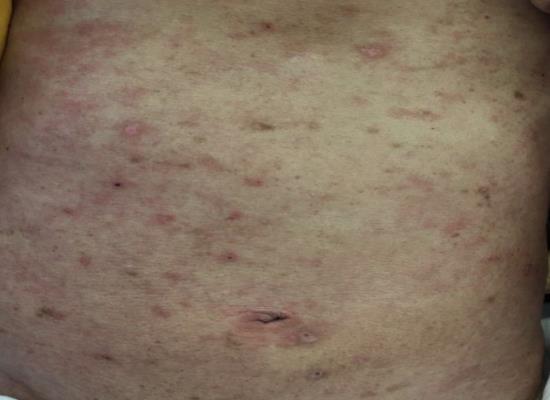
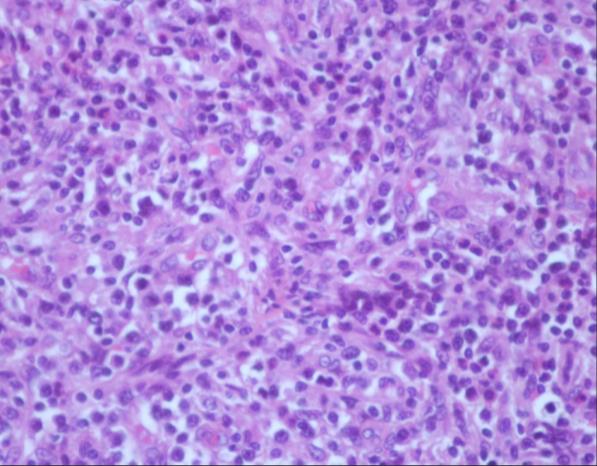
A 70 years old male was admitted to the dermatology department for 2 years history of generalised chronic pruritus associated with constitutional symptoms (fever, weight loss, and night sweats). Dermatological examination revealed scraping lesions such as excoriated papules and linear striations as well as physical examination found generalized lymphadenopathy and ascites but no hepatosplenomegaly or pleural effusion. Biological examinations showed leukocytosis, anemia and elevated lactate dehydrogenase. Skin biopsy revealed a leukocytoclastic vasculitis. An excisional biopsy of an inguinal lymph node demonstrated lymphocytic infiltrate with histiocytes, eosinophils, neutrophils, and plasma cells. Follicular hyperplasia was not evident, but interfollicular regions were expanded with proliferating vessels. Atypical lymphocytes showed strong positivity for CD5, CD10, and CD30 at immunohistological staining. The patient was diagnosed with AITL and was treated with chemotherapy.
Discussion
AITL is a rare systemic lymphoproliferative disorder but represents one of the most frequent subtypes 18% of peripheral T cell lymphomas [2]. Clinical aspect associates generalized lymphadenopathy, fever, weight loss, hepatosplenomegaly, pleural effusion, ascites and non- specific cutaneous involvement such as morbilliform eruptions, urticarial, purpura and pruritus. Polyclonal hypergammaglobulinemia, elevation of Lactate Dehydrogenase and Anemia are the most commonly found biological abnormalities. Histopathology is fundamental for diagnosis. The most common finding is a superficial perivascular infiltrate with or without atypical lymphocytes expressing CD2, CD3, CD4, CD5, and occasionally CD8 [1, 3]. A deficiency of cellular immunity explains the frequent occurrence of infections [3].
1st line treatment of AI T-cell lymphoma is Anthracycline-based therapy, including: (cyclophosphamide, doxorubicin, vincristine, and prednisone), but infectious complications are frequent [1, 3]. Newer treatments have been applied including: rituximab (anti-CD20 therapy that targets B cells);
El Anzi O, et al. Chronic Pruritus Revealing Angioimmunoblastic T- Cell Lymphoma. Med J Clin Trials Case Stud 2019, 3(1): 000205.
cyclosporine, interferon, bevacizumab, thalidomide; romidepsin; and alemtuzumab (which targets CD52 on B and T cells). Autologous bone marrow transplantation is proposed to the youngest patients [1, 3, 4]. AI T-cell lymphomas have a very unfavorable prognosis with an overall survival of 26 to 36% at 5 years [5].
Conclusion
AITL must be considered if an elderly patient presents with a generalized pruritus or pruritic rash in the context of lymphadenopathy, fever, pleural effusions, and recent infections.
References
-
Min MS, Yao J, Kim SJ (2015) Development of a reticular rash in a febrile woman: An unusual cutaneous presentation of angioimmunoblastic T-cell lymphoma. JAAD Case Reports 1(3): 160-162.
-
Priyadarshini Pathak, Stuthi Perimbeti, Ashley Ames, Alison J Moskowitz (2019) Guillain Barré syndrome heralding the diagnosis of angioimmunoblastic T-cell lymphoma. Leukemia & Lymphoma.
-
Florence Lachenal (2007) Lymphomes T angio- immunoblastiques Angioimmunoblastic T-cell lymphoma. La Presse Médicale 36(11): 1655-1660.
-
Joly L, Rosenstingl S, Huillard O, Gatfossé M (2008) Importante plasmocytose sanguine et médullaire réactionnelle à un lymphome angioimmunoblastique. La Revue de médecine interne 29(S1): 131.
-
Antoine C, Fongue J, Abed S, Okhremchuk I, Sahuc P, et al. (2015) Un DRESS atypique révélateur de lymphome T angio-immunoblastique. La Revue de médecine interne 36(1): A86. Copyright© El Anzi O, et al.
- Psychogenic Erectile Dysfunction in Late Adulthood: A Case Report on Clinical Intervention and Intimacy Restoration
- Clinical Trials on COVID-19 in 2025: A New Chapter in Global Health Research
- Innovations and Challenges in Contemporary Medical Clinical Trials: An Editorial Perspective
- Innovations and Challenges in Contemporary Medical Clinical Trials: A Critical Perspective
- Reimagining Clinical Trials: The Power of Continuous Feedback from Medical Reports
- Factors Influencing Brain Drain: Perspectives from a Medical School in Turkey