
Morphological and Essential Oils Diversities among Twelve Tunisian Mentha spp. Accessions
Eight quantitative and thirteen qualitative traits were analyzed using univariate and multivariate analysis. Significant differences have been showed between the accessions and the cluster analysis revealed five main groups within the mint collection. The first group (accession 1) was identified as M.aquatica L.; the second group (accession 12) was identified as M.pulegium L.; the third group (accession 3), was identified as M.longifolia L.; the fourth group (accession 8) was identified as M.rotundifolia L.; and the fifth group (accessions 2, 4, 5, 6, 7, 9, 10 and 11) was identified as M.spicata L. Thereafter, phytochemical diversity of these accessions was analyzed by gas chromatography (GC-FID and GC-MS). 52 essential oil constituents were identified, representing 78-100% of total essential oils. Cluster analysis of quantitative and qualitative diversity of these essential oils identified four groups. The first (accession 1) was characterized by linalool (47.02%), 1.8-Cineol (8.75%) and linalyl acetate (13.90%); the second (accessions 3 and 12) was characterized by pulegone (59.08 to 60.06%) and menthone (12.06 to19.72%); the third group (accession 8) was characterized by piperitone oxide (74.25%); and the fourth group (accessions 2, 4, 5, 6, 7, 9, 10, and 11) was characterized by carvone (53.71-75.53%), limonene (17.85-10.15%) and 1.8-Cineol (9.6%).
Introduction
Mints are perennial aromatic herbs with aworldwise distribution. They are cultivated for their essential oils used both for medicinal and aromatic purposes. The genus Mentha includes 25 to 30 species that grow in the temperate regions of Eurasia, Australia and South Africa. In Tunisia, it is represented by five species M. rotundifolia L., M. longifolia L. Huds., M. spicata L., M. aquatica L., and M. pulegium L. [1]. Most Mentha species are characterized by a great genetic diversity, reflected a high number of taxonomic ranks and over 3000 mint names published since 1753. According to the lastest taxonomic treatment Mentha genus includes 18 species and 11 hybrids, grouped on the basis of basic chromosome numbers and morphological features into fives sections (Audibertia, Eriodontes, Pulegium, Preslia, Mentha). It is more easy to identify the first four sections in the absence of natural interspecific hybridation [2]. In fact, natural interspecific hybridation occurs is very frequent in the section Mentha. Several studies used morphological descriptors to study phylogenic relations between mint species [3, 4, 5].
In addition to their high morphological diversity, mint species are characterized by a great chemical diversity. Several studies characterized mint specific composites of their essential oils for their economic value in pharmacy, cosmetic and food industries [6]. Several studies used chemical markers to study phylogenic relations between mint species [3, 4, 5].
In Tunisia, few studies have addressed the genetic diversity of the genus Mentha. The purpose of the present study was to characterize 12 Tunisian accessions of genus Mentha by morphological descriptors and chemical composition of their essential oils. Indeed, Mint is considered an important aromatic and medicinal plant.
Material and Methods
Plant Material
This study was based on 12 accessions of Mentha spp. collected from natural habitats and cultivated fields during the flowering stage from ten Tunisian localities (Table1).
| Accession | Habitat | Collection site | Geo-reference | ||||||||
|---|---|---|---|---|---|---|---|---|---|---|---|
| Acc 1 | Cultivated | Beja | 9°32’53.305’’E/36°57’ 62.53’’N/105m | ||||||||
| Acc 2 | Cultivated | Bizerte | 3°40’08.768’’E/33°06’55.346’’N/8.21 m | ||||||||
| Acc 3 | Cultivated | Tozeur | 008°18'598’’E/33.95'531’’N/50 m | ||||||||
| Acc 4 | Cultivated | Mednine | 11°23’52.241’’E/10°38’23.888’’ N/52.5 m | ||||||||
| Acc 5 | Wild | Sousse | 36°04’36.9”/10°.4’17.52" | ||||||||
| Acc 6 | Wild | Monastir | 35.65000.10.88000 | ||||||||
| Acc 1 | Cultivated | Tataouine | 10°21’19,66’’E/32°57’53,75’’N/272,17 m | ||||||||
| Acc 8 | Wild | Beja | 36.72654,9.18169 | ||||||||
| Acc 9 | Cultivated | El kef | 33°24’04.808’’ E/10°37’58.164’’N/50.3m | ||||||||
| Acc 10 | Wild | Zaghouan | 36°34’10.48’’/ 10°8’43.51’’ | ||||||||
| Acc 11 | Cultivated | Sidi bouzid | 008°89’ 659’’E/33.70'644’’N/17 m | ||||||||
| Acc 12 | Cultivated | Beja | 9°32’53.305’’E/36°57’ 62.53’’N/105m |
Table 1: Plant material.
Morphological Characterization of Mint Accessions
Fifteen morphological descriptors were considered using Mentha standardized descriptors and flora descriptors [1, 7].
Quantitative descriptors include plant height (Hp), leaf length (L), upper part leaf width (W1), median part leaf width (W), basal part leaf width (W2), petiole length (Lpe), and inflorescence length (Linf). They were measured using a centimeter rule on 10 plants per accession. Qualitative descriptors include growth habit (GH), leaf shape (LS), leaf margin, (LM), leaf apex (LA), leaf texture (LT), leaf surface (LSu), leaf attachment (Lat), and inflorescence shape (IS). They were visually assessed on 10 plants per accession (Table 2).
| Descriptor | Categories | Illustrations | ||||||
| GH | (1) Erect: upright; perpendicular (2) Semi-erect: partly erect (3) Prostrate: lying flat on the ground | (1) (2) (3) |
Table 2: Morphological descriptors used to characterize mint accessions.
Morteza A. Morphological and Essential Oils Diversities among Twelve Tunisian Mentha spp. Accessions. Med J Clin Trials Case Stud 2019, 3(2): 000212.
| LS | (1) Oval: shaped leaf with the middle greater than half the length. (2) Deltoide: triangularshaped leaf. (3) Lanceolate: lance-shapped, longer than wide (4) Lineair: long, thin and elongated leaf with parallel sides and no lobes (5) Eliptic: narrow oval the is boarder in the center than the ends. | (1) (3) (2) (4) (5) |
|---|---|---|
| LM | (1) Serrate: toothed so as to resemble a saw; with regular, asymmetric teeth pointing forward (2) Dentate: with sharp, spreading, rather coarse teeth standing out from the margin (2) (3) Crenate: with obtuse or rounded teeth which either point forwards or are perpendicular to the margin (3) | (1) (2) (3) |
| LA | (1) Acute: tapered to short, sharp point (1) (2) Obtuse: blunt at the apex (2) (3) Rounded: rounded at the apex (3) | (1) (2) (3) |
| L T: | (1) Flatten: press against surface (2) Slightly wrinkled (3) Wrinkled: make or cause liners or folds | |
| LSu | (1) Glabrous: without hairs of any kind. (2) +- Pubescent: having fine, entangled hairs (3) Pubescent: with a hairy surface | |
| LA | (1) Petiolate: having a petiole (1) (2) Sub-sessile: very shortly stalked (2) (3) Sessile: without a stalk petiole (3) | (1) (2)… ……...(3) |
| IF | (1) Cylindrical: cylinder shaped (1) (2) Globular: spherical or orbicular; circular in outline (2) (3) Conical: cone-shaped (3) | (1) (2) (3) |
Table 3: Morphological descriptors used to characterize mint accessions.
GH- growth Habit, LS- Leaf Shape, LM- Leaf Margin, LA-Leaf Apex, LT- Leaf Texture, LSu- Leaf Surface, Lat- Leaf Attachment, IS- Inflorescence Shape Table 2: Morphological descriptors used to characterize mint accessions.
Morteza A. Morphological and Essential Oils Diversities among Twelve Tunisian Mentha spp. Accessions. Med J Clin Trials Case Stud 2019, 3(2): 000212.
Essential Oils Characterization
Aerial parts of 12 mint accessions were collected in the flowering stage and subjected to hydrodistillation. The distillation process was conducted using a Clevenger- type apparatus. Distillation time was approximately 3 hour. The oil phase was separated and kept in brown glass bottle at 4 °C until GC-MS. Three replicates were performed for each plant material.
GC analysis of volatile components was carried out using an Agilent 6890N gas chromatograph equipped with a flam ionization detector (FID). The components were separated on a capillary column (5% phenyl methyl siloxane, 30 m x 0.25 mm x 0.25 μm film thickness). The temperature of the column was kept at 40 °C for 1 minute and programmed to 200 °C at a rate of 6 °C/min. The temperature of both injector and detector was respectively 280 °C and 300 °C, and the flow rate of helium as a carrier gas was 1 ml/min. A mixture of aliphatic hydrocarbons alkanes (C7-C30) in hexane was directly injected into the GC injector. The retention indices of all components were determined according to the Van Den Dool’s method (Van Den Dool et al., 1963).
GC/MS was performed with an Agilent 5973 MS coupled to an Agilent 6890 GC, fitted with a split-splitless injector at 250 °C (splitless mode). Analytical conditions have been fixed as follows: Agilent HP-5MS capillary column (30 m x 0.25 mm, 0.25 μm film thickness); temperature program ranges from 40-250°C at 6°C/min; and mobile phase was He at 1 mL/min. The mass spectra have been recorded in El mode (70 eV) and scanned mass range ranges from 35 to 500 amh. Each sample component was identified by comparison of its mass spectra with those available from the equipment data base (Wiley 275.L). The Kovats Index of each compound was calculated in relation to its retention time using a calibration curve of n-alkanes according to the Van Den Dool’s menthod [8].
Data Analysis
Quantitative data of morphological characterization were subjected to ANOVA using SPSS (version 18) software. Cluster analysis was carried out using R software (Version 2.13.1) to reveal the relationships between accessions using morphological and phytochemical data.
Results and Discussion
Morphological Characterization of Mint Accessions
Morphological characterization of the 12 Tunisian accessions with qualitative descriptors revealed a great diversity among these accessions. However, all the accessions do not form distinct groups. In fact, Accessions 2, 7, 9, 10, and 11 were morphologically identical; they were so similar that it was difficult to find a reliable and stable morphological trait to discriminate them. Accessions 4 and 5 were only different in leaf apex form (rounded vs obtuse). The eight qualitative descriptors discriminates eight accession groups (Table 3). These results allowed us to construct a dichotomous key to identify the 12 mint accessions with seven qualitative descriptors (Table 4).
| IS | LS | LT | LA | LM | LS | LAt | GH | Accessions | ||||||||||||||||||
|---|---|---|---|---|---|---|---|---|---|---|---|---|---|---|---|---|---|---|---|---|---|---|---|---|---|---|
| Conical | Glabrous | Smooth | Acute | Serrate | Oval-deltoid | Petiolate | Erect | 1 | ||||||||||||||||||
| Cylindrical | +- Pubescent | Slightly wrinkle | Rounded | Dentate | Lanceolate-oval | Sub-sessile | Prostate | 2, 7, 9, 10, & 11 | ||||||||||||||||||
| Lanceolate-linear | Sessile | Erect | 3 | |||||||||||||||||||||||
| Obtuse | Oval | Sub-sessile | Semi-erect | 4 | ||||||||||||||||||||||
| 5 | ||||||||||||||||||||||||||
| 6 | ||||||||||||||||||||||||||
| Pubescent | Wrinkled | Rounded | Sinuate | Elliptic | Sessile | Erect | 8 | |||||||||||||||||||
| Globular | +- Pubescent | Smooth | Obtuse | Dentate | Lanceolate | Sub-sessile | prostate | 12 |
Table 4: Identification grid for 12 Tunisian mint accessions according to eight qualitative descriptors.
IS- Inflorescence Shape, LS- Leaf Surface, LT- Leaf Texture, LM- Leaf Margin, LS- Leaf Shape, LA- Leaf Apex, GH- Growth Habit, LAt- Leaf Attachment. Table 3: Identification grid for 12 Tunisian mint accessions according to eight qualitative descriptors.
Morteza A. Morphological and Essential Oils Diversities among Twelve Tunisian Mentha spp. Accessions. Med J Clin Trials Case Stud 2019, 3(2): 000212.
| S.No | ||||
|---|---|---|---|---|
| 1 | Conical shape of inflorescences | Acc 1 | ||
| Cylindrical or Globular shape of inflorescences | 2 | |||
| 2 | Globular shape of inflorescences | Acc 12 | ||
| Cylindrical shape of inflorescences | 3 | |||
| 3 | Glabrous leaf surfaces | Acc 2, 7, 9, 10 & 11 | ||
| Leaf surfaces +/- pubescent or pubescent | 4 | |||
| 4 | Leaf margins sinuate and leaf shape elliptic | Acc 8 | ||
| Leaf margins dentate and leaf shape lanceolate-linear or oval | 5 | |||
| 5 | Leaf shape lanceolate-linear and leaf apex rounded | Acc 3 | ||
| Leaf shape oval | 6 | |||
| 6 | Leaf attachment sessile and leaf apex obtuse | Acc 6 | ||
| Leaf attachment sub-sessile | 7 | |||
| 7 | Leaf apex rounded | Acc 4 | ||
| Leaf apex obtuse | Acc 5 |
Table 5: Identification key of 12 Tunisian mint accessions with eight qualitative descriptors.
Mint accessions had significant diversity for quantitative descriptors (P<0.01). The Duncan test at 5% revealed three accession groups according to petiole length (PL); seven groups according to plant height (Hp), leaf length (L1), upper part leaf width (W1), median part leaf width (W) and basal part leaf width (W2); and nine groups according to inflorescence length (Linf) (Table 5). Thereafter, for each mint descriptor, we defined three quantitative categories for a better characterization of the studied accessions (Table 6). According to these descriptors, Accessions 1, 3, 6, 8 and 12 are distinct. Nevertheless, Accessions 2, 7, 9, 10, and 11 are morphologically identical. Likewise, Accessions 4 and 5 were morphologically identical in a distinct group. These results allowed us to construct a dichotomous key to identify the 12 mint accessions with seven categorized quantitative descriptors (Table 7) and an identification grid (Table 8). The cluster analysis of the 12 mint accessions with 15 descriptors produced a dendrogram with six main clusters. The first one grouped five accessions (2, 7, 9, 10 & 11); the second grouped three accessions (4, 5 & 6) with three distinct sub-clusters; and the four others are four distinct accessions (1, 3, 8 & 12).
| Accessions/Desc.1 | Hp | L1 | L1 | W1 | W | W2 | Lp | Linf | ||||||||||||||||||
|---|---|---|---|---|---|---|---|---|---|---|---|---|---|---|---|---|---|---|---|---|---|---|---|---|---|---|
| Acc1 | 622 c | 44.3 e | 44.3 e | 15.4 d | 26.9 c | 33.2 c | 13.20 a | 58.95 e | ||||||||||||||||||
| Acc2 | 363 de | 42.50 fg | 42.50 fg | 13.4 e | 18.6 d | 17.10 e | 3.55 b | 114.20 c | ||||||||||||||||||
| Acc3 | 1095 b | 87.95 a | 87.95 a | 4.4 g | 12.2 g | 15.5 f | 0 c | 129 b | ||||||||||||||||||
| Acc4 | 372 de | 52.10 c | 52.10 c | 26.60 b | 35.6 a | 33.4 c | 3.5 b | 83.85 g | ||||||||||||||||||
| Acc5 | 393 d | 49.75 d | 49.75 d | 22.9 c | 27.8 c | 28.8 d | 3.55 b | 94.18 f | ||||||||||||||||||
| Acc6 | 278 f | 51.92 c | 51.92 c | 26.30 b | 33 b | 35 b | 0 c | 65.28 h | ||||||||||||||||||
| Acc7 | 404 d | 43.75 ef | 43.75 ef | 12.70 e | 18.60 d | 16.80 fe | 3.28 | 104 e | ||||||||||||||||||
| Acc8 | 1372 a | 58.25 b | 58.25 b | 29.20 a | 35.20 a | 37.40 a | 0c | 83.05 g | ||||||||||||||||||
| Acc9 | 357 de | 41.65 g | 41.65 g | 16.01 f | 16 f | 16 fe | 3.4 b | 111.20 d | ||||||||||||||||||
| Acc10 | 391 d | 41.30 g | 41.30 g | 12.20 fe | 18.10 de | 16.10 fe | 3.61 b | 95.05 f | ||||||||||||||||||
| Acc11 | 307 fe | 41.56 g | 41.56 g | 12.60 e | 16.90 ef | 16.40 fe | 3.360 b | 113.85 c | ||||||||||||||||||
| Acc12 | 164 g | 12.65 h | 12.65 h | 5.3 g | 6.2 g | 3.4 g | 3.35 b | 201.1 a | ||||||||||||||||||
| F significance2 | ** | ** | ** | ** | ** | ** | ** | ** |
Table 6: Quantitative descriptors of 12 Tunisian mint accessions.
1: Hp- plant Height, Ll- leaf length, W1- Upper part leaf width, W- median part leaf width, W2- basal part leaf width, Lpe- Petiole length, Linf- Inflorescence length. 2: p<0.01, Table 5: Quantitative descriptors of 12 Tunisian mint accessions.
Morteza A. Morphological and Essential Oils Diversities among Twelve Tunisian Mentha spp. Accessions. Med J Clin Trials Case Stud 2019, 3(2): 000212.
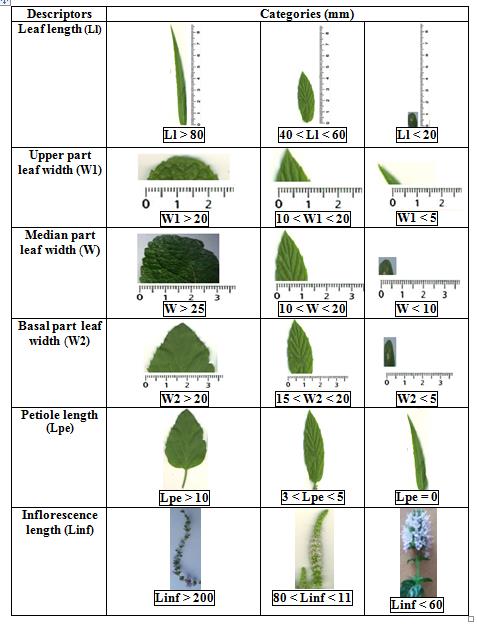
| S.No | ||||
|---|---|---|---|---|
| 1 | Ll < 20 mm ; Linf > 200 mm and Hp < 200 mm | Acc 12 | ||
| Ll > 40 mm and Linf de 60-110 mm | 2 | |||
| 2 | Ll > 80 mm ; W1 < 5 mm and Pe = 0 | Acc 3 | ||
| 40 <Ll <60 mm and W1 > 10 mm | 3 | |||
| 3 | Pe > 10 mm and Linf < 60 mm | Acc 1 | ||
| Pe < 10 mm and 80<Linf <110 mm | 4 | |||
| 4 | Pe = 0 mm | 4a | ||
| 3 <Pe < 5 mm | 4b | |||
| 4a | Hp > 1000 mm | Acc 8 | ||
| 250<Hp <600 mm | Acc 6 | |||
| 4b | 10<W1 <20 mm ; 15<W2 <20 mm and 10<W <20 mm | Acc 2, 7, 9, 10, 11 | ||
| W1 > 20 mm ; W2 > 25 mm and W > 25 mm | Acc 4 & 5 |
Table 7: Identification key of 12 Tunisian mint accessions with seven quantitative descriptors with three categories for each des
Morteza A. Morphological and Essential Oils Diversities among Twelve Tunisian Mentha spp. Accessions. Med J Clin Trials Case Stud 2019, 3(2): 000212.
| Hp (mm) | Ll (mm) | Linf (mm) | W1 (mm) | W2 (mm) | W (mm) | Pe (mm) | Accessions | ||||||||||||||||
| < 200 | < 20 | > 200 | < 5 | < 5 | < 10 | 3-5 | 12 | ||||||||||||||||
| 250-600 | 40-60 | < 60 | 10-20 | > 25 | > 25 | >10 | 1 | ||||||||||||||||
| 80-110 | 10-20 | 15-20 | 10-20 | 2,7,9,10 & 11 | |||||||||||||||||||
| 3-5 | 4 & 5 | ||||||||||||||||||||||
| > 20 | > 25 | > 25 | 0 | 6 | |||||||||||||||||||
| 8 | |||||||||||||||||||||||
| > 1000 | > 80 | < 5 | 15- 20 | 10-20 | 3 |
Table 8: Identification grid for mint accessions according to quantitative descriptors.
Hp- plant Height, Ll- leaf length, Linf- Inflorescence length, W1- upper part leaf width, W- median part leaf width, W2- basal part leaf width, Lpe- Petiole length. Table 8: Identification grid for mint accessions according to quantitative descriptors.
In summary, the seven categorized quantitative descriptors distinguished seven accession groups (2-7-9- 10-11; 4-5; 1; 3; 6; 8; and 12). The eight qualitative descriptors confirmed this classification and distinguished accessions 4 and 5. The cluster analysis confirmed these classifications with six mains clusters and three sub-clusters. According to Pottier-Alapetite and Šarić-Kundalić, et al. we can identify easily nine accessions (1, 2, 3, 7, 8, 9, 10, 11, and 12) but we can’t reliably identify accessions 4, 5 and 6 (Table 9) [1, 7]. These results showed that morphological descriptors have some limits to characterize the 12 Tunisian mint accessions. Chemical composition of mint essential oils could be useful to face these limits.
Essential Oils Characterization
The essential oil yield of the 12 mint accessions ranged from 0.9 to 1.8%. These values are in accordance with the results of Hassanpouraghdam, et al. and Hussain, et al. [9, 10]. Fifty-five compounds were identified, representing 78 to 100% of total essential oil composition (Table 10). Quantitative and qualitative diversities of these essential oils were significant. Cluster analysis produced a dendrogram with four main clusters. Accessions 1 & 8 were distinguished in two main clusters. Accession 1 is particularly characterized by a high Linalool concentration (> 45%). Linalool has been reported as the main constituent in M. aquatica and M. arvensis [11, 12]. However, Kofidis, el al. and Kokkini and Vokou characterized a chemotype linalool in M. spicata [13, 14]. Thereafter, according to our chemical and morphological characterization, we could identify this accession as M. aquatic. Accession 8 is extraordinary characterized by a very high concentration of piperitone oxide (> 70%). This chemical composition is characteristic of M. rotundifolia [15, 16].
The third cluster grouped the accessions 3 and 12 which are characterized by a high concentration of pulegone (59-50%) and menthone (12-20%). Therefore, accession 3 could be phytochemically distinguished from accession 12 by high concentrations of isomenthone and 1,8 Cineole (Table 11). Lorenzo, et al. in Uruguay showed that pulegone (73.4%) followed by isomenthone (12.9%) were the main compound of M. pulegium [15]. Ait- Ouazzou, et al., in Morocco showed that pulegone (69.8%) was the most abundant individual compound in M. pulegium [17]. Hajlaou, et al. in Tunisia showed that essential oils of M. longifolia and M. pulegium were rich in pulegone (47.15 and 61.11%, respectively). Moreover, 1,8 cineole (11.54%) was only present in M. longifolia oil [18]. Therefore, accession 3 could be identified as M. longifolia and accession 12 could be identified as M. pulegium.
The largest fourth cluster grouped eight accessions (2, 4, 5, 6, 7, 9, 10 & 11). Carvone is the main compound of this group (53.71-75.53%) and Limonene has the second highest concentration (10.15-30.31%). However, the group may be divided in six sub-clusters according to the other major compounds (Table 11). In fact, accession 5 is characterized by the highest concentration of carvone and the absence of 1,8 cineole and carveol. Therefore, Accession 4 has the lowest concentration of limonene and the highest concentration of dihydro-carveol (Table 12). According to Foda, et al. in Egypt; Younis, et al. in Sudan; Abdullah, et al. in Pakistan and Mkaddem, et al. in Tunisia carvone and limonene are the main compound of M. spicata [19, 20, 21]. Therefore this group could be identified as cultivated mint (M. spicata). However, environmental conditions, geographic variations and genetic diversity are known to affect the biosynthesis of essential oils [21].
Morteza A. Morphological and Essential Oils Diversities among Twelve Tunisian Mentha spp. Accessions. Med J Clin Trials Case Stud 2019, 3(2): 000212.
Conclusion
The results of the present study reveal a great morphological and chemical diversity of mint accessions. These results showed that morphological descriptors have some limits to characterize the 12 Tunisian mint accessions. Further, environmental conditions, geographic variations and genetic diversity are known to affect the biosynthesis of essential oils.
References
-
Pottier-Alapetite G (1981) Flore de la Tunisie Angiospermes dicotylédones. Gamopétales. Pub Sci Tun 1: 1-654. [INLINE_TABLE:7:0]
-
Padalia RC, Verma RS, Chauhan A, Sundaresan V, Chanotiya CS (2013) Essential oil composition of sixteen elite cultivars of Mentha from western Himalayan region, India. Maejo Int J Sci Tech 7(1): 83- 93.
-
Rodrigues L, Póvoa O, van den Berg C, Figueiredo AC, Moldão M, et al. (2013) Trichomes micromorphology and essential oil variation at different developmental stages of cultivated and wild growing Mentha pulegium L. populations from Portugal. Industrial Crops and Products 43: 692-700.
-
Soković MD, Vukojević J, Marin PD, Brkić DD, Vajs V, et al. (2009) Chemical Composition of Essential Oils of _Thymus_ and _Mentha_ Species and Their Antifungal Activities. Molecules 14(1): 238-294.
-
Kanatt SR, Chander R, Sharma A (2007) Antioxidant potential of mint (_Mentha spicata_ L.) in radiation- processed lamb meat. Food Chem 100(2): 451-458.
-
Šarić-Kundalić B, Fialová S, Dobeš C, Ölzant S, Tekeľová D, et al. (2009) Multivariate numerical taxonomy of Mentha species, hybrids, varieties and cultivars. Sci Pharm 77(4): 851-876.
-
Van Den Dool H, Kratz, PD (1963) A generalization of the retention index system including linear temperature programmed gasliquid partition chromatography. J Chromatogr 11: 463-471.
-
Hassanpouraghdam MB, Akhgari AB, Aazami MA, Emarat-pardaz J (2011) New menthone type of _mentha pulegium_ l. volatile oil from northwest Iran. Czech J Food Sci 29: 285-290.
-
Hussain AI, Anwar F, Nigam PS, Ashraf M, Gilani A (2010) Seasonal variation in content, chemical composition and antimicrobial and cytotoxic activities of essential oils from four Mentha species. J Sci Food Agric 90(11): 1827-1836.
-
Kapp K (2016) Polyphenolic and Essential Oil Composition of Mentha and Their Antimicrobial Effect. Division of Pharmaceutical Biosciences, Faculty of Pharmacy, University of Helsinki.
-
Gracindo LAMB, Grisi MCM, Silva DB, Alves RBN, Bizzo HR, et al. (2006) Chemical characterization of mint (_Mentha spp.)_ germplasm at Federal District, Brazil. Rev Bras Pl Med Botucatu 8: 5-9.
-
Kofidis G, Bosabalidis A, Kokkini S (2004) Seasonal variation of essential oils in a linalool-rich chemotype of Mentha spicata grown wild in Greece. J Essential Oil Res 16(5): 469-472.
-
Kokkini S, Vokou D (1989) _Mentha spicata_ (Lamiaceae) Chemotypes Growing Wild in Greece. Economic Botany 43(2): 192-202.
-
Lorenzo D, Paz D, Dellacassa E, Davies P, Vila R, et al. (2002) Essential oils of Mentha pulegium and Mentha rotundifolia from Uranguay. Brazilian Arch Biol Technol Avol 45(4): 519-524.
-
Brada M, Bezzina M, Marlier M, Carlier A, Lognay G (2007) Variabilité de la composition chimique des huiles essentielles de Mentha rotundifolia du Nord de l’Algéries. Biotechnol Agro Soc Environ 11(1): 3-7.
-
Ait-Ouazzou A, Loran S, Arakrak A, Laglaoui A, Rota C, et al. (2011) Evaluation of the chemical composition and antimicrobial activity of Mentha pulegium, Juniperus phoenicea, and Cyperus longus essential oils from Morocco. Food Res Int 45(1): 313-319.
-
Hajlaoui H, Trabelsi N, Noumi E, Snoussi M, Fallah H, et al. (2009) Mentha longifolia and Mentha pulegium used in the Tunisian folkloric medicine. World J Microbiol Biotechnol 25: 2227-2238. Morteza A. Morphological and Essential Oils Diversities among Twelve Tunisian Mentha spp. Accessions. Med J Clin Trials Case Stud 2019, 3(2): 000212.
-
Foda IM, El-Sayed MA, Hassan AA, Rasmy NM, El- Moghazy MM (2010) Effet of Spearmint Essential Oil on Chemocal Composition and sensory Properties of While Cheese. J Ame Sci 6(5): 272-279.
-
Mkaddem M, Bousaid M, Ben Najeh F (2007) Variability of volatiles in Tunisian Mentha pulegium L. (Lamiaceae). J Essent Oil Res 19(3): 211-215.
-
Figueiredo MVB, Burity HB, Martinez CR, Chanway CP (2008) Alleviation of water stress effects in common bean (_Phaseolus vulgaris_ L.) by co-inoculation Paenibacillus x Rhizobium tropici. Applied Soil Ecol 40: 182-188.
-
Bohloul A, Farahani HA, Valadabadi SA, Moaveni P (2009) Investigation of variations of the morphological values and flowering shoot yield in different mint species and Iran. J Horticul Fores 1(7): 109-112. Morteza A. Morphological and Essential Oils Diversities among Twelve Tunisian Mentha spp. Accessions. Med J Clin Trials Case Stud 2019, 3(2): 000212.
- Psychogenic Erectile Dysfunction in Late Adulthood: A Case Report on Clinical Intervention and Intimacy Restoration
- Clinical Trials on COVID-19 in 2025: A New Chapter in Global Health Research
- Innovations and Challenges in Contemporary Medical Clinical Trials: An Editorial Perspective
- Innovations and Challenges in Contemporary Medical Clinical Trials: A Critical Perspective
- Reimagining Clinical Trials: The Power of Continuous Feedback from Medical Reports
- Factors Influencing Brain Drain: Perspectives from a Medical School in Turkey