
Eczema of the Eyelids: Who is the Culprit?
Periorbital dermatitis is a commonly occurring dermatological disorder and cosmetics are the most frequent allergens. We report a case of allergic dermatitsis of the eyelid secondary to a silicone bi-canalicular probe used to treat lacrimation of the eye of a 12 years old child. Silicone has long been considered chemically inert which does not involve any immunological reaction. However, granulomatous inflammatory reactions have been reported, particularly with breast implants, as well as rare cases of allergic hypersensitivity to pacemaker silicone components and cochlear implants. The diagnosis of contact dermatitis to silicone of the canalicular probe should be evoked in cases of eczema and pruritus located on the site of implantation.
Introduction
Eyelid contact dermatitis is common; it often leads to aesthetic damage, impaired quality of life or even ocular complications in the absence of treatment. The most frequent allergens are cosmetics. Common allergens include gold, fragrances, formaldehyde-related preservatives, methylisothiazolinone, and betaine-related allergens [1]. Contact allergy to silicone components has rarely been reported [2]. We report a case of allergic dermatitsis of the eyelid secondary to a silicone bi- canalicular probe for the treatment of lacrimation of the eye.
Observation
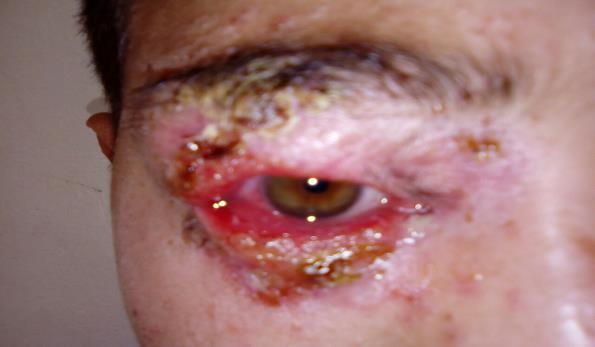
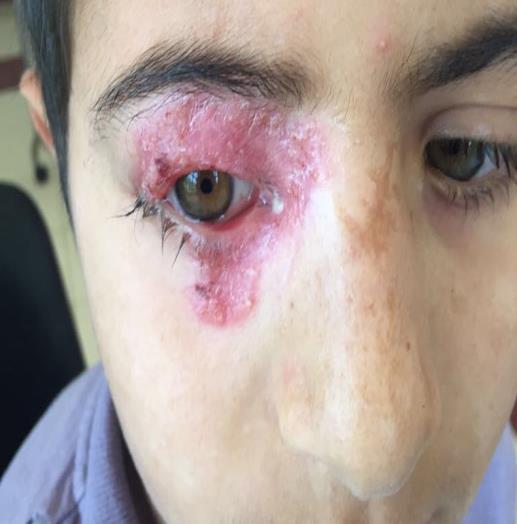
A 12 years old boy consulted for or a pruritic dermatosis of the right eyelid evolving for several months. He had a history of ocular traumatism complicated by tear canal obstruction, with lacrimation treated by silicone bi- canalicular probe. The examination showed erythema, oozing vesicles, melliceric crusts, ectropian, and a depilation of the eyelashes. He also had conjunctivitis and purulent secretions. This aspect evoked eyelid dermatitis with super infection. Initial antibiotic treatment eliminated super infection, and then treatment with topical corticosteroids was recommended without improvement. Eyelid dermatitis was refractory to treatment with topical steroids, suggesting that the suspect allergen was still present. An environmental allergen would have caused bilateral dermatitis. An ophthalmological examination was requested and objectified a bi-canalicular probe still in place. The probe was removed and the evolution was marked by an improvement suggesting hypersensitivity reaction.
Discussion
The eyelids are one of the most sensitive areas of the skin, mainly because of the deposit of allergens in the palpebral folds, and also due to a thin stratum corneum and epidermis. As a result, Allergic contact dermatitis of the eyelids is considered as the most common skin reaction that affects the eyelids [3]. It is characterized by eczematous lesions involving the eyelids or periorbital skin while conjunctivitis only rarely occurs [4, 5]. Allergens can be directly applied on the eyelids, transferred from the hands, or airborne. Eczema can also result from an indirect proxy contact with an allergen in a conjugal setting. Sources of allergy are mainly cosmetics (used on the face, hair and nails), topical medications for ophthalmological or dermatological use and more rarely professional allergens [6]. Rarely, it can be caused by direct contact with an irritant or an allergen. Allergic contact dermatitis with implants and intraocular silicone probe has not been found in the literature. However, giant papillary conjonctivis secondary to silicone hydrogel lens have been reported. Silicone has long been considered chemically inert, resulting in no immunological response [7]. This material has mainly been used to reduce the risk of allergic reactions [8].
However, granulomatous inflammatory reactions have been reported, particularly with breast implants, as well as rare cases of allergic hypersensitivity to pacemaker silicone components and cochlear implants [9, 10]. Four cases have been reported. Some individuals have had local and distant immunological tissue responses to the silicone polymer when free liquid silicone disseminates as emboli [11]. The inflammatory response to disseminated silicone can take two forms [12]. In silicone granulomatosis, silicone particles are present within distant lesion as evidenced in locoregional lymph adenopathy. Alternatively, cutaneous inflammatory lesions arise without containing silicone particles [13].
These reactions seem to vary according to the localization, the viscosity and the type of silicone used [14]. Silicone includes a large family of synthetic polymers whose cure and treatment processes differ. The silicone could be degraded into silica, known as irritant and potentially antigenic. This mechanism may be involved in allergic hypersensitivity to silicone, but the pathophysiological mechanisms are not clearly understood. In the absence of treatment, the disease may contribute to the occurrence of other functional disorders, including tearing, cicatricial ectropion and ptosis.
As the suppression of the allergen is essential for successful treatment, identifying the culprits is a challenge for practitioner. For our patient, ablation of the Sqalli HA, et al. Eczema of the Eyelids: Who is the Culprit?. Med J Clin Trials Case Stud 2019, 3(4): 000229.
probe allowed an improvement. Corticosteroids and Calcineur in inhibitors are the first-line therapy. In our case, treatment with topical corticosteroids was continued after ablation of the probe with good evolution (Figures 1 & 2).
Conclusion
Allergic eyelid dermatitis is commonly related to eye drops and topical cosmetics or skin care products. Identification and elimination of causative agents is important for successful treatment. Topical corticosteroids often facilitate resolution of the associated inflammation. Therapy resistant patients may benefit from formal allergy testing. This case demonstrates that it Copyright© Sqalli HA, et al.
is important to consider silicone contact allergy despite the safety of this materiel.
References
-
Rietschel RL, Warshaw EM, Sasseville D, Fowler JF, De Leo V, et al. (2007) Common contact allergens associated with eyelid dermatitis: data from the North American Contact Dermatitis Group 2003-2004 study period. Dermatitis 18(2): 78-81
-
Maushagen E, Reichle B, Simon H (1994) Circumscribed erythema after cardiac pacemaker implantation. Z Kardiol 83(5): 340-342.
-
Zirwas MJ (2018) Contact Dermatitis to Cosmetics. Clinical Reviews in Allergy& Immunology 56(1): 119- 128.
-
Chisholm SA, Couch SM, Custer PL (2017) Etiology and Management of Allergic Eyelid Dermatitis. Ophthal Plast Reconstr Surg 33(4): 248-250.
-
Feser A, Mahler V (2010) Periorbital dermatitis: causes, differential diagnoses and therapy. J Dtsch Dermatol Ges 8(3): 159-166.
-
Hospital V, Amarger S, Franck F, Ferrier Le Bouëdec MC, Souteyrand P, et al. (2011) Dermite de contact lymphomatoïde par procuration. Annales de Dermatologie et de Vénéréologie 138(4) : 315-318.
-
Forister JF, Forister EF, Yeung KK, Ye P, Chung MY, et al. (2009) Prevalence of contact lens-related complications: UCLA contact lens study. Eye Contact Lens 35(4): 176-180. Sqalli HA, et al. Eczema of the Eyelids: Who is the Culprit?. Med J Clin Trials Case Stud 2019, 3(4): 000229.
-
Hayes DL, Loesl K (2002) Pacemaker component allergy: case report and review of the literature. J Interv Card Electrophysiol 6(3): 277-278.
-
Tickunas T, Howarth S, Godwin Y (2014) Inflammatory changes of the nippleareolar complex of a patient with PIP breast implants: A possible immune response to free silicone from gel bleed?. J Plastic, Reconstructive & Aesthetic Surgery 67(3): 423-425.
-
Mihaela L Oprea, Heike Schnöring, Jörg S Sachweh, Hagen Ott, Julia Biertz, et al. (2009) Allergy to Pacemaker Silicone Compounds: Recognition and Surgical Management. Ann Thorac Surg 87(4): 1275- 1277.
-
Nascimbeni C, Chuffart M, Morice C, Moreau S, Castel B, et al. (2014) Un rare cas d’eczéma de contact aux composants silicone d’un implant cochléaire. Annales de Dermatologie et de Vénéréologie 141(12): 412.
-
Bartsich S, Wu JK (2010) Silicone emboli syndrome: a sequela of clandestine liquid silicone injections. A case report and review of the literature. J Plast Reconstr Aesthet Surg 63(1): 1-3.
-
Lahiri A, Waters R (2006) Locoregional silicone spread after high cohesive gel silicone implant rupture. J Plast Reconstr Aesthet Surg 59(8): 885- 886.
-
Cawrse NH, Pickford MA (2011) Cutaneous manifestation of silicone dissemination from a PIP implant e a case for prophylactic explanation?. J Plast Reconstr Aesthet Surg 64(8): 208-209. Copyright© Sqalli HA, et al.
- Psychogenic Erectile Dysfunction in Late Adulthood: A Case Report on Clinical Intervention and Intimacy Restoration
- Clinical Trials on COVID-19 in 2025: A New Chapter in Global Health Research
- Innovations and Challenges in Contemporary Medical Clinical Trials: An Editorial Perspective
- Innovations and Challenges in Contemporary Medical Clinical Trials: A Critical Perspective
- Reimagining Clinical Trials: The Power of Continuous Feedback from Medical Reports
- Factors Influencing Brain Drain: Perspectives from a Medical School in Turkey