
Primary Essential Cutis Verticis Gyrata: Case Report
Cutis verticis gyrata is a scalp condition where there are convoluted folds that resemble the surface of the cerebral cortex. It is classified by the underlying etiology, as primary essential, primary non-essential and secondary. The primary nonessential type is associated with neuropsychiatric disorder, whereas the primary essential form does not present any other associated abnormalities. We present a rare case of a 25 year-old female patient with primary essential cutis verticis gyrata.
Introduction
Cutis verticis gyrata (CVG) is an unusual scalp condition characterized by the formation of thick skin folds and grooves resembling cerebral cortex gyri. Cutis gyrate is a manifestation of a variety of causes rather than an individual disease entity and can be congenital or acquired. It can be classified into primary form (essential and nonessential) and secondary. Primary form is characterized by a normal skin histopathology and can reveal neuropsychiatric or ophthalmological conditions, whereas secondary cutis verticis gyrata is a manistation of an inflammatory or a neoplastic process directly causing changes in the scalp structure. We report a case of primary essential cutis verticis gyrate in a young healthy female patient.
Case Report
A 25 year-old Caucasian female patient, with no medical history, presented to our department with progressive skin changes affecting the scalp. She reported that folds and wrinkles had progressively appeared on her scalp within the last 3 years becoming deeper and more unaesthetic over the time. Medical examination revealed several symmetrical large skin folds affecting the occipital and the parietal regions of the scalp (Figure 1).
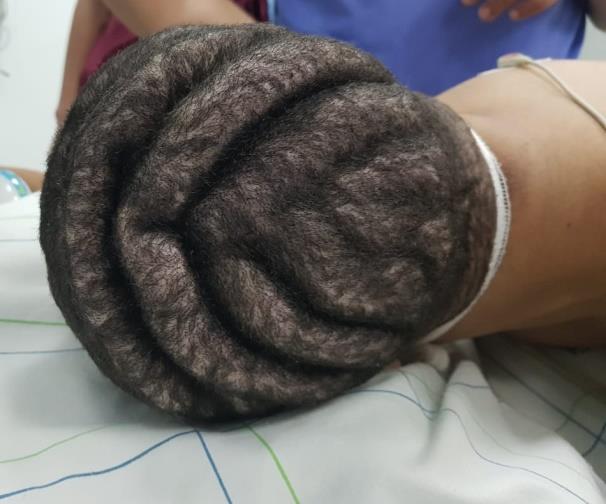
Anatomopathological examination, performed on a skin biopsy, was normal. Investigations to search for associated conditions or a cause of secondary cutis vercitis gyrate were made and were all normal.
The diagnosis of primary essential cutis verticis gyrata was made and the patient underwent a surgical excision of the excess skin with good aesthetic results.
Discussion
Cutis verticis gyrata (CVG) is an unusual scalp condition that was initially reported in 1837 by Alibert. In 1907, Unna was the first to refer to it by the term “cutis verticis gyrate” which has been used since then to describe this particular condition [1]. In 1953 Polan and Butterworth classified CVG into two forms: primary and secondary. This classification was modified in 1984, to include primary essential cutis verticis gyrata which is extremely rare and in which no other abnormalities are identified [2].
The primary form can be divided in essential and non- essential. The primary essential form is seen more often in men. It can start during or right after puberty; but in 90% of the cases, it develops in the fourth decade [3]. There are no other abnormalities apart from the very peculiar aspect of the scalp with skin thickening and development of large deep folds resembling cortical circumvolutions. The primary non-essential type presents with the same folds of the scalp and is accompanied by neuropsychiatric (microcephaly, seizures, mental retardation, epilepsy, schizophrenia) or ophthalmological manifestations (cataract, strabismus, blindness,) [4].
The secondary form can be caused by the use of anabolic steroids. It can also be a result of inflammatory or neoplastic processes that produce changes in the scalp structure such as: pachydermoperiostosis, acromegaly, myxedema, scalp inflammatory diseases, leukemia, acanthosis nigricans, cerebriform intradermal nevus, tuberous sclerosis, syphilis. It may also occur in association with various congenital syndromes (Ehler Danlos, Turner syndrome) [5, 6].
Treatment of primary essential CVG depends on size and location of the lesions and the patient’s aesthetic demand, since no organic function needs to be corrected. Local hygiene is necessary to avoid pruritus and unpleasant odors that can be caused by accumulation of sweat and sebum between the skin folds.
Mai S, et al. Primary Essential Cutis Verticis Gyrata: Case Report. Med J Clin Trials Case Stud 2019, 3(5): 000243.
Surgical treatment can be proposed to improve the clinical aspect of the scalp. Different techniques have been described. Small lesions can be excised and closed primarily or with rotational flaps. Partial resection, skin grafting or placement of tissue expander in healthy skin and later grafting have also been suggested as treatment options [1, 7].
Conclusion
Primary essential, CVG is a rare skin condition with very particular clinical presentation. The main concern of the clinician should be to look for an associated neuropsychiatric or ophthalmological condition and other causes of CVG. Treatment is mostly surgical and depends on the cause, the extension of the lesions and the patient’s aesthetic demand. Source of Support: Nil Conflict of Interest: None
References
-
Radwanski HN, Rocha Almeida MW, Pitanguy I (2009) Primary essential cutis verticis gyrata – a case report. J Plastic Reconstructive Aesthetic Surgery 62(11): e430-e433.
-
Polan S, Butterworth T (1953) Cutis verticis gyrata. A review with report of seven new cases. Am J Ment Retard 57(4): 613-631.
-
Cribier B, Lipsker D, Mutter D, Grosshans E (1993) Cutis vertices gyrata: reduction surgical treatment. Ann Dermatol Venereol 120(8): 542-545.
-
Diven DG, Tanus T, Raimer SS (1991) Cutis Verticis Gyrata. Int J Dermatol 30(10): 710-712.
-
Schöttler L, Denisjuk N, Körber A, Grabbe S, Dissemond J (2007) Asymptomatic cerebriform folds of the scalp. Diagnosis: primary Cutis verticis gyrata (CVG). Hautarzt 58: 1058-1061.
-
Larsen F, Birchall N (2007) Cutis verticis gyrata: Three cases with different aetiologies that demonstrate the classification system. Australas J Dermatol 48(2): 91-94. Copyright© Mai S, et al.
-
Yang JJ, Sano DT, Martins SR, Tebcherani AJ, Sanchez APG (2014) Primary essential cutis verticis gyrata - Mai S, et al. Primary Essential Cutis Verticis Gyrata: Case Report. Med J Clin Trials Case Stud 2019, 3(5): 000243. Case report. Anais Brasileiros de Dermatologia 89(2): 326-328. Copyright© Mai S, et al.
- Psychogenic Erectile Dysfunction in Late Adulthood: A Case Report on Clinical Intervention and Intimacy Restoration
- Clinical Trials on COVID-19 in 2025: A New Chapter in Global Health Research
- Innovations and Challenges in Contemporary Medical Clinical Trials: An Editorial Perspective
- Innovations and Challenges in Contemporary Medical Clinical Trials: A Critical Perspective
- Reimagining Clinical Trials: The Power of Continuous Feedback from Medical Reports
- Factors Influencing Brain Drain: Perspectives from a Medical School in Turkey