
Use of Topical Minoxidil in Latissimus Dorsi Flap - Our Experience
The purpose of this study was to determine the effectiveness of topically applied minoxidil in the pharmacological delay phenomenon. There are various types of delay including surgical delay, pharmacological delay. We have used topical minoxidil application on latissimus dorsi flap reconstruction for a patient who had undergone neoadjuvant chemoradiation. We have found that topical minoxidil can be used to prevent flap necrosis in such conditions.
Introduction
Flap cover for a wound is a common procedure in Plastic Surgery. It is time-consuming as well, as it requires meticulous dissection, pedicle identification, as well as inset. Surgeons employ the latissimus dorsi flap (LDF) for the reconstruction of a wide variety of breast cancer surgery defects, including quadrantectomy, lumpectomy, modified radical mastectomy, and others. The LDF can be useful in delayed or immediate reconstruction, in combination with or without tissue expanders for a staged reconstruction, with implant-based immediate reconstruction, or alone as an autogenous flap. However, there is an increased chance of flap failure in post-radiotherapy patients who undergo reconstruction and may require adjuvant procedures to avoid flap necrosis. Recently we have come across the role of topical minoxidil in the prevention of flap necrosis and we have applied it in our case, and we would like to share our experience.
Materials and Methods
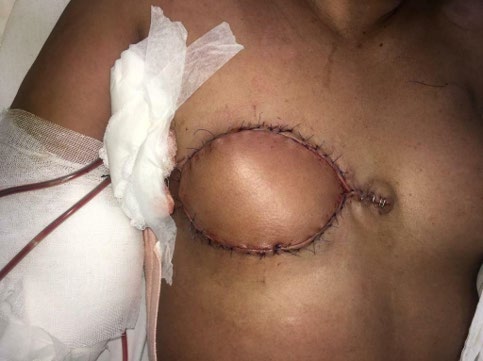
The study was conducted in the Department of Plastic Surgery of a tertiary care centre, during August 2020. The patient was a 45-year-old lady with complaints of a Lump in the right breast, which was diagnosed as a malignant lesion of stage T3aN2bMo. The patient was managed with Preoperative chemotherapy and radiotherapy, following which the patient completely responded and the tumor downgraded to T1N0M0. However, as the surrounding areas were found to be fibrosed, a plan was made to excise the fibrous tissue and cover with a regional lattismus dorsi myocutaneous pedicled flap (Figure 1). Topical minoxidil 5% (Figure 2) was applied three times a day for 1 week daily. The cost of minoxidil 5% is 300 to 500 rupees and one bottle are sufficient for one patient for treatment.

Results
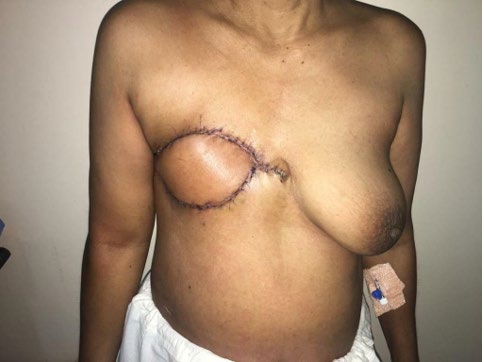
There was no evidence of flap necrosis for the patient after 1 week (Figure 3)
Discussion
The impact of radiotherapy on breast reconstruction has been well documented. Radiation toxicity, like skin changes, vascular compromise, fibrosis which can compromise the viability and aesthetics of the reconstruction may require repeated procedures [1, 2]. In patients who require implants, complications in relation to radiotherapy are scarring, capsular contracture, infection, pain, skin necrosis, fibrosis, as well as impaired wound healing [3, 4, 5, 6, 7]. Surgical delay is known to be the best technique to improve flap viability and is often used to provide better flap survival. However, there are disadvantages such as bleeding, infection, pain, swelling, and also scar formation. It also requires a two-stage procedure and needs long duration of wound care. Many pharmacological agents such as sympatholytics, vasodilators, calcium channel blockers, hemorheological agents, prostaglandin inhibitors, anticoagulants, adenosine, monophosphoryl lipid A, growth hormone, and glucocorticoids have been used for the same purpose and act in different ways.
The topical application of minoxidil to provide pharmacological delay has the advantages that it eliminates systemic effects and time-consuming procedures such as the need for hospitalization and surgical intervention and is easy to use as well as inexpensive. The efficacy of topical minoxidil arises from its local effects, not its systemic effect. The angiogenic effect of minoxidil may be due to its possible direct proangiogenic action and stimulation of the release of angiogenic factors. Stimulation of the release of angiogenic factors is its main effect, and the direct effect on vascular muscles causes vasodilation. Minoxidil is known to be a vasoactive agent and to increase blood flow to the tissues when administered systemically, so it has been used as an antihypertensive agent [8, 9, 10]. Its mechanism of action is direct vasodilation of vascular smooth muscles induced by its active metabolite, minoxidil sulfate (MxSO4), and acts as K+ channel agonist to improve K+ permeability, leading to relaxation of smooth muscle [11].
Conclusion
Topical minoxidil has been found useful in the prevention of flap necrosis in latissimus dorsi flap for a patient who underwent reconstruction following neoadjuvant chemoradiation. However, this is a single patient study and needs large scale multicentre Randomised control trials for large scale clinical use.
References
-
Kronowitz SJ (2012) Current Status of implant- based breast reconstruction in patients receiving postmastectomy radiation therapy. Plast Reconstr Surg 130(4): 513e-523e.
-
Kronowitz SJ (2012) Current status of autologous tissue-based breast reconstruction in patients receiving postmastectomy radiation therapy. Plast Reconstr Surg 130(2): 282-292.
-
Jagsi R, Jiang J, Momoh AO, Aldermanet A, Giordano SH, et al. (2016) Complications after mastectomy and immediate breast reconstruction for breast cancer: A claims-based analysis. Ann Surg 263(2): 219-227.
-
Krueger EA, Wilkins EG, Strawderman M, Cederna P, Goldfarb S, et al. (2001) Complications and patient satisfaction following expander/implant breast reconstruction with and without radiotherapy. Int J Radiat Oncol Biol Phys 49(3): 713-721.
-
Contant CM, van Geel AN, van der Holt B, Griep C, Tjong Joe Wai R, et al. (2000) Morbidity of immediate breast reconstruction (IBR) after mastectomy by a subpectorally placed silicone prosthesis: The adverse effect of radiotherapy. Eur J Surg Oncol 26(4): 344-350.
-
6.Tallet AV, Salem N, Moutardier V, Zalta R, Cowen D, et al. (2003) Radiotherapy and immediate two-stage breast reconstruction with a tissue expander and implant: Complications and esthetic results. Int J Radiat Oncol Biol Phys 57(1): 136-142.
-
Ascherman JA, Hanasono MM, Newman MI, Hughes DB (2006) Implant reconstruction in breast cancer patients treated with radiation therapy. Plast Reconstr Surg 117(2): 359-365.
-
Headington JT (1987) Hair follicle biology and topical minoxidil: possible mechanisms of action. Dermatologica 175: 19-22.
-
Smorlesi C, Caldarella A, Caramelli L, Di Lollo S, Moroni F (2003) Topically applied minoxidil may cause fetal malformation: a case report. Birth Defects Res A 67(12): 997-1001.
-
DeVillez RL (1990) The therapeutic use of topical minoxidil. Dermatol Clin 8(2): 367-375.
-
Meisheri KD, Cipkus LA, Taylor CJ (1988) Mechanism of action of minoxidil sulfate-induced vasodilation: a role for increased K+ permeability. J Pharmacol Exp Ther 245(3): 751-760.
- Psychogenic Erectile Dysfunction in Late Adulthood: A Case Report on Clinical Intervention and Intimacy Restoration
- Clinical Trials on COVID-19 in 2025: A New Chapter in Global Health Research
- Innovations and Challenges in Contemporary Medical Clinical Trials: An Editorial Perspective
- Innovations and Challenges in Contemporary Medical Clinical Trials: A Critical Perspective
- Reimagining Clinical Trials: The Power of Continuous Feedback from Medical Reports
- Factors Influencing Brain Drain: Perspectives from a Medical School in Turkey