
Management of Post COVID-19 Fatigue using Systemic Enzymes and Probiotics- Case Series
Background: Several long-term health consequences are seen in patients with COVID-19, with some symptoms persisting for months after resolution of the infection. Weakness and muscle fatigue are reported to be the most common persistent symptoms. However, there is no specific medication for post-viral fatigue. Case Discussion: Eight patients experiencing fatigue post discharge from COVID-19 hospitalization were included in the case study. Of these, one patient each experienced muscle pain and nausea, in addition to fatigue; 2 had comorbid conditions and reported concomitant medications. Vitals were stable in patients throughout the study. Patients were treated with ImmunoSEB (BD) and ProbioSEB CSC3 (OD) for 14 days. The supplemental treatment resulted in a significant improvement (p < 0.001) in fatigue as assessed by the Chalder Fatigue Scale (CFQ-11) scores on days 5 (17.13), 7 (12.38), 10 (7.63), 12 (4.38), and 14 (2.75) as compared to the post-COVID baseline (26.63). All patients reported no more than usual or less than usual fatigue at the end of the 14 days treatment period. No adverse events were reported. Conclusion: The present cases demonstrate that a 14 days supplementation of ImmunoSEB + ProbioSEB CSC3 significantly reduces post-COVID-19 fatigue in patients. The proposed supplement regimen could be a potential tool to aid in the recovery of COVID-19 patients, many of whom continue to experience severe fatigue several months after initial infection. A large-scale, placebo-controlled prospective study is warranted to further evaluate this effect.
Introduction
The COVID19 pandemic caused by SARS-CoV-2 has emerged as a global health crisis and as of 2 Feb 2021, has affected over 69 million people worldwide [1]. Several long- term health consequences are seen in patients with COVID-19, with some symptoms persisting for months after resolution of the infection. Among these symptoms, fatigue is the most persistent and debilitating. Fatigue has been a common complaint in our patients, confirming reports from other centers [2]. Over 53% of patients assessed approximately 2 months after onset of the first COVID-19 symptoms reported fatigue in a previous study [3]. In another study, 48% of participants met the definition for fatigue at least 6 weeks post discharge, and this was not associated with severity of initial infection [4].
According to the World Health Organization, people suffering from chronic fatigue are amongst those who may require rehabilitation to manage the after-effects of COVID-19 [5]. Unfortunately, there is no specific medication for post- viral fatigue. The most effective current treatment option, according to the British Association for CFS/ME (Chronic Fatigue Syndrome, Myalgic Encephalomyelitis), is total rest [6]. Based on anecdotal evidence from our previous study which examined the effects of ImmunoSEB and ProbioSEB CSC3 on hospitalized confirmed mild to moderate COVID-19 patients, we hypothesized that these supplements may be beneficial in patients with post-COVID fatigue [7].
This case series was planned to evaluate the effect of the dietary supplements ImmunoSEB and ProbioSEB CSC3 on post-COVID fatigue. The multi-enzyme formulation ImmunoSEB contains Peptizyme SP an enteric coated serratiopeptidase, bromelain, amylase, lysozyme, peptidase, catalase, papain, glucoamylase, and lactoferrin. ProbioSEB CSC3 is a combination of three probiotic strains: Bacillus coagulans LBSC (DSM 17654), Bacillus subtilis PLSSC (ATCC SD 7280), and Bacillus clausii 088AE (MCC 0538).
Case Presentation
Eight patients (6 males and 2 females, age 27-59 years) presented with fatigue 0-7 days post discharge from the hospital (Chirayu Medical College and Hospital, India). All patients had a history of hospitalization managed with standard treatment as per COVID-19 guidelines and had received oxygen support. The patients had been discharged as per the hospital discharge criteria, including a negative SARS-CoV-2 test. All patients complained of fatigue. Two patients experienced additional symptoms: Case 2, muscle pain; Case 8, nausea. Two patients had underlying comorbidities and reported concomitant medications. Baseline characteristics of patients are presented in Table 1. Fatigue was assessed using the validated Chalder Fatigue Scale (CFQ-11). All patients had a score more than 22 on the CFQ-11 at baseline, indicating presence of fatigue.
| Case study no. | Age | Gender | Hospital Admission Date | Hospital Discharge Date | Post Discharge Symptoms | Supplement Treatment Start Date | Co-Morbi dities | Con Meds | Smoker | Height (cm) | Weight (kg) | Temp °C | HR Beats/ min | RR Breaths /min | BP (mmHg) |
|---|---|---|---|---|---|---|---|---|---|---|---|---|---|---|---|
| 1 | 36 | M | 1-Dec-20 | 20-Dec-20 | Fatigue | 27-Dec-20 | Nil | Nil | No | 167 | 75 | 37.5 | 85 | 22 | 118/88 |
| 2 | 28 | M | 7-Dec-20 | 22-Dec-20 | Fatigue, Muscle pain | 27-Dec-20 | Nil | Nil | No | 154 | 80 | 37.1 | 76 | 21 | 110/70 |
| 3 | 27 | F | 11-Dec-20 | 27-Dec-20 | Fatigue | 27-Dec-20 | Nil | Nil | No | 155 | 98 | 37 | 86 | 19 | 130/80 |
| 4 | 49 | M | 11-Dec-20 | 27-Dec-20 | Fatigue | 27-Dec-20 | DM | Amaryl | Yes | 163 | 50 | 37.1 | 81 | 19 | 128/82 |
| 5 | 58 | M | 18-Dec-20 | 27-Dec-20 | Fatigue | 30-Dec-20 | DM, HT | Insulin, clopidogril | No | 177 | 88 | 37.1 | 84 | 22 | 168/92 |
| 6 | 33 | F | 3-Dec-20 | 26-Dec-20 | Fatigue | 30-Dec-20 | Nil | Nil | No | 173 | 90 | 37 | 78 | 18 | 96/70 |
| 7 | 51 | M | 16-Dec-20 | 28-Dec-20 | Fatigue | 30-Dec-20 | Nil | Nil | No | 168 | 78 | 37.2 | 70 | 19 | 130/90 |
| 8 | 59 | M | 21-Dec-20 | 28-Dec-20 | Fatigue, Nausea | 03-Jan-21 | Nil | Nil | No | 153 | 74 | 37 | 82 | 18 | 134/92 |
Table 1: Fatigue was assessed using the validated Chalder Fatigue Scale (CFQ-11). All patients had a score more than 22 on the CF
Management and outcome
All patients were treated with ImmunoSEB (2 capsules twice daily [BD]) + ProbioSEB CSC3 (2 capsules once daily [OD]) for 14 days. Fatigue was assessed using the validated Chalder Fatigue Scale (CFQ-11) at baseline, and at days 3, 5, 7, 10, 12 and 14. Participants were asked to answer the questions in comparison to their pre-COVID-19 status with responses measured on a Likert scale (0–3), with a total of 33 being the worst possible total fatigue score. Vitals, including SpO2 levels were also assessed at all-time points.
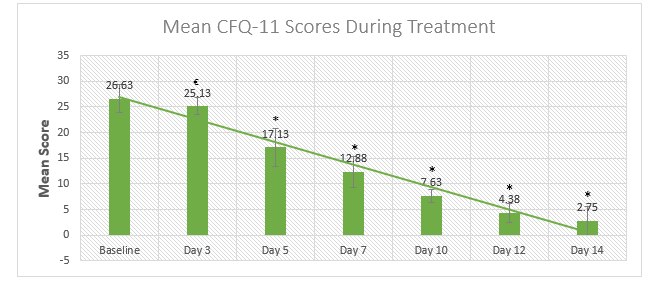
All patients had a total fatigue score more than 22 on the CFQ-11 at baseline which significantly declined during the course of treatment over 14 days (data not shown). Figure 1 shows the mean CFQ-11 scores of the patients during the treatment period. The mean score at baseline was 26.63 indicating “more than usual” or “much more than usual fatigue”. The mean score on day 14 of treatment was 2.75, indicating “no more than usual” or “less than usual” fatigue. There was a significant progressive decline in the scores starting as early as day 3 (25.13, p < 0.05) and was further reduced (p < 0.001) on days 5 (17.13), 7 (12.38), 10 (7.63),
12 (4.38), and 14 (2.75) as compared to the post-COVID baseline (26.63).
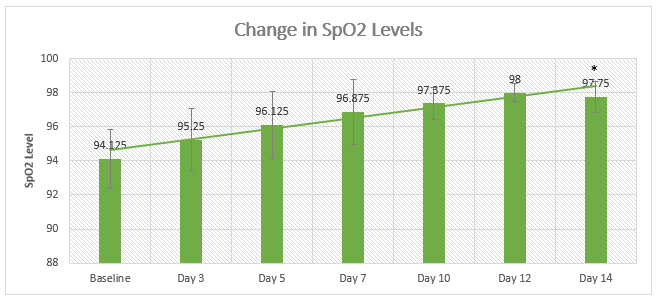
Mean SpO2 levels of patients at the various time points are shown in Figure 2. There was a progressive increase in SpO2 levels in all patients during the treatment period. The mean SpO2 level at the end of the study period was significantly higher (p = 0.001) on day 14 of treatment (97.8; range, 96-99) as compared to baseline (94.1; range, 92-97).
The vital status of all patients remained stable throughout the study. The supplements were well-tolerated and no adverse event was reported by any patient during the treatment period.
Discussion
Several research studies and health reports estimate that a large proportion of patients suffer from fatigue several weeks to months after the resolution of infection. A lengthy post infection fatigue burden impairs quality of life and is expected to have a significant impact on individuals, employers and healthcare systems [8]. Supplementation with ImmunoSEB and ProbioSEB CSC3 as an early intervention could significantly shorten recovery time and greatly reduce this burden.
We have evaluated the effect of supplements ImmunoSEB and ProbioSEB CSC3 on the reduction of post-COVID fatigue using CFQ-11. The Likert scoring system weighs the intensity of the symptoms with a score of “0” on each question indicating a feeling of tiredness “less than usual”; “1” indicating “no more than usual”; “2” indicating “more than usual”; and “3” indicating “much more than usual”, with a maximum score of 33 [9, 10]. A significant reduction in the fatigue score was seen on all days assessed during the treatment period as compared to baseline. These results suggest the efficacy of a 14 days treatment of these dietary supplements in reducing COVID-19-induced fatigue. To the best of our knowledge, these are the first 8 reported case observations to manage post-COVID fatigue using a systemic enzyme complex and probiotics.
It is interesting to note that there was a progressive increase in SpO2 levels throughout the treatment period, with all patients maintaining a level of 96 or higher by day 10. The improvement in the fatigue scores corresponds with the increase in oxygen saturation.
According to a CDC report, non-hospitalized COVID-19 illness can result in prolonged illness and persistent symptoms, even in young adults and persons with no or few chronic underlying medical conditions [11]. While the need to provide a suitable treatment for the millions of patients experiencing fatigue remains under-addressed, the proposed supplementation with ImmunoSEB and ProbioSEB CSC3 could be a potential tool to aid in the recovery of all COVID-19 patients, many of whom continue to experience severe fatigue several months after initial infection.
Conclusion
The present cases support the use of a 14 days supplementation of a combination of ImmunoSEB + ProbioSEB CSC3 to improve COVID-19 induced fatigue in patients post resolution of mild to moderate COVID-19 disease. There is a need for large-scale, placebo-controlled prospective studies to further evaluate this effect.
References
-
World Health Organization (2020) Coronavirus disease (COVID-19) pandemic update.
-
Haplin SJ, Mclvor C, Whyatt G, Adams A, Harvey O, et al. (2020) Post- discharge symptoms and rehabilitation needs in survivors in COVID-19 infection: A cross- sectional evaluation. J Med Virol 93(2): 1013-1022.
-
Carfi A, Bernabei R, Landi F (2020) Persistent symptoms in patients after acute COVID-19. JAMA 324(6): 603-605.
-
Townsend L, Dowds J, O’Brien K, Sheill G, Dyer AH, et al. (2021) Persistent poor health post COVID-19 is not associated with respiratory complications or initial disease severity. Annals of the American Thoracic Society.
-
Microsoft PowerPoint - EPI-WIN COVID Update 36_9 September 2020 - Long-term symptoms.pptx (who.int)
-
Post-viral fatigue: a guide to management. North Bristol NHS Trust.
-
Shah N, Parate R, Vispute A (2021) Potential of the combination of a systemic enzyme complex and probiotics administration to combat COVID-19: a randomized open label prospective analysis, Advances in Clinical Toxicology 6(1): 1-10.
-
Townsend L, Dyer AH, Jones K, Dunne J, Mooney A, et al. (2020) Persistent fatigue following SARS-CoV-2 infection is common and independent of severity of initial infection. PLoS One 15(11): e0240784.
-
Chalder T, Berelowitz G, Pawlikowska T, Watts L, Wessely S, et al. (1993) Development of a fatigue scale. Journal of Psychosomatic Research 37 (2): 147-153.
-
Butler S, Chalder T, Ron M, Wessely S (1991) Cognitive behaviour therapy in chronic fatigue syndrome. J Neurol Neurosurg Psychiatry 54(2): 153-158.
-
Tenforde MW, Kim SS, Lindsell CJ, Rose EB, Shapiro NI, et al. (2020) Symptom duration and risk factors for delayed return to usual health among outpatients with COVID-19 in a multistate health care systems network – United States, March-June. Morbidity and Mortality Weekly Report 69(30): 993-998.
- Psychogenic Erectile Dysfunction in Late Adulthood: A Case Report on Clinical Intervention and Intimacy Restoration
- Clinical Trials on COVID-19 in 2025: A New Chapter in Global Health Research
- Innovations and Challenges in Contemporary Medical Clinical Trials: An Editorial Perspective
- Innovations and Challenges in Contemporary Medical Clinical Trials: A Critical Perspective
- Reimagining Clinical Trials: The Power of Continuous Feedback from Medical Reports
- Factors Influencing Brain Drain: Perspectives from a Medical School in Turkey