
Role of Low Level Laser Therapy in Macrodactyly
The effectiveness of low level laser therapy (LLLT) for macrodactyly to reduce the bulk of the tissue has not been discussed much in the literature. Although low level laser therapy & its effectiveness and the process by which it reduces body fat from fat cell is inadequate this study tries to review the literature & its application. In our study low level laser therapy was used in a subject with left big toe macrodactyly to evaluate the efficacy.
Introduction
Macrodactyly is characterized by excessive growth of the fingers or toes. Primary macrodactyly is defined as non-syndromic, congenital overgrowth of a digits that occurs in isolation without concomitant limb hypertrophy or vascular abnormality. It affects both the bone and soft tissue components. One in 18,000 people are estimated to have primary macrodactyly, with a little male predominance. Additionally, tumour-forming conditions such neurofibromatosis, lymphangiomas, fibrousdysplasia, and haemangiomas, as well as conditions like Proteus or Klippel-Trenaunay syndromes, can cause foot enlargement. Only the skin or soft tissue is hypertrophied in these cases of secondary macrodactyly. Low level laser therapy its effectiveness and the process by which it reduce body fat from fat cell is inadequate. Aim of study is to evaluate the effectiveness of LLLT in macrodactyly.
The effectiveness of low level laser therapy (LLLT) for macrodactyly to reduce the bulk of the tissue has not been discussed much in the literature. Although low level laser therapy & its effectiveness and the process by which it reduces body fat from fat cell is inadequate, this study tries to review the literature & its application. In our study low level laser therapy was used in a subject with left big toe macrodactyly to evaluate the efficacy.
Materials and Methods
This study was conducted in tertiary care center in department of plastic surgery after getting the department ethical committee approval. Informed consent was obtained for examination and clinical photography. The subject was a 12 years old female with increased size of the left big toe since 11 years. The symptom was first observed by her mother at the age of 1 year. The size increased progressive as she grew and attained the present size .No history of trauma, difficulty in walking, increase in size elsewhere in the body. No history of any vertebral and anal anomalies, heart disease, organomegaly. Child appears short for her age and not attained menarche.
On local examination of left leg and foot showed a swelling of left big toe which was non pulsatile, non-compressible. Skin over the swelling shows no sign of inflammation. (Figure 1) Skin over swelling was pinchable. The range of movements at knee, ankle, toe movements at MTP, PIP, DIP joints was normal. The distal sensation, capillary refill times were normal. The opposite limb normal. The gait was normal. Other systemic examinations were within normal limits (Figure 2).
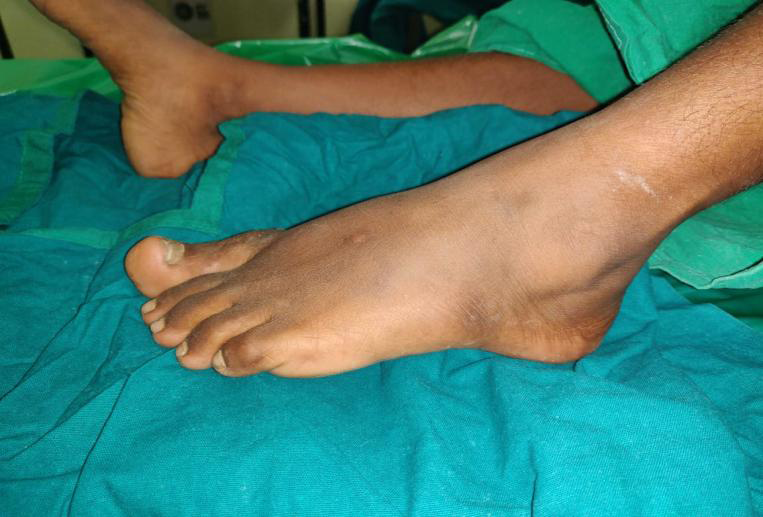
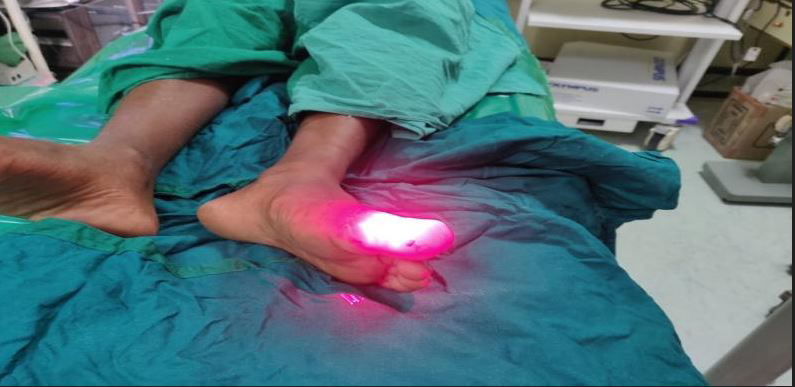
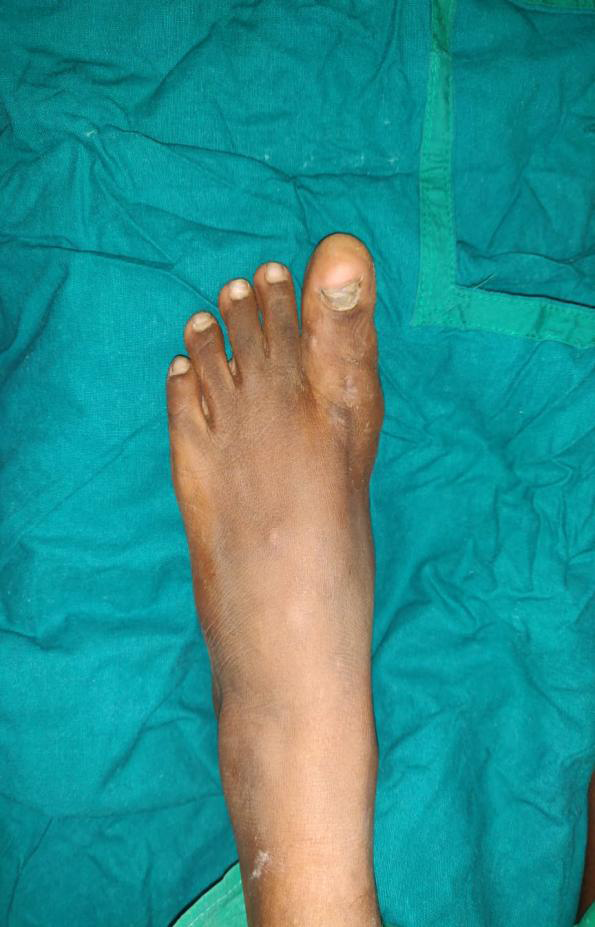
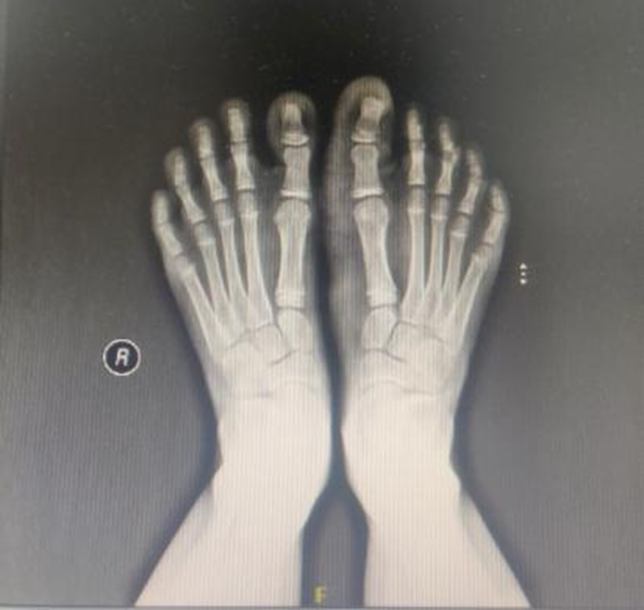
Figure 2: Low level laser therapy to left big toe. Initially patient underwent liposuction assisted debulking. Then patient underwent five session of low level laser therapy (LLLT) once every three days (Figure 3). We used Gallium Arsenide (GaAs) diode red laser wavelength 650nm, frequency 10 KHz and output power 100 Mw. Duration of therapy 125 second every time (Figure 4).
Results
After application of five session of LLLT, we observed a successfully reduce of the size of the enlarged toe. No adverse local or systemic effect noted with use of LLLT.
Discussion
Macrodactyly occurs due to gain-of-function mutation in the PIK3CA pathway (Phosphatidylinositol-4,5-Bisphosphate
3-Kinase) . The correct regulation of cell growth, metabolism, and survival depends on the PI3K/AKT/mTOR signalling pathway. Cancer and a range of diseases known as the PIK3CA-Related Overgrowth Spectrum can result from somatic mutations in this system (PROS). AKT and mTOR are physiologically inappropriately activated by PIK3CA mutations in PROS, which results in asymmetric overgrowth. This spectrum includes conditions like macrodactyly, hemimegalencephaly, and CLOVES (Congenital Lipomatous Overgrowth, Vascular Malformation, Epidermal nevi, Spinal/ Skeletal Anomalies) [1, 2]
Patients with diagnoses of other recognised overgrowth syndromes or other syndromic presentations of enlargement of the lower extremities that were not otherwise characterised were excluded, including Klippel-Trenaunay syndrome, Proteus syndrome, CLOVES syndrome, Ollier’s disease, Maffucci syndrome, Milroy’s disease, neurofibromatosis, and Ollier’s disease.
The condition manifests unilaterally in 95% of cases. It appears from the great toe to the fifth toe in a diminishing pattern and is significantly more common in men. In the progressive version, the toe’s growth stops when the epiphysis closes, the sensitivity is often normal, the mobility gets worse over time, and there are lots of early ulcers.
Ten percent of patients with macrodactyly have syndactyly, while a smaller number of patients have polydactyly and cryptorchidism. It may be connected to “non-true” forms of macrodactyly such as Klipper Syndrome Trenaunag Weber (hemangiomatosis, varicose veins, and limb hypertrophy), Maffuci Syndrome (multiple hemangiomatosis), Proteus Syndrome (hamartomatous dysplasia, pigmented nevi, and subcutaneous tumours), lipomas, osteoid osteoma, and melorrestosis 11 Possibly, Macrodactyl2.
Low-level lasers that affect biological systems without using heat include those made of Krypton, Argon, He, Ne, and ruby. When the tissue chromophores are influenced by laser energy, the cytochromes in the mitochondria absorb the laser radiation and convert them into energy by the cell (ATP), and created energy induces protein synthesis and acceleration or stimulation of cell proliferation. The interaction of light with biological tissues is influenced by various factors, including wavelength, laser dose, and the tissue’s optical characteristics. The structure, water content, thermal conductivity, heat capacity, density, and capacity to absorb, disperse, or reflect the released energy are examples of tissue qualities [3, 4, 5].
Conclusion
Macrodactyly patient who undergo many surgical procedures throughout infancy typically end up with unsatisfactory results. Low level laser therapy will be an alternate, non-invasive therapy for macrodactyly.
References
-
Gluck JS, Ezaki M (2015) Surgical treatment of macrodactyly. Journal of Hand Surgery 40(7): 1461- 1468.
-
A de Greef (1983) Macrodactyly. A review with a case report. Afr Med J 63(24): 939-941.
-
Avci P, Nyame TT, Gupta GK, Sadasivam M, Hamblin MR (2013) Low-Level Laser Therapy for Fat Layer Reduction: A Comprehensive Review. Lasers in Surgery and Medicine 45(6): 349-357.
-
Arjmand B, Khodadost M, Sherafat, Tavirani MR, Ahmadi N, (2021) Low-Level Laser Therapy: Potential and Complications. Journal of Lasers in Medical Sciences pp: 12-e42.
-
Kim J, Park JW, Hong SW, Jeong JY, Hong HS, et al. (2015) Ray amputation for the treatment of foot macrodactyly in children. Bone Joint J B(10): 939-941.
- Psychogenic Erectile Dysfunction in Late Adulthood: A Case Report on Clinical Intervention and Intimacy Restoration
- Clinical Trials on COVID-19 in 2025: A New Chapter in Global Health Research
- Innovations and Challenges in Contemporary Medical Clinical Trials: An Editorial Perspective
- Innovations and Challenges in Contemporary Medical Clinical Trials: A Critical Perspective
- Reimagining Clinical Trials: The Power of Continuous Feedback from Medical Reports
- Factors Influencing Brain Drain: Perspectives from a Medical School in Turkey