
Oncocytic Sinonasal Papilloma A Rare Case Report
Oncocytic sinonasal papilloma, also known as oncocytoma or oncocytic Schneiderian papilloma is a rare benign tumor that typically arises from the Schneiderian epithelium lining the nasal cavity and paranasal sinuses. There are three types of papillomas, of which oncocytic papillomas are the least common. It constitutes 3–5% of all the papilloma cases. Here we present a rare case report of a patient who was an 85-year-old female presented with shortness of breath and a slight obstruction in the nasal cavity, which she felt on the right side. She was examined clinically as sinonasal mass. A CT scan was performed, and surgical excision was suggested. After surgical removal tissue was sent for histopathological evaluation and a diagnosis of oncocytic papilloma was made.
Introduction
Many different types of neoplasms may occur in the sinonasal tract. Sinonasal papillomas form a clinically important group for differential diagnosis. These papillomas are ectodermal that are derived primarily from the ciliated epithelium of the respiratory epithelium. The respiratory epithelium is the membrane that surrounds the nasal cavity and the paranasal sinus. The aim of this case report was to evaluate the clinical features of this rarest form of sinonasal papilloma. The patient was kept on follow-up.
Case Presentation
An 80-year-old female came to our hospital with complaints of a mass in her right nasal cavity. She said that she had noticed the mass three months ago. She was suffering from mild headache. Initially, the mass was small and painless, but over the time, it has grown in size and has become uncomfortable . She described occasional episodes of epistaxis associated with the mass. There is no history of trauma to the nose or any preceding upper respiratory tract infections. She had history of becoming faint, shortness of breath and decreased sense of smell. No previous surgical intervention in the nasal cavity or paranasal sinus was reported. During endoscopy, surgeon found a large, bulging, one-sided mass attached to the cribriform plates. A CT scan showed no bony damage. Clinically it appeared as inflammatory polyp. Surgery was performed and mass was sent for histopathological examination. After biopsy, we diagnosed the mass as sinonasal oncocytic papilloma. Patient recovered well after the surgery.
Gross Examination and Microscopic Findings
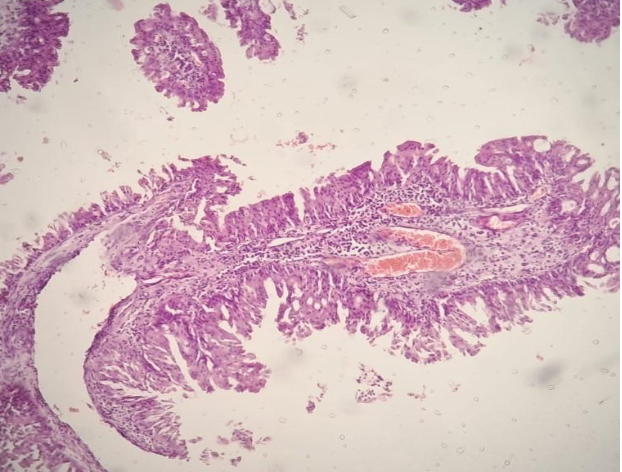
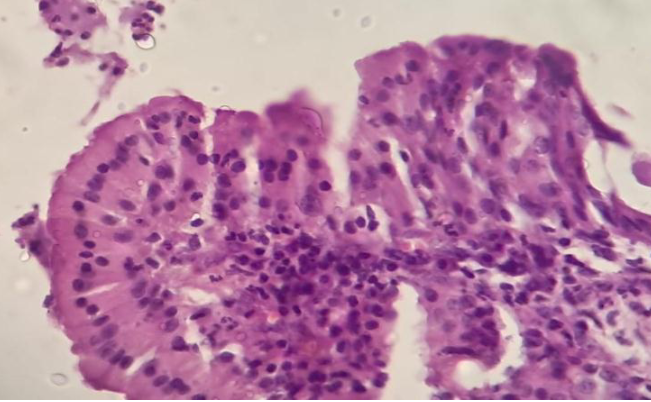
The mass comprised of several gray-white soft tissue pieces, all together measuring 7x6 cms. On microscopic examination, biopsy revealed tissue lined by hyperplastic epithelium with a predominantly exophytic growth pattern.
Focal areas show endophytic pattern. The epithelium was lined as pseudo-stratified columnar epithelium, with abundant eosinophilic granular cytoplasm and hyper chromatic uniform nuclei. Intraepithelial mucin-filled cysts with neutrophilic micro abscesses were seen. A dense lymphoplasmacytic infiltrate was present. Stromal edema was evident.
Result
The sinusoidal mass, classified clinically as polyp, underwent radiologic and histopathologic examination and was diagnosed as a rare form of oncocytic papilloma. Histomorphology was consistent with the sinonasal papilloma-oncocytic type. The patient was operated for the same, and recovered satisfactorily (Figures 1 & 2).
Discussion
A variety of both benign and malignant neoplasms may occur in the sinonasal tract [1]. Sinonasal papillomas form a clinically important group for differential diagnoses. They arise from the ectodermally derived ciliated columnar, respiratory epithelium which linines the nasal cavity, and paranasal sinuses, and are therefore also called as Schneiderian papillomas [2] Sinonasal papillomas are rare tumors, with an overall annual incidence of 0.74 cases per 100,000 people [3]. There is a high rate of recurrence so it is necessary to follow up the patient carefully. In our case the patient was kept on follow up. Till now there was no recurrence [4]. Some of our patients experienced late recurrences and therefore, we currently advise them to contact our hospital if any sinonasal symptoms reccur after the last endoscopic follow‐up examination. There was increasing possibility of recurrence in smokers. Our patient was nonsmoker. Both previous and current smoking have been reported to be a risk factor for recurrences in Sino Nasal Papilloma patients and consequent increased mucosal inflammation has been the suggested possible explanation [5, 6]. According to the WHO Classification of Head and Neck Tumors around 4%–17% of all Sinonasal papilloma harbor carcinoma [1]. However, re‐ evaluation of the three references to this claim showed that this issue warrants further consideration.
The first article by Kaufman et al reports 40 patients with Sinonasal inflammatory papilloma and Sinonasal Oncocytic papilloma [4]. In our patient there was no malignancy and dysplasia was discovered .Oncocytic papilloma is most common in old age patient. Our patient was elderly female. In a case report of 20 patients, tumor location was most often the maxillary sinus (60%), followed by the nasal cavity, including the ethmoidal area (35%), and the frontal sinus (5%). None of the tumors was located in the sphenoid sinus. This is in accordance with other studies reporting maxillary sinus as the most usual site for these tumors [2, 6, 7]. Kapadia, et al. reported nine cases of carcinoma ex Sinonasal Oncocytic papilloma from two major institutions [8]. In eight cases, the malignancy was synchronous and metachronous in one. There were six squamous cell carcinomas, two mucoepidermoid carcinomas, and one undifferentiated carcinoma. Based on the literature findings mentioned above, it seems that nearly all malignancies associated with Sinonasal Oncocytic papilloma are synchronous in nature and metachronous malignancies are rare. This conclusion might be an important addition to patient counseling.
Conclusion
Any isolated unilateral process in the paranasal sinuses with long-standing symptoms must be given careful attention due to the chance of this process being an inverted papilloma with malignization; therefore, a histological confirmation of all these is mandatory. The Oncocytic papilloma of the sphenoid sinus is rare, and non-specific symptoms make this pathology easily misdiagnosed. The CT scan indicating a unilateral opacification of the paranasal sinuses with local calcifications is a good point toward endoscopic sphenoidotomy, which is recommended as a treatment of choice. Follow-up with the patient is important, as there are chances of recurrence and the development of malignancy.
References
-
El‐Naggar A, Chan J, Grandis J, Takata T, Slootweg P (2017) WHO Classification of Head and Neck Tumours. 4th (Edn.), (9).
-
Barnes L, Bedetti C (1984) Oncocytic schneiderian papilloma a reappraisal of cylindrical cell papilloma of the sinonasal tract. Hum Pathol 15(4): 344-351.
-
Buchwald C, Franzmann MB, Tos M (1995) Sinonasal papillomas a report of 82 cases in copenhagen county including a longitudinal epidemiological and clinical study. Laryngoscope 105(1): 72-79.
-
Kaufman MR, Brandwein MS, Lawson W (2002) Sinonasal papillomas: clinicopathologic review of 40 patients with inverted and oncocytic schneiderian papillomas. Laryngoscope 112(8 pt 1):1372-1377.
-
Moon IJ, Lee DY, Suh MW (2010) Cigarette smoking increases risk of recurrence for sinonasal inverted papilloma. Am J Rhinol Allergy 24(5): 325-329.
-
Roh HJ, Mun SJ, Cho KS, Hong SL (2016) Smoking, not human papilloma virus infection, is a risk factor for recurrence of sinonasal inverted papilloma. Am J Rhinol Allergy 30(2): 79-82.
-
Karligkiotis A, Bignami M, Terranova P, Gallo S, Meloni F et al. (2014) Oncocytic schneiderian papillomas: clinical behavior and outcomes of the endoscopic endonasal approach in 33 cases. Head Neck 36(5): 624-630.
-
Kapadia SB, Barnes L, Pelzman K, Mirani N, Heffner DK, et al. (1993) Carcinoma ex oncocytic schneiderian (cylindrical cell) papilloma. Am J Otolaryngol 14(5): 332-338.
- Psychogenic Erectile Dysfunction in Late Adulthood: A Case Report on Clinical Intervention and Intimacy Restoration
- Clinical Trials on COVID-19 in 2025: A New Chapter in Global Health Research
- Innovations and Challenges in Contemporary Medical Clinical Trials: An Editorial Perspective
- Innovations and Challenges in Contemporary Medical Clinical Trials: A Critical Perspective
- Reimagining Clinical Trials: The Power of Continuous Feedback from Medical Reports
- Factors Influencing Brain Drain: Perspectives from a Medical School in Turkey