
Ventricular Arrhythmia Complicating Treatment with Hydroxychloroquine and Azithromycin in a Covid-19 Patient
Hydroxychloroquine, used alone or in combination with Azithromycin for the treatment of Covid-19, is known theoretically by its cardiotoxicity and the occurrence of ventricular arrhythmias. We report here the observation of a 19-year-old patient diagnosed with Covid-19 and who developed a Torsades de pointe after three days of treatment with Hydroxychloroquine and Azithromycin in combination. The hydro electrolytic assessment, in the course of time, had shown a slight hypomagnesemia. Conclusion: Monitoring of ionic blood disorders and the EKG on a regular basis is necessary to monitor Covid-19 patients to avoid ventricular arrhythmias.
Introduction
Oseltamivir (Tamiflu), a neuraminidase inhibitor, an antiviral medication, is used as prophylaxis and treatment for seasonal flue and it is used recently for swine flu and bird flu in people at high risk of complications within 48 hours of first symptoms of infection. It is approved by the US Food and Drug Administration in 1999.
A Randomized Controlled Trials showed that early initiation (within 36 h) of treatment reduced illness duration by 30% and severity by 40% [1, 2]. It also significantly reduced the frequency of secondary complications of influenza, and early initiation of the antiviral drug might decrease the frequency of complications in high risk population. Other studies gave similar results.
Relenza (zanamivir) followed the same pattern in accompanying Tami flue as many randomized trials appealed its role in prophylaxis and treatment of flue [1, 3]. Although of its effectiveness, still the fear of Tamiflu resistance is concerning [4, 5]. Fortunately, In Iraq Tamiflu could not be available easily [6, 7, 8, 9, 10]. Tamiflu is available in limited pharmacies with an expensive price. It is available in hospitals for influenza after throat swab confirmation. Many studies explain Tamiflu resistance and the emergence of a new strain of the virus.
By emerging the COVID19 pandemic, researchers try to find any prophylaxis that can protect people [11, 12, 13, 14]. Covid19 is a novel human coronavirus (SARS-CoV-2), was identified in China in December 2019. Studies gave the possibility of Asymptomatic Carrier Transmission of COVID-19 and variable incubation period as it ranges from five to fourteen days that force the health care provider to look for solutions.
Influenza vaccine is one of the first issues that researchers think but many cases of covid19 appeared with history of influenza vaccine [15, 16]. Vaccines still have an interesting topic as children who complete their vaccines had no or mild infection in Iraq. This brings an inquiry; could one of childhood vaccine give protection to covid 19.
Tamiflu is given as trials to give prophylaxis to covid 19 as there is no resistance to it yet in Iraq due its limited use. Hand wash, mask-wearing and social isolation would give additional protection.
Objectives - Tamiflu may be used as prophylaxis. - It may lessen the severity of covid19 if it is used in early disease.
Subjects and Methods
This is a descriptive study, included 37 patients who attended to Al-Dora Family Medical Centre from 1st to 31 of December. The cases ranged from 7 years old to 75 years old, presented with various symptoms included shortness of breath, fever, headache, diarrhea, malaise, chest pain, shivering, and dry cough. The patients looks tired and terrified, they describe their illness as strange flue. At that times Corona infection is not familiar in Iraq so most cases considered as a type of influenza. Many similar cases presented in other primary health care centers and within the medical field. The cases were severe enough to take the whole attention so medications were prescribed; Amoxil capsule, oseltamivir tab (Tamiflu), butadin inhaler, and paracetol tab. The cases were sent to Al-Yarmook hospital for throat swab. The results showed “it is not influenza infection, it is another viral infection”, as COVID19 test was not available in Iraq at that time. Chest X-ray was sent for some cases, usually the severe cases, as we were not aware of corona yet. It showed bilateral and/or multilobar involvement. The treatment of cases continues until full recovery with no complications. The contacts to suspected cases were 15 persons. They were given Tamiflu as prophylaxis regime followed for influenza since we did not expect Corona pandemic yet. Out of those contacts, 11 persons did not experience any symptoms, others had mild symptoms.
Results
Young age groups did not present in suspected cases.
| Age groups | No. | Percent |
|---|---|---|
| 7-15 | 7 | 18.90% |
| 16-25 | 0 | 0% |
| 26-35 | 0 | 0% |
| 36-45 | 8 | 21.60% |
| 46-55 | 5 | 13.50% |
| 56-65 | 8 | 21.60% |
| 66-75 | 9 | 24.30% |
Table 3: Age groups of corona suspected cases.
Out of 37 cases attended the family medical center, 30 cases presented dyspnea and the whole cases had fever.
| Symptoms | No. | Percent |
|---|---|---|
| Dyspnea | 30 | 81% |
| Fever | 37 | 100% |
| Cough | 28 | 75.60% |
| Headache | 7 | 18.90% |
| Diarrhea | 4 | 10.80% |
| Malaise | 29 | 78.30% |
| Chestpain | 23 | 62.10% |
| Shivering | 18 | 48.60% |
Table 1: Showed the symptoms of presented cases.
Cases received Tamiflu presented with mild symptoms as many cases presented with low-grade fever.
| Tamiflu | Influenza vaccine | None | Total | |
|---|---|---|---|---|
| Mild; low grade fever with or without headache sore throat | 9 | 600.00% | 0 | 15 |
| Severe cases; dyspnea, fever with or without headache, diarrhea, and cough | 0 | 5.00% | 17 | 22 |
| Total | 9 | 11.00% | 17 | 37 |
Table 2: Variation of symptoms according to tamiflu and influenza vaccine.
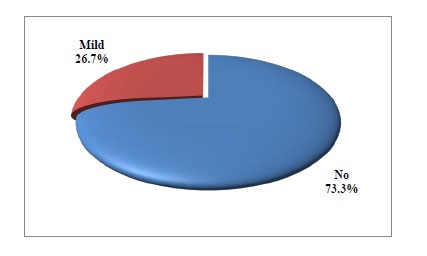
Contact to suspect cases were 15 persons, 73.3% of them showed no symptoms, while the others showed mild symptoms after taking Tamiflu as prophylaxis.
Discussion and Conclusions
Young age groups did not present in this study, Children less than 7 years as well as. This gives the possibility of the role of immune system in facing covid19. In addition to the suspicion of childhood vaccination could give protection to covid19, as rarely a child case is discovered.
All the cases had fever. It ranges from mild to severe, continuous or intermittent. Sometimes, it is accompanied with other symptoms, mainly, dyspnea, headache and cough. Cases received Tamiflu showed mild symptoms as its use is limited in Iraq so no resistance to it yet.
Cases had history of influenza vaccine had variable results. Anyway, these cases were old age with comorbid conditions that made them more vulnerable to covid19. When Tamiflu was given to contacts, they showed no or mild symptoms.
The study gives a conclusion that Tamiflu may have a role in prophylaxis against covid19 especially in countries with no resistance to it.
Limitation of the Study
Cases in the current study were in a limited area so results cannot be generalized. This requires further studies.
Recommendations: Supplying family medical centers with more resources to face covid19.
References
-
Gupta YK, Meenu M, Mohan P (2015) The Tamiflu fiasco and lessons learnt. Indian J Pharmacol 47(1): 11-16.
-
Tamiflu (oseltamivir) dosing, indications, interactions, adverse effects, and more. Medscape.
-
Penelope W, Ian S, James S, Pia S, Regina D (2005) Oseltamivir (Tamiflu®) and its potential for use in the event of an influenza pandemic. Journal of Antimicrobial Chemotherapy 5(1): 5-21.
-
Jefferson T, Jones MA, Doshi P, et al. Effectiveness of Tamiflu and Relenza questioned. Cochrane Database of Systematic Reviews.
-
Jefferson T, Jones MA, Doshi P, Chris B DM, Rokuro H, et al. (2014) Neuraminidase inhibitors for preventing and treating influenza in adults and children. Cochrane Database Syst Rev 2014(4): CD008965.
-
Li L, Li Y, Zhang L, Hou T (2012) Theoretical studies on the susceptibility of oseltamivir against variants of 2009 A/H1N1 influenza neuraminidase. J Chem Inf Model 52(10): 2715-2729.
-
Seibert CW, Rahmat S, Krammer F, Palese P, Bouvier NM (2012) Efficient Transmission of Pandemic H1N1 Influenza Viruses with High-Level Oseltamivir Resistance. J Virol 86(9): 5386-5389.
-
Ives JAL, Carr JA, Mendel DB, Tai CY, Lambkin R, et al. (2002) The H274Y mutation in the influenza A/ H1N1 neuraminidase active site following oseltamivir phosphate treatment leave virus severely compromised both in vitro and in vivo. Antiviral Res 55(2): 307-317.
-
Wu NC, Young AP, Dandekar S, Wijersuriya H, Al- Mawsawi LQ, et al. (2013) Systematic Identification of H274Y Compensatory Mutations in Influenza A Virus Neuraminidase by High-Throughput Screening. J Virol 87(2): 1193-1199.
-
Abed Y, Pizzorno A, Bouhy X, Rheaume C, Boivin G (2014) Impact of Potential Permissive Neuraminidase Mutations on Viral Fitness of the H275Y Oseltamivir- Resistant Influenza A(H1N1)pdm09 Virus In Vitro, in Mice and in Ferrets. J Virol 88(3): 1652-1658.
-
Baek YH, Song MS, Lee EY, Young-il K, Eun-HK, et al. (2015) Profiling and Characterization of Influenza Virus N1 Strains Potentially Resistant to Multiple Neuraminidase Inhibitors. J Virol 89(1): 287-299.
-
Hurt AC, Holien JK, Parker MW, Barr IG (2009) Oseltamivir resistance and the H274Y neuraminidase mutation in seasonal, pandemic and highly pathogenic influenza viruses. Drugs 69(18): 2523-2531.
-
Storms AD, Gubareva L V, Su S, John TW, Margaret OA, et al. (2012) Oseltamivir-resistantc pandemic (H1N1) 2009 virus infections, United States, 2010-11. Emerg Infect Dis 18(2): 308-311.
-
Wang B, Dwyer DE, Blyth CC, Maly S, Haijing S, et al. (2010) Detection of the rapid emergence of the H275Y mutation associated with oseltamivir resistance in severe pandemic influenza virus A/H1N1 09 infections. Antiviral Res 87(1): 16-21.
-
Bai Y, Yao L, Wei T, Tian F, Jin DY, et al. (2020) Presumed Asymptomatic Carrier Transmission of COVID-19. JAMA 323(14): 1406-1407.
-
Lauer SA, Grantz KH, Bi Q, Jones FK, Zheng Q, et al. (2020) The incubation period of coronavirus disease 2019 (CoVID-19) from publicly reported confirmed cases: Estimation and application. Ann Intern Med 172(9): 577-582.
- Psychogenic Erectile Dysfunction in Late Adulthood: A Case Report on Clinical Intervention and Intimacy Restoration
- Clinical Trials on COVID-19 in 2025: A New Chapter in Global Health Research
- Innovations and Challenges in Contemporary Medical Clinical Trials: An Editorial Perspective
- Innovations and Challenges in Contemporary Medical Clinical Trials: A Critical Perspective
- Reimagining Clinical Trials: The Power of Continuous Feedback from Medical Reports
- Factors Influencing Brain Drain: Perspectives from a Medical School in Turkey