
A Study to Assess the Effectiveness of Skill Training of Children on First-Aid
<p style="text-align: justify;">Background and Objectives: A study was conducted to determine the effectiveness of a Skill Training Programme (STP) on first-aid for selected Accidents and Emergencies for school children. The objectives of the study were to: develop and validate a STP on first-aid for selected accidents and emergencies, determine the level of knowledge of high school children regarding first-aid for selected accidents and emergencies, as measured by a structured knowledge questionnaire before and after the administration of STP, determine the level of skill of high school children regarding first-aid for selected accidents and emergencies, as measured by an observation checklist, before and after the administration of STP, determine the effectiveness of STP in terms of gain in post-test knowledge and skill scores, find the association between the level of knowledge and selected variables such as gender, parent’s educational status, parent’s occupation and source of prior information, find the association between the level of skill and selected variables such as gender, parent’s educational status, parent’s occupation and source of prior information, determine the high school children’s opinion about the STP.</p> <p style="text-align: justify;">Methods: The conceptual framework of the present study is based on System’s Model of WHO SEARO technical publications. The hypotheses were developed and tested at 0.05 level of significance. The research approach used for the study was an evaluative approach with one group pretest posttest pre-experimental design. The study sample consisted of 56 high school children of 9th standard from Manipal Pre University College, Manipal. The sampling technique adopted for the study was non-probability cluster sampling for the selection of samples and convenience sampling for the selection of the school. The pretesting was done by administering the tool to seven students studying in the English medium in 9th standard from Christian high school, Udupi. Reliability of the structured knowledge questionnaire was ensured by administering the tool to 20 students, and skills of the 12 students were assessed out of the twenty studying in the 9th standard of Indrali English medium high school, Udupi. The pilot study was conducted on ten students studying in 9th standard of SDA English Medium High School, Bangalore. The study design was found to be feasible and practicable.</p> <p style="text-align: justify;">Results: The major findings of the study were that the t test showed that there was a significant difference between the mean pretest and posttest skill scores of ‘first-aid for bleeding wounds’ of the high school children t = 27.94, t(55) = 2, p < 0.05 which is significant, the t test showed that there was a significant difference between the mean pretest and posttest skill scores of ‘first-aid for closed fracture of the hand ‘of the high school children t = 24.59, t(55) = 2, p < 0.05 which is significant, the t test showed that there was a significant difference between the mean pretest and posttest skill scores of ‘first-aid for poisonous snake bite’ of the high school children t = 22.54, t(55) = 2, p < 0.05 which is significant. Conclusions: The opinionnaire on STP showed that all (100%) students agreed that the language of the STP was simple and clear and the content is easy to remember because of the visual aids. Majority (91.07%) of the students agreed that STP is easy to practice and they have gained adequate skills to provide first-aid and (98.21%) students agreed that their doubts were clarified.</p>
Introduction
Children and young people represent a country's future. Their health needs are vital, and they share an entitlement to good health and quality health services with the rest of the community. Children and adolescents have the right to knowledge and skills about health in the Universal Declaration of Children's Rights. It is estimated that 50% of deaths occur within the first hour of the accident, 30% between one hour and one week and 20% occur after first week. The ‘golden hour’ and ‘platinum hour’ highlights the importance of early trauma care. Important factors responsible for increasing secondary injuries and complications are non-availability of first-aid, delay in transfer of patients from the injury site to a hospital, lack of definitive treatment in first contact hospitals, absence of triage and external medico- legal problems [1, 2, 3, 4, 5].
Statement of the Problem
A study to assess the effectiveness of a skill training programme on First-Aid for School Children.
Objectives of the Study
To develop and validate a skill training programme (STP) on first-aid for selected accidents and emergencies.
1. To determine the level of knowledge of high school children regarding first-aid for selected accidents and emergencies, as measured by a structured knowledge questionnaire, before and after the administration of STP.
2. To determine the level of skill of high school children regarding first-aid for selected accidents and emergencies, as measured by an observation checklist, before and after the administration of STP.
3. To determine the effectiveness of STP in terms of gain in post test knowledge and skill scores.
4. To find the association between the level of knowledge and selected variables.
5. To find the association between the level of skill and selected variables.
6. To determine the high school children’s opinion about the STP.
Conceptual Framework
The conceptual framework of the present study is based on System’s Model of WHO SEARO technical publications. This model is described under three major headings: input, process and output. Input refers to the high school children with their background information, process deals with the preparation of STP, assessment of knowledge and skill and administration of STP and the Nursing & Healthcare International Journal
output includes the evaluation of the gain in knowledge and skill scores.
Methodology
The research approach used for the study was an evaluative approach with one group pretest posttest pre- experimental design. The study sample consisted of 56 high school children of 9th standard from Manipal Pre University College, Manipal. The sampling technique adopted for the study was non-probability cluster sampling for the selection of samples and convenience sampling for the selection of the school. The content validity of the developed tools and the STP were established by giving it to seven experts from various fields. Reliability of all the tools were obtained, pretesting and pilot study was also done. Data collection instrument used by the researcher for the study were – Tool 1: Demographic Proforma.
Tool 2: Structured Knowledge Questionnaire on First-aid
for selected Accidents and Emergencies.
Tool 3: Observation Checklist to evaluate the skill -
Tool 3a: Observation Checklist on First-aid for Bleeding
Wounds
Tool 3b: Observation Checklist on First-aid for Closed
Fracture of the hand
Tool 3c: Observation Checklist on First-aid for Poisonous
Snake-bite
Tool 4: Opinionnaire on STP.
The pretesting was done by administering the tool to seven students studying in the English medium in 9th standard from Christian high school, Udupi. Reliability of the structured knowledge questionnaire was ensured by administering the tool to 20 students, and skills of the 12 students were assessed out of the twenty studying in the 9th standard of Indrali English medium high school, Udupi. The pilot study was conducted on ten students studying in 9th standard of SDA English Medium High School, Bangalore. The study design was found to be feasible and practicable.
Findings of the Study
The Sample Characteristics
Majority of the students (51.79%) were girls. Most of the student’s father’s educational qualification (30.36%) was PUC. Most of the student’s mother’s educational qualification (35.71%) was PUC. Majority of the students fathers (89.28%) were non health professionals. Majority of the students mothers (64.28%) were house-wives. Majority of the students (73.21%) had prior information on first-aid.
Effectiveness of STP on First-Aid for Selected Accidents and Emergencies for High School Children
Gain in knowledge scores of high school children: In the pretest, maximum students 43 (76.78 %) had average knowledge and only one student had good knowledge whereas in the posttest, majority of the students 34 (60.71%) had average knowledge and 22 (39.29 %) students had good knowledge. The posttest mean knowledge score (22.10) was apparently higher than the pretest mean knowledge score (14.60) (Figure 1).
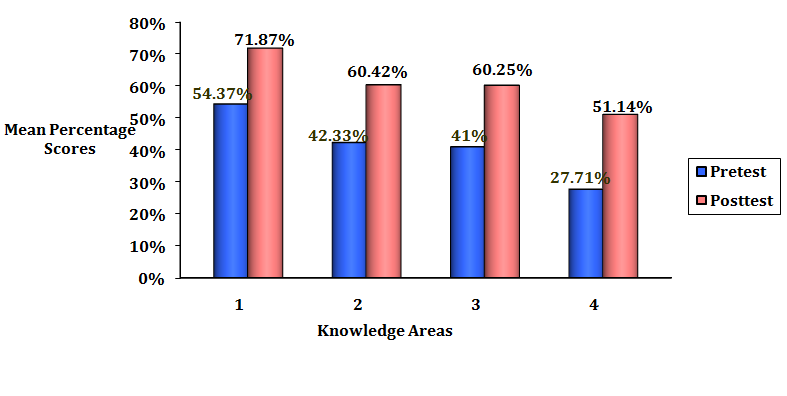
Figure1: Bar diagram on area wise mean percentage pretest and posttest knowledge scores of high school children. Key: Area wise knowledge a. General first-aid b. First-aid for wounds c. First-aid for fracture d. First-aid for bites and stings Nursing & Healthcare International Journal
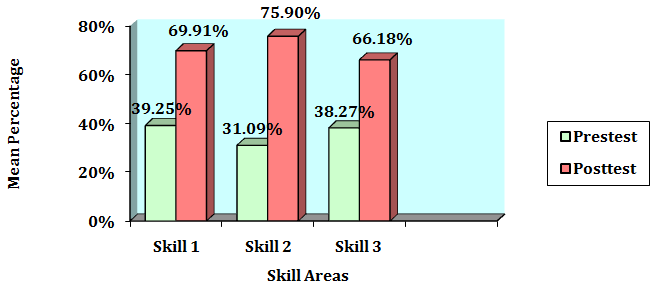
Significance of difference between mean of the pretest and posttest knowledge scores of high school children: The t test showed that there was a significant difference between the mean pretest and posttest knowledge scores of the high school children on first-aid for selected accidents and emergencies t = 13.41, t(55)= 2, p < 0.05 which is significant [6]. Hence the null hypothesis was rejected which indicated that the STP was an effective method in improving the knowledge of high school children (Figure 2). Association between pretest knowledge scores of high school children with the selected variables: Chi-square was computed between pretest knowledge scores of the high school children and the selected variables which indicated that there was no significant association between the pretest knowledge score and selected variables. Gain in skill scores of high school children: The skill scores of ‘first-aid for bleeding wounds’ of school children showed that the mean posttest scores (8.39) is higher than that of mean pretest scores (4.71). The skill scores of ‘first-aid for closed fracture of the hand’ of school children showed that the mean posttest scores (8.35) is higher than that of mean pretest scores (3.42). The skill scores of ‘first-aid for poisonous snake bite’ of school children showed that the mean posttest scores (7.28) is higher than that of mean pretest scores (4.21).
Significance of difference between mean of the pretest and posttest skill scores of high school children: The t test showed that there was a significant difference between the mean pretest and posttest skill scores of ‘first-aid for bleeding wounds ‘of the high school children t= 27.94, t(55) = 2, p < 0.05 which is significant. The t test showed that there was a significant difference between the mean pretest and posttest skill scores of ‘first-aid for closed fracture of the hand’ of the high school children t = 24.59, t(55) = 2, p < 0.05 which is significant. The t test showed that there was a significant difference between the mean pretest and posttest skill scores of ‘first-aid for poisonous snake bite’ of the high school children t = 22.54, t(55)= 2, p < 0.05 which is significant. Hence the null hypothesis was rejected indicating that the STP was effective method in improving the skills of the high school children. Association between pretest skill scores of high school children with the selected variables: Chi-square values computed between pretest skill scores and the selected variables showed that there was a significant association between the pretest skill score of ‘first-aid for bleeding wounds’ of the high school children and mother’s educational status. There was significant association between the pretest skill score of ‘first-aid for closed fracture of the hand’ of the high school children and father’s educational status. There was significant association between the pretest skill score of ‘first-aid for poisonous snake bite and gender of the student and the mother’s occupation. Opinion of the School Children on STP The opinionnaire on STP showed that all (100%) students agreed that the language of the STP was simple and clear and the content was easy to remember because of the visual aids. Majority (91.07%) of the students agreed that STP was easy to practice and they have gained adequate skills to provide first-aid and (98.21%) students agreed that their doubts were clarified.
Nursing & Healthcare International Journal
questionnaire on first-aid and game situation data sheet. The findings showed that only 36% of the coaches achieved the passing scores that is above 80% of marks. A study was conducted at Texas to increase the mother’s knowledge of child healthcare among 37 substance abuse mothers. The findings of the study showed that the mean pretest scores related to basic first –aid was 62.7%. In order to examine the effectiveness of STP on first-aid for selected accidents and emergencies for school children, the following studies were discussed [7, 8, 9, 10]. The investigator failed to locate any study similar to the one undertaken by the researcher. The studies related to STP in areas of health and illnesses are presented in the section. The findings of the present study showed that the posttest mean knowledge score (22.10) was apparently higher than the pretest mean knowledge score (14.60). The data computed using paired t test showed that research hypothesis was accepted depicting that the high school children gained knowledge regarding first-aid for selected accidents and emergencies (t=13.41, p<0.05). This indicates that the STP was an effective method in increasing the knowledge of the school children. The present study findings could be supported by the following studies. An evaluative study was conducted in Udupi district, Karnataka to determine the knowledge of primary school teachers on health appraisal of school children and to determine the effectiveness of STP on knowledge of health appraisal in selected schools. One group pretest posttest design and non-probability convenience sampling was used. The findings showed that posttest knowledge mean scores (29.74) were significantly higher than that of pretest mean scores (16.16), t(49) = 27.77, p<0.01 was highly significant indicated that STP was effective in improving the knowledge level of primary school teachers. The study concluded that it was important to provide information to teachers about health appraisal of children and STP was an effective strategy for improving their knowledge. An evaluative study was conducted in Udupi district, Karnataka to determine the knowledge of the life style practices of children between 10-12 years of age and the effectiveness of STP on healthy lifestyle practices among children in selected schools. Descriptive evaluative survey with one group pretest posttest pre experimental design was used. The findings of the study showed that 63.16% of children’s knowledge of lifestyle was inadequate. It also showed that posttest knowledge mean scores (29.37) were significantly higher than that of pretest mean scores (15.53), t(80) = 2.64, p< 0.05. Majority of (74.72%) children expressed that the teaching programme was effective to a great extent. The study concluded that STP was an effective strategy for improving the knowledge of children on healthy lifestyle practices. The present study revealed that there was no significant association observed between pretest knowledge score and selected variables i.e. gender, parent’s educational status, parent’s occupation and source of prior information. A study was done to determine the effectiveness of teaching protocol on Nurses responsibility in ABG analysis for nurses working in critical care units of a selected hospital in Karnataka. The findings of the study showed that there was no significant association between the pretest knowledge and selected variables such as years of experience and participation in in-service education at 0.05 level of significance. This study is supports the findings of the present study. A study was conducted to assess the effectiveness of a booklet for mothers of under five children on prevention of injuries in selected areas of Udupi district, Karnataka. The chi-square value showed that there was there was significant association between the knowledge of the mothers and selected variables such as education of the mothers and the socio-economic status of the family at 0.05 level of significance. This study contradicts the findings of the present study. Chi-square between pretest skill scores of the school children and the selected variables shows that there was significant association between the pretest skill score of ‘first-aid for bleeding wounds’ and mother’s educational status. There was significant association between the pretest skill score of ‘first-aid for closed fracture of the hand’ and father’s educational status. There was significant association between the pretest skill score of ‘first-aid for poisonous snake bite and gender of the student and the mother’s occupation. A study was done to determine the effectiveness of teaching protocol on Nurses responsibility in ABG analysis for nurses working in critical care units of a selected hospital in Karnataka. The findings of the study showed that there was no significant association between the pretest practice and selected variables such as years of experience, participation in in- service education at 0.05 level of significance. This study contradicts the findings of the present study. The opinionnaire on STP showed that all (100%) students agreed that the language of the STP was simple and clear and the content is easy to remember because of the visual aids. Majority (91.07%) of the students agreed that STP is easy to practice and they have gained adequate skills to provide first-aid and (98.21%) students agreed that their doubts were clarified. The findings of the study are supported by a study on effectiveness of STP on health appraisal in selected schools of Udupi district. Majority of teachers (87.7 %) strongly agreed that STP was highly effective to a great extent.
Nursing & Healthcare International Journal
Conclusion
It is thus concluded that STP is an effective strategy in bringing about the desired change in the knowledge and skills. Health education programme conducted by the nursing personnel in the school setting helps in imparting knowledge and skills to the students in providing immediate first-aid measures and thereby prevent complications.
Recommendations
On the basis of the findings of the study, the following recommendations are made for the future research – a similar study can be replicated with a control group on a larger population of the students, a similar study can be replicated on a larger sample with different demographic characteristics, a similar study can be replicated with broader content area on accidents and emergencies, a comparative study can be conducted to determine the knowledge and skills of different groups of students.
References
-
Varghese M, Mohan D (2003) Transportation injuries in rural Haryana, North India. Proceedings of the international conference on traffic safety. New Delhi: Macmillian India Ltd, 326-329.
-
Gururaj G, Suryanarayana SP (2004) Burden and Impact of injuries: Result of population- based survey. Proceedings of the 7th world conference on injury prevention and control, Vienna 275-276.
-
Choovoravech P, Choovoravech N, Voravan T, Limratana P (1980) Motor vehicle accidents in childhood. Journal of the Medical Association of Thailand 63: 304-309.
-
Aganga AO, Umoh JU, Abechi SA (1983) Epidemiology of Road Traffic Accidents in Zaria, Nigeria. Journal of the Royal Society for Public Health 103(4): 123-126.
-
Sinha SN, Sengupta SK, Purohit RC (1981) A five-year review of deaths following trauma. P N G Med J 24(4): 222-228.
-
Sood S (1988) Survey of factors influencing injury among riders involved in motorized two-wheeler accidents in India: A prospective study of 302 cases. J Trauma 28(4): 530-534.
-
Wong TW, Phoon WO, Lee J, Yin IP, Fung KP, et al. (1990) Motorcyclist traffic accidents and risk factors: a Singapore study. Asia Pac J Public Health 4(1): 34- 38.
-
Klossner J, Hatfield N (2006) Introductory maternity and pediatric nursing 10th (Edn.), Lippicott Williams & Wilkins 657-659.
-
Swami HM, Puri S, Bhatia V (2006) Road Safety awareness and practices among children of chidigarh. Indian Journal of Community Medicine 31(3): 191- 203.
-
Waters A, Trace F, Nicholson AJ (2006) The road safety in Irish children over the past five years. Ir Med J 99(1): 19-21.
- Teaching Cognitive Behavioral Therapy to Graduate Psychiatric Mental Health Nurse Practitioner Students: Utilizing A Mixed Methods Course Evaluation
- The Role of Pharmacogenetic Testing in Clinical Practice: A Path toward more Effective, Personalized and Cost-effective Care
- Implementing Screening with the GAD-7 in an Outpatient Mental Health Setting: A Quality Improvement Project
- Social Media and Health Promotion
- Impact of Covid-19 Pandemic on the Academic Performance and Attitude of Nursing Students towards E-Learning
- A Study to Assess the Knowledge Regarding Ill Effects of Tobacco Consumption on Health among Adolescents in Selected Higher Secondary School in Nadiad City