
Assessment of the Learning Management Systems in Tertiary Institutions in Nigeria: A Narrative Review of Published Studies from 2008 to 2024
Background: The emerging technology to aid learning is the Learning Management Systems (LMS) that help to improve learning and teaching. There is an evolving new perspective to the concept of education with the recent fast development of technologies towards the generation of knowledge, the presentation of knowledge and the new way to reach knowledge. This formulated the increase adoption of Learning Management Systems (LMS) with various adoption patterns. Objectives: We narratively reviewed the Learning Management Systems in Tertiary Institutions in Nigeria from 2008 -January 2024 to generate evidence for planning and policy. Methods: The study was a narrative overview of studies related to learning management systems in tertiary institutions in Nigeria. Studies published between 2008- January 2024. The search terms included key words, set synonyms in databases relating to learning management systems. Three main databases: Google Scholar, PubMed, and CINAHL were considered. Abstract and full-text articles were obtained. Results: The geographical spread of the studies reviewed had national geographical spread (56.4%) across board with 25.6% of the studies carried out in institutions in the South-west geographical zone. The most popular instrument used in the studies is the questionnaire (56.4%), while data base constituted 12.8% of the studies. The majority (87.2%) were carried out in the university setting while 12.8% in the colleges of education. Table 6 presents the studies focus indicated that 20.5% of the studies assessed the usages of LMS, 10.2% Conclusion: The study largely suggested satisfaction of LMS with full positive impact on educational sectors promoting improvement in learning and teaching. However, many institutions are still far from its implementation.
Abbreviations
LMS: Learning Management Systems; DAP: Digital Awareness Program; ICT: Information and Communications Technology; WPAT: Word Processing Achievement Test; UTAUT: Unified Theory of Acceptance and Use of Technology.
Introduction
The Nigerian experience of complete lockdown in the COVID-19 period and its negative effects on the economy and educational sector resulted in the option of virtual learning platforms [1]. This is enhanced by the need to devise efficiency and continuity of ease of operations through technology to utilize information and communication to capture, store and retrieve information to the advancement of scientific endeavour [2]. The emerging technology to aid learning is the Learning Management Systems (LMS) that help to improve learning and teaching in students-assisted attendance submission, performance evaluation and support classroom learning [1]. This ensures effective pedagogy and curriculum implementation in technology [3]. ICT processes the storage and processing of information technology in the collection of techniques, skill methods used in the product and services [2]. This innovative technology advancement has contributed to monumental growth in most institution of higher learning. These include the use of software, internet, CD-ROM, online learning or interactive media to disseminate information [3]. There is an evolving new perspective to the concept of education with the recent fast development of technologies towards the generation of knowledge, the presentation of knowledge and the new way to reach knowledge. This formulated the increase adoption of Learning Management Systems (LMS) with various adoption patterns [4]. The uses of LMS include the Moodle, Blackboard, and the WebCT among others. This is reported to be one of the most efficient tools for advancing knowledge, skill and development [1]. This has provided remote teaching outside the physical classroom environment with high learning outcome impacting positively the post Covid-19 era with trends in ICT the Learning Management Systems information that is up-to-date, authoritative with flexible courses that accommodate different learning skills which includes assignment and project submission ease [5].
The technology advancement fallout of the Digital Awareness program (DAP) of the partnership of the federal government and the Afrihab-Zinox promoted the ICT sustainability interventions of learning systems an integral tool to improve teaching and learning facilitated information exchange amongst educators and the outside world affording the opportunity to shift from teachers centered to student centered learning in tertiary Institutions in Nigeria. However, the challenges of infrastructural inadequacy, organizational and operational model due to institutional delivery are reported in Literatures. This review provides a window for the assessment of the Learning Management Systems in the Nigerian Institutions of learning. We narratively reviewed the Learning Management Systems in Tertiary Institutions in Nigeria from 2008 -January 2024 to generate evidence for planning and policy.
Methods
Study Area
The study covered prior works on Learning Management Systems in tertiary institutions in Nigeria from 2008 to January, 2024.
Review Question
How has Learning Management Systems impacted the learning and teaching process in Nigerian Tertiary?
Study Population and Types of Study Included in the Review
Studies that passed the eligibility criteria and were found in databases such as Google Scholar, PubMed and CINAHL were included in the study.
Sample Size and Sampling Method
We utilized the entire 39 article eligible for the study.
Eligibility Criteria
Inclusion Criteria: Studies published in English Language related to learning management systems with clearly stated design and protocol and carried out within Nigeria. Studies published between 2008 and January, 2024. Ineligibility Criteria: Eligible studies with conflict of interest and those with incomplete study design.
Study Design
Study was a narrative overview of studies related to learning management systems in tertiary institutions in Nigeria.
Information Sources
Literature search was conducted using Google Scholar, PubMed and CINAHL.
Article Search Process
The search reviewed relevant journals and articles on learning management systems. Studies published between 2008- January 2024.The search terms included key words, set synonyms in databases relating to learning management systems. Three main databases: Google Scholar, PubMed and
Results
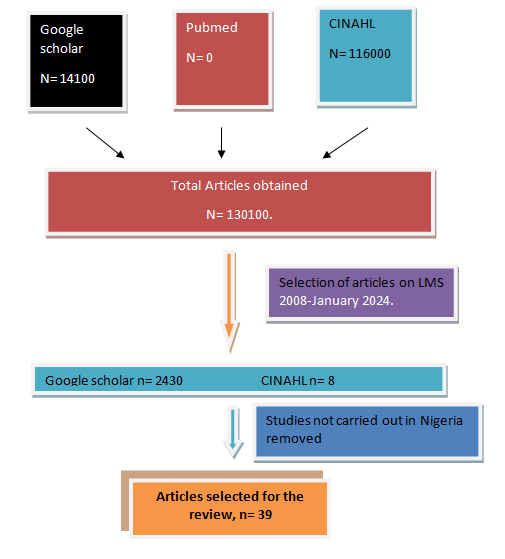
CINAHL were considered. Abstract and full-text articles were obtained. A total of 130,100 articles were obtained relating to learning management systems. These articles were then assessed for eligibility. A total of 39 articles were selected for the review.
Study Articles Selection Process
A total of 130,100 articles were obtained relating to learning management systems; 14100 from Google Scholar, 0 from PubMed and 116,000 from CINAHL. These were assessed based on the eligibility criteria. Duplicate articles were removed and on further screening Figure 1, a total of 39 articles were used for the review.
Data Analyses
The data extracted from the selected articles were entered into a spread sheet for statistical analysis. The variables registered for each articles and reference noted. Data was summarized using proportion and percentages.
| References | Title | Location | Design | Year of publication | Study outcome | Recommendations | Study Instrument |
|---|---|---|---|---|---|---|---|
| Nicholas- Omoregbe OS, et al. [1]. | Predicting the adoption of e-learning management system: a case of selected private universities in Nigeria. Turkish Online | South-West/ Private Universities | uses SLT and UTAUT | 2017 | The significant relationship with Behavioral Intention to adopt eLMS. | The report from the study will assist stakeholders in planning | Questionnaire |
| Ekoh-Nweke AC, et al. [2] | Information and communication technology as an integral tool for improving teaching and learning for sustainable education in tertiary institutions in Nigeria | South-East/ Widespread | descriptive survey research design | 2020 | . Effective utilization of ICT by educators to enhance/ improve teaching and learning process. | The teaching and learning to be improved by ICT utilization | Questionnaire |
| Ogudu JE [3] | An Assessment of the Use of Emerging Technologies in Education in Kogi State Tertiary Institutions in the New Normal | North- Central/ Colleges of Education | Descriptive survey | 2023 | The technologies available improve teaching and learning process in the classroom activities | The emerging technologies to be employed in the improvement of teaching and learning | Questionnaire |
| Ifijeh G, et al. [4] | Assessing E-Learning Tools in an Academic Environment | South-West /University | Descriptive survey | 2015 | Availability and use of e-learning tools as emerging paradigms in Covenant University | Adequate internet is highly recommended to enhance the use of e-learning platforms in Universities in Nigeria | Questionnaire |
| Adegbile JA, et al. [5] | Assessment of support facilities available to degree programme distance learning students in the southwestern Nigerian universities | South-West Universities | Descriptive survey | 2009 | The study assessed the availability of support facilities to degree programme distance learning students | Adequate support facilities to be provided to facilitate better distance learning | Questionnaire |
| Oguguo BCE, et al. [6] | Analysis of Teachers in the Use of Digital Resources in Online Teaching and Assessment in COVID Times | Colleges of education in Nigeria | A descriptive survey | 2023 | The measurement of ICT learning outcomes in higher institution. | The utilization of online learning applications was recommended for assessing students. | Questionnaire |
| Hadiza YB [7] | Availability and utilization of electronic learning technologies for improving teaching and learning in tertiary institutions in Sokotostate | North-West University | Descriptive survey | 2022 | Some e-learning technologies are available and some are utilized by both lecturers and students in Computer Science program in high extent. | Lecturers should be encouraged to utilize fully, the available e-learning resources and prepare e-books so as to encourage students in the reading of e-books and e-journals. | Questionnaire |
| Olatunji T, et al. [8] | Comparative Analysis of Operational Structures in Single- and Dual- Mode Distance Learning Institutions in Nigeria | South-West University | Case study research | 2021 | Differences in the operations of the included compulsory tutorial attendance at OAU and the deployment of part-time and quasi part-time facilitators at NOUN and OAU | Increase in the use of information and communications technology (ICT) | Questionnaire |
| Ifijeh G, et al. [9] | COVID – 19 pandemic and the future of Nigeria’s university system: The quest for libraries’ relevance | Nigerian Universities | Responsive library website design | 2020 | the evolving paradigm shift in teaching methodologies in Nigerian universities as a result of the outbreak of Covid-19 | Dynamism in library service delivery, urgency in the acquisition of new skill sets by academic librarians in Nigeria | Secondary data using various search engines and data sights. |
| Ogunlade BO, et al. [10] | Creating a virtual community of practice through blended learning in teacher education | Southwest Nigerian universities | quasi- experimental design | Jan-24 | The use of blended learning to create a virtual community of practice have significantly different professional development outcomes | NIL | Questionnaire |
| Adedoyin A, et al. [11] | Design and im- plementation of an online teaching and learning management system | North- Central university | System design and modeling of the proposed LMS application | 2023 | Create an online E-Learning System that provides all in one tool for teachers to develop and administer courses online | Moodle is the most used and favored open-source LMS, | Questionnaire |
Determinants of Learning Management Systems during COVID-19 Pandemic for Sustainable Education TAM, and UTAUT2 models’ constructs Cavus N, et al. [12]
Nigerian Universities
2021 Determinants of learning management systems adoption in Nigeria
Yakubu MN, et al. [13]
4 Nigerian University Descriptive survey 2020
Managing the shift to online: lecturers’ strategies during and beyond lockdown Nigerian Colleges of Education Qualitative descriptive survey 2023 Ayodele AO, et al. [14]
Managing the shift to online: lecturers’ strategies during and beyond lockdown A college of Education in Nigeria.
Ayodele AO, et al. [14]
Descriptive survey 2023
Effect of Emotion on Distance e-Learning Oluwalola FK [15]
Narrative discuss 2015
performance results for all the four developed AI models indicate a significant correlation coefficient between LMS usage and the study parameters The model can be used in scientific studies Questionnaire System quality, perceived ease of use, and perceived usefulness are important predictors’ use of LMS.
Implications for practice and theory are discussed. Questionnaire
The quality of teaching and assessment was compromised by factors irregular power supply, poor internet connection, high data costs and limited digital skills Strategies for educational management advocated Interview Strengthening educational technology training for lecturers and students, Interviews Technophobia effect on distance learning students.
ICT as a catalyst to distance e-learning advancement is to be emphasized.
Narrative essay
| Odekeye OT, et al. [16] | Perception of Learning Management System (LMS) on the Academic Performance of Undergraduate Students during the COVID-19 Pandemic | South-west. Osun State university | Descriptive survey design | 2023 | LMS is helpful in reflecting on students’ knowledge gaps when preparing for classes | Recommends students and lecturers to improve on their computer literacy skills. | Questionnaire |
|---|---|---|---|---|---|---|---|
| Ifegwu AN, et al. [17] | E-Learning: Roadmap to Sustainable Learning and Education in Nigeria. | Nigerian universities | Discourse approach based on content analysis. | 2023 | The parents should step up in their contributions towards sustainable education and shun any nefarious activities capable of lowering the standard of education. | Teachers/ lecturers or administrator should become more conscious in the discharge of their duty | Conference analysis |
| Olugbeko SO [18] | E-learning in Nigeria: the perception of Nigerian certificate in education (NCE) pre-service teachers | Nigerian college of Education | Descriptive survey | 2023 | Pre-service teachers perceived e-learning as not as useful to them as the conventional physical learning and believed that e-learning is not easy and not as helpful as face- to-face learning | The adoption of blended learning that combines the features of face-to- face learning and e-learning. | Questionnaire |
| Owolabi JI, et al. [19] | Evaluating gender differences on the impact of moodle and edmodo learning management system platforms on students’ achievement. | South-West | quasi experimental design using Conference paper | 2022 | . The differences in the impact of Moodle and Edmodo Learning Management System (LMS) platforms on achievement in Word Processing across gender. | Moodle LMS platform should be employed to improve on Business Education students’ achievement in word processing skills. | Word processing achievement test (WPAT) |
| Chukwuemerie OC, et al. [20] | Experiences, challenges and acceptance of e-learning by adult learners in sandwich programme of Nnamdi Azikiwe University Awka, Nigeria | South-East Nigeria. University. | Descriptive survey research design | 2024 | Adult learners had pleasant experiences of e-learning in sandwich programmes of Nnamdi Azikiwe University in the 2021/2022 Session | The management of Nnamdi Azikiwe University should invest more in e-learning by way of upgrading their ICT architecture and organize more training. | Questionnaire |
| Olugbade D [21] | Exploring the Impact of Learning Technologies in Teaching Interaction Design: A Case Study at First Technical University, Nigeria. | South-West/ University | an action research approach | 2023 | the potential of technology- enhanced pedagogies in creating a more engaging and effective learning environment | Educators and institutions can use these insights to optimize their teaching strategies and create engaging learning environments that promote active student participation, critical thinking, | First Technical instruments: instruction, including static slides and lectures. |
| Burwa UM, et al. [22] | ICT and managing university education for quality assurance in Nigeria. | Nigerian University | Reviews | 2023 | insufficient funding which resulted in numerous set- back to Quality management systems | For efficient and effective management of university system, total quality management is expedient. | Search engines |
| Awe BA [23] | Imperatives of Paradigm Shift in Current Pedagogical Strategies in Nigerian Public Universities. | Nigerian Public Universities. | Narratives discuss. | 2021 | concept of virtual learning, the influence of ICT revolution on pedagogical strategies | Adequate funding of NUPs, massive deployment of ICT infrastructure for virtual learning, reduced cost of internet services, provision of Wi-Fi on the campuses. | Essay |
| Olusanya O, et al. [24] | Information And Communication Technology (ICT): Catalyst For Enhancing The Intellectual Capacities of Educationists | Nigerian Universities | Review | Jan-24 | The effect of E-learning on the overall learning experience is a quantum leap. | Review |
Information and communication technology as a blended- learning tool for sustainable development for university students South-west Nigerian University.
Kayode AE, et al. [25]
descriptive survey 2023 Institutional factors and use of open educational resources in Nigerian university libraries Nigerian university libraries.
Idowu TA, et al. [26]
Descriptive survey 2023
Knowledge management considerations in learning management systems in higher education institutions: a systematic review, synthesis and research agenda Systematic literature review 2023 Omanyo JO, et al. [27]
Nigerian Universities.
Lecturers’ Perceptions of a Learning Management System Migration at an Open Distance and e-Learning Institution.
Biccard P, et al. [28]
Nigerian universities Explorative studies 2024
The trends and innovations in curriculum development and delivery in the digital age Ifarajimi MA [29]
Nigerian universities Explorative survey 2023
mobile phones, printers and interactive whiteboards constituted the most available ICT tools for students’ utilization on campus Questionnaire OER has been deployed and used in Nigerian university libraries Reviews interlink between knowledge management and learning management systems is still less explored Search Engines of data base websites Hasty and haphazard deployment, insufficient training, and a lack of consultation are factors to be considered if the use of LMS is to be adopted.
Questionnaire
Some of the opportunities and barriers that educators face in adopting LMS
Data base websites
| Asuzu CM [30] | Online learning: a 21st century approach to education | Nigerian Universities | Narrative Analysis | 2023 | Online learning in the 21st century. | ||
|---|---|---|---|---|---|---|---|
| Alumona D, et al. [31] | Perceived benefits, challenges and level of implementation of Learning Management System (LMS) among staff and students in delta state tertiary institutions | South-South of Nigeria. University | Descriptive survey | 2023 | The benefits of the learning management system as perceived by academic staff is high; that there is a significant difference between the perception of staff and students | Management should conduct pragmatic seminars and workshops to educate students and staff about LMS. | Questionnaire |
| Hamzat AS, et al. [32] | Remote teaching and learning in Nigerian private universities | Nigerian universities | Narrative discus | 2023 | The pandemic produced the use of remote learning process without adequate preparations resulting in some challenges | new hybrid model of education will emerge with significant benefits | |
| Oladipo AJ, et al. [33] | Scale development and validation of learners’ satisfaction in Open and Distance Learning (ODL) in the University of Lagos | Descriptive survey | South-West Nigeria. University. | 2023 | Development of an instrument for the measurement of learner satisfaction in ODL services in Nigeria | Prospective investigations on Distance learning should be carried out. | Questionnaire |
| Mustapha AM, et al. [34] | Students‘ Motivation and Effective Use of Self-regulated Learning on Learning Management System | North-West Nigeria University. | Quasi- experimental study. | 2023 | Utilizing Moodle as a learning management system enhances ability to learn independently and motivates them to work hard. | Self-Regulated Learning strategies of Moodle as LMS is highly recommended to promote autonomous learning. | Questionnaire |
| Ekwueme LO, et al. [35] | Teaching and learning of library and information science education in open and distance learning using electronic platforms | Open University of Nigeria | Descriptive survey | 2023 | Electronic platforms fostered intercultural communication irrespective of time, allow teaching irrespective of location and space. | Electronic platforms recommender for teaching. | Questionnaire |
| Smah SO [36] | The construction of effective learning ecosystems in open and distance learning (ODL) Universities: technologies, institutional preparedness, and change | Nigeria Universities. | Documentary review | 2023 | Determinant factor for the construction of open distance learning | Institutional preparedness and national priorities drive the effective direction of the change that meets the requirements of ODL learning systems | Literature evaluation |
| Eze SC, et al. [37] | The utilization of e-learning facilities in the educational delivery system of Nigeria | Nigerian University | Descriptive research design | 2018 | E-learning facilities are adequate and accessible to users, | e-learning facilities should be constantly upgraded, | Interviews |
| Yakubu MN, et al. [38] | Factors affecting the adoption of e-learning technologies among higher education students in Nigeria | Nigerian University | Unified theory of acceptance and use of technology (UTAUT). | 2019 | Factors that influence the adoption and use of educational technology | formulation of approaches and guidelines to enhance the adoption highly recommended | Unified theory of acceptance and use of technology (UTAUT). |
Table 3: The Evidence-based table of studies evaluated for the Learning Management Systems in tertiary institutions in Nigeria N=
| S/N | Description of Items | n | Percentage (%) |
|---|---|---|---|
| 1 | Descriptive Study | 21 | 53.8 |
| 2 | Comparative analysis | 1 | 2.5 |
| 3 | Responsive analysis | 1 | 2.5 |
| 4 | Quasi-experiment | 3 | 7.6 |
| 5 | Action Research | 1 | 2.5 |
| 6 | Reviews | 4 | 10.2 |
| 7 | Narrative discus | 5 | 12.8 |
| 8 | Explorative | 2 | 5.1 |
| 9 | Documentary | 1 | 2.5 |
| Total | 39 | 100 |
Table 4: The distribution of Study Types N=39.
| S/N | Description of Items | No | Percentage (%) |
|---|---|---|---|
| 1 | South-West | 10 | 25.6 |
| 2 | South-East | 2 | 5.1 |
| 3 | Nigeria widespread | 22 | 56.4 |
| 4 | North-central | 2 | 5.1 |
| 5 | North-west | 2 | 5.1 |
| 6 | South-south | 1 | 2.5 |
| Total | 39 | 100 |
Table 6: Geographical location spread of the studies N=39.
| Description of Items | n | Percentage (%) | |
|---|---|---|---|
| 1 | Questionnaire | 22 | 56.4 |
| 2 | Database search | 5 | 12.8 |
| 3 | Interview and focus group | 3 | 7.7 |
| 4 | Literature | 4 | 10.3 |
| 5 | First technical instrument instructions | 1 | 2.6 |
| 6 | Unspecified | 3 | 7.7 |
| 7 | Word processing achievement test (WPAT) | 1 | 2.6 |
| Total | 39 | 100 |
Table 7: The data collection instrument used in the studies N=39.
| Description of Items | No | Percentage (%) | |
|---|---|---|---|
| 1 | University | 34 | 87.2 |
| 2 | Colleges of education | 5 | 12.8 |
| Total | 39 | 100 |
Table 8: Educational study sites N=39.
| Description of Items | n | Percentage (%) | |
|---|---|---|---|
| 1 | Adoption of LMS | 4 | 10.2 |
| 2 | LMS improving learning processes | 1 | 2.5 |
| 3 | Assessment of usages of LMS | 8 | 20.5 |
| 4 | Structural designs of LMS | 1 | 2.5 |
| 5 | Challenges of usage of LMS | 3 | 7.6 |
| 6 | Improvement of academic performances by LMS | 1 | 2.5 |
| 7 | Perception of users of LMS | 3 | 7.6 |
| 8 | Perceived benefits of LMS | 1 | 2.5 |
| 9 | Library services utilization of LMS | 3 | 7.6 |
| 10 | LMS as sources of online and DLP | 4 | 10.2 |
| 11 | History, innovative emergence and scaling ups of LMS | 4 | 10.2 |
| 12 | Extent of preparedness of the Nigeria | 1 | 2.5 |
| 13 | Impact of LMS on learning | 3 | 7.6 |
| 14 | Success factors of LMS | 1 | 2.5 |
| 15 | Areas of research on LMS | 1 | 2.5 |
| Total | 39 | 100 |
Table 5: Study focus N=39.
Discussion
Overview of Learning Management Systems
Technology advancement has set a pace in providing options from the Covid-19 lockdown to making the teaching and learning process between students and teachers more resourceful and successful, enhancing management of online course, distributing course materials, promoting collaboration between students and lecturer of the value added technology in education. It manages all aspects of student’s procedures from registration to storing of every students evaluation through digital assignments [7]. LMS created interactive websites assisting student learning with assessment, grading, reporting, and tracking progresses to infuse improvement in learning [8]. Students are able to monitor academic progress enhancing training evaluation [9]. The use of LMS is not only time and money saving but support the delivery of effective instructions that will enhance interactive learning environment between students and faculty [8].
LMS in Tertiary Institutions in Nigeria
The adoption of LMS in tertiary institutions in Nigeria, have yielded dividend of effective utilization of ICT enhancing learning and teaching [2]. This has positively impacted the quality of learning especially with the innovative on-line teaching platforms. There is significant need to investigate the published works to identify the coverage of researches on learning management systems in tertiary institutions to evaluate the impact of the system on educational sector as indicated in Table 1. However the success story of LMS [14] opined that the quality of teaching and assessment could have been compromised by factors such as irregular power supply, poor internet connections, high data cost and students limited digital skills [10, 39].
In this review, majority of the studies were descriptive surveys, few were reviews, and quasi-experimental and minuscule of them are comparative and action researches (Table 2). The geographical spread of the studies reviewed had a national geographical spread above average and predominant across board. A quarter of the studies were carried out in institutions in the south-west geographical zone (Table 3). The most popular instrument used in the studies was the questionnaire, while data base constituted 12.8% of the studies (Table 4). The majority of studies were carried out in the university setting while a minimal proportion took place in the colleges of education (Tables 5 & 6) presents the studies focuses indicated that one-fifth of the studies assessed the usages of LMS, one-tenth considered LMS adoption, and LMS as sources of online and distance learning platforms, History and innovative emergence of LMS, and scaling ups studies [40, 41, 42, 43]. Improvement of academic performances and extent of preparedness of Nigeria for this advancement were the least utilized.
Conclusion
The study reveals the evidence-based satisfaction of LMS with full positive impact on educational sectors promoting improvement in learning and teaching. However, not many of the tertiary institutions have implementation LMS. The decision to the choice of types of system also required critical evaluation and sensitivity in selection adoptions types. However the highlighted challenges must be adequately viewed in the implementations.
Recommendations
It is highly recommended that the adoption of LMS must be fully employed in tertiary institutions of learning and the blended learning that combines the features of face-to- face and e-learning be employed for effective and efficient learning processes in the tertiary institutions.
Study Limitations
The searches carried out were related to learning management systems in tertiary institutions in Nigeria, some articles containing details may have been omitted through the search terms used during the study.
Ethical Approval
Not applicable.
Conflict of Interest
The authors have none to declare.
Sponsorship
None was received for this study.
References
-
Nicholas-Omoregbe OS, Azeta AA, Chiazor IA (2017) Predicting the Adoption of E-learning Management System: A Case of Selected Private Universities in Nigeria. Turkish Online Journal of Distance Education 18(2): 106-121.
-
Ekoh-Nweke AC, Nwanneka AG (2020) Information and Communication Technology as an Integral Tool for Improving Teaching and Learning for Sustainable Education in Tertiary Institutions in Nigeria. Journal of the Nigerian Academy of Education 16(2): 79-92.
-
Ogudu JE (2023) An Assessment of the Use of Emerging Technologies in Education in Kogi State Tertiary Institutions in the New Normal. International Journal of Advances in Engineering and Management 5(4): 1459- 1466.
-
Ifijeh G, Osinulu I, Esse U, Adewole OE, Fagbohun M (2015) Assessing E-Learning Tools in an Academic Environment: A Study of Availability and Use among Undergraduate Students in a Nigerian University. International Journal of Progressive Education 11(2): 76-87.
-
Adegbile JA, Oyekanmi JO (2009) Assessment of Support Facilities Available to Degree Programme Distance Learning Students in the South-western Nigerian Universities. Educational Research and Review 4(2): 42- 47.
-
Oguguo BCE, Ezechukwu RI, Nannim FA, Offor KE (2023) Analysis of Teachers in the Use of Digital Resources in Online Teaching and Assessment in COVID Times. International Journal of Technology and Educational Innovation 9(1): 81-96.
-
Hadiza YB (2022) Availability and Utilization of Electronic Learning Technologies for Improving Teaching and Learning in Tertiary Institutions in Sokoto State, Nigeria. Scholarly Journal of Science and Technology Research & Development 1(6): 33-47.
-
Olatunji T, Adewumi AT (2021) Comparative Analysis of Operational Structures in Single- and Dual-Mode Distance Learning Institutions in Nigeria. International Review of Research in Open and Distributed Learning 22(1): 59-77.
-
Ifijeh G, Yusuf F (2020) Covid - 19 Pandemic and the Future of Nigeria’s University System: The Quest for Libraries Relevance. The Journal of Academic Librarianship 46(6): 102226.
-
Ogunlade BO, Ogunlade JO (2024) Creating a Virtual Community of Practice through Blended Learning in Teacher Education in Southwest Nigerian Universities. Journal of Research Administration 6(1).
-
Adedoyin A, Enebe FO, Oyekunle RA, Balogun NA (2023) Design and Implementation of an Online Teaching and Learning Management System. FUDMA Journal of Sciences 7(1): 148-155.
-
Cavus N, Mohammed YB, Yakubu MN (2021) Determinants of Learning Management Systems during COVID-19 Pandemic for Sustainable Education. Sustainability 13(9): 5189.
-
Yakubu MN, Dasuki SI, Abubakar AM (2020) Determinants of Learning Management Systems Adoption in Nigeria: A Hybrid SEM and Artificial Neural Network Approach. Educ Inf Technol 25: 3515–3539.
-
Ayodele AO, Tijani F (2023) Managing the Shift to Online: Lecturers’ Strategies during and Beyond Lockdown. Educational Research 65(1): 24-39.
-
Oluwalola FK (2015) Effect of Emotion on Distance E-Learning- The Fear of Technology. International Journal of Social Science and Humanity 5(11): 966-970.
-
Odekeye OT, Fakokunde JB, Metu DV, Adewusi MA (2023) Perception of Learning Management System (LMS) on the Academic Performance of Undergraduate Students during the COVID-19 Pandemic. International Journal of Education and Development using Information and Communication Technology 19(1): 7-19.
-
Ifegwu AN, Nwakwuribe AJ, Ezeodili OVN (2023) E-Learning: Roadmap to Sustainable Learning and Education in Nigeria. International Journal of Public Administration 2(1): 1-18.
-
Olugbeko SO (2023) E-learning in Nigeria: the Perception of Nigerian Certificate in Education (NCE) Pre-service Teachers. Journal of Contemporary Issues in Education 7(1): 128-143.
-
Owolabi JI, Owolabi J (2024) Evaluating Gender Differences on the Impact of Moodle and Edmodo Learning Management System Platforms on Students’ Achievement in Word Processing.
-
Chukwuemerie OC, Akpan E, Okoye PU (2021) Experiences, Challenges and Acceptance of E-learning by Adult Learners in Sandwich Programme of Nnamdi Azikiwe University Awka, Nigeria. Journal of Educational Research 2(2): 90-97.
-
Olugbade D (2023) Exploring the Impact of Learning Technologies in Teaching Interaction Design: A Case Study at First Technical University, Nigeria. Journal of Education and Practice 14(21): 43-55.
-
Burwa UM, Aliyu ADZ, Rabiu M (2023) ICT and Managing University Education for Quality Assurance in Nigeria. Journal of Science, Technology and Mathematics Pedagogy 1(2): 35-48.
-
Awe BA (2021) Imperatives of Paradigm Shift in Current Pedagogical Strategies in Nigerian Public Universities. American Journal of Educational Research 9(1): 1-10.
-
Olusanya O, Oluwasanya AT (2024) Information and Communication Technology (ICT): Catalyst for Enhancing the Intellectual Capacities of Educationists and Closing Observed Skill Gaps of Graduates in Higher Education Institutions in Nigeria. American Journal of Engineering Research 3(2): 217-229.
-
Kayode AE, Lingaliso L (2023) Information and Communication Technology as a Blended-learning Tool for Sustainable Development for University Students. International Journal of Sciences and Research 79(1).
-
Idowu TA, Giwa R, Simisaye AO, Okiki PC (2023) Institutional Factors and Use of Open Educational Resources in Nigerian University Libraries. Lokoja Journal of Information Science Research 1(1): 1226-146.
-
Omanyo JO, Ndiege JR (2023) Knowledge Management Considerations in Learning Management Systems in Higher Education Institutions: A Systematic Review, Synthesis and Research Agenda. Journal of Information and Knowledge Management Systems.
-
Biccard P, Makgato KP (2024) Lecturers Perceptions of a Learning Management System Migration at an Open Distance and e-Learning Institution. International Journal of E-learning and Distance Education 38(2): 1-34.
-
Ifarajimi MA (2023) The Trends and Innovations in Curriculum Development and Delivery in the Digital Age. Sapientia Global Journal of Arts, Humanities and Development Studies 6(2): 185-198.
-
Asuzu CM (2023) Online Learning: A 21st Century Approach to Education. Journal of Psychology and Behavioural Disciplines COOU 3(1): 24-35.
-
Alumona D, Akinseinde SI (2023) Perceived Benefits, Challenges and Level of Implementation of Learning Management System (LMS) among Staff and Students in Delta State Tertiary Institutions. European Journal of Education Studies 10(4): 329-352.
-
Hamzat AS, Olatokun MW (2023) Remote Teaching and Learning in Nigerian Private Universities. Library and Information Perspectives and Research 5(2): 15-27.
-
Oladipo AJ, Adewara JA, Olayiwola PO, Afolabi F, Oladele AO, et al. (2023) Scale Development and Validation of Learners’ Satisfaction in Open and Distance Learning (ODL) in the University of Lagos. Nigerian Online Journal of Educational Sciences and Technology 5(1): 108-124.
-
Mustapha AM, Megat AZMZ, Yahaya N, Abuhassna H, Mamman B, et al. (2023) Students ‘Motivation and Effective Use of Self-regulated Learning on Learning Management System Moodle Environment in Higher Learning Institution in Nigeria. International Journal of Information and Education Technology 13(1): 195-202.
-
Ekwueme LO, Mayowa AO, Ajie IA, Omotunde OI (2023) Teaching and Learning of Library and Information Science Education in Open and Distance Learning using Electronic Platforms. Journal of Library and Information Science 21: 72-90.
-
Smah SO (2023) The Construction of Effective Learning Ecosystems in Open and Distance Learning (ODL) Universities: Technologies, Institutional Preparedness, and Change. Journal of Research and Innovation in Open and Distance Learning 2(1): 1-14.
-
Eze SC, Chinedu VC, Bello AO (2018) The Utilization of E-learning Facilities in the Educational Delivery System of Nigeria: A Study of M-University. International Journal of Educational Technology in Higher Education 15: 34.
-
Yakubu MN, Dasuki SI (2019) Factors Affecting the Adoption of E-learning Technologies among Higher Education Students in Nigeria: A Structural Equation Modeling Approach. Information Development 35(3): 492-502.
-
Ajijola EM, Ogunlade OO, Aladesusi GA, Olumorin CO (2021) Perception of Learning Management System among Distance Learners in South-West, Nigeria. Journal of Digital Learning and Education 1(2): 72-84.
-
Isacha HD, Nathan N (2017) Development of an Online Learning Management System (OLMS) A Case Study of Adamawa State University Mubi Nigeria. International Journal of Computer Applications 179(49): 13-19.
-
Fuad AA, Trayek A, Sharifah SSH (2013) Attitude towards the Use of Learning Management System among University Students: A Case Study. Turkish Online Journal of Distance Education 14(3): 91-103.
-
Edebatu DC, Ekwonwune EN, Ezeobi C (2019) Learning Management System for Improved Service Delivery in Tertiary Institution. Int J Communications, Network and System Sciences 12(3): 37-48.
-
Alaidi AH, Yahya O, Alrikabi HT (2020) Using Modern Education Technique in Wasit University. IJIM 14(6): 82- 94.
- Teaching Cognitive Behavioral Therapy to Graduate Psychiatric Mental Health Nurse Practitioner Students: Utilizing A Mixed Methods Course Evaluation
- The Role of Pharmacogenetic Testing in Clinical Practice: A Path toward more Effective, Personalized and Cost-effective Care
- Implementing Screening with the GAD-7 in an Outpatient Mental Health Setting: A Quality Improvement Project
- Social Media and Health Promotion
- Impact of Covid-19 Pandemic on the Academic Performance and Attitude of Nursing Students towards E-Learning
- A Study to Assess the Knowledge Regarding Ill Effects of Tobacco Consumption on Health among Adolescents in Selected Higher Secondary School in Nadiad City