
Features of phase-refined materials
The concepts of phase-refined materials are introduced and interpreted in this paper. Phase-refined materials are refined structures from the phase view in single or multiple phases. β-zinc oxalate refines zinc oxalate into villous structures. The specific β-phase zinc oxalate grows from multiphase α and β zinc oxalate. Compared with conventional methods, the phase always produces regular-shaped ï¡-zinc oxalate instead of multiphase α and β phases. ï¢-phase zinc oxalate is activated and refined into a villous shape. This villous material can be used for H2 sensing, bio sensing, and other applications. Moreover, villous material can be a template for super paramagnetic iron oxide, which is used in magnetic target nanomedicine.
Introduction
Zinc is an integral part of more than 200 enzymes in the human body. Most of crucial zinc-containing enzymes in the human body include carbonic anhydrase, pancreatic carboxypeptidase, DNA polymerase, aldehyde dehydrogenase, glutamate dehydrogenase, malic acid dehydrogenation enzymes, lactate dehydrogenase, alkaline phosphatase, and pyruvate oxidase. Zinc- containing enzymes include zinc ions and a boiligand mixed structure. The zinc in the enzymes activates catalytic and regulating effects. Therefore, the design of active centers and synthesized complexes has become a research topic. Oxalate is an important organic ligand. It can be coordinated with transition and nontransition elements to form complexes with various molecular structures. Oxalate can coordinate with metallic ions to form one-, two-, and three-dimensional complex polymers such as zinc oxalate.
Purpose of this work
The purpose of this paper is briefly to review the structures and preparation methods of zinc oxalates and to interpret the concepts of phase-refined materials. Conventional materials feature single or multiple phases and exist in their original status following manufacture. Therefore, the properties of these materials are determined. Advanced methods are required to refine materials further to achieve superior properties. Phase- recurring materials are a new type of materials from the phase perspective. These materials can be used to synthesize novel magnetic target nanomedicine.
Structure of zinc oxalate
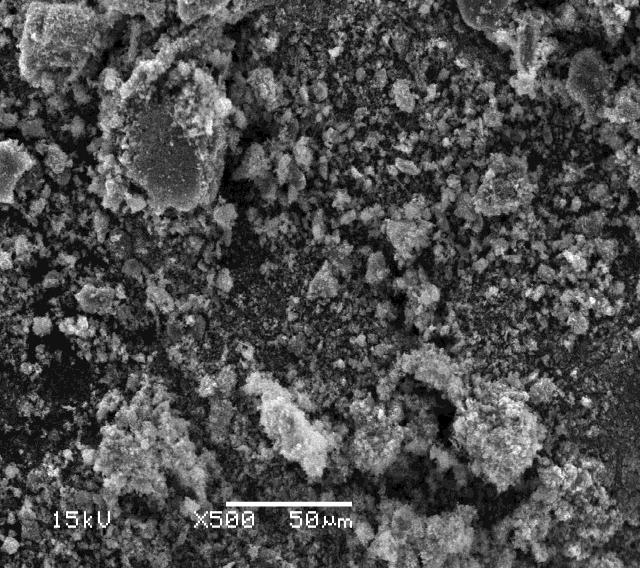
Zinc oxalate (ZnC2O4) normally exhibits an elongated tetrahedral geometry with two basic structures, namely α-ZnC2O4 and β-ZnC2O4[1]. The crystal form of α-ZnC2O4 is triclinic. The adjacent metal ions are linked in a one- dimensional chain structure, but the interchain is linked in a three-dimensional network structure through hydrogen bonding. By contrast, the structure of β-ZnC2O4 is determined by its cation and anion chains (i.e., –C2O4– Zn–C2O4–Zn and Zn–O). The octahedral structure formed through zinc cobonding is the optimal place for the insertion of impurities.
Preparations from convention methods
Zn2C2O4 can be prepared using various methods such as solid-phase, liquid-phase, or so-gel methods [2, 3, 4, 5]. Zinc acetate (C4H6O4Zn)and oxalic acid are used to prepare ZnC2O4. For the liquid-phase method, C4H6O4Zn and oxalic acid are combined, ground, and then heated. After the reaction, the precipitate is washed and dried. ZnC2O4 can also be prepared using the sol-gel method from zinc oxide and graphene. Templates play a pivotal role in the shape control of H2C2O4[6]. Sodium dodecylbenzenesulfonate (DBS) is used as a template to prepare rod-like nanoscale ZnC2O4·2H2O whiskers. Zinc acetate hydrate (ZnAc2·2H2O) dispersed in DBS in the presence of DBS xylene to form a homogeneous cloudy mixture. Finally, the resulting white precipitate is centrifuged with deionized water to purify the product. H2C2O4 can be prepared using various acids [7]. For example, zinc sulfate heptahydrate, zinc nitrate heptahydrate, zinc chloride heptahydrate, and oxalic acid synthesis zinc oxalate dihydrate compounds have been used to synthesize zinc oxide with various structures and morphologies.
An example of phase-refined materials - novel villous zinc oxalate
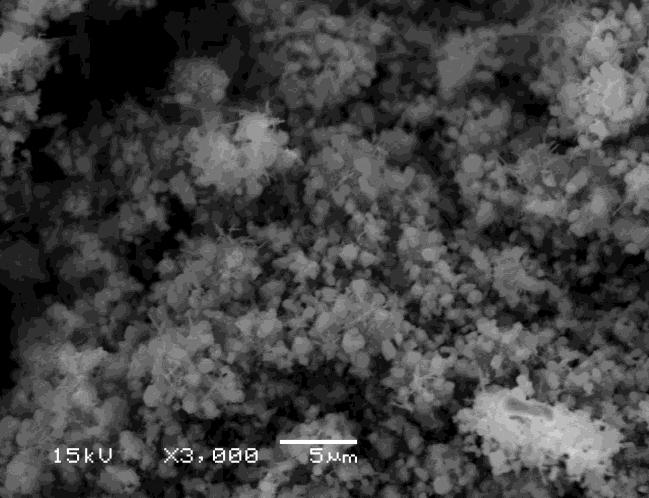
A villous structure was prepared and published in a previous paper [5] and is illustrated in Figure 2 The zinc oxalate surface was melted and resolidified as protrusions that resemble a villous structure. The octa site can be occupied by other elements and exits specific properties owing to open structures. The villous structure possesses excellent H2 sensing capability and will publish later.
Possible applications for nanomedicine
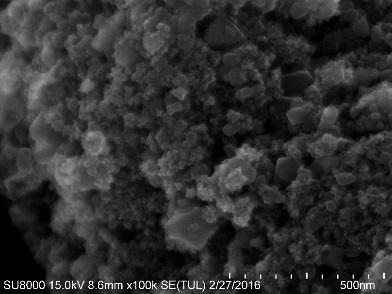
The villous structure exhibited an adhere capacity. Figure 3 shows the field emission scanning electron microscopy image of super paramagnetic Fe3O4. Iron oxide is commonly used in magnetic targeted nanomedicine. Villous zinc oxalate can be used as a template to nucleate and grow super paramagnetic nanoparticles of iron oxide. It can also be used as a template for surface-coated materials. For example, the villous structure can be coated as a film form for recombination tissue plasaminogen activator (rtPA).
Conclusions
Phase-refined materials refine material structures are introduced in terms of phases. Herein, the example of zinc oxalate is used to explain these materials. When produced through conventional methods, zinc oxalate is normally dominated by elongated tetrahedralα structures. To include the β-phase, the sol-gel method is adopted to produce α- and β-zinc oxalate. To further refine the β- phase structure into a villous structure, the β-zinc oxalate is remelted in α-matrix by a microbeam laser. The phase- refined villous zinc oxalate provides excellent properties including hydrogen sensing.
References
-
Małecta B, Droźdż-Cieśla E, Małecki A (2004) Mechanism and kinetics of thermal decomposition of zinc oxalate. ThermochimicaActa 423(1-2): 13-18.
-
Zhang J,Xu, M ZhouX (2005) Synthesis of nanometer ZnO by solid phase method. Inorganic chemicals industry37: 7- 18.
-
Cao YL, Liu L, Jia DZ, Xin XQ (2005) One-step Solid- state Synthesis and Characterization of Two Kinds of ZnC2O4·2H2O Hollow Nanostructures. Chinese Journal of Chemistry 23(5): 539-542.
-
Ni L, Wang L, Shao B, Wang Y, Zhang W, et al. (2011) Synthesis of Flower-like Zinc Oxalate Microspheres in Ether-water Bilayer Refluxing Systems and Their Conversion to Zinc Oxide Microspheres. J Mater SciTechnol 27(6): 563-569.
-
Hsu C, Hsu LA (2017) Fabrication and Characteristics of villous Zinc Oxalate by using a Sol-Gel and Microbeam-laser Method. Nanomed Nanotechnol 2(1): 000112.
-
Guo L, Ji Y, Xu H, Wu Z, Simon P(2003) Synthesis and evolution of rod-like nano-scaled ZnC2O4 .2H2O whiskers to ZnO nanoparticles. J Materials Chemistry 13(4): 754-757.
-
Raj CJ, Joshi RK, Varma KBR (2011) Synthesis from oxalate, growth mechanism and optical properties of ZnOnano/micro structures. Cryst Res Technol 46(11): 1181-1188.
- Solution-Processed Chiral Perovskites for Biomedical Applications
- Nanotechnology in Health Chemistry and Medicine: Current Challenges and Future Directions
- Human Exposure to Micro- and Nanoplastics: Pathways, Toxicity, and Intervention Strategies
- Exosome Nanomedicine for Cancer Therapy
- Micro and Nanoplastics–Plastisphere, Biotoxicity, Impact on Human Health, and Mitigation Strategies
- Process Validation of Cefixime Powder for Suspension Dosage Form, 50 mL