
Current Trends in Designing and Applications of Nanoporous Carbon Spheres: A Mini Review
Great progress has been made in the synthesis and applications of nanoporous carbon spheres in the recent years. In this brief review, we will review the synthesis and applications of nanoporous carbon spheres, and further describe their advantages and disadvantages. The synthesis techniques are mainly introduced in the review including the Stöber method and those based on templating, self-assembly, emulsion and hydrothermal carbonization, while applications are described shortly. We cover the key applications of these nanoporous carbon spheres, including adsorption, catalysis, separation, energy storage and biomedicine. In the end, we put up some outlook in the improvement of the synthesis methods and commercial applications of nanoporous carbon spheres.
Introduction
Porous carbon materials have attracted considerable attention because of their applications in a wide range of areas, including energy storage and conversion, adsorption, catalysis, sensor technology, and controlled drug release and cellular delivery. As an important class of novel porous carbons, nanoporous carbon spheres (NCS) have become a research hotspot due to their unique nanospherical morphology, large surface area and pore volume, good electrical conductivity, and high physical and chemical stability. In recent years, with the rapid growth in the synthesis and applications of NCS [1, 2, 3, 4, 5, 6, 7], these materials present great utilitarian value for catalysis, adsorption, water and air purification, and energy storage and conversion. Currently, there are several strategies for preparing NCS and multi- component CS, such as templating [4, 5, 6], hydrothermal carbonization (HTC) [7], emulsion polymerization [8], self-assembly [9] and the Stöber method [10, 11, 12, 13]. As a result, NCS have been fabricated with particle sizes ranging from nanometres to micrometres, diverse morphologies, pore sizes ranging from micropores (below 2 nm) to mesopores (2-50 nm) and macropores (>50 nm), and controlled pore orientation. Moreover, functionalized NCS have been synthesized by surface modification, heteroatom doping and graphitization [4, 5, 6, 7, 8, 9, 10, 11, 12, 13].
The NCS can be classified by their morphological as solid NCS (s-NCS), hollow NCS (h-NCS), core-shell NCS (cs- NCS) and york-shell NCS (ys-NCS). This Review briefly summarizes the key developments in synthesis and applications of NCS, and discusses the impact of their functionalization on the growing range of applications, including adsorption, catalysis, energy storage and nanomedicine. In the end, we shortly elaborate the applications and future of the development of NCS.
Synthesis of Nanoporous Carbon Spheres
There is a wide variety of methods for preparing NCS, including hard and soft templating, HTC, emulsion polymerization, self-assembly and Stöber synthesis (Table 1). Although a number of other methods such as direct pyrolysis of hydrocarbons or chemical vapor deposition (CVD) have been used to synthesize NCS, these result in polydisperse NCS and are thus more demanding from an experimental viewpoint. Further integration of the above- mentioned methods would be desirable to discover new ways of synthesizing NCS with higher levels of complexity and functionality.
Hard and Soft-Templating
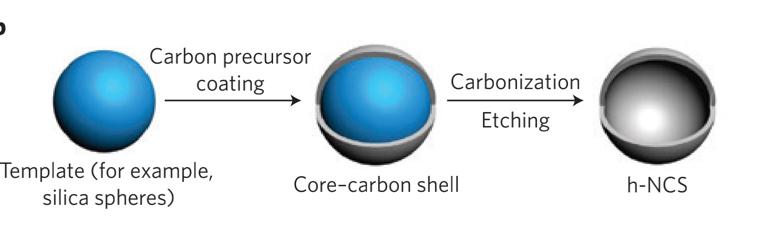
As shown in Figure 1(i), the hard-templating (HT) strategy mainly contains the following steps. First, prepare mesoporous silica spheres. Second, fill their pores with suitable carbon precursors. Finally, silica dissolution with NaOH or HF solutions. Kim et al. were the first to publish the paper about the HT synthesis of ordered mess-CS which is using 3D cubic-ordered mesoporous silica named MCM-48 as a hard template [4]. Nowadays, we expect to discover more appropriate precursors and hard templates. As shown in Figure 2, preparing hollow NCS also involves three main steps. Synthesizing hard templates, coating the templates with specific carbon precursors and removing the templates. Current understanding in this area allows that HT is the most straightforward way of synthesizing h-NCS [13]. However, there is a major drawback of HT method that it is difficult to complete the procession of forming special hard templates and use hazardous chemicals such as HF and NaOH, which limits its popularity. Compared with the HT method, soft templating (ST) does not need preparing and removing templates [5, 6, 14, 15, 16, 17]. Up till now, the reports on the ST technique of preparing mesoporous CS (meso-CS, Figure 1(ii)) are rare so this method is inappropriate for scaling up. What is similar to the HT synthesis is that the ST concept has been also used to synthesize h-NCS (Figure 1(iii)) [18]. However, its low yield and relatively high cost make it a great challenge.
![Figure 1: Hard and soft templating method for fabrication of CS [18]. Pore filling, carbonization, silica dissolution are labeled as the step a, b, and c in the HT strategy.](/fulltextimages/902/fig_1.jpeg)
| Synthesis Method | Types of NCS | Carbon Precursors | ||||||
|---|---|---|---|---|---|---|---|---|
| h-NCS [13] | Glucose, sucrose, dopamine, 1-alkyl-3-methylimidazolium bromide, | |||||||
| HT | ||||||||
| ys-NCS | phenolic resins (phenol-formaldehyde, resorcinol-formaldehyde) | |||||||
| h-NCS [6,17,18] | ||||||||
| Phenolic resins (phenol-formaldehyde, resorcinol-formaldehyde), | ||||||||
| ST | cs-NCS | |||||||
| cyclodextrins | ||||||||
| ys-NCS | ||||||||
| Biomass derivatives (glucose, cyclodextrins, fructose, sucrose, xylose), | ||||||||
| h-NCS | ||||||||
| HCT | furfural alcohol, phenolic resins (phenol-formaldehyde, melamine- | |||||||
| cs-NCS [11] | ||||||||
| formaldehyde, resorcinol-formaldehyde-hexamethylenetetramine), pyrrole | ||||||||
| Microemulsion | micro-CS | |||||||
| Styrene,1,2-divinylbenzene | ||||||||
| polymerization | [8,22,23] | |||||||
| h-NCS [13] | Phenolic resins (resorcinol-formaldehyde, aminophenol-formaldehyde, | |||||||
| Stöber method | cs-NCS [11] | phloroglucinol-terephthalaldehyde, resorcinol-melamine-formaldehyde), | ||||||
| ys-NCS [19] | dopamine | |||||||
| Benzene derivatives (benzene, nitrobenzene, aniline, naphthalene, | ||||||||
| Direct pyrolysis | micro-CS [21] | |||||||
| anthracene, phenanthrene, pyrene), polyacrylonitrile | ||||||||
| Microwave | Phenolic resins (resorcinol-formaldehyde, resorcinol-melamine- | |||||||
| micro-CS | ||||||||
| treatment | formaldehyde) | |||||||
Table 1: Carbon precursors and methods.
HTC Synthesis of Micro-CS and H-NCS
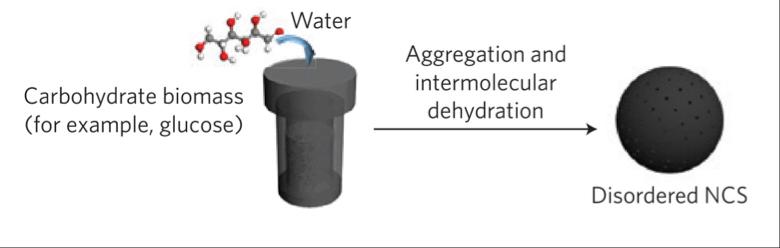
Currently, there are great interests in exploring how to prepare CS by the HTC of biomass derivatives at lower temperatures (160-200°C, Figure 3) because of its simplicity, sustainable and versatile chemistry, low cost and high efficiency [7]. In contrast with templating, the steps of HTC are more complex involving dehydration, condensation, polymerization and aromatization. Using this method, we can obtain micro-CS with tunable particle size scoping from 200nm to 5000nm and a series of various functionalities hinging on carbon precursors used (Table 1) [7, 19, 20]. As a viable way of preparing CS, HTC also have problems in any way. For example, its application is still limited in controlling porosity and CS size lacking of the proper biomass-derived carbon precursors.
Microemulsion Polymerization Synthesis
Microemulsion polymerization synthesis is a most popular method for producing mono disperse polymer spheres, this strategy is a big challenge to researchers who have failed to turn colloidal spheres into their carbonaceous analogues owing to thermolysis and serious particle agglomeration [21, 22]. Adding divinylbenzene crosslinking could overcome these issues (Figure 4).
![Figure 4: Microemulsion polymerization synthesis of CS [8].](/fulltextimages/902/fig_4.jpeg)
Extension of the Stöber Method
Extension of the Stöber method is a great breakthrough in the development of NCS which was completed in 2011. Recently, researchers discovered that the sol-gel formation of silica spheres is similar to the process of forming phenolic resin polymer [10]. Why we can believe this conclusion is because of the successful preparation of monodisperse phenolic resin spheres with tunable particle sizes through the Stöber process [10]. Making these polymeric spheres carbonized supports micro-CS high yield and its tunable particle size can range from 150-900nm (Figure 5(i)). Surprisingly, it is by this technique that we obtain the NCS with various functionalities [11, 12, 13]. Some compounds such as 3- methylphenol, 1,3,5-trihydroxybenzene and 3- aminophenol which are the derivatives of phenol were used to product phenolic resin spheres highly monodispersed and in the meantime develop the corresponding NCS whose molecular particle size is controlled [23, 24]. We usually use melamine, resorcinol and formaldehyde as precursors, creating a range of melamine-phenolic resin-based spheres and N-doped NCS which is special having particular particle sizes, microporosity and nitrogen content in the framework [25]. In addition, the Stöber method also provides opportunities for the design of h-NCS. There is an example in the Figure 5(ii). Adding colloidal silica helps create the same spherical mesopores in CS. However, this method is limited by selecting available carbon precursors. Besides, in the procession of the Stöber, ammonia is one of the basic catalysts, which makes it difficult to extend the popularity of this method.
![Figure 5: NCS prepared by using the Stöber method [11].](/fulltextimages/902/fig_5.jpeg)
The Selection of Precursor in the Design Process of NCS
Selecting appropriate precursor is of great importance for the design of NCS, especially for those with particular composition, framework and functionality. There are a variety of precursors shown in Table 1, which are able to be used for the synthesis of NCS with the methods of templating, HTC and Stöber. For instance, the preparation of N-doped NCS needs a kind of biocompatible precursor such as dopamine. In addition, phenolic resins integrate several advantages including high thermal stability and easy conversion to carbon materials. Therefore, these resins through special process can be as the excellent precursors for the design of NCS. What' more, it was used for fabricating the NCS at the molecular level that can be synthesized by selecting proper phenol and aldehyde derivatives (Table 1).
Applications
Carbon-based materials are the most attractive material types in both fundamental research and industrial applications, partly because of their well- controlled nano-morphologies. In the past two decades, researchers have witnessed a number of breakthroughs in carbon research: fullerenes, carbon nanotubes, and graphene. Nowadays, carbon nanospheres are attracting more and more attention worldwide due to their excellent performance in various fields: drug delivery, heterogeneous catalysis, encapsulation of support and electrode materials, energy conversion and storage, nanomedical, and environmental science. Actually, spherical carbon is an old material, whereas controlling carbon spheres in the nanometer range is a recent story. Here, we present a brief summary of the various applications for NCS (Figure 6). Throughout this article, a special emphasis is placed on the possible modulation of spherical structures at the nanoscale, and we wish to inspire many more designs and applications of carbon nanostructures in the near future. Due to the unique morphological and structural properties of NCS, there are many current applications which we will give a brief summary.
Energy Storage and Conversion
In brief, we can take electrodes and electrocatalysts for examples. Carbon nanomaterials can be as electrodes in super capacitors, lithium-ion batteries and Li-S batteries, and as electrocatalysts for hydrogen evolution reactions and oxygen reduction reactions [27]. In the Table 2, we list the key properties of NCS for specific applications.
| Applications | Preferred properties | Type of NCS | ||||||
|---|---|---|---|---|---|---|---|---|
| Super | Hierarchical porous structure , large surface area, high electronic | |||||||
| cs-NCS | ||||||||
| capacitors | conductivity, heteroatom doping | |||||||
| Facilitated Li+ transport, large surface area, short diffusion distance, | ||||||||
| Lithium-ion | h-NCS | |||||||
| heteroatom doping, suppressed agglomeration of active particles, | ||||||||
| batteries | ys-NCS | |||||||
| buffer space for volume expansion | ||||||||
| h-NCS | ||||||||
| Facilitated Li+ transport, large surface area, short diffusion distance, | ||||||||
| Li-S batteries | ys-NCS | |||||||
| avoid sulphuric melting | ||||||||
| meso-NCS | ||||||||
| Fast gas diffusion, high porosity, large surface contact angle, high air | ||||||||
| cs-NCS | ||||||||
| Fuel cells | permeability, rapid water vapor diffusion, high electronic conductivity, | |||||||
| ys-NCS | ||||||||
| enhanced oxidative stability | ||||||||
| Fast diffusion of reactant and products, highly exposed catalytic active | cs-NCS | |||||||
| Catalysis | ||||||||
| sites, homogenous environment, recyclability | ys-NCS | |||||||
| Large surface area, narrow pore size distribution, basicity of the | Super microporous basic | |||||||
| CO capture 2 | ||||||||
| framework, fast diffusion | ys-NCS | |||||||
| Appropriate particle size, multifunctional ability (fluorescence, drug, | Multifunctional carbon | |||||||
| Biomedical | ||||||||
| antibody, diagnosis), low toxicity | nanospheres | |||||||
Biomedical Applications
Compared with other types of carbon such nanotubes and graphene, NCS will cause no or minimal damage to cells because of their low cytotoxicity and no-sharp edges. For example, NCS can be used to deliver drugs, contrast agents and target molecules such as genes. In addition, owing to NCS's hydrophobic properties, they exhibit better affinity towards hydrophobic drug molecules.
Catalytic and Adsorption-Based Applications
Functionalized NCS can be used as heterogeneous catalysts or catalytic supports for a variety of reactions like Friedel-Craft alkylation [28], hydrogenation, Fischer- Tropsch synthesis and photocatalytic reactions. The porous carbon shell of h-NCS or ys-NCS acts as a physical barrier but still allows reactants and products to travel between the catalyst surface and the bulk phase containing the reactants. Moreover, carbonaceous materials have high chemical stability in various reaction environments (such as acidic and basic). Compared with other supports such as SiO2, Al2O3 and TiO2, interactions of NCS with active metal catalysts are weaker, which prevents the formation of mixed compounds between metal catalysts and supports [27].
![Figure 6: Various applications of NCS [26].](/fulltextimages/902/fig_6.jpeg)
Outlook and Summary
From the researches in recent years, there is a great development in the synthesis and application of NCS, especially towards controlling the sizes of particle and pore. Templating, HTC, Stöber method which are all the available techniques for preparing NCS, but they also have some limits. Thus, in spite of a mass of achievements in NCS, we need badly new synthesis methods and applications. Some techniques described above are difficult to scope up, while for the future applications the design of NCS at the molecular lever is an important basis. In the near future, there is great interest in developing carbon nanostructures beyond carbon nanospheres for many more applications.
References
-
Deshmukh AA (2010) Carbon spheres. Mater Sci Eng R 70: 1-28.
-
Nieto-Marquez A, Romero R, Romero A, Valverde JL (2011) Carbon nanospheres: synthesis, physics chemical properties and applications. J Mater Chem 21(6): 1664-1672.
-
Lu A, Hao GP, Sun Q, Zhang XQ, Li WC (2012) Chemical synthesis of carbon materials with intriguing nanostructure and morphology. Macromol Chem Phys 213(10-11): 1107-1131.
-
Kim T, Chung PW, Slowing II, Tsunoda M, Yeung ES, et al. (2008) Structurally ordered mesoporous carbon nanoparticles as transmembrane delivery vehicle in human cancer cells. Nano lett 8(11): 3724-3727.
-
Fang Y, Gu D, Zou Y, Wu Z, Li F, et al. (2010) A low- concentration hydrothermal synthesis of biocompatible ordered mesoporous carbon nanospheres with tunable and uniform size. Angew Chem Int Ed Engl 49(43): 7987-7991.
-
Liu J, Yang T, Wang DW, Max Lu GQ, Zhao D, et al. (2013) A facile soft-template synthesis of mesoporous polymeric and carbonaceous nanospheres. Nature Commun 4: 3798.
-
Sun X, Li Y (2004) Colloidal carbon spheres and their core/shell structures with noble-metal nanoparticles. Angew Chem Int Ed Engl 43(5): 597-601.
-
Ouyang Y, Shi H, Fu R, Wu D (2013) Highly monodisperse microporous polymeric and carbonaceous nanospheres with multifunctional properties. Sci Rep 3: 1430.
-
Wang S, Li WC, Hao GP, Hao Y, Sun Q, et al. (2011) Temperature-programmed precise control over the sizes of carbon nanospheres based on benzoxazine chemistry. J Am Chem Soc 133(39): 15304-15307.
-
Liu J, Qiao SZ, Liu H, Chen J, Orpe A, et al. (2011) Extension of the Stöber method to the preparation of monodisperse resorcinol-formaldehyde resin polymer and carbon spheres. Angew Chem Int Ed Engl 50(26): 5947-5951.
-
Choma J, Jamioła D, Augustynek K, Marszewski M, Gaoc M, et al. (2012) New opportunities in Stöber synthesis: preparation of microporous and mesoporous carbon spheres. J Mater Chem 22(25): 12636-12642.
-
Qiao Z, Guo B, Binder AJ, Chen J, Veith GM, et al. (2013) Controlled synthesis of mesoporous carbon nanostructures via a 'silica-assisted' strategy. Nano Lett 13(1): 207-212.
-
Fuertes AB, Valle-Vigón P, Sevilla M (2012) One-step synthesis of silica @ resorcinol-formaldehyde spheres and their application for the fabrication of polymer and carbon capsules. Chem Commun 48(49): 6124- 6126.
-
Laing C, Hong K, Guiochon GA, Mays JW, Dai S (2004) Synthesis of a large-scale highly ordered porous carbon film by self-assembly of block copolymers. Angew Chem Int Ed 43(43): 5785-5789.
-
Tanaka S, Nishiyama N, Egashiraa Y, Ueyamaa K (2005) Synthesis of ordered mesoporous carbons with channel structure from an organic-organic nanocomposite. Chem Commun (16): 2125-2127.
-
Meng Y, Dong Gu , Zhang F, Shi Y, Yang H, et al. (2005) Ordered mesoporous polymers and homologous carbon frameworks: Amphiphilic surfactant templating and direct transformation. Angew Chem Int Ed 44(43): 7053-7059.
-
Gu D, Bongard H, Deng Y, Feng D, Wu Z, et al. (2010) An aqueous emulsion route to synthesize mesoporous carbon vesicles and their nanocomposites. Adv Mater 22(7): 833-837.
-
Yang ZC, Zhang Y, Kong JH, Wong SY, Li X et al. (2013) Hollow carbon nanoparticles of tunable size and wall thickness by hydrothermal treatment of a- cyclodextrin templates by F127 block copolymers. Chem Mater 25(5): 704-710.
-
Hu B, Wang K, Wu L, Yu SH, Antonietti M, et al. (2010) Engineering carbon materials from the hydrothermal carbonization process of biomass. Adv Mater 22(7): 813-828.
-
Shin Y, Wang LQ, Bae IT, Arey BW, Exarhos GJ (2008) Hydrothermal synthesis of colloidal carbon spheres from cyclodextrins. J Phys Chem C 112(37): 14236- 14240.
-
Scholz S, Leech PJ, Englert BC, Sommer W, Weck M, et al. (2005) Cobalt-carbon spheres: pyrolysis of dicobalthexacarbonyl-functionalized poly (p- phenyleneethynylene)s. Adv Mater 17(8): 1052-1055.
-
Agrawal M, Guptaa S, Stamm M (2011) Recent developments in fabrication and applications of colloid based composite particles. J Mater Chem 21(3): 615-627.
-
Zhao J, Niu W, Zhang L, Cai H, Han M, et al. (2013) A template-free and surfactant- free method for high- yield synthesis of highly monodisperse 3- aminophenol-formaldehyde resin and carbon nano/microspheres. Macromolecules 46(1): 140-145.
-
Qian J, Liu M, Gan L, Tripathi PK, Zhu D, et al. (2013) A seeded synthetic strategy for uniform polymer and carbon nanospheres with tunable sizes for high performance electrochemical energy storage. Chem Commun 49(29): 3043-3045.
-
Zhou H, Xu S, Su H, Wang M, Qiao W, et al. (2013) Facile preparation and ultra-microporous structure of melamine-resorcinol-formaldehyde polymeric microspheres. Chem Commun 49(36): 3763-3765.
-
Liu J, Wickramaratne NP, Qiao SZ, Jaroniec M (2015) Molecular-based design and emerging applications of nanoporous carbon spheres. Nat Mater 14(8): 763- 774.
-
Arico AS, Bruce P, Scrosati B, Tarascon J, van Schalkwijk W (2005) Nanostructured materials for advanced energy conversion and storage devices. Nature Mater 4(5): 366-377.
-
Dou J, Zeng HC (2012) Preparation of Mo-embedded mesoporous carbon microspheres for Friedel-Crafts alkylation. J Phys Chem C 116(14): 7767-7775.
- Solution-Processed Chiral Perovskites for Biomedical Applications
- Nanotechnology in Health Chemistry and Medicine: Current Challenges and Future Directions
- Human Exposure to Micro- and Nanoplastics: Pathways, Toxicity, and Intervention Strategies
- Exosome Nanomedicine for Cancer Therapy
- Micro and Nanoplastics–Plastisphere, Biotoxicity, Impact on Human Health, and Mitigation Strategies
- Process Validation of Cefixime Powder for Suspension Dosage Form, 50 mL