
The Characterization and Application of a Prepared Photo- Catalytic TiO2 Coating on Glazed Ceramic Tiles
Photocatalytic TiO2 coating was synthesized on glazed ceramic tiles by suitable thermal treatment. The structural and morphological properties were investigated by X-ray diffraction (XRD) and scanning electron microscopy (SEM). The photocatalytic effect was investigated in fighting against fungal and bacterial growth under sunlight irradiation for the purpose of manufacturing ceramic tiles that are fungal and bacterial resistant to be used in the lining of water treatment storage reservoirs and swimming pools.
Introduction
In the recent years, scaling optical and electronic properties of nanomaterials focused attention on the preparation of nanoparticle semi-conductors [1]. Well- dispersed titania nanoparticles with very fine sizes are promising in many applications such as pigments, adsorbents and catalytic supports [2, 3, 4]. In almost all of these cases, when the particle size is reduced greatly to nano scales, some novel optical properties are expected [5]. Photocatalysis is a promising technology for the purification of pre-treated and non-biodegradable waste water [6]. Photocatalysts have been widely used for the decomposition of harmful compounds in environment [7]. Among different photocatalytic materials, titania (TiO2) is the most attractive material due to its unique properties like high chemical stability, non-environmental impact, and low cost [8]. So, TiO2 is being used in different applications such as disinfection and detoxification of water and waste water, air purification, anti-fogging surfaces, self-cleaning surfaces, self-sterilizing surfaces, amongst other applications [8, 9, 10]. TiO2 is an effective material for the degradation of dyes from waste water [11, 12, 13]. Titanium dioxide exists in both crystalline and amorphous forms and mainly exists in three crystalline polymorphos, namely, anatase, rutile and brookite. Anatase and rutilehave a tetragonal structure, whereas brookite has an orthorhombic structure [14]. The immobilization of TiO2 nanoparticles on an appropriate support has been widely accepted since it could help to eliminate the costly phase separation processes and to promote the practicality of such catalysts as an industrial process. The photocatalytic activity of immobilized TiO2 particles on macroporous ceramic alumina foams has been reported [15]. It was found that reticulated macroporous ceramic foam with an open three-dimensional structure assure low flow resistance and improves light penetration and fluid flow. This offers a promising support for photocatalytic applications and water purification systems. TiO2 thin films have found application in dye- sensitized solar cells (DSSC) because of their interconnected pore networks and large surface area, which allows sufficient dye adsorption and efficient light harvesting. Hence, the performance of such cells depends on the nature of porous structure and average particle size [16, 17, 18, 19, 20, 21]. The aim of this paper is to synthesize TiO2 nanoparticles and coatings applied on the surface of glazed ceramic tiles by using a sol–gel method. Anatase is the most widely used photocatalytic agent because of its high photocatalytic activity, non-toxicity and durability. Native solar energy can be used as a clean energy source to inhibit surface growth of fungi and bacteria on lining materials used in storage water reservoirs. White ware is a generic term for ceramic products which are usually white and of fine texture. Glazing is important in white wares. A glaze is a thin coating of glass melted onto the surface of porous ceramic ware. It contains ingredients of two distinct types in different proportions: i) refractory materials such as feldspar, silica and china clay, ii) fluxes such as soda, potash, fluorspar and borax. Nephelinesyenite permits firing at a lower temperature. The glaze may be put on by dipping, spraying, pouring, or brushing [22]. Once the raw materials are processed, a number of steps take place to obtain the finished product. These steps include batching, mixing and grinding, spray- drying, forming, drying, glazing, and firing. Many of these steps are now accomplished using automated equipment.
Materials and Methods
Preparation of TiO2 nanoparticles
TiO2 nanoparticles were prepared by sol-gel method [23]. In a typical method, 4ml of titanium (IV) isopropoxide was added to 80 ml bi-distilled water during vigorous stirring. Then 5 ml of acetic acid and 0.4ml of nitric acid were added during continuous stirring of the sol at constant heating at 80°C for 4-5 hours. Immobilization of TiO2 nanoparticles on silica gel (TiO2/SiO2) was done by adding appropriate amounts of silica gel powder during sol-gel formation process. The complete sol containing the silica gel was then transferred to a Teflon-lined autoclave and heated for 12 h at 190°C. The obtained gel was then dried at 80°C till complete evaporation of the solvent and the obtained powder was then calcined at 450°C for 30 min.
Preparation of Tio2 Coating on Ceramic Tiles
The percentage oxide composition of glaze used was as follows: Al2O3 (8.79℅), SiO2(62.23℅), B2O3 (5.55℅), CaO (8.98℅), MgO (1.82℅), ZnO (2.51℅), K2O (3.70℅), Na2O (0.81℅) and ZrO2 (5.61℅). TiO2 was added into glazed ceramic tiles by means of spraying technology using a small spray gun. The quantity of deposition was estimated to be about 1.2 g transparent sol per cm2.
Photo Degradation Experiments
Ceramic tiles coated by TiO2 were tested for micro- organisms growth by fixing on the walls of water reservoirs in Basyoun Water and Sanitation Company drinking water treatment plant. Reservoirs of water under coagulation process were used. The coated tiles were studied over periods of time up to 4 months in areas exposed to direct sunlight.
Identification of Algae
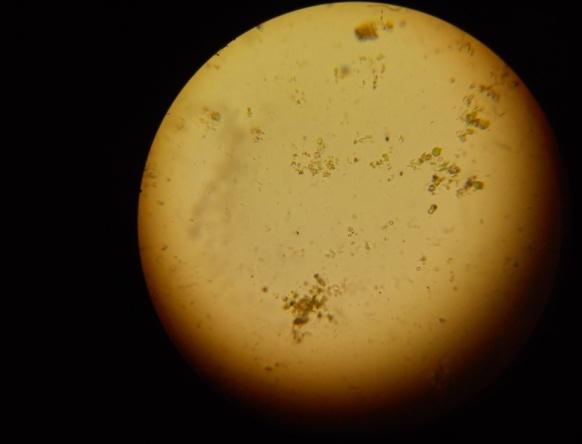
Algae were identified on ceramic surfaces by the usual morphological examination using a light microscope.
Identification of Bacteria
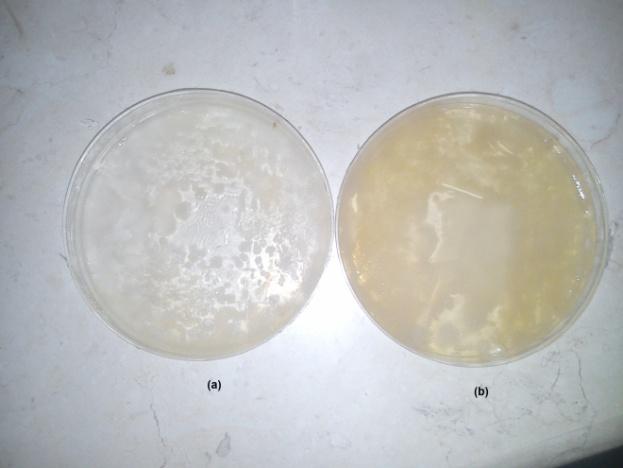
Gram staining is a bacteriological laboratory technique [24]. Bacteria on two ceramic tiles were examined by culturing on nutrient agar for 24 hours at 37°C.
Results and Discussion
The XRD analysis of the prepared sample of TiO2 nanoparticles was done using a APD 2000 pro x-ray Diffractometer, wavelength (λ)=1.5406 Å and data was taken for the 2 ϴ range of 10° to 70° with a step of 0.1972°. The results confirmed the nano sized powder TiO2. The X-ray diffraction pattern of the synthesized Titania nanoparticles is shown in Fig.1 reports that absence of spurious diffractions indicates the crystallographic purity. The 2ϴ at peak 25.4° confirms the TiO2 anatase structure [25]. Strong diffraction peaks at 25° and 48° indicating TiO2 in the anatase phase [26, 27, 28]. The 2ϴ peaks at 25.27° and 48.01° confirm its anatase structure. The intensity of XRD peaks of the sample reflects that the formed nanoparticles are crystalline and broad diffraction peaks indicate very small size crystallite. The crystalline sizes of powder samples were based on the main peak calculated using the well-known Scherrer equation 𝐾𝜆
A=
𝛽𝑐𝑜𝑠Ѳ where K is the shape factor (here, K=0.89), λ is the wave length of the X ray beam used (λ=0.15405 nm), θ is the Bragg angle, and β is the full width at half maximum (FWHM) of the X ray diffraction peak. The average crystallite size of a-TiO2 is only 3.4 nm.
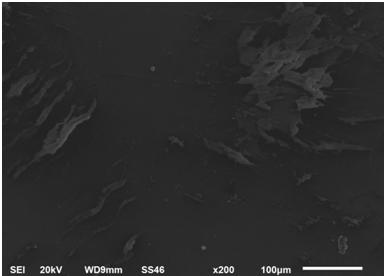
Figure 1: XRD spectra of TiO2 nanoparticles. In order to obtain the morphology of the TiO2powder, SEM observation was carried out. Fig. 1 shows the SEM image of the dried gel and TiO2powder. The grains are nearly spherical with approximately uniform particle size and its distribution ranging between 3 and 100nm, which are clearly observed in Figure 1. The scanning electron microscopic (model: JEOL JSM 6510 LV) images for as- prepared TiO2 nanoparticlesis shown in Figure 2. The SEM surface images of TiO2 coating heat-treated at 1100°C. It is seen that there is a smooth surface at low magnification is shown in Figure 3.
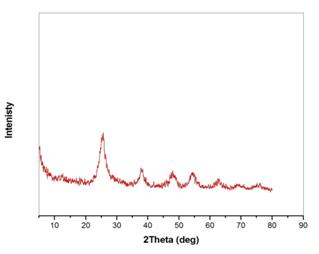
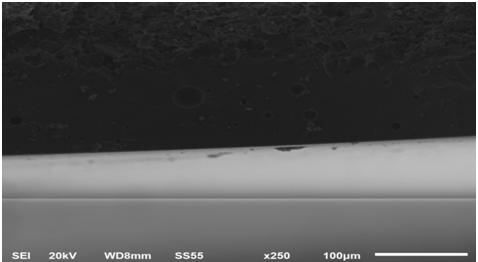
Figure 3: SEM surface images of TiO2 coating. The SEM (model: JEOL JSM 6510 LV) cross-section image of a TiO2 coated glazed tile is shown in Figure 4 a,b. Three layers are seen including the ceramic tile body, the glaze and the TiO2 coating layer. The thickness of the a- TiO2 coating is 343nm, which is tightly integrated with the glaze layer (Figure 4 a,b). In addition, EDS (EDS, model Oxford X-Max 20) was used to quantitatively determine the elemental composition. The EDS spectra of TiO2 coating reveals that the TiO2 coating is mainly composed of Ti and O elements is shown in Figure 4c. The mass percent of Ti element is 20.35 wt%, while that of O is 43.58 wt%.
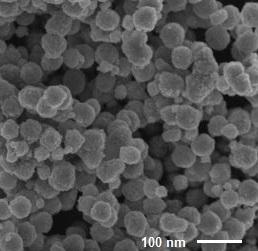
Figure 4a: SEM cross-section images of TiO2–coated glazed tile.
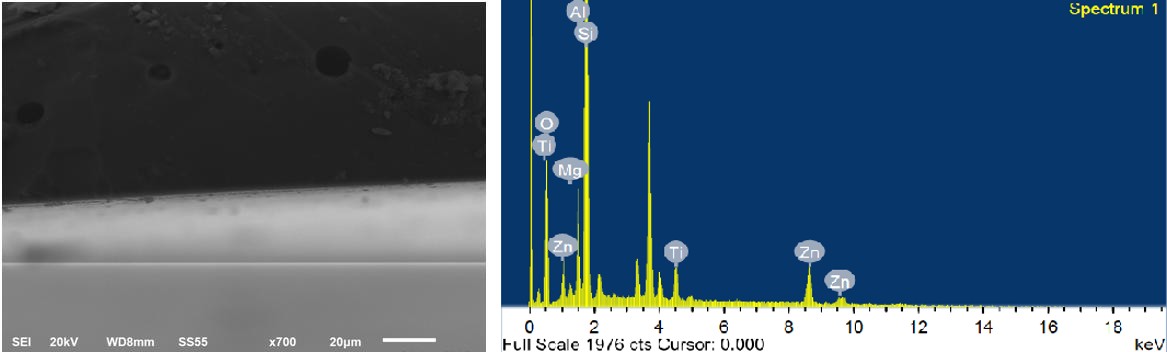
Figure 4b: SEM cross-section images of TiO2–coated glazed tile.
The visual appearance of micro-organisms progressing growth on the surface of TiO2 uncoated and coated tiles under sunlight irradiation is shown in Table 1. The study was extended for four months. Table 1 shows Comparison
Figure 4c: EDS spectrum of TiO2 – coated glazed tile.
between micro-organisms progressing growth on the surfaces of TiO2 uncoated and coated tiles under sunlight irradiation.
| Uncoated with TiO2 | Coated with TiO2 | |||||||
|---|---|---|---|---|---|---|---|---|
| Period | ||||||||
| After 10 days | ||||||||
| After one month | ||||||||
| After two month | ||||||||
Table 1: Comparison between micro-organisms progressing growth on the surfaces of TiO2 uncoated and coated tiles under sunlight i
| After three month | ||||||||
| After four month | ||||||||
Table 2: Comparison between micro-organisms progressing growth on the surfaces of TiO2 uncoated and coated tiles under sunlight i
Table 1: Comparison between micro-organisms progressing growth on the surfaces of TiO2 uncoated and coated tiles under sunlight irradiation. Results in Table 1 reveals that the photocatalytic activity of TiO2 plays a remarkable role in the inhibition of micro-organisms growth on glazed tile surfaces. This is due to the fact that when TiO2 is illuminated with the lightof λ ˂ 390 nm, electrons are promoted from the valence band to the conduction band of the semiconducting oxide to give electron-hole pairs. The valence band (h+VB ) potential is positive enough to generate hydroxyl radicals at the surface and the conduction band (e-CB) potential is negative enough to reduce molecular oxygen. The hydroxyl radical is a
| spirogyra | |||||
| diatoms | |||||
| chlorella | |||||
| mougeotia | |||||
Table 3: Upon using TiO2-coated glazed ceramic tile, only Chlorella algae growth was morphologically identified is shown in Figur
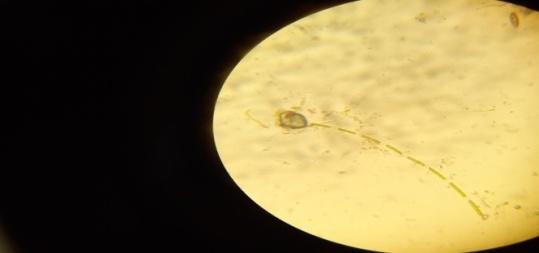
powerful oxidizing agent of pollutants present at or near the surface of TiO2. Identification of algae on the un-coated glazed ceramic tiles was performed according to usual morphological criteria showing the growth of Spirogyra, Diatoms, Chlorella and mougeotiais shown in Table 2. Upon using TiO2-coated glazed ceramic tile, only Chlorella algae growth was morphologically identified is shown in Figure 4. Table 2 shows identification of algae on the un-coated glazed ceramic tiles was performed according to usual morphological criteria.
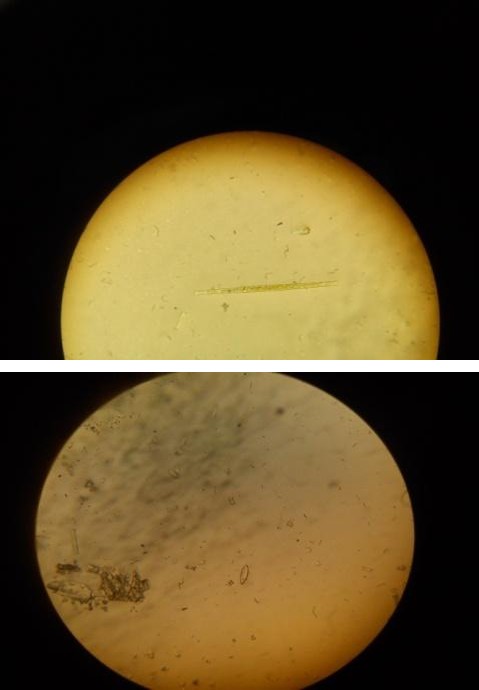
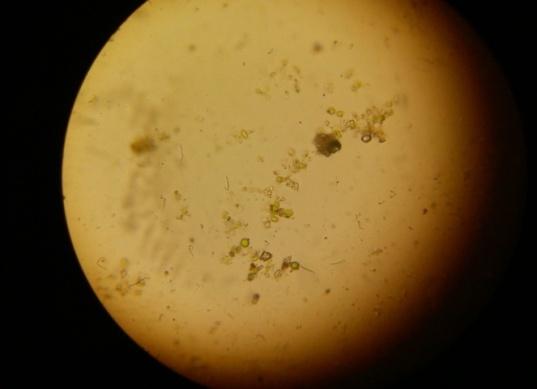
| Chlorella | |||||
Table 5: Show bacteria identification on two tiles.
| Ceramic with TiO 2 | Ceramic without TiO 2 | ||||
|---|---|---|---|---|---|
| Gram positive Cocci | Gram positive Cocci and diplococci |
Table 4: Show bacteria identification on two tiles.
| Ceramic with TiO 2 | Ceramic without TiO 2 | ||||
|---|---|---|---|---|---|
| -ve | -ve |
Table 6: Show identification of fungi on both ceramic.
Conclusion
Titanium dioxide (TiO2) nanoparticles have been successfully synthesized using a sol-gel method. The size and morphology of the samples were characterized using scanning electron microscopy (SEM). TiO2 coated on glazed ceramic tiles to fight against micro-organisms growth in water storage reservoirs and swimming pools. Therefore, the ceramic tiles coated TiO2 may be applied in lining of these installations allowing the use of sunlight as a clean and environmentally – friendly energy source. The application of TiO2 coating enables minimizing the frequently exhausting and environmentally hazardous cleaning- up process of these installations.
Competing Interests
The authors declare that there is no conflict of interest regarding the publication of this paper.
Acknowledgements
This work is supported by ceramica prima factory at El Sadat City Fifth Industrial Zone, Egypt.
References
-
Tomkiiewicz M (2000) Scaling properties in photocatalysis. Catalysis Today 58(1-2): 115-123.
-
Ramakrishna G, Ghosh HN (2003) Optical and Photochemical Properties of Sodium Dodecylbenzene sulfonate (DBS) - Capped TiO2 Nanoparticles Dispersed in Nonaqueous Solvents. Langmuir 19(3): 505-508.
-
Rahman MM, Krishna KM, Soga T, Jimbo T, Umeno M (1999) Optical properties and X-ray photoelectron spectroscopic study of pure and Pb-doped TiO2 thin films. Journal of Physics and Chemistry of Solids 60(2): 201-210.
-
Pelizzetti E, Minero C (1993) Mechanism of the photo-oxidative degradation of organic pollutants over TiO2 particles. Elecrochim Acta 38(1): 47-55.
-
Sahni S, Reddy SB, Murty BS (2007) Influence of process parameters on the synthesis of nano-titania by sol–gel route.Materials Science and Engineering A (452-453): 758-762.
-
Nakata K, Fujishima A (2012) TiO2photocatalysis: Design and applications. Journal of Photochemistry and Photobiology C: Photochemistry Reviews 13(3): 169-189.
-
Habibpanah AA, Pourhashem S, Sarpoolaky H (2011) Preparation and characterization of photocatalytictitania–alumina composite membranes by sol–gel methods.Journal of the European Ceramic Society 31(15): 2867-2875.
-
Fujishima A, Zhang X, Tryk DA (2008) TiO2 photocatalysis and related surface phenomena. Surface Science Reports 63(12): 515-582.
-
Hofer M, Penner D (2011) Thermally stable and photocatalytically active titania for ceramic surfaces.Journal of the European Ceramic Society 31(15): 2887-2896.
-
Fassier M, Peyratout CS, Smith DS, Ducroquetz C, Voland T (2010) Photocatalytic activity of titanium dioxide coatings: Influence of the firing temperature of the chemical gel. Journal of the European Ceramic Society 30(13): 2757-2762.
-
Yang Y, Li XJ, Chen JT, Wang LY (2004)Effect of doping mode on the photocatalytic activities of Mo/TiO2.Journal of Photochemistry and Photobiology A: Chemistry163(3): 517-522.
-
Chen YS, Crittenden JC, Hackney S, Sutter L, Hand DW (2005) Preparation of a Novel TiO2-Based p−n Junction Nanotube Photocatalyst. Environ Sci Technol 39(5): 1201-1208.
-
Hoffmann MR, Martin ST, Choi W, Bahnemann DW (1995) Env Appl Semr Photo 95(1): 69.
-
Mahshid S, Askari M, Ghamsari MS (2007) Synthesis of TiO2 nanoparticles by hydrolysis and peptization of titanium isopropoxide solution. Journal of Materials Processing Technology 189(1-3): 296-300.
-
Plesch G, Gorbar M, Vogt UF, Jesenak K,Vargova M (2009) Reticulated macroporous ceramic foam supported TiO2 for photocatalytic applications. Materials Letters 63(3-4): 461-463.
-
Gratzel M (2004) Conversion of sunlight to electric power by nanocrystalline dye-sensitized solar cells. Journal of Photochemistry and Photobiology A: Chemistry 164(1-3): 3-14.
-
Gratzel M (2006) Photovoltaic performance and long- term stability of dye-sensitized meosocopic solar cells. Comptes Rendus Chimie 9(5-6): 578-583.
-
Hagfeldt A, Gratzel M (2000) Molecular Photovoltaics. Acc Chem Res 33(5): 269-277.
-
Yi KC, Fendler JH (1990) Template-directed semiconductor size quantization at monolayer-water interfaces and between the headgroups of Langmuir- Blodgett films. Langmuir 6(9): 1519-1521.
-
Youn HC, Baral S, Fendler JH (1988) Dihexadecyl phosphate, vesicle-stabilized and in situ generated mixed cadmium sulfide and zinc sulfide semiconductor particles: preparation and utilization for photosensitized charge separation and hydrogen generation. J Phys Chem 92(22): 6320-6327.
-
Zhou J, Zhang Y, Zhao XS, Ray AK (2006) Photodegradation of Benzoic Acid over Metal-Doped TiO2. Ind Eng Chem Res 45(10): 3503-3511.
-
Ibrahim SA (2010) International conference on X- Rays, related techniques in research and industry, (ICXRI), Langkawi, Malaysia.
-
Han F, Kambala VSR, Srinivasan M, Rajarathnam D, Naidu R (2009) Tailored titanium dioxide photocatalysts for the degradation of organic dyes in wastewater treatment: A review. Applied Catalysis A General 359(1-2): 25-40.
-
Vijayalakshmi R, Rajendran V (2012) Synthesis and characterization of nano-TiO2 via different methods. Archives of Applied Science Research 4(2): 1183- 1190.
-
Austin GT (1984) Shreve's Chemical Process Industries, Chapter 9, McGraw-Hill, New York, London.
-
Ryan KJ, Ray CG (2004) Sherris Medical Microbiology 4th (edn.) McGraw Hill, pp: 232.
-
Abbad MB, Kadhum AH, Mohamad A, Takriff MS, Sopian K (2012) Synthesis and Catalytic Activity of TiO2 Nanoparticles for Photochemical Oxidation of Concentrated ChlorophenolsunderDirect Solar Radiation.Int J Electrochem Sci 7: 4871-4888.
-
Thamaphat K, Limsuwan P, Ngotawornchai B (2008) J Kasetsart Nat Sci 42: 357.
- Solution-Processed Chiral Perovskites for Biomedical Applications
- Nanotechnology in Health Chemistry and Medicine: Current Challenges and Future Directions
- Human Exposure to Micro- and Nanoplastics: Pathways, Toxicity, and Intervention Strategies
- Exosome Nanomedicine for Cancer Therapy
- Micro and Nanoplastics–Plastisphere, Biotoxicity, Impact on Human Health, and Mitigation Strategies
- Process Validation of Cefixime Powder for Suspension Dosage Form, 50 mL