
Preparation & Characterization of Bosentan Loaded Ethyl cellulose Nanoparticles by Solvent Evaporation Technique
The aim of this study was to prepare Bosentan loaded nanoparticles by Solvent Evaporation (SE) technique. Bosentan belongs to a class of drugs known as endothelin receptor antagonists (ERAs). It is a dual endothelin receptor antagonist important in the treatment of pulmonary artery hypertension (PAH). Ethyl cellulose (EC) was used as a polymer. Bosentan and ethyl cellulose were dissolved in Ethanol at various drug polymer ratios i.e. 1:1, 1:2, 1:3. Among the three formulations 1:3 formulation was considered as the best formulation with better drug content (97.43%) and entrapment efficiency (95.57%).
Introduction
Definition
The word ‘Nano’ is derived from the Greek word "nanos", which means dwarf or extremely small. A nanometer is a billionth of a meter or 10-9 m. Nanoparticles may be defined as particulate dispersions or solid particles within the size range of 10- 1000nm.They are composed of polymers and the active ingredients which may be dissolved, entrapped, encapsulated or adsorbed within the polymer matrix. Depending upon the method of preparation, nanoparticles, nanospheres and nanocapsules are obtained.
Materials such as synthetic polymers, proteins or other natural macromolecules are used in the preparation of nanoparticles. Drug nanoparticles have potential applications in the administration of therapeutic molecules such as tissue targeting in cancer therapy, controlled release, carrier action for the delivery of peptides and increase in the solubility of drug [1, 2]
Techniques for the Preparation of Polymeric Nanoparticles
Various techniques can be used to produce polymer nanoparticles, such as solvent evaporation, salting-out, dialysis, supercritical fluid technology, micro-emulsion, mini-emulsion, surfactant-free emulsion, and interfacial polymerization Desolvation technique, pH induced aggregation [3, 4, 5, 6].
Phase Separation in Aqueous Medium
The protein or polysaccharide from an aqueous phase can be desolvated by pH change or change in temperature or by adding appropriate counter ions. Cross-linking may be affected simultaneously or subsequent to the desolvation step. It contains three steps. Protein dissolution, protein aggregation and protein deaggregation. The appropriate levels of desolvation and resolvation, the aggregate size could be maintained and finally these aggregated nanoparticles are cross linked using glutaraldehyde. Sodium sulphate is the main desolvating agent. Alcohol, Ehanol, isopropanol are added as desolvating agents. The addition can be optimized turbidometrically using nephelometer. Only desolvation gives the final product as nanosphere. Desolvation deaggregates the protein and turns the suspension colloidal and hence milky in appearance. Both lipophilic and hydrophilic drugs can be entrapped in nanoparticles using this technique. H Induced aggregation: The protein phase also be separated through pH change. The pH –induced aggregation to prepare nanoparticle has been extensively used for the preparation of nanoparticles. Counter Ion Induced aggregation: The aggregation of dispersed phase can occur by adding appropriate counter ions. It can be propagated by adding secondary species of counter ions followed by rigidization step.
Solvent Evaporation Technique
This is one of the most frequently used methods for the preparation of nanoparticles. Emulsification-solvent evaporation involves two steps. The first step requires emulsification of the polymer solution into an aqueous phase. During the second step polymer solvent is evaporated, inducing polymer precipitation as nanospheres. The nanoparticles are collected by ultracentrifugation and washed with distilled water to remove stabilizer residue or any free drug and lyophilized for storage (Song et al., 1997) [7, 8, 9, 10, 11].
Bosentan belongs to a class of drugs known as endothelin receptor antagonists (ERAs). It is a dual endothelin receptor antagonist important in the treatment of pulmonary artery hypertension (PAH). Bosentan is used to treat pulmonary hypertension by blocking the action of endothelin molecules that would otherwise promote narrowing of the blood vessels and lead to high blood pressure. Patients with PAH have elevated levels of endothelin, a potent blood vessel constrictor, in their plasma and lung tissue. Bosentan blocks the binding of endothelin to its receptors, thereby negating endothelin's deleterious effects.
Mechanism of action: Endothelin-1 (ET-1) is a neurohormone, the effects of which are mediated by binding to ETA and ETB receptors in the endothelium and vascular smooth muscle.ET-1 concentrations are elevated in plasma and lung tissue of patients with pulmonary arterial hypertension, suggesting a pathogenic role for ET- 1 in this disease. Bosentan is a specific and competitive antagonist at endothelin receptor types ETA and ETB. Bosentan has a slightly higher affinity for ETA receptors than for ETB receptors (Rubin et al., 2002) [12, 13, 14, 15]
Materials and Methods
Materials
Drug: Bosentan (DIVIS Laboratories limited) Polymer: Ethyl cellulose (Hi Media Laboratories Pvt. Ltd., Mumbai) Solvent: Ethanol (SD fine-chem Limited, Mumbai)
Method
Emulsion Solvent Evaporation
Experimental Methodology
Bosentan loaded Ethyl cellulose nanoparticles were formulated by employing Emulsion Solvent Evaporation technique. Ethyl cellulose was used as a polymer and ethanol was used as solvent [16, 17, 18, 19, 20, 21].
Emulsion Solvent Evaporation Method
Bosentan and ethylcellulose were dissolved in Ethanol at various drug-polymer ratios (1:1, 1:2, 1:3) and sonicated for 5-10 mins. Then this organic dispersion was emulsified by mixing at 700 rpm with a REMI LAB overhead mechanical stirrer provided with a 3-bladed paddle steel rotor, into an external phase containing Tween-20 (0.25%) at room temperature. The organic phase to the aqueous phase ratio was maintained as 1:10.
The organic phase was added drop wise to the aqueous phase at a constant rate. Stirring of the oil in water emulsion was continued until ethanol was evaporated. The resultant dispersion was collected by Rotary Vacuum evaporator and kept for drying.
Evaluation
The prepared formulations of Bosentan loaded EC nanoparticles were evaluated for Drug Content, Entrapment Efficiency, Loading Capacity and Invitro Dissolution studies. Drug Content: Drug content determination was done by transferring accurately weighed 50mg of the drug equivalent to formulation into a 100ml beaker containing 50ml of methanol. Magnetic stirring of this solution was done at 700 rpm for 3 hrs. The resultant solution was then filtered and the drug content was determined by using UV-Spectrophotometer at a wavelength of 272 nm.
𝐷𝑟𝑢𝑔𝐶𝑜𝑛𝑡𝑒𝑛𝑡 % = 𝐷𝑟𝑢𝑔𝑤𝑒𝑖𝑔𝑡𝑖𝑛𝑛𝑎𝑛𝑜𝑝𝑎𝑟𝑡𝑖𝑐𝑙𝑒𝑠
𝑇𝑜𝑡𝑎𝑙𝑊𝑒𝑖𝑔𝑡𝑜𝑓𝑛𝑎𝑛𝑜𝑝𝑎𝑟𝑡𝑖𝑐𝑙𝑒𝑠
$$ \times 1 0 0 $$
determines the amount of drug incorporated into the
formulation. The drug incorporation with nanoparticles
can either be in the form of entrapment in the matrix
and/or adsorption onto the surface.
Entrapment efficiency was determined by using a High-Speed Ultracentrifuge and centrifuging the samples containing 40mg of the drug equivalent to formulation in 40ml of pH 6.8 phosphate buffer at 17000 rpm at a temperature of -4ºC for 40 mins. Entrapment Efficiency (%)= 𝑇𝑜𝑡𝑎𝑙𝑑𝑟𝑢𝑔𝑎𝑑𝑑𝑒𝑑– 𝐹𝑟𝑒𝑒𝑛𝑜𝑛𝑒𝑛𝑡𝑟𝑎𝑝𝑝𝑒𝑑𝑑𝑟𝑢𝑔 𝑇𝑜𝑡𝑎𝑙𝑑𝑟𝑢𝑔𝑎𝑑𝑑𝑒𝑑 × 100 Loading Capacity: Loading capacity is the amount of drug loaded per unit weight of the nanoparticle, indicating the percentage of mass of the nanoparticle that is due to the encapsulated drug. Loading capacity (%) = 𝑇𝑒𝐴𝑚𝑜𝑢𝑛𝑡𝑜𝑓𝑡𝑜𝑡𝑎𝑙𝑒𝑛𝑡𝑟𝑎𝑝𝑝𝑒𝑑𝑑𝑟𝑢𝑔 𝑇𝑒𝑇𝑜𝑡𝑎𝑙𝑛𝑎𝑛𝑜𝑝𝑎𝑟𝑡𝑖𝑐𝑙𝑒𝑤𝑒𝑖𝑔 𝑡 ×
100 Invitro Drug Release Studies: Drug release kinetics were determined by performing invitro dissolution studies using an Orbitary shaker. Accurately weighed 50mg of each formulation was taken in 250ml conical flask along with 50ml of pH 6.8 phosphate buffer and placed in the orbitarys haker at 100 rpm and the temperature was maintained at 37ºC. 2ml samples were withdrawn at predefined intervals of time and replaced with fresh buffer of the same volume. The amount of drug release was determined by taking the absorbance values at 272 nm using Elico UV-Spectrophotometer.
Results and Discussion
The prepared formulations were evaluated for the above mentioned parameters and the results are discussed below:
Evaluation of Bosentan loaded Ethyl cellulose Nanoparticles
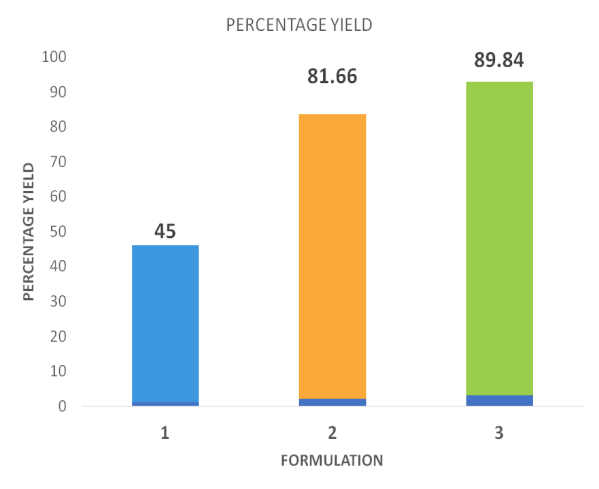
Product Yield: The prepared nanoparticles were dried and the percentage yield of all the three formulations was calculated. The highest % yield (89.84± 2 %) was found to be of 1:3 formulation among the three formulations (Figure 1).
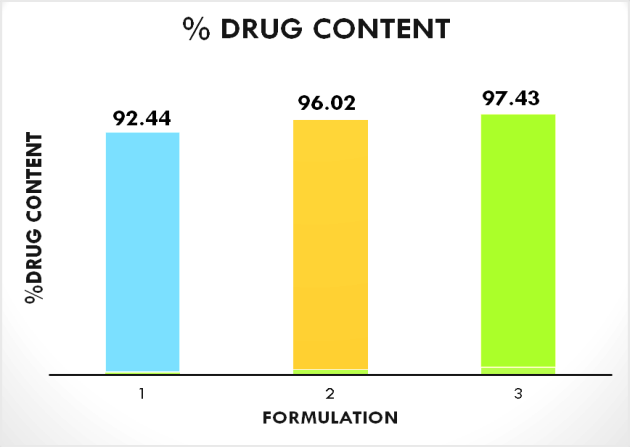
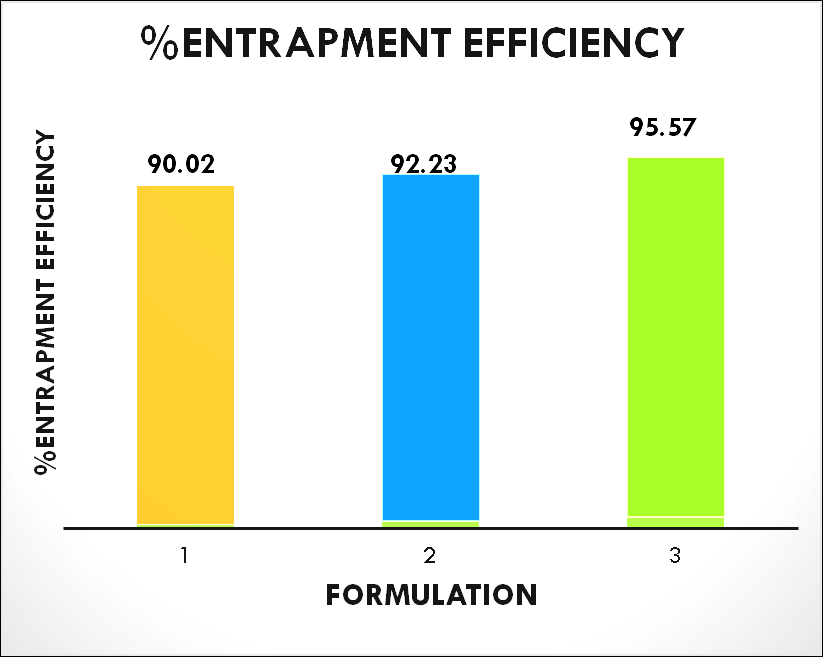
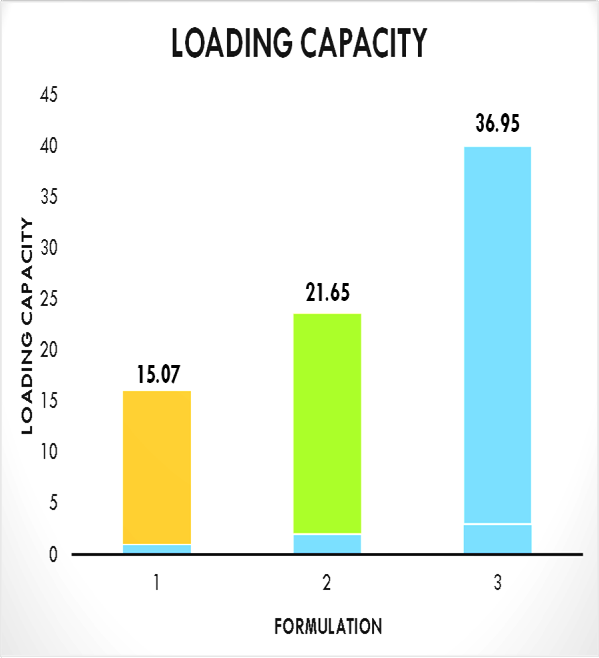
Loading Capacity: It indicates the capacity of the polymer to load a drug. From the results it was found that among the three formulations, 1:3 formulation showed highest loading capacity (Figure 4,5).
Discussion
In this study, Bosentan loaded ethyl cellulose nanoparticles were prepared by varying drug to polymer ratios i.e. 1:1, 1:2 & 1:3. The formulation 1:3 was found to be the best formulation with better characteristics when compared with the other two i.e. high percentage yield, drug content, loading capacity and better entrapment of the drug with better drug release.
Conclusion
In the present study Bosentan loaded ethyl cellulose nanoparticles were prepared by solvent evaporation technique. Among all the three formulation 1:3 formulation was considered as the best formulation with better results.
Acknowledgment
The authors sincerely thank Dr. M. Sumakanth, The Principal, RBVRR Women’s college of Pharmacy for providing access for library and databases. We also thank Mrs. Suvarna and Mrs. Sumalatha, for providing technical assistance.
References
-
Couvreur P, Dubernet C, Puisieux F (1995) Controlled drug delivery with nanoparticles: current possibilities and future trends. Eur J Pharm Biopharm 41: 2-13.
-
Couvreur P, Barratt G, Fattal E, Legrand P, Vauthier C (2002) Nanocapsule technology: a review. Crit Rev Ther Drug Carrier Syst 19(2): 99-134.
-
Allémann, E, Gurny, R, Doekler (1993) E. Drug- loaded nanoparticles-preparation methods and drug targeting issues. Eur J Pharm Biopharm 39: 173-191.
-
Birnbaum, DT, Kosmala, JD, Brannon-Peppas L (2000) Optimization of preparation techniques for poly(lactic acid-co-glycolic acid) nanoparticles. J Nanoparticle Res Virginia 2(2): 173-181.
-
Balkrushna P, Vidhi MKP, Manisha P (2012) Preparation and evaluation of ethyl cellulose microspheres prepared by emulsification–solvent evaporation method. International Journa lfor Research in Management and Pharmacy 1: 82.
-
De Jaeghere F Doelker E, Gurny R (1999) Nanoparticles. In: Mathiowitz E (Eds.), The Encyclopedia of Controlled Drug Delivery, Wiley, New York, pp: 641-664.
-
Jain N K (2001) Advances in Controlled and Novel Drug Delivery, CBS Publishers and Distributers, New Delhi p: 408.
-
Moinard-Chécot D, Chevalier Y, Briançon S, Fessi H, Guinebretière S (2006) Nanoparticles for drug delivery: review of the formulation and process difficulties illustrated by the emulsion-diffusion process. J Nanosci Nanotechnol 6(9-10): 2664- 2681.
-
Mohan Raj VJ, Chen Y (2006) Nanoparticles– A review. Tropical Journal of Pharmaceutical Research 5(1): 561-573.
-
Song CX, Labhasetwar V, Murphy H, Humphrey WR, Shebuski RJ, et al. (1997) Formulation and characterization of biodegradable nanoparticles for intravascular local drug delivery. Journal of Control release 43(2-3): 197-212.
-
Vyas SP, Khar RK (2002) Novel carrier systems, Targeted and Controlled Drug Delivery. CBS Publications: 331-387.
-
Rubin LJ, Badesch DB, Barst RJ, Galiè N, Black CM, et al. (2002) Bosentan therapy for pulmonary arterial hypertension. N Engl J Med 346(12): 896-903.
-
Soares AF, Carvalho Rde A, Veiga F (2007) Oral administration of peptides and proteins: nanoparticles and cyclodextrins as biocompatible delivery systems. Nanomedicine 2(2): 183-202.
-
Zambaux MF, Bonneaux F, Gref R, Maincent P, Dellacherie E, et al. (1998) Influence of experimental parameters on the characteristics of poly (lactic acid) nanoparticles prepared by a double emulsion method. Journal of Control Release 50(1-3): 31-40.
-
Krishnasailaja A, Sarita A (2014) Preparation and characterization of Aspirin loaded ethyl cellulose nanoparticles by solvent evaporation technique. 2014. World Journal of pharmacy and Pharmaceutical Sciences 3(6): 1781-1793.
-
Senthilkumar B, Rajasekaran R (2016) Cmputational resources fordesigning peptide based drugs preferred in the field of nanomedicine. Journal of Bionanosci 10(1): 1-4.
-
Reis CP, Neufeld RJ, Ribeiro AJ, Veiga F (2006) Nanoencapsulation I. Methods for preparation of drug loaded polymeric nanoparticles. Nanomedicin e 2(1): 8-21.
-
Quintanar-Guerrero D, Fessi H, Alle’mann E, Doelker E (1996) Influence of stabilizing agents and preparatives variables on the formation of poly(d,l- lactic acid) nanoparticles by an emulsification diffusion technique. Int J Pharm 143(2): 133-141.
-
Quintanar-Guerrero D, Allémann E, Fessi H, Doelker E (1998) Preparation techniques and mechanism of formation of biodegradable nanoparticles from preformed polymers. Drug Dev Ind Pharm 24: 1113-1128.
-
Limayem A, Mohapatra SS, Haller E (2016) Novel Nanotherapeutic Approaches for the Treatment of Emerging Multidrug Resistance. Nanomed Nanotechnol 1(2): 000107.
-
Quiñones JP, Kjems J, Yang C, Peniche C, Brüggemann O (2017) Self-Assembled O6-Succinyl Chitosan Nanoparticles for Controlled Release of Diosgenin and Agrochemicals. Nanomed Nanotechnol 2(3): 000128.
- Solution-Processed Chiral Perovskites for Biomedical Applications
- Nanotechnology in Health Chemistry and Medicine: Current Challenges and Future Directions
- Human Exposure to Micro- and Nanoplastics: Pathways, Toxicity, and Intervention Strategies
- Exosome Nanomedicine for Cancer Therapy
- Micro and Nanoplastics–Plastisphere, Biotoxicity, Impact on Human Health, and Mitigation Strategies
- Process Validation of Cefixime Powder for Suspension Dosage Form, 50 mL