
Water Molecules in the Carbon Confined Space (H2O)3@C60
Endohedral fullerene studies find a lot of interest in theoretical and experimental methods. Theoretical predictions and experimental methods on a single water molecule and a double water molecules fixing in C60 (H2O @ C60) and in C70 ((H2O)2 @C70) respectively leading the way to study the water trimer and polymer in Carbon confined space like fullerenes. In this line, the molecular properties of water trimer embedded in fullerene C60 ((H2O)3@C60) has been reported using ab-initio, Restricted Hartree-Fock (RHF) and Density Functional Theory (DFT) methods. Hydrogen bond formation between O-H and O-atom of nearby water molecule of all the three water molecules trapped inside the C60 is unusual and not in a straight line as compared to the bonding of water molecules in ice, which emphasize the characteristics of endofullerene. The shape of the hydrogen bond formation works with Ortho conformer with a flipping action as sin wave in a non-uniformed circular motion. The Dipole moment of 0.84 and 1.0 Deby exhibits the conducting and magnetic properties of water molecules embedded in the fullerene.
Introduction
Water in liberal space expresses bond formation exclusively directed by orbital interaction of oxygen and independent dual hydrogen atoms. But, within the proximity of Vander Waals fields encapsulating the liberty of water molecules as in the case of Fullerene, its behavior tend to change while forming Dimers, Trimers or Polymers, which is a matter of great interest. There were few successful attempts in the recent past having been the features of C70Buckminster Fullerenes (C60) which has been injected with dual water molecules. Those water molecules expressed exceptional properties in bond alignment and formations into a dimer inside a distance of 3.7A° X 4.6 A°, a prolate C70 Fullerene. The endohedral C70 structure offered an opportunity to review the properties of embedded monomeric and dimeric water molecules with hydrogen bonding. X-ray diffraction provided insight into this formation. The property of the individual atoms and molecules tends to change when confined to a cage of nano dimension. Some of the recent endohedral fullerene work shows lot of useful insights in science and technology [1, 2, 3, 4, 5]. Low frequency features have been observed in the photoelectron spectra attributed to the hindered rotational excitations of the encapsulated H2O molecule in the fullerene [6].
Fullerene C60 is truncated icosahedrons which resembles like football with 20 hexagons and 12 pentagons. Vander Waals diameter of nucleus to nucleus diameter is 0.71 nm. The discovery of fullerenes opened up ways of constructing large atomic cluster of various shapes and sizes and research has been going on for the last three decades in discovering similar cage structure and modifying the known cage structures to yield materials with different characteristics. Fullerenes that have additional atoms, ions, or charges enclosed within their inner spheres are called as endohedral fullerene. The arrangement of water molecules in a cluster is known to depend on the environment.
Having studied fullerenes and water clusters, one wonders about the shape of water cluster inside the confines of a fullerene cage. The fullerene cage is so stable and the space within is so limited, water cluster inside the fullerene cage forming unusual geometries. In this paper, the situation of embedding triple water molecule in fullerene C60 is presented. This pursuit was to increase the total charge available in the modulated fullerene with water and to achieve dipole movement of much higher than 0.5 Debye [6] realized through one water molecule encapsulation.
Methods of Calculation
Computational calculations were carried out at the Ab- initio Restricted Hartree-Fock method and DFT calculations. 6-31G** basis set at RHF and B3LYP5 at DFT is used to get the optimized geometrical calculations have been carried out by using Quantum Computational package, Firefly ver. 8.2.2 [7, 8] and Avogadro [9]. The structures are optimized and their molecular properties are reported. The results thus exhibited from computational calculations were analyzed.
Results
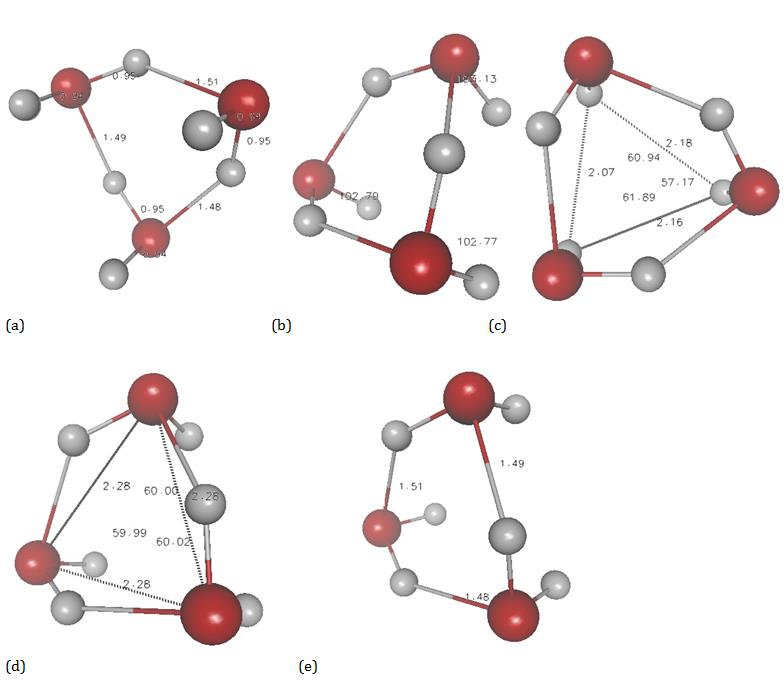
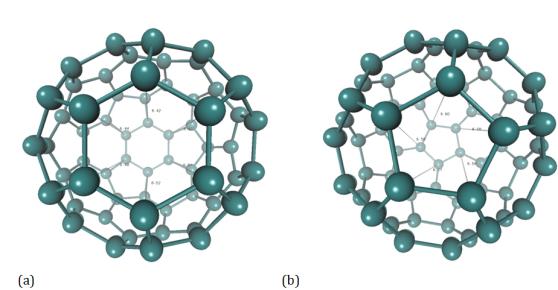
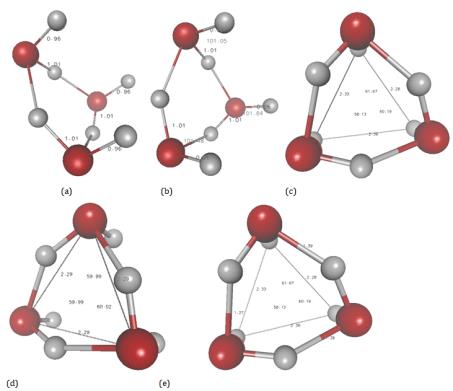
The structure of endohedral fullerene in which three water molecules encapsulated in Carbon 60 is shown in Figure 1. The structure at different views and orientations of three encapsulated water molecules inside the fullerene is shown in Figure 2. The view of the three encapsulated water molecules and the end to end distance between six member rings is as shown in Figures 3a & b. The ab-initio calculation is optimized at 6-31G level by RHF method and B3LYP5 level by DFT method. Total energy in a.u for the water trimer, bucky ball (C60) and enhdohedral fullerene encapsulating three water molecules are given in Table 1. It is noteworthy to identify that the trimer molecule of water orients inside C60 differently compared to free water trimer molecules [10]. The hydrogen bond length between the oxygen atoms of the water molecules in the trimer of the endohedral fullerene is found to be 1.5Å at 6-31Glevel by RHF method optimized structure and 1.4Å at B3LYP5 level by DFT method is found, which is the indication of strong hydrogen bonds in encapsulation against the free water trimer molecules forming cyclic hydrogen bonds of 2.0Å at 6-31G** level by RHF method and 1.9 Å at B3LYP5 level by DFT method is found, which can be compared with reported values [11]. Also the water trimer in the encapsulated fullerene shows a strange behavior of forming orthometa stable state which was discussed for one water molecule in C60 [12]. This result is in line with our earlier works on hydrogen bonded dimers involving linear and circular hydrogen bonds [13, 14, 15, 16]. This study shows the importance of high end computations as we reported [17] (Figures 4-6).
Optimized at 6-31G** Level by RHF method
![Figure 1: The structure at different views and orientations of three encapsulated water molecules inside the fullerene is shown in Figure 2. The view of the three encapsulated water molecules and the end to end distance between six member rings is as shown in Figures 3a & b. The _ab-initio_ calculation is optimized at 6-31G** level by RHF method and B3LYP5 level by DFT method. Total energy in a.u for the water trimer, bucky ball (C60) and enhdohedral fullerene encapsulating three water molecules are given in Table 1. It is noteworthy to identify that the trimer molecule of water orients inside C60 differently compared to free water trimer molecules [10]. The hydrogen bond length between the oxygen atoms of the water molecules in the trimer of the endohedral fullerene is found to be 1.5Å at 6-31G**level by RHF method optimized structure and 1.4Å at B3LYP5 level by DFT method is found, which is the indication of strong hydrogen bonds in encapsulation against the free water trimer molecules forming cyclic hydrogen bonds of 2.0Å at 6-31G** level by RHF method and 1.9 Å at B3LYP5 level by DFT method is found, which can be compared with reported values [11]. Also the water trimer in the encapsulated fullerene shows a strange behavior of forming orthometa stable state which was discussed for one water molecule in C60 [12]. This result is in line with our earlier works on hydrogen bonded dimers involving linear and circular hydrogen bonds [13-16]. This study shows the importance of high end computations as we reported [17] (Figures 4-6).](/fulltextimages/3583/fig_1.jpeg)
Optimized at B3LYP5 level by DFT method
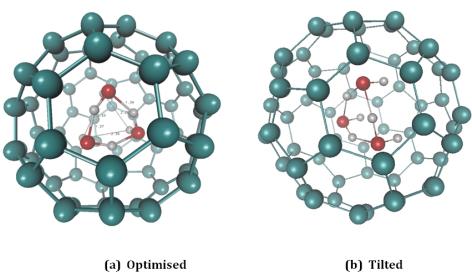
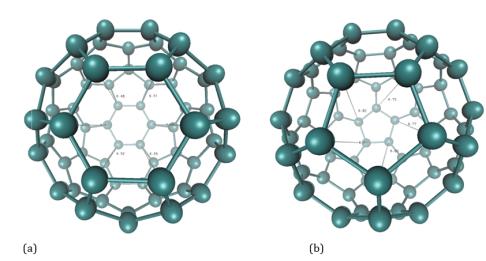
Dipole moment values indicate the role of charges in conductivity. This pursuit was to increase the total charge available in the modulated fullerene with water and to achieve dipole movement of much higher than 0.5 Debye [6] realized through one water molecule encapsulation in C60. Water trimer is actively involved in flipping and circular activities inside the endohedral bucky ball. It provides an opportunity to investigate further results in the domain of conductivity and molecular encapsulations. Our ab-initio calculations on the three water molecule embedded in C60 shows the dipole moment of 0.84 Debye at B3LYP5 of DFT method and 1.0 Debye at 6-31G** of RHF method. This is the indication of structural distortion and the starting point of conductivity. Because of orthometa stable state water trimer inside the endohedral fullerene magnetism may arise (Figure 4).
- Molecule
- Total Energy in
- Dipole moment
- Atomic Units in Debye
- RHF-6-31G**
- (H2O)3 C60
- -2499.627507
- 0.997
- DFT-B3LYP5
- (H2O)3 C60
- -2513.788543
- 0.844
- RHF-6-31G**
- Water Trimer
- -228.095019
- 0
- DFT-B3LYP5
- Water Trimer
- -229.178814
- 0
- RHF-6-31G**
- Carbon60
- -2271.829236
- 0
- DFT-B3LYP5
- Carbon60
- -2284.832996
- 0
Table 1: Total energy of the Molecules in Atomic Units.
Discussion
One hydrogen atom of all the three water molecules encapsulated in the endohedral fullerene is anchored with respect to H-O … in a triangle among themselves in an angle H.H.H, 57.17°, 60.94° and 61.89° respectively. On the other hand, the other hydrogen atom is deflected in all the three water molecules with respect to ...O-H and the angle between the deflected hydrogen is 60.26, 59.84 and 59.90 respectively. The bond length of the deflected hydrogen atom of one water molecule and the oxygen of the second water molecule, deflected hydrogen of second water molecule and the oxygen of the third water molecule and deflected hydrogen of third water molecule and the oxygen of the first water molecule have been observed respectively as 1.499 Å, 1.477 Å and 1.510 Å respectively. The ab-initio calculations of Fullerene (C60), Water trimer and Water trimer encapsulated fullerene in different levels of basis sets 6-31G** at RHF and B3LYP5
at DFT have been taken place and their optimized and the total energy for stabilizing the molecules is presented as shown in the table-1. Water molecules in the endohedral fullerene adopt an angle (H-O-H) is 102.8°, 102.8° and 103.1° and their bond length as defined in the Figures 2 & 5 is in Table 2. The angles of each of the water molecules and their bond lengths are having little deviation from their corresponding experimental values for gas phase, O- H length is 0.9572 Å and the H-O-H angle is 104.474° [18] and liquid water, O-H length 0.991 Å, H-O-H angle 105.5° and 106.0° [19, 20]. However, the end to end length of the six and five member ring optimized at 6-31G** level by RHF method is closed to 6.478Å and 6.578Å respectively. On the other hand the end to end length of the six and five member ring optimized at B3LYP5 level by DFT method is closed to 6.515Å and 6.820 Å respectively. In these two cases, the end to end length between five member rings in the endohedral fullerene is higher than the end to end length between six to six member rings is 0.1Å and 0.305Å respectively. The other angle of the water molecule i.e. H-O . . . H-O-H is as given in Table 2. Hydrogens and oxygens of all the three water molecules are stabilized by maximally interacting with five member and six member rings of the fullerene molecule. This work at higher level calculation is the extension of the previous research work published [21]. The interaction between the water molecules was also calculated and shown in Figures 2 & 5. Graphical representation of the molecule is referred by Visual Molecular Dynamics software Package [22, 23].
| RHF | DFT | |||||||
|---|---|---|---|---|---|---|---|---|
| Water Molecule | ||||||||
| Angle /Bond Length | Angle /Bond Length | |||||||
| H ─ O ─ H 11 1 12 | 102.8-0.95-0.94 | 101.05-1.01-0.96 | ||||||
| H ─ O ─ H 21 2 22 | 102.8-0.95-0.94 | 101.84-1.01-0.96 | ||||||
| H ─ O ─ H 31 3 33 | 103.1-0.95-0.94 | 101.48-1.01-0.96 | ||||||
| O ─ O ─ O 1 2 3 | 60-00-2.28-2.28 | 59.99-2.29-2.29 | ||||||
| O ─ O ─ O 2 3 1 | 60.02 | 59.9 | ||||||
| O ─ O 3 1 | 2.28 | 2.29 | ||||||
| O ─ O ─ O 3 1 2 | 59.99 | 59.9 | ||||||
| O ─ H 1 21 | 1.51 | 1.37 | ||||||
| O ─ H 2 31 | 1.49 | 1.39 | ||||||
| O ─ H 3 11 | 1.48 | 1.38 | ||||||
| H ─ H ─ H 12 22 33 | 57.17-2.162-2.186 | 61.67-2.33-2.28 | ||||||
| H ─ H ─ H 22 33 12 | 60.94-2.084 | 60.19-2.36 | ||||||
| H ─ H ─ H 33 12 22 | 61.89 | 58.13 |
Table 2: Different orientations of Water Molecules in the Endohedral Fullerene.
Conclusion
The water molecules in the confined space of Carbon inside fullerene provide the opportunity for conductivity due to the presence of dipole moment. The unusual arrangement of circular hydrogen bonded water trimer molecules with flipping action shows ortho meta stable state is interesting and to be investigated further for applications in the field of conductivity and magnetism.
Acknowledgement
The authors acknowledge the support of the Principal, Management of KGRCET, Telangana-501504, India and the support rendered by Central Forensic Science Laboratory, Directorate of Forensic Science Services, Ministry of Home Affairs, Govt. of India, Sector-36A, and Chandigarh.
References
-
Kurotabi K, Murata Y (2011) A Single Molecule of Water Encapsulated in Fullerene C60. Science 333(6042): 613-616.
-
Xu BX, Chen X (2013) Electrical-Driven Transport of Endohedral Fullerene Encapsulating a Single Water Molecule. Physical Review Letters 110(15).
-
Zhang R, Murata M, Aharen T, Wakamiya A, Shimoaka T, et al. (2016) Synthesis of a Distinct Water Dimer inside Fullerene C70. Nature Chemistry 8: 435-441.
-
Hadlington S (2016) Chemistry World 7th March.
-
Choi JI, Snow SD, Kim JH, Janq SS (2015) Interaction of C60 with Water: First-Principles Modeling and Environmental Implications. Environmental Science& Technology 49(3): 1529-1536.
-
Zhu GZ, Liu Y, Hashikawa Y, Zhang QF, Murata Y, et al. (2018) Probing the Interaction between the Encapsulated Water Molecule and the Fullerene Cages in H2O@C60-and H2O@C59N. Chemical Science 9(25): 5666-5671.
-
Meier B, Mamone S, Levitt MH (2015) Electrical Detection of Ortho-Para conversion in Fullerene Encapsulated Water. Nature Communications 6: 8112.
-
Granovsky AA (2014) Firefly Version 8.1.1.
-
Schmidt MW, Baldridge KK, Boatz JA, Elbert ST, Gordon MS, et al. (1993) General Atomic and Molecular Electronic Structure System. Journal of Computational Chemistry 14(11): 1347-1363.
-
Hanwell MD, Curtis DE, Lonie DC, Vandermeersch T, Zurek E, et al. (2012) Avogadro: An Advanced Semantic Chemical Editor, Visualization, and Analysis Platform. Journal of Cheminformatics 4: 17.
-
Xantheas SS, Dunning TH (1993) The Structure of the Water Trimer from AbInitio Calculations. The Journal of Chemical Physics 98: 8037.
-
Beduz C, Carravetta M, Chen JYC, Concistre M, Denning M, et al. (2012) Quantum Rotation of Orthoand Para-Water Encapsulated in a Fullerene Cage. PNAS, 109(32): 12894-12898.
-
Sathyan N, Santhanam V, Sobhanadri J (1995) Ab Initio Calculations on Some Binary Systems Involving Hydrogen Bonds. Journal of Molecular Structure: Theochem 333(1-2): 179-189.
-
Sathyan N, Santhanam V, Madhurima V, Sobhanadri J (1995) Conformational Study on the Binary Mixture Acetone-Methanol Involving H-Bonding. Journal of Molecular Structure: Theochem 342: 187-192.
-
Madhurima V, Sathyan N, Murthy VRK, Sobhanadri J (1998) Dielectric and Conformational Studies of Hydrogen Bonded Acetone and Acetonitrile System. Spectrochimica Acta Part A 54(2): 299-304.
-
Sathyan N, Santhanam V, Sobhanadri J (1996) Conformational Analysis of Chloromethylenimine and Its Hydrogen-Bonded Dimers with Water from the Study of Nuclear Quadrupole Interactions. Zeitschriftfür Naturforschung A 51: 534-536.
-
Sathyan N, Johns J, Gopalakrishnan T (2016) Quest for Computation-Solving Quantum Mechanical Calculation on Molecules. International Journal of Advanced Networking & Applications (IJANA) 128: 577-579.
-
Isaacs ED, Shukla A, Platzman PM, Hamann DR, Barbiellini B, et al. (2000) Compton Scattering Evidence for Covalency of the Hydrogen Bond in Ice. Journal of Physics and Chemistry of Solids 61(3): 403- 406.
-
Hasted JB (1972) Liquid Water: Dielectric Properties. In: Franks F, (Eds.), Water, A Comprehensive Treatment. Plenum Press, New York 1: 255-309.
-
Ichikawa K, Kamed Y, Yamaguchi T, Wakita H, Misawa M (1991) Neutron-Diffraction Investigation of the Intramolecular Structure of a Water Molecule in the Liquid Phase at High Temperatures. Molecular Physics 73(1): 79-86.
-
Baskar M, Sathyan N, Gopalakrishnan Nair TR (2018) Water Molecules in the Carbon C60 Confined Space, Journal of Biophysical Chemistry 9(2): 15-21.
-
Zhu GZ, Liu Y, Hashikawa Y, Zhang QF, Murata Y, et al. (2018) Probing the Interaction between the Encapsulated Water Molecule and the Fullerene Cages in H2O@C60- and H2O@C59N-. Chemical Science 9: 5666-5671.
-
Humphrey W, Dalke A, Schulten K (1996) VMD: Visual Molecular Dynamics. Journal of Molecular Graphics 14(1): 33-38.
- Solution-Processed Chiral Perovskites for Biomedical Applications
- Nanotechnology in Health Chemistry and Medicine: Current Challenges and Future Directions
- Human Exposure to Micro- and Nanoplastics: Pathways, Toxicity, and Intervention Strategies
- Exosome Nanomedicine for Cancer Therapy
- Micro and Nanoplastics–Plastisphere, Biotoxicity, Impact on Human Health, and Mitigation Strategies
- Process Validation of Cefixime Powder for Suspension Dosage Form, 50 mL