
Importance of Sorbent Surface Modification in Adsorption of Elemental Mercury
Mercury is a toxic heavy metal and is present in air and water both. Its increasing concentration levels are matter of concern. Elemental mercury sorption is very popular Convention sorbents like fly ash and charcoal etc has limited sorption capacity. This work discusses the standard sorbent synthesis rout and effect of surface modification for mercury sorption. It also compares the sorption capacities of various sorbents with and without surface modification and explains the reasons behind increasing sorption capacities with surface modification. This work is very useful for the researchers working in advance sorbent synthesis and air pollution abatement. This also provides and understanding for selecting sorbent for mercury respirator cartridges.
Introduction
Mercury can be found in atmosphere, hydrosphere and biosphere and has very good electrical and physical properties [1, 2]. It has wide industrial applicability which leads to exposure pathways as shown in Figure 1. It was reported in recent works that coal fire based boilers were responsible for approximately 50 tons of mercury and at the same time mercury emission in china was more than 290 tons [3, 4]. Being a heavy metal pollutant is well known for its toxicity and harmful effects to human health. Minamata disease, immune system dysfunction, kidney malfunctioning and central nervous system damages are few reported aftereffects of mercury exposure [5, 6]. Mercury has a significant impact on the environment, human beings and wildlife. It exists in three chemical forms named ionic mercury (Hg2+), elemental mercury (Hg0) and particle bound mercury (Hgp) out of which elemental mercury is most difficult to remove [7, 8, 9]. Because of its persistence, mercury may circulate in ambience for very long period and can be widely dispersed and transported to farther distances. Its increasing level of bioaccumulation in environment as well as in food chain is a reason for concern [10, 11]. The disadvantages associated with the available treatment technologies as well as strict environmental regulations have led to search for environmental friendly, low-cost and efficient processes for the removal of mercury from liquid as well as air. Moreover, due to scarcity of researchers in the field and mastery of few commercial companies over the core technology, there is an urgent requirement of significant research in the field of mercury sorption [5, 12].
![Figure 1: It was reported in recent works that coal fire based boilers were responsible for approximately 50 tons of mercury and at the same time mercury emission in china was more than 290 tons [3,4]. Being a heavy metal pollutant is well known for its toxicity and harmful effects to human health. Minamata disease, immune system dysfunction, kidney malfunctioning and central nervous system damages are few reported aftereffects of mercury exposure [5,6]. Mercury has a significant impact on the environment, human beings and wildlife. It exists in three chemical forms named ionic mercury (Hg2+), elemental mercury (Hg0) and particle bound mercury (Hgp) out of which elemental mercury is most difficult to remove [7-9]. Because of its persistence, mercury may circulate in ambience for very long period and can be widely dispersed and transported to farther distances. Its increasing level of bioaccumulation in environment as well as in food chain is a reason for concern [10,11]. The disadvantages associated with the available treatment technologies as well as strict environmental regulations have led to search for environmental friendly, low-cost and efficient processes for the removal of mercury from liquid as well as air. Moreover, due to scarcity of researchers in the field and mastery of few commercial companies over the core technology, there is an urgent requirement of significant research in the field of mercury sorption [5,12].](/fulltextimages/8832/fig_1.png)
Mercury Sorption and Popular Sorbents
Most recent elemental mercury removal techniques from gaseous effluents has been discussed in detail in various reported works [13, 14, 15]. Among all the recent methods for mercury contaminated air purification adsorption is most popular and widely applied due to its simplistic approach and ease of treatment [16]. Activated charcoal based sorbents are the most popular for treatment of mercury contamination through adsorption and when sulfer impregnation is done over charcoal surface its adsorption capacity is enhances [17, 18]. There are studies showing that when activated charcoal surface is modified with acid treatment adsorption capacity increases 3-4 times [19]. Similarly when silver, copper gold or any other metal doping is done over activated charcoal surface its adsorption capacity increases exceptionally.
Sorbent Synthesis Surface Modification and Characterization
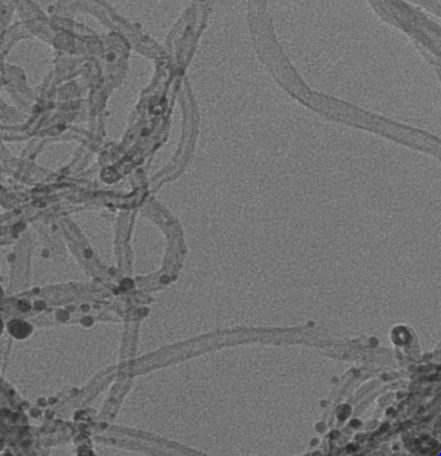
Various materials reported in literature were reviewed for enhancement of performance by material modification. Few self-synthesized materials viz; carbon nano tubes (CNT) and iron dust (Fe3O4) were also tested for modification aftereffects. Carbon nano tubes surface was functionalized with acid treatment and was decorated with silver using a method mentioned in literature and sorption capacity was verified in literature. Method for the silver doped CNT preparation was adapted from the previous literature [20]. Final sorbent material was characterized using various characterization techniques viz; SEM, TEM and BET etc. Figure 2 represents the TEM image of acid treated and silver decorated functionalized carbon nano tube surface. Another material HA coated Fe3O4 NPs were synthesized using procedure defined in previous literature with small variation [21]. It was found that after humic acid coating, adsorption efficiency increases. Details related to adsorption efficiency are shown in result & discussion section.
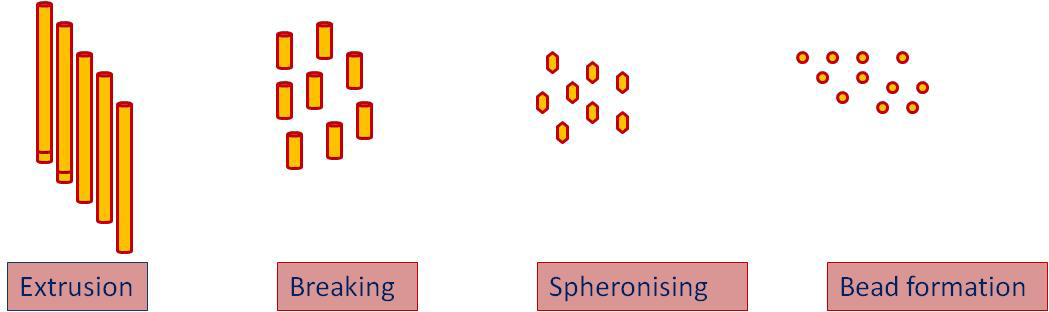
Synthesized material was converted in to adsorption beads of suitable sizes using spheronizer. Steps involved in bead formation are schematically represented in Figure 3.
Experimental Details
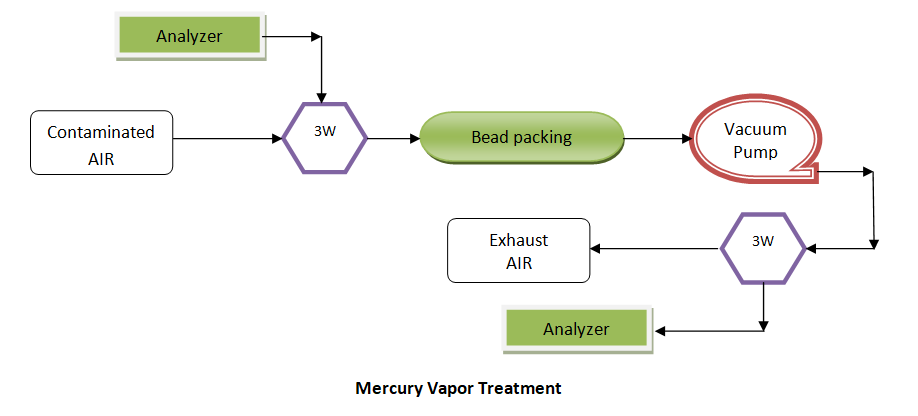
Experiments for calculating adsorption capacities were conducted in a setup schematically represented in Figure 4. Contaminated air enters to the packed column named bead packing through a three way valve (3W) which is having a sample analyzer tapping. Mercury contamination is measured by a commercial UV based analyzer at inlet as well as outlet. Suction of contaminated air takes place through a vacuum pump. Effect of different sorbent beads was observed by replacing the packing material of bead packing packed bed. Adsorption of mercury in packing material was determined using commercial Direct Mercury analyzer instrument.
Results and Discussion
Sorption capacities of various materials are mentioned in Table 1. It can be seen that sorption capacity of commercially available respirators are very high and so is the cost. To compete the commercially available cartridge materials in terms of sorption capacity, synthesized sorbents must be modified but the modification should be feasible and economic both. It can be seen in Table 1 that if virgin bead type activated carbon is doped with gold its sorption capacity increases. Similarly porous carbon shows higher sorption capacity in comparison to poultry liter and coal based activated carbon. When humic acid coating is done over iron dust i.e. Fe3O4 nano particles, sorption capacity increases exceptionally. Improved surface properties and surface area are the primary reason behind increased sorption capacities.
| Sr. No | Material | Mercury sorption capacity (µg/gm sorbent) | Reference |
|---|---|---|---|
| 1 | 3M-6009 respirator cartridge | 10500 | [22] |
| 2 | Virgin bead-type activated carbon (BAC) | 0.077 | [23] |
| 3 | bead-type activated carbon with gold doping (BAC-Au) | 0.093 | [23] |
| 4 | Coal-based commercial activated carbon | 119.3 | [24] |
| 5 | Char (poultry litter) | 100 | [25] |
| 6 | Ag-CNT | 9292 | [20] |
| 7 | Ag beads | 0.2 | [20] |
| 8 | Fe O Nano Particles 3 4 | 0.028 | This work |
| 9 | HA coated Fe O Nano Particles 3 4 | 343.71 | This work |
| 10 | Porus carbon | 141.23 | This work |
Table 1: mercury adsorption capacities of various sorbents.
Conclusion & Future Work
In this work as mentioned advance mercury sorbents were synthesized, characterized and experiments for obtaining maximum sorption capacities were conducted. Mercury sorption capacities of synthesized material were compared before and after modification viz. coating and doping. Also the sorption capacities from previous literature were compared and it can be clearly seen that modification in material properties may improve the adsorption capacity of sorbent. This work will help the researchers working in the arena of material synthesis, characterization and research related to any type of respirator cartridge material synthesis.
Conflicts of Interest
There are no conflicts to declare.
Acknowledgements
Authors of this paper thanks to Dr. Pallavi Singhal, BARC for helping in material synthesis.
Author Contributions Section
Pragati Shukla conceptualized and performed the literature survey and gap areas, analyzed the data and drafted the manuscript. S. Manivannan planned the study and edited the manuscript. D. Mandal helped in data interpretation and contributed to the final editing of the manuscript.
References
-
Reddy BM, Durgasri N, Kumar TV, Bhargava SV (2012) Abatement of gas phase mercury- recent developments. Cat Rev Sci Eng 54(3): 344-398.
-
Pirrone N, Keeler GJ, Nriagu JO (1996) Regional differences in worldwide emissions of mercury to the atmosphere. Atmos. Environ 30(17): 2981-2987.
-
U.S. EPA, Mercury and air toxics standards (MATS), 16 December 2011.
-
Wang SB, Luo KL (2017) Atmospheric emission of mercury due to combustion of steam coal and domestic coal in China. Atmos Environ 162(1): 45-54.
-
Shukla P, Mishra A, Manivannan S, Melo JS, Mandal D (2020) Parametric optimization for adsorption of mercury (II) using self assembled bio-hybrid. Journal of Environmental Chemical Engineering 8(3): 103725.
-
Shukla P, Manivannan S, Mandal D (2020) Numerical approach to minimize mercury contamination by geometric and parametric optimization. Heliyon 6(12): e05549
-
Zhang L, Wang S, Wang L, Wu Y, Duan L, et al. (2015) Updated emission inventories for speciated atmospheric mercury from anthropogenic sources in China. Environ Sci Technol 49(5): 3185-3194.
-
Shukla P, Mishra A, Manivannan S, Mandal D (2022) Metal-Organic-Frames (MOFs) Based Electrochemical Sensors for Sensing Heavy Metal Contaminated Liquid Effluents: A Review. Nanoarchitectonics 3(2): 1-15.
-
Fu X, Feng X, Sommar J, Wang S (2012) A review of studies on atmospheric mercury in China. Sci Total Environ 421- 422(1): 73-81.
-
Johari K, Alias AS, Saman N, Song ST, Mat H (2015) Removal performance of elemental mercury by low- cost adsorbents prepared through facile methods of carbonisation and activation of coconut husk. Waste Management & Research 33(1): 81-88.
-
Sprovieri F, Pirrone N, Ebinghaus R, Kock H, Dommergue A (2010) A review of worldwide atmospheric mercury measurements. Atmos Chem Phys 10(1): 8245-8265.
-
Li CF, Duan Y, Tang H, Zhu C, Zheng Y, et al. (2018) Mercury emissions monitoring in a coal-fired power plant by using the EPA method 30B based on a calcium- based sorbent trap. Fuel 221(1): 171-178.
-
Liu YX, Adewuyi YG (2016) A review on removal of elemental mercury from flue gas using advanced oxidation process: chemistry and process. Chem Eng Res Des 112(1): 199-250.
-
Yang S, Zhang JY, Zhao YC, Yu C, Zhang K (2010) Pre- investigation of nanostructured TiO2-activated carbon composites for photocatalytic oxidation removal of mercury vapor. J Eng Thermophys 31(1): 339-342.
-
Liu YX, Pan JF, Wang Q (2014) Removal of Hg0 from containing-SO2/NO flue gas by ultraviolet/H2O2 process in an ovel photochemical reactor. AIChE J 60(6): 2275- 2565.
-
Yang HQ, Xu ZH, Fan MH, Bland AE, Judkins RR (2007) Adsorbents for capturing mercury in coal-fired boiler flue gas. J Hazard Mater 146(1-2): 1-11.
-
Yun YR (2004) Study of the chemical adsorption characteristics of low level air-borne mercury vapor on activated carbon adsorbent, M.S. Thesis, Inje University, Korea.
-
Karatza D, Lancia A, Musmarra D, Zucchini C (2000) Study of mercury adsorption and desorption on sulfur impregnated carbon. Experimental Thermal and Fluid Science 21(1-3): 150-155.
-
Bae KM, Kim BJ, Park SJ (2011) A review of elemental mercury removal processing, Carbon letters 12(3): 121- 130
-
Luo G, Yao H, Xu M, Cui X, Chen W, et al. (2010) Carbon nanotubes-silver composite for mercury capture and analysis. Energy Fuels 24(1): 419-426.
-
Liu JF, Zhao ZS, Jiang GB (2008) Coating Fe3O4 Magnetic Nanoparticles with Humic Acid for High Efficient Removal of Heavy Metals in Water. Environmental Science & Technology 42(18): 6949-6954.
-
Chung TS, Kim KI, Yun YR (2009) Adsorption of elemental mercury vapor by impregnated activated carbon from acommercial respirator cartridge. Powder Technology 192(1): 47-53.
-
Song YC, Lee TG (2016) Preparation of gold- and chlorine-impregnated bead-type activated carbon for a mercury sorbent trap. Chemosphere 165(1): 470-477.
-
Hsi HC, Tsai CY, Kuo TH, Chiang CS (2011) Development of low-concentration mercury adsorbents from biohydrogen-generation agricultural residues using sulfur impregnation. Bioresource Technology 102(160): 7470-7477.
-
Cuesta AF, Somoano MD, Anton MAL, Cieplik M, Fierro JL, et al. (2012) Biomass gasification chars for mercury capture from a simulated flue gas of coal combustion. Journal Environmental Management 98(1): 23-28.
- Solution-Processed Chiral Perovskites for Biomedical Applications
- Nanotechnology in Health Chemistry and Medicine: Current Challenges and Future Directions
- Human Exposure to Micro- and Nanoplastics: Pathways, Toxicity, and Intervention Strategies
- Exosome Nanomedicine for Cancer Therapy
- Micro and Nanoplastics–Plastisphere, Biotoxicity, Impact on Human Health, and Mitigation Strategies
- Process Validation of Cefixime Powder for Suspension Dosage Form, 50 mL