
Application of Nanocontainers in Medicine: The Revolution of Nanotechnology
When a person is diagnosed with cancer, doctors suggest that the tumor be operated on or undergo chemotherapy, radiotherapy, or hyperthermia [1]. All these interventions are painful. Regarding chemotherapy, some collateral difficulties or phenomena are visible, like hair loss, and others are invisible but have consequences on patient function, such as cardiac toxicity of drugs.
Editorial
When a person is diagnosed with cancer, doctors suggest that the tumor be operated on or undergo chemotherapy, radiotherapy, or hyperthermia [1]. All these interventions are painful. Regarding chemotherapy, some collateral difficulties or phenomena are visible, like hair loss, and others are invisible but have consequences on patient function, such as cardiac toxicity of drugs. The critical question is what cancer is and its difference from healthy organs. Cancer is characterized by high temperatures of about 37 degrees Celsius, redox environments different from healthy cells, and pHs between 3.8 and 4.5 [1] How can a chemotherapy drug be transferred to cancer and other organs untouched by these chemical drugs? These drugs can be transported directly to cancer if one builds a container in which they will be trapped and transported to cancer, but they must autonomously recognize this environment with a different temperature, Redox, and pH. These nanocontainers can target cancer by targeting molecules that bind to cancer receptors.
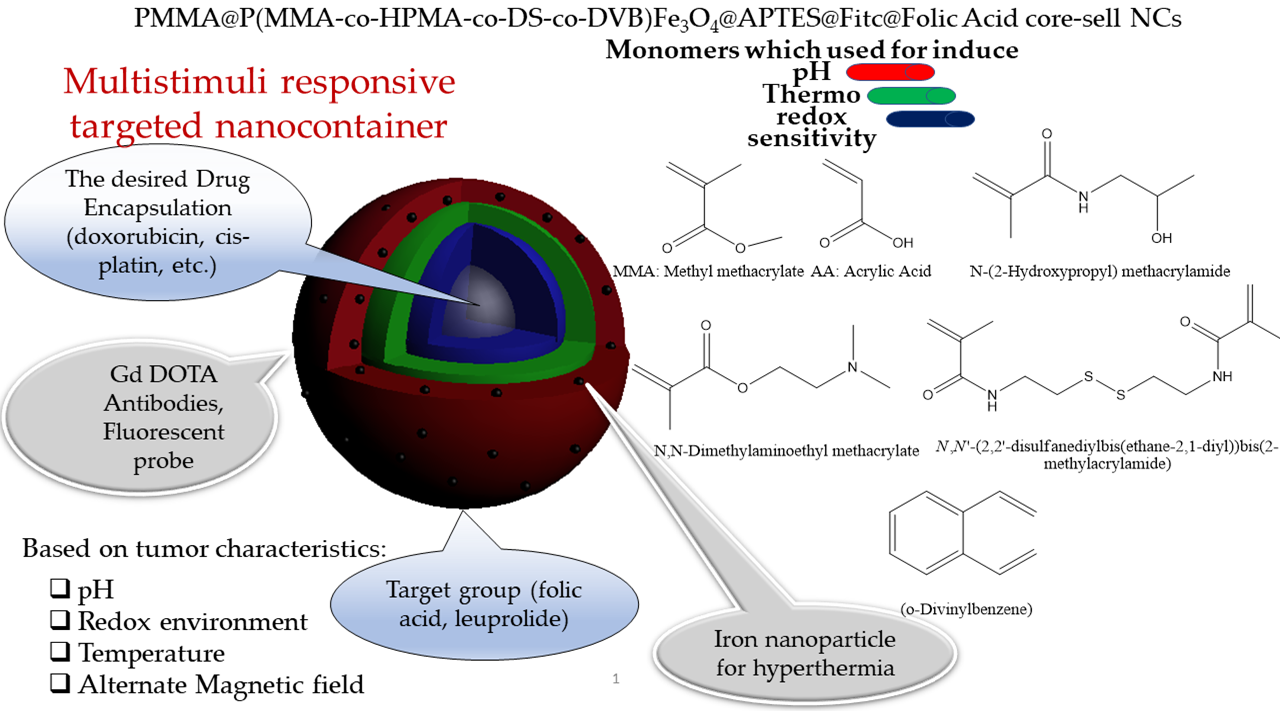
Figure 1 shows such a nanocontainer consisting of three shells [2]. The first shell is sensitive to pH, the second is sensitive to temperature, and the third is exposed to the Redox of cancer. These carriers are loaded with chemotherapy drugs like Doxorubicin or cisplatin. In addition, iron nanoparticles for hyperthermia are placed on the surface of these containers. The surface of the nanocontainers also contains gadolinium to enable monitoring of the particles with MRI techniques and fluorescent probes to monitor them with fluorescence spectroscopy. Finally, these containers are grafted with targeting molecules such as folic acid to target breast cancers and leuprolide to target prostate cancer.
When we develop a new drug delivery system, the inventor of this system needs to characterize and thoroughly evaluate its performance of this system. Many questions need to be answered, such as whether nanocontainers enter cancer, whether nanocontainers are toxic, what is the distribution of nanocontainers in different organs after injection into the body, is there a therapeutic effect with the introduction of these nanocontainers into the body. In other words, the inventor should thoroughly check to ensure effectiveness without side effects.
Our team named these quadruple stimuli responsive nanocontainers Nano4XX (XX=Dox, Sis, etc.) platforms, and from now on, this term will be used. One of the questions that arise is whether the Nano4XX platform enters cancer. To answer this question, we made containers that we loaded with Doxorubicin. A total of 2 experiments were conducted. The first experiment was done without using folic acid as a target molecule, and the second experiment was done with a nanocontainer doxorubicin-charged that had folic acid as a target molecule. When nanocontainers do not have folic acid, they accumulate around cancer and do not enter it. This is shown in Figure 2A, with the green points corresponding to collected containers where the light in green is attributed to the Fitc.
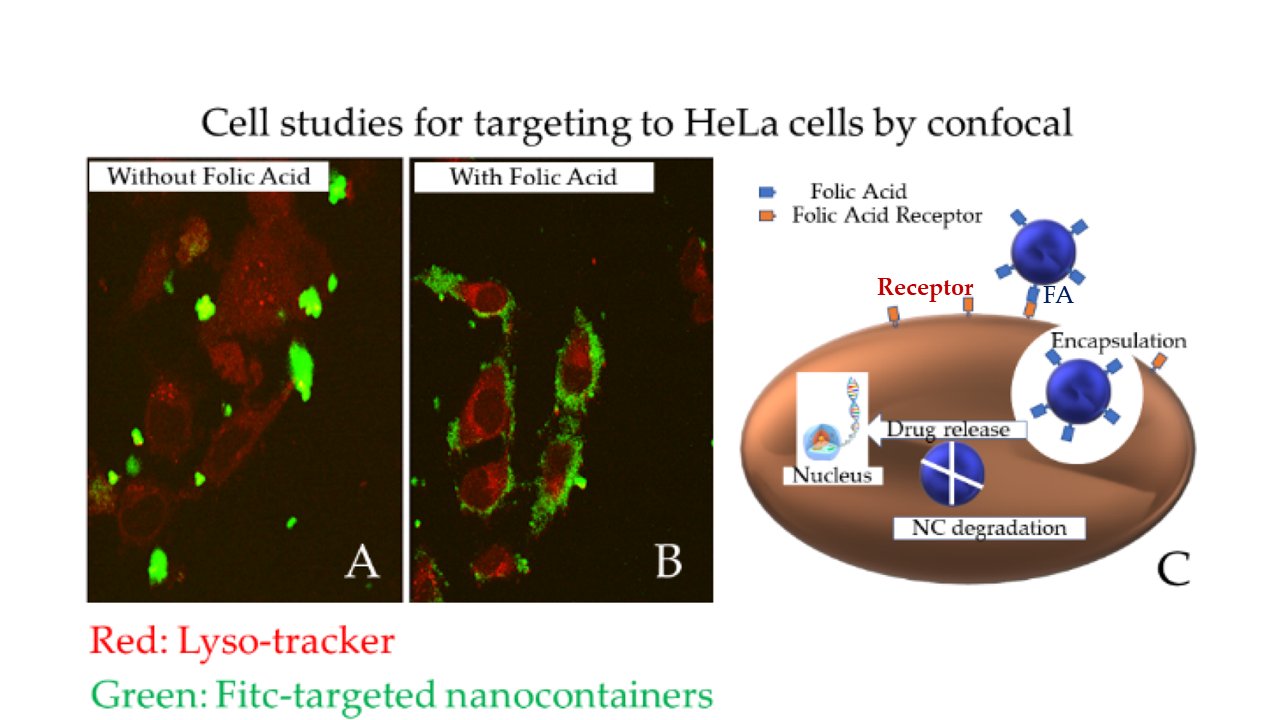
In contrast, however, when nanocontainers have a folic acid targeting molecule, they surround cancer where they bind to the receptors. Then the nanocontainers are encapsulated in cancer because they have the same temperature, Redox, and pH; they break down and release Doxorubicin. As a result, Doxorubicin illuminates the inside of the cancer red, as shown in Figure 2B.
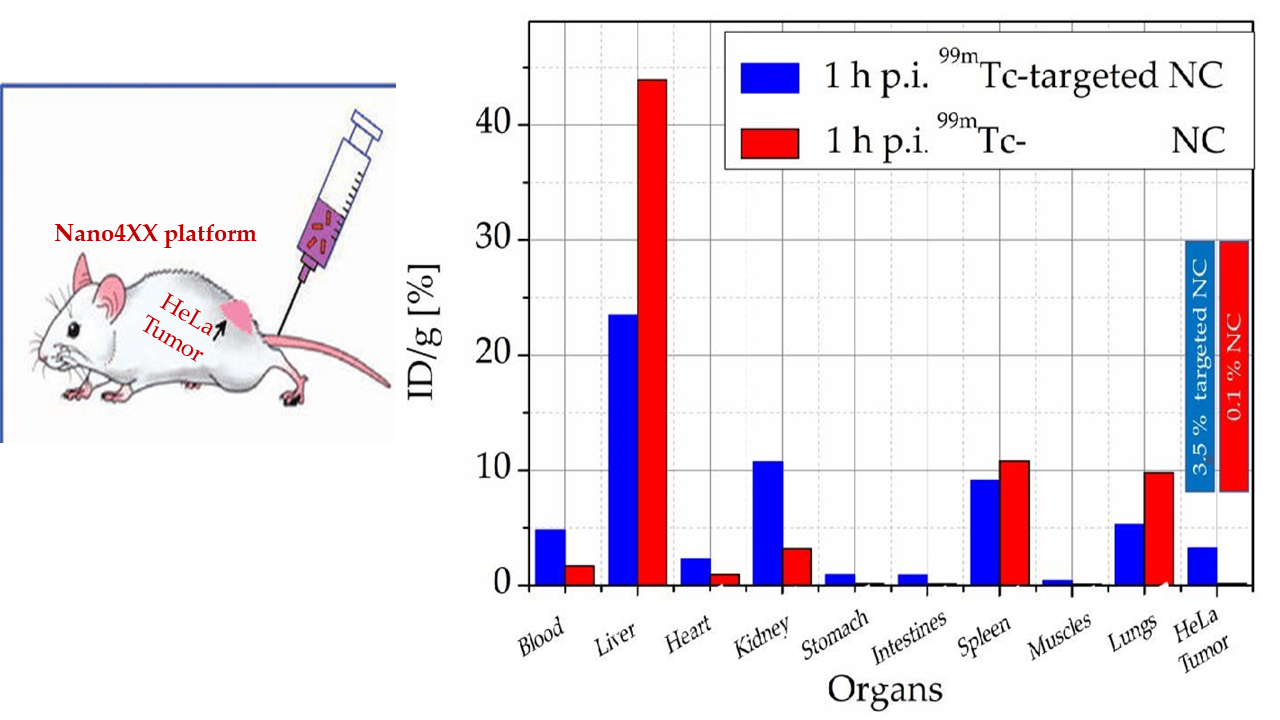
Another critical question is where they disperse when we inject them into living organisms and if they find cancer. The distribution of the container to the various organs of living organisms was measured by the PET method, where the results are shown in Figure 3. HeLa carcinomas were used for these experiments. The picture shows the different measurements and the number of nanocontainers found in them for the 2 cases where we used folic acid in the Nano4XX platform and the other where we did not use folic acid. The result is significant when we see that in cancer, you find a quantity of 3.5% from nanocontainers concentrated in HeLa tumors with folic acid, while this concentration is zero if we have not incorporated folic acid in the container.
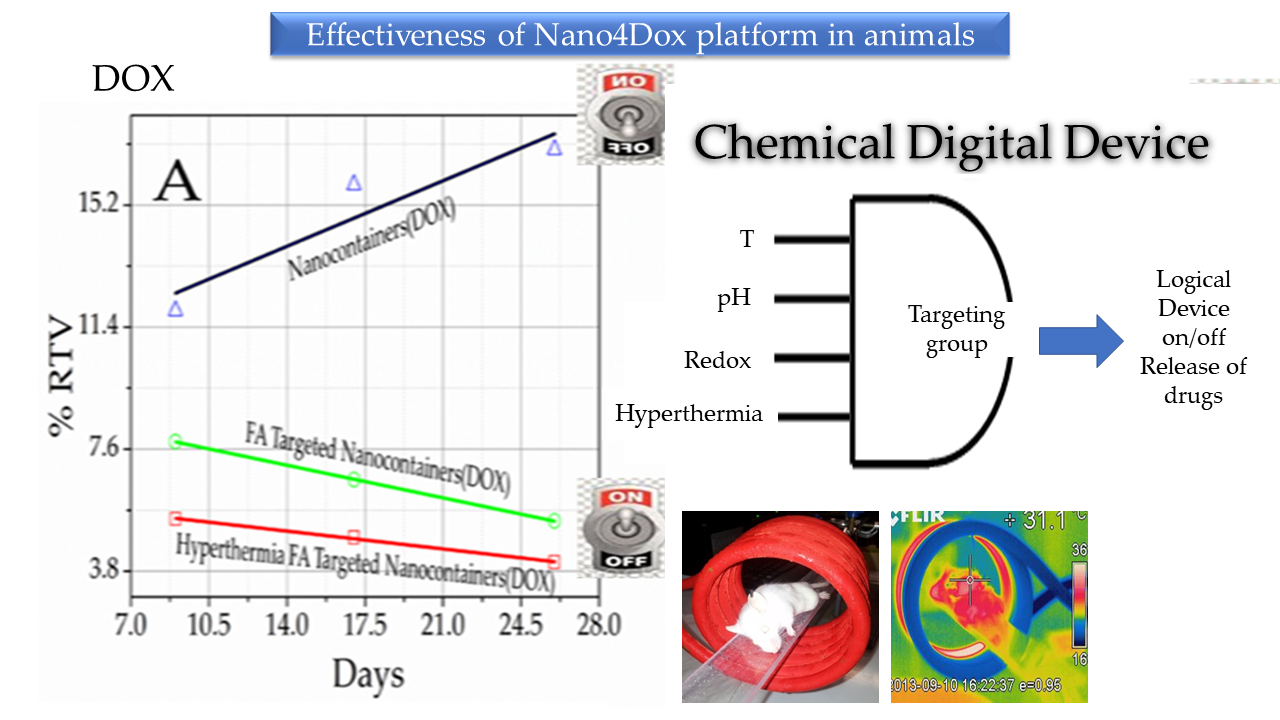
The therapeutic effectiveness of the Nano4XX platform in animals was another critical issue we studied. Figure 4 shows the results of these experiments using the Nano4XX platform; in the first category, they used folic acid, and in the second category, the containers were not grafted with folic acid. When the upper vessels do not have folic acid, we measure an increase in cancer over time. But when the Nano4XX has folic acid, the cancer is drastically reduced;
specifically, in 25 days, we see a reduction of 30% since this treatment becomes even better if hyperthermia is applied to the appropriate containers. This picture shows us that the containers were functioning like chemical digital devices. When T, Redox, and pH parameters are the same as cancer’s, grafted with targeting molecules embedded in these containers, this logical structure releases the drug and leads to effective cancer treatment.
Conclusions
The platform we developed relieves chemotherapy of cardiotoxicity. A better activity was observed, and the body did not alter chemotherapy drugs. This method can be used in many types of cancers and is protected by a worldwide patent. We can also use all chemotherapy drugs and other medications which may be helpful for other diseases, such as diabetes and inflammation.
Acknowledgments
The European Research Council funded this work under NANOTHERAPY AdG.
References
-
Efthimiadou EK, Fragogeorgi E, Palamaris L, Karampelas T, Lelovas P, et al. (2017) Versatile quarto stimuli nanostructure based on Trojan Horse approach for cancer therapy: Synthesis, characterization, in vitro and in vivo studies. Materials Science and Engineering C 79: 605-612.
-
Kordas G (2019) Nanotechnology in Cancer Treatment as a Trojan Horse: From the Bench to Preclinical Studies. In: Sarat Kumar Swain MJ (Ed.), Nanostruct London, UK, pp: 323-365.
- Solution-Processed Chiral Perovskites for Biomedical Applications
- Nanotechnology in Health Chemistry and Medicine: Current Challenges and Future Directions
- Human Exposure to Micro- and Nanoplastics: Pathways, Toxicity, and Intervention Strategies
- Exosome Nanomedicine for Cancer Therapy
- Micro and Nanoplastics–Plastisphere, Biotoxicity, Impact on Human Health, and Mitigation Strategies
- Process Validation of Cefixime Powder for Suspension Dosage Form, 50 mL