
Role of Solid Nano Dispersion in Drug Delivery
In the ever-evolving landscape of pharmaceuticals, researchers and scientists continually strive to enhance the effectiveness of drug delivery systems. Among the innovative solutions, Solid Nano Dispersions stands out as a groundbreaking technology with the potential to transform the way we administer medicines. These tiny, strong particles could improve drug solubility, bioavailability, and patient outcomes in the pharmaceutical workplace. This collection sought to compile works of research offering insights into the Role of Solid Nano Dispersion in drug delivery. Drug solubility is crucial for oral dosage forms to reach the appropriate systemic circulation quantities.
Editorial
In the ever-evolving landscape of pharmaceuticals, researchers and scientists continually strive to enhance the effectiveness of drug delivery systems. Among the innovative solutions, Solid Nano Dispersions stands out as a groundbreaking technology with the potential to transform the way we administer medicines. These tiny, strong particles could improve drug solubility, bioavailability, and patient outcomes in the pharmaceutical workplace. This collection sought to compile works of research offering insights into the Role of Solid Nano Dispersion in drug delivery [1]. Drug solubility is crucial for oral dosage forms to reach the appropriate systemic circulation quantities. To be effective, medications must first dissolve in the gastrointestinal (GI) fluid before passing through the GI tract barrier and into the blood [2]. According to Loftsson, et al. 90% of therapeutic candidates in development and about 40% of commercially available pharmaceuticals had poor water solubility [3]. Self- nano emulsifying systems, complexation with cyclodextrin, and nanostructured lipid carriers are some of the strategies that have been investigated so far to get around the problem of water solubility and increase oral bioavailability [4]. The limitations in scale-up production and clinical treatment are affecting these formulations. Solid Nano dispersion, which blends solid dispersion with nanotechnology, may be able to overcome these problems and improve oral absorption of poorly water-soluble drugs [5]. Interestingly, there is not much research on developing and troubleshooting solid oral dosage forms including ASDs.
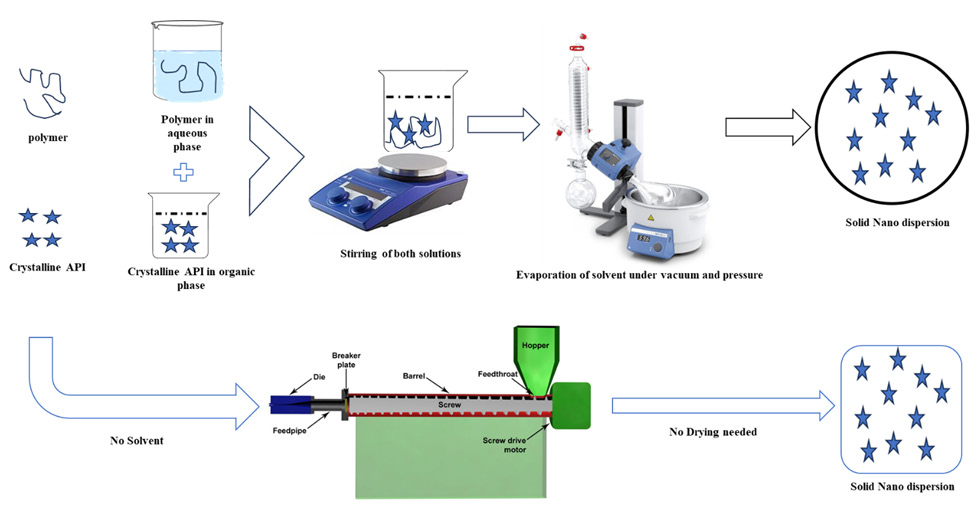
One or more active ingredients dispersed in a carrier matrix material are referred to as a solid dispersion. In most cases, a polymer makes up the matrix, and examples include PVP (polyvinyl pyrrolidone), HPMC (hydroxypropyl methylcellulose), HPMCP (hydroxypropyl methylcellulose phthalate), chitosan, CMC (carboxymethylcellulose), sodium alginate and sodium starch glycolate [6]. Furthermore, adding surfactants to the ASD composition appears pertinent to boosting the production of nanoparticles during the dissolution process, and the surfactant-drug ratio is a crucial factor in enhancing oral bioavailability [7]. Spray drying, solvent evaporation, freeze drying, co-precipitation, fusion techniques, hot melt extrusion, and supercritical fluid precipitation are a few techniques that can be used to produce solid dispersions as shown in Figure 1. There are now over 20 ASD products approved for use by the FDA since 2007 [8].
Anane-Adjei, et al. [9], focused heavily on the pre- formulation evaluations and workflows used at AstraZeneca as it addresses the design, fabrication, and use of ASD formulations in preclinical drug research [9].
Arun Butreddy, et al. [10], examined whether HPMCAS LG and hydrophobic and hydrophilic polymers (HPMCAS HG, Eudragit® FS100, Eudragit® RSPO) can work together to stabilize the supersaturated condition of nifedipine (NIF) in a solution [10].
Mona Qushawy, et al. [11], used water-soluble carriers to manufacture glimepiride as a solid dispersion to increase its aqueous solubility and thereby increase its bioavailability. All produced formulations had good yields (98.4 ± 2.8 to 99.8 and 2.2%), and high drug contents (97.2 ± 3.2 to 99.6 and 2.1%) [11].
Selvakumar Muruganantham, et al. [12], prepared nanodispersions to increase zaltoprofen’s solubility, using polyvinyl pyrrolidone K30 (PVP K30) and Poloxamer 407 in different ratios using the solvent evaporation approach. Their results showed the enhanced aqueous solubility of the drug [12].
In conclusion, Solid Nano Dispersions represent a remarkable advancement in the field of drug delivery, offering a lifeline to patients and a source of inspiration for researchers. Their ability to overcome solubility barriers, enhance bioavailability, and enable precise drug targeting opens new horizons in medicine. As we look forward to the future, Solid Nano Dispersions are poised to play a pivotal role in improving healthcare outcomes and advancing the pharmaceutical industry.
References
-
Vo Van H, Dibyendu G (2012) Amorphous nanoparticles- Experiments and computer simulations. Physics Reports 518(3): 81-140.
-
Tran P, Pyo YC, Kim DH, Lee SE, Kim JK, et al. (2019) Overview of the Manufacturing Methods of Solid Dispersion Technology for Improving the Solubility of Poorly Water-Soluble Drugs and Application to Anticancer Drugs. MDPI Phramceutics 11(3): 132.
-
Brewster ME, Loftsson T (2010) Pharmaceutical applications of cyclodextrins: basic science and product development. Journal of Pharmacy and Pharmacology 62(11): 1607-1621.
-
Vinarov Z, Abrahamsson B, Artursson P, Batchelor H, Berben P, et al. (2021) Current challenges and future perspectives in oral absorption research: An opinion of the UNGAP network. Advanced Drug Delivery Reviews 171: 289-331.
-
Zhang X, Li J, Rong R, Wang D, Wang D, et al. (2023) Enhancing the oral bioavailability of poorly water- soluble amisupiride with solid nanodispersion. Journal of Drug Delivery Science and Technology 86: 104635.
-
Maria Rosa Gigliobianco, Casadidio C, Censi R, Martino PD (2018) Nanocrystals of Poorly Soluble Drugs: Drug Bioavailability and Physicochemical Stability. MDPI Pharmaceutics 10(3): 134.
-
Tambe S, Jain D, Meruva SK, Rongala G, Juluri A, et al. (2022) Recent Advances in Amorphous Solid Dispersions: Preformulation, Formulation Strategies, Technological Advancements and Characterization. MDPI Pharmaceutics 14(10): 2203.
-
Bhujbal SV, Mitra B, Jain U, Gong Y, Agrawal A, et al. (2021) Pharmaceutical amorphous solid dispersion: A review of manufacturing strategies. Acta Pharmaceutica Sinica B 11(8): 2505-2536.
-
Anane Adjei AB, Jacobs E, Nash SC, Askin S, Soundararajan R, et al. (2022) Amorphous solid dispersions: Utilization and challenges in preclinical drug development within AstraZeneca. International Journal of Pharmaceutics 614: 121387.
-
Butreddy A, Sarabu S, Almutairi M, Ajjarapu S, Kolimi P, et al. (2022) Hot-melt extruded hydroxypropyl methylcellulose acetate succinate based amorphous solid dispersions: Impact of polymeric combinations on supersaturation kinetics and dissolution performance. International Journal of Pharmaceutics 615: 121471.
-
Qushawy M, Nasr A, Swidan S, Mortagi Y (2020) Development and Characterization of Glimepiride Novel Solid Nanodispersion for Improving Its Oral Bioavailability. Scientia Pharmaceutica 88(4): 52.
-
Muruganantham S, Krishnaswami V, Kandasamy R, Alagarsamy S (2022) Potentiating the solubility of BCS class II drug zaltoprofen using nanodispersion technology. Journal of Dispersion Science and Technology.
- Solution-Processed Chiral Perovskites for Biomedical Applications
- Nanotechnology in Health Chemistry and Medicine: Current Challenges and Future Directions
- Human Exposure to Micro- and Nanoplastics: Pathways, Toxicity, and Intervention Strategies
- Exosome Nanomedicine for Cancer Therapy
- Micro and Nanoplastics–Plastisphere, Biotoxicity, Impact on Human Health, and Mitigation Strategies
- Process Validation of Cefixime Powder for Suspension Dosage Form, 50 mL