
Tungsten Oxide-based Materials: Synthesis, Properties, and Applications
Non-stoichiometric compounds of tungsten oxides that are abundant on the earth received extensive attention in electrochromic devices, electrochemistry, photothermal conversion, gas sensors, and photocatalysis because of their unique physicochemical structures and highly tunable structures. Because of its high colouring efficiency, quick optical reaction time, and reversible colour changes, tungsten oxide (WO3), along with various oxidation states of oxygen-deficient tungsten oxide (WO3-x), has been identified as one of the mainly effective possibilities for electrochromic materials among transition metal oxides. For example, one-dimensional nanostructures of WO3-x such as nanotubes, nanowires, and nanorods, have gotten huge attention due to their unique electrical, optoelectrical, and optical properties. Additionally, distinct oxygen-deficient tungsten oxides (WO3-x) - WO2.72, WO2.83, and WO2.9, for example - have significant light absorption characteristics up to the near-infrared (NIR) region and a stable crystal phase, which sets them apart from surface-reduced WO3. Out of these, reduced tungsten oxide (WO2.72) is one of the most studied owing to promising properties such as unusual defect structures and abundant oxygen vacancies. These oxygen vacancies create new discrete energy bands below the conduction band thus narrowing its bandgap The other series of tungsten-based materials is tungsten bronze (MxWO3, where M= Na, Cs, K, Rb, etc) which has mixed-valence states. These are the materials that are explored less but have excellent properties as compared to WO3. So, in this review, the applications, synthesis methods, and properties of MxWO3 and WO2.72 are studied in detail.
Introduction to Tungsten based Materials
Tungsten is one of the uncommon metallic elements that have been the most important resource of nature for decades.
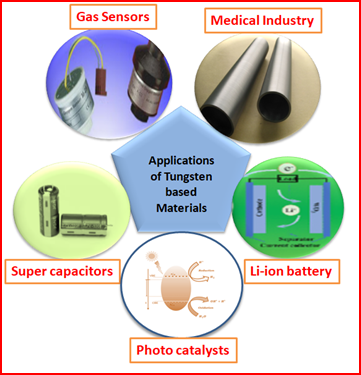
The world-famous application of tungsten is its utilization as a filament of the bulb, which drew interest towards tungsten in earlier times. It has the highest melting point among metals. It is well known for its different oxidation states, such as tungsten(III)oxide (W2O3), tungsten(IV) dioxide (WO2), tungsten(VI) trioxide(WO3), and tungsten(V) pentoxide (W2O5) etc [1, 2]. Tungsten-based materials have a lot of applications in the fields of photocatalysis, gas sensors, supercapacitors, and the medical industry, etc (Figure 1).
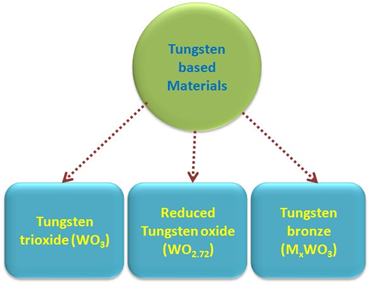
In mixed-valence state tungsten-based compounds, tungsten always has more than one oxidation state; the above- mentioned non-stoichiometric tungsten-based oxides have unique chemical and physical properties that result in many applications in advanced environmental purification, disease treatment, electronic appliances, and so on. WO3, WO2.91, and WO2.72 are tungsten-based suboxides that are conventionally formed by reacting metal with trioxides. Another important material is tungsten bronze (MxWO3, where M=K, Cs, Rb, Na, etc.) another series of tungsten-based materials with mixed- valence states. The most important tungsten-based materials are WO3, WO2.72, and MxWO3, due to their unique properties and applications (Figure 2).
There are several uses for tungsten oxide (WO3), a kind of transition metal oxide. Because of their propensity to experience notable colour changes during electrochemical redox processes, transition metal oxides with multi-step reduction states have found widespread application as electrochromic active materials. Another well-known characteristic of tungsten trioxide is its nonstoichiometric properties, such as the lattice structure’s resilience to many oxygen vacancies [3].
By becoming nanostructured, WO3 can gain special properties and perform better than when it is in its bulk form. The features that set nanostructured WO3 apart from bulk WO3 are as follows: Because atomic species near the surface have different bond structures than those embedded in the bulk, i) increased surface-to-volume ratio provides more surface area for both physical and chemical interactions; ii) significantly altered surface energies allow for property engineering and tuning, and iii) quantum confinement effects because of the material’s inherent small size. WO3 with a nanostructure has special qualities and is incredibly flexible. One of the most researched functional metal oxides, it has influenced research fields from solid-state chemistry to condensed matter physics. Because of WO3’s exceptional chromic properties, thin films made of nanostructured WO3 are being researched further and used to make electrochromic devices [4]. Studies on the chromic properties of WO3 are far more developed than those on a number of other functional metal oxide nanostructures, including TiO2, ZnO, NiO, and their substoichiometric analogs.
WO3-x nanocrystals have also attracted the interest of cancer therapy researchers because of their local surface plasma resonance (LSPRs) and significant light absorbance in the near-infrared (NIR) region, which is crucial for photothermal therapy. Because of its strong NIR light absorbance and peculiar defect structure, monoclinic WO2.72 has received a lot of interest in a variety of disciplines, including photothermal water evaporation, transparent smart windows, and photocatalysts [5]. On the other hand, MxWO3 has mixed-valence states ie W6+ and W5+, due to these mixed-valence states; it has a large number of free electrons for conductivity. It is used in many applications such as smart window coatings, photocatalysis, gas sensors, and supercapacitors, etc. [6]. Due to its properties like superconductive, electrochromic, and optical-electrical Properties, the different kinds of tungsten bronze, ammonium tungsten trioxide can be transferred to hexagonal tungsten trioxide or monoclinic tungsten trioxide depending on the temperature and this makes it an intermediate in the synthesis of nanostructures of tungsten trioxides. Moreover, different metal tungstates such as but, not limited to FeWO4, CoWO4, NiWO4, CaWO4, CuWO4, CdWO4, Bi2WO6, PbWO4, and ZnWO4, have been synthesized and utilized in various fields of applications [7].
Tungsten-based materials have unique electrical, optoelectrical, and optical properties. WO3, despite its unique properties of high thermal stability, superior charge transport, tunable electrical properties, and high electron mobility, is not commonly used in the electrical device sector. The electronic devices are used in a variety of environments, including humid, dry, and high-temperature environments, as well as in the dark or under light irradiation. WO3 is one of the typically unintentionally doped n-type characteristic semiconductors. WO3 often presents sub-stoichiometric oxide (WO3−x) due to the presence of several oxygen deficiencies, such as WO2.9, WO2.83, WO2.8, and WO2.72. That is to say, the lattice of WO3−x could sustain a considerable amount of oxygen vacancy and contain a number of W5+. Consequently, a change of oxygen vacancies in WO3−x could effectively tune the density of electrons and then have considerable conductivity. WO3 that strictly satisfies the stoichiometric ratio should be an insulator, and non-stoichiometric WO3−x exhibits n-type semiconductor behavior. A slight change in oxygen content can also greatly change the conductivity of WO3, so its electrical properties vary with its oxygen content and can be divided into exhibiting metal and semiconductor behavior. Extrinsic n-doping is therefore not required for WO3 to exhibit significant conductivity. Due to the greater bandgap of quasi-two-dimensional (Q2D) WO3, Q2D WO3 nanoflakes have more potential electrical applications.
Preparations of Tungsten Oxide based Materials
Mechanochemical Method: Ball milling and grinding are examples of mechanochemical processes that are thought to be viable options for solvent-free synthesis. This process includes a chemical reaction produced by mechanical forces like shearing, compression, or friction. For instance, tungsten trioxide powder and its precursor, Na piece, were ground to create a tungsten bronze (Na0.88WO3) nanocrystal with a standard grain size of 17 nm [8]. The prepared tungsten bronze nanocrystal displayed semiconductor characteristics in its electoral property that might arise from the material lattice distortion as an effect of high-energy ball milling. Another study group created hydrogen tungsten bronzes (H0.23WO3 and H0.33WO3) by reactive mechanical alloying of powder tungsten trioxide under a hydrogen atmosphere, and they also investigated the influence of milling duration on the composition of hydrogen tungsten bronze. This mechanochemical technique of preparation offers various advantages, together with the utilization of inexpensive raw materials, the creation of microscopic particles, and the convenience of the process [9]. Its major drawback is that the chemical reactions for those moisture and air-sensitive chemicals must be regulated.
Solid-Phase Reactions: A solid phase reaction is a procedure between two solids that produces a solid product in the absence of chemical equilibrium. This procedure is easy and needs little equipment. Nonetheless, at high temperatures, the pace of reaction is slow. Solid-phase reaction techniques have been used to manufacture many types of MxWO3, including sodium tungsten bronze, cesium tungsten bronze, rubidium tungsten bronze, and potassium tungsten bronze. For example, hexagonal cesium tungsten bronze (Cs0.33WO3), hexagonal rubidium tungsten bronze (Rb0.33WO3), and cubic sodium tungsten bronze (Na0.75WO3) were powdered precursor metal salts and WO3NH3 calcined at 550 °C under H2/Ar or H2/N2 for one hour, followed by annealing at 800 °C in nitrogen gas for one hour [10]. This approach produced tungsten bronze with broad and strong NIR peaks at around 1,500 nm, particularly cesium tungsten bronze and rubidium tungsten bronze. Because of their near- infrared absorption, hexagonal phases of tungsten bronzes (M0.33WO3) are excellent for use in solar filter applications. Furthermore, due to the modified optical response of the quaternary element of sodium, quaternary tungsten bronze displayed better near-infrared absorption capacity than conventional tungsten bronzes in the wavelength range of 780 nm to 1,200 nm [11].
Chemical Vapor Transport: According to the principles of chemical vapor transport (CVT), a solid is volatilized in the presence of gaseous reactants (known as ‘transport agent’) deposits the solid, generally in the form of crystals, somewhere. Tungsten bronze crystal growth of alkali metals such as potassium, rubidium, and cesium were synthesized by this method. Different kinds of transporting agents such as mercuric chloride, mercuric bromide, mercuric iodide, chlorine, and platinum chlorides were utilized however, mercuric chloride and mercuric bromide were discovered to be just as effective as transport agents in the growth of massive tungsten bronze crystals. The crystals developed by this method were 6 mm in for hexagonal-MxWO3 [12]. Nevertheless, utilizing mercuric chloride and mercuric bromide, the synthesized tetragonal tungsten bronzes (MxWO3) had a size of 0.1 mm, where x was 0.25. On the other hand, extremely little or no transit happened when x ≥ 0.35. The concentration of alkali metals was shown to decrease both the transport speeds and the diameters of the crystals. They produced almost the same results when manufactured under isothermal circumstances with and without the use of transport agents. When utilized as transport agents, the data did, however, demonstrate a noticeable transport impact. Additionally, take note of the fact that using transport agents might harm the environment due to their high energy usage.
Hydrothermal Method: It is easy to use and adaptable for producing inorganic nanomaterials from aqueous solutions at high temperatures and pressures. The most often used solvent in the hydrothermal process is water. Temperature, pressure, and precursor concentration are the three most crucial variables that must be regulated to determine the properties of the nanomaterials. Temperature and pressure affect the dielectric constant and density of water. Water’s decreased dielectric constant greatly speeds up the pace of reaction, which improves crystal formation nucleation. This approach offers several advantages, such as a one-step synthetic process, eco-friendliness, effective solution dispersion, manufacturing feasibility, and cost- effectiveness. Furthermore, the hydrothermal method avoids the utilization of hydrogen gas and largely improves environmental safety. Different tungsten bronze compounds such as cesium tungsten bronze, potassium tungsten bronze, and ammonium tungsten bronze have been synthesized by this method. For example, cesium tungsten bronzes were prepared by mixing the precursor Cs2WO4, WO2, WO3, and distilled water and heating the mixture for 24 h at 800°C [13]. Moreover, K2WO4, K2SO4, and distilled water were heated for 24 h at 200oC to create potassium tungsten bronze nanorods. These nanorods were then calcined for two h at 600oC in an environment of H2 (5 vol%) /N2 [14]. Similarly, acetic acid, ammonium paratungstate, and ethylene glycol were heated for 72 h at 200 degrees Celsius to create ammonium tungsten bronze nanorods [15]. Additionally, potassium tungsten bronze nanowires were created via an electrostatic- induced method that involved heating K2WO4 as a precursor, ethylene diamine (EDA), and water for 48 h at 250°C in an electric oven. It’s actually crucial to recognize that many nanoparticles have unique processing requirements and reaction schemes based on their preparations. It is therefore desirable to ascertain the appropriate chemical reactions under favorable circumstances for various nanoparticles.
Inductively Coupled Thermal Plasma Method: The inductive coupled thermal plasma method is a process in which thermal plasma is used as the main source of heat source to evaporate solid precursor and/or to decompose gaseous precursor. In this technique, reactive gases are used as the main constituent for plasma flame formation in the preparation of nanomaterials. Previously, metal tungsten bronze was prepared from its precursor (NH4)10(H2W12O42). 4H2O and salt of HCOOCs, Na2CO3, and K3C6H5O7 in which different ratios of W and M were used [16]. Nevertheless, a small amount of H2 was used with central gas Ar to provide the required reducing environment for the fabrication of tungsten bronze. A mixture of tungsten and alkali salts with low decomposition temperatures was used as the precursor. This thermal plasma method of preparation owes merits such as ease of material handling, raw material cost, and processing throughput. It has been proved to be an exceptional method to produce a high output of tungsten bronze. For alkali metal tungsten bronze of cesium, potassium, and sodium nanopowder having high purity was prepared from cost- effective precursor material. Generally, materials synthesized by thermal plasma possess advantages such as high purity, favorable optical absorption, and tunable composition as well as the use of low-cost materials. Tungsten oxide materials prepared by this technique are being utilized in different areas of application such as coatings and heat shielding filters, due to their property of a high extinction coefficient in the NIR region with little effect on transparency or visible color. The inductively coupled thermal plasma method is a fast reaction technique that can be used to produce large quantities of product at low temperatures [17]. It has high potential and can be used extensively in future research.
Solvothermal Method: Instead of using water as a solvent or reducing agent, this synthesis process employs ethylene glycol and alcohol. By adjusting the solvent, reaction environment, surfactant type, reactant concentration, pH, and system volume, control factors in this process may be changed. This process has been used by several researchers to manufacture non-stoichiometric tungsten oxides. For instance, W(CO)6 and ethanol were heated in an electric oven for 12 h at 160°C to create urchins similar to W18O49 [18]. By baking the combination in an electric oven at 160°C for 24 h, another set of researchers was able to synthesize the same material with the same shape using tungsten hexachloride and 100% ethanol [19]. With varying amounts of tungsten hexachloride added to the mixture different morphologies of W18O49 namely, nanowire and urchin were prepared from WCl6 and ethanol by a similar solvothermal method at 180°C for 10 h. W18O49 nanoparticles, which is another kind of W18O49 morphology were also synthesized from WCl6 and ethanol as a precursor and octadecyl amine as a surfactant by heating for 24 h at 180°C [20]. Greater near-infrared harvesting capability from various W18O49 morphologies has been demonstrated by urchin-like W18O49. Compared to the hydrothermal method, the solvothermal approach lowers the heat treatment temperature by substituting alcohol. In addition, the ethanol solvent has the dual purpose of controlling the morphology and lowering the heat treatment temperature. As a result, reducing the reaction’s temperature can help solve the issue of excessive energy use; yet, the hydrothermal approach is generally more ecologically benign.
Applications
Tungsten oxide-based materials such as WO3, WO2.72, MxWO3, and their hybrids have attracted huge attention in different fields of study including heat generation, photocatalysis, and energy-related and gas-sensor applications.
Electrochromism and Supercapacitors: The most promising electrochromic (EC) materials are functional oxide semiconductors based on tungsten oxides because of their simple synthesis, quick color change rate, cyclic stability, and high coloration efficiency [21]. Reversible color changes, known as electrochromism, are the outcome of a substance’s changing electron states due to low direct current potential, which can range from a few volts to a fraction of a volt. Through redox processes, an electrochromic material may reversibly alter its light-absorption characteristics within a certain wavelength range [22]. One of the inorganic electrochromic materials with the most research done on it is WO3-x, which exhibits transparency and a blue hue when negative and positive voltages are applied alternately.
Supercapacitors’ great power density and safe operation make them an attractive option for storing power and super- high cycle life. It is an important energy storage technology in fields such as fuel-efficient transport and renewable energy. In recent years, supercapacitors based on WO3-x have been vigorously studied in the pursuit of high performance. Due to their excellent electrochemical performance, high electrical conductivity, phase structure, and suitability for fast ion insertion, tungsten-based materials are also appealing options for pseudo-capacitors [23]. It is well known that monoclinic W18O49 causes oxygen deficiency in a material by possessing tungsten in the W5+ oxidation state. Because the oxygen vacancies lower the oxide materials’ resistivity, they promote excellent electrochemical activity. W18O49 exhibits several oxidation states because of its oxygen deficiencies, which is another reason why its use as an active material in pseudo-capacitor applications is now of interest. Using a template approach, Yoon et al. created ordered mesoporous WO3-x, which has excellent capacitance (366 μF cm-2, 639 F cm-3), and a high rate capability [24]. Additionally, W18O49 nanowire assemblies with a potential range of -0.5 to 0.4 V (vs SCE) and a specific capacitance of 579 F g-1 in 0.5 M H2SO4 are reported by Pang and colleagues [25]. The electrochromic response and pseudo-capacitive behavior result from ion insertion/extraction coupled with redox reactions between W6+ and W5+ (e.g., WO3 + x e- + xH + ↔ HxWO3). For quick pseudo-capacitors and electrochromic applications, Zhao et al. synthesized WO2.94 quantum dots with an average crystalline size of 1.6 nm [26].
Optical Recording Device: Optical recording materials are a cutting-edge technology with practical applications for high- density, reversible information storage. When WO3-x was first considered for this field, digital pictures were recorded using a mix of electrochromic and photochromic effects [27]. Subsequently, Lu and colleagues discovered that a single pulse of KrF excimer laser light at 248 nm could colour an amorphous WO3 thin film, while a single pulse of Nd-Y- Al-garnet laser light at 1.06 μ m could bleach it in air [28].
Additionally, studies have been carried out to show how WO3-x films’ crystal phase may be altered by laser light, leading to corresponding modifications in optical transmission. Using this method, 25 GB of storage might be found on a single platter.
Lithium-ion Batteries (LIB): WO3 has been used as an anode material because it is low-cost, eco-friendly, and has a high theoretical capacity. The single major drawback is its weak electrical conductivity, which has been enhanced by WO3-x compounds. Yoon, et al. [29] main goal was to create anode mesoporous WO3-x with high electrical conductivity and excellent performance by employing a hard template. Comparing the produced material to the bulk WO3-x, it showed a high volumetric capacity (1500 mAh cm−3) and a high reversible capacity (748 mAh g−1). According to Lee, et al. [30], flexible reduced tungsten oxide–carbon composite nanofiber (WOx-C-NF) films show superior rate performance in comparison to WOx–C-nano and WOx–nanoelectrodes, as well as a high reversible capacity (481 mA h g−1). The films were also observed to display a stable cycle. These investigations demonstrated that one of the most promising anode materials for LIB is WO3-x. It was recently claimed that WO3-x composites might be used as anode materials for high- performance lithium-ion batteries [31].
Gas Sensors: In our daily lives, gas sensors are essential for the detection and monitoring of sustainable energy sources, the semiconductor industry, food processing, ecological inspection, air quality control, and clinical discoveries [32]. The crystal lattice of WOx contains oxygen defects, which cause the band to bend and allow conductivity. When the material comes into touch with oxygen, the surface energy band bends upward and oxygen takes electrons from the semiconductor’s surface to generate negative ions. As a result, the gas sensing material’s surface electron concentration drops, its electrical conductivity decreases, and its resistance rises in the sensor. On the other hand, desorption takes place, the surface energy band is lowered, the electrical conductivity and electron concentration rise and the resistance value of the sensor falls if the gas-sensitive material comes into contact with the reducing gas.
WO3 and WO2.72 were reported as sensor materials to monitor flammable and toxic gases such as NH3, NOx, H2, H2S, and SOx [33, 34, 35]. WOx can also reduce gases such as H2, CH4, COx, and C2H5OH. Although WO2.72 has the largest oxygen deficiency, it has greater potential in this field. WO3 nanorod/sulfonated reduced graphene oxides (WO3/S- rGO) were synthesized by Wang, et al. [36]. WO3/S-rGO demonstrated quick response recovery characteristics at all NO2 gas concentrations, demonstrating its strong response and recovery qualities for sensor applications. The WOx gas sensor still has issues with poor selectivity, high working temperature, and poor stability, though. Therefore, the main goal of our present study is to figure out how to lower the operating temperature while increasing the detecting gas’s sensitivity and selectivity. The sensitivity of WOx for reducing gases has been shown to be improved by composite and metal-hybrid doping. Gas sensors and the characteristics of WO2 have led to much research into WO3 and its hybrid. But MxWO3 hasn’t been thoroughly investigated yet [37].
Medical Application of Tungsten-based Materials: Tungsten-based compounds have emerged as a potential new material for nuclear medicine shielding against gamma radiation that is devoid of lead. Lead’s toxicity to the environment has sparked interest in radiation-shielding materials as a potential lead replacement. Tungsten carbide has the potential to take the role of lead as a new lead-free radiation shielding material in nuclear medicine, as demonstrated by Nadal, et al. It can be employed as a material for radiation shielding to thwart gamma radiation. Utilizing radiation shielding materials free of lead is crucial to reducing the harmful effects on our health and environment [38]. Pure tungsten plates are mainly used in X-ray inspection equipment testing solder joints, medical X-ray detection devices, radiation shielding material and nuclear facilities radiation protection equipment, medical tungsten used for general purposes the radiation protection of the equipment (such as X-ray operators the apron), consumers use the products, such as vibration suppression, weight, voice (sound) raw materials. The medical field also makes use of tungsten tubes. In addition, medical tungsten is utilized in the production of injection needles, setting rods, electrodes, filaments, lead, and support for vacuum heating furnaces. Medical tungsten finds its application in several fields, including collimators, nuclear shielding, beam stop, vial shields, isotope containers, FDG containers, and multi- leaf collimators [39, 40].
Phototherapy applications: Photothermal therapy (PTT) and photodynamic therapy (PDT) have recently attracted attention for cancer therapy due to their non-invasive nature [41]. The reagents for photothermal treatment and photodynamic therapy require near-infrared (NIR) light absorption capabilities. A great deal of research has been done on a variety of nanomaterials, such as carbon nanomaterials, CuS nanoparticles, and noble metals like Au nanostructures and Pd nanosheets [42]. Because of their distinct defect structure and LSPR effect, oxygen-deficient tungsten oxides (WO3-x) like W18O49 exhibit significant absorption in the near- infrared (NIR) range, potentially making them useful as PTT and PDT reagents [43]. Chen, et al. [44] used ultrathin PEGylated W18O49 nanowires as a 980-nm-laser-driven PTT reagent to kill vivo cancer cells. Following the injection of the nanowire solution, the in vivo tumours were exposed to low-intensity (0.72 W cm-2) NIR laser light for two minutes, causing the temperature to rise to 50.0°C. Within ten minutes, the cancer cells were eradicated. In a similar vein, Zhou and colleagues created WO2.9 nanorods as a potentially effective theranostic agent treating concurrent tumours in vivo [45]. Additionally, materials made of metal tungsten oxide, such as tungsten bronzes (MxWO3, M = Cs, K, Na, and NH4; 0 < x < 1/3), have been found to have similar LSPR properties to tungsten oxide [46]. These materials have also been successfully used as a novel PTT agent to effectively photothermally ablate human cancer cells in vitro under 980 nm NIR irradiation [47].
Conclusion and Future Outlook
Tungsten oxide-based WO3-x, MxWO3, and related nanocomposite composites represent a significant class of functional materials with a variety of uses. This material has a special advantage in that it contains both mixed chemical valence tungsten ions (W6+ and W5+) and highly tuneable oxygen vacancies. These properties may stimulate novel applications such as full spectrum responsive photocatalytic degradation of organic pollutants and photocatalytic reduction of toxic heavy metals, as well as provide a platform for a wider range of future applications. Significant and promising advancements in materials based on tungsten oxides have been produced in the last 10 years for very effective photocatalysis, electrochemistry, and phototherapy. In this article, we first describe the synthesis and characteristics of (WO3, WO2.72), and its hybrids, after which we discuss how to effectively employ them to capture solar energy. The mixed chemical valence tungsten ions (W6+ and W5+) present in this material are a unique advantage. It may stimulate intriguing properties for new uses in photothermal steam generation as well as provide support for a wider range of potential future uses, including photothermal ablation, therapy, sensors, and electricity generation fields. Overall, tungsten-based materials are highly useful materials in all application fields. In the near future, more applications for medical research will be studied for tungsten-based materials.
Acknowledgment
This manuscript is IICT communication No. IICT/ Pubs./2023/388.
Conflict of Interest
The corresponding author has taken approval from all authors for submitting the manuscript and there is no conflict of interest on behalf of all authors.
References
-
MacIsaac D, Kanner G, Anderson G (1999) Basic physics of the incandescent lamp (lightbulb). The physics teacher 37(9): 520-525.
-
Yin S, Asakura Y (2019) Recent research progress on mixed valence state tungsten based materials. Tungsten 1(1): 5-18.
-
Deb SK (2008) Opportunities and challenges in science and technology of WO3 for electrochromic and related applications. Solar Energy Materials and Solar Cells 92(2): 245-258.
-
Zheng H, Ou JZ, Strano MS, Kaner RB, Mitchell A, et al. (2011) Nanostructured tungsten oxide–properties, synthesis, and applications. Advanced Functional Materials 21(12): 2175-2196.
-
Wu CM, Motora KG, Chen GY, Kuo DH, Gultom NS (2023) Highly efficient reduced tungsten oxide-based hydrogen gas sensor at room temperature. Materials Science and Engineering: B 289: 116285.
-
Wu CM, Motora KG, Kuo DH, Lai CC, Huang BR, et al. (2021) Cesium tungsten bronze nanostructures and their highly enhanced hydrogen gas sensing properties at room temperature. International Journal of Hydrogen Energy 46(50): 25752-25762.
-
Zheng JY, Haider Z, Van TK, Pawar AU, Kang MJ, et al. (2015) Tuning of the crystal engineering and photoelectrochemical properties of crystalline tungsten oxide for optoelectronic device applications. CrystEngComm 17(32): 6070-6093.
-
Wang J, Liu G, Du Y (2003) Mechanochemical synthesis of sodium tungsten bronze nanocrystalline powders. Materials Letters 57(22-23): 3648-3652.
-
Castro FJ, Tonus F, Bobet JL, Urretavizcaya G (2010) Synthesis of hydrogen tungsten bronzes HxWO3 by reactive mechanical milling of hexagonal WO3. Journal of Alloys and Compounds 495(2): 537-540.
-
Takeda H, Adachi K (2007) Near infrared absorption of tungsten oxide nanoparticle dispersions. Journal of the American Ceramic Society 90(12): 4059-4061.
-
Li JY, Xu Q, Li G, Yin YX, Guo YG, et al. (2017) Research progress regarding Si-based anode materials towards practical application in high energy density Li-ion batteries. Materials Chemistry Frontiers 1(9): 1691- 1708.
-
Hussain A, Gruehn R, Rüscher CH (1997) Crystal growth of alkali metal tungsten brozes MxWO3 (M) K, Rb, Cs), and their optical properties. Journal of alloys and compounds 246(1-2): 51-61.
-
Okusako T, Tokuyama T, Mikami K, Nogami Y, Hanasaki N (2012) Thermoelectric effect in hexagonal tungsten oxides. Journal of the physical society of japan 81: 1-4.
-
Wu X, Wang J, Zhang G, Katsumata KI, Yin S, et al. (2017) Series of MxWO3/ZnO (M= K, Rb, NH4) nanocomposites: Combination of energy saving and environmental decontamination functions. Applied Catalysis B: Environmental 201: 128-136.
-
Guo C, Yin S, Dong Q, Sato T (2012) Simple route to (NH4) xWO3 nanorods for near infrared absorption. Nanoscale 4(11): 3394-3398.
-
Liu G, Wang S, Nie Y, Sun X, Tang Y, et al. (2013) Electrostatic-induced synthesis of tungsten bronze nanostructures with excellent photo-to-thermal conversion behavior. Journal of Materials Chemistry A 1(35): 10120-10129.
-
Wu CM, Naseem S, Chou MH, Wang JH, Jian YQ (2019) Recent advances in tungsten-oxide-based materials and their applications. Frontiers in Materials 6: 1-17.
-
Deng Y, Tang L, Feng C, Zeng G, Chen Z, et al. (2018) Insight into the dual-channel charge-charrier transfer path for nonmetal plasmonic tungsten oxide based composites with boosted photocatalytic activity under full-spectrum light. Applied Catalysis B: Environmental 235: 225-237.
-
Huang ZF, Zou JJ, Pan L, Wang S, Zhang X, et al. (2014) Synergetic promotion on photoactivity and stability of W18O49/TiO2 hybrid. Applied Catalysis B: Environmental 147: 167-174.
-
Bhuyan B, Paul B, Dhar SS, Vadivel S (2017) Facile hydrothermal synthesis of ultrasmall W18O49 nanoparticles and studies of their photocatalytic activity towards degradation of methylene blue. Materials chemistry and physics 188: 1-7.
-
Chang X, Sun S, Dong L, Hu X, Yin Y (2014) Tungsten oxide nanowires grown on graphene oxide sheets as high- performance electrochromic material. Electrochimica acta 129: 40-46.
-
Seidel J, Luo W, Suresha SJ, Nguyen PK, Lee AS, et al. (2012) Prominent electrochromism through vacancy-order melting in a complex oxide. Nature Communications 3(799): 1-6.
-
Jung, J, Kim DH (2018) W18O49 nanowires assembled on carbon felt for application to supercapacitors. Applied Surface Science 433: 750-755.
-
Yoon S, Kang E, Kim JK, Lee CW, Lee J (2011) Development of high-performance supercapacitor electrodes using novel ordered mesoporous tungsten oxide materials with high electrical conductivity. Chemical communications 47(3): 1021-1023.
-
Wang D, Li J, Cao X, Pang G, Feng S (2010) Hexagonal mesocrystals formed by ultra-thin tungsten oxide nanowires and their electrochemical behaviour. Chemical communications 46(41): 7718-7720.
-
Cong S, Tian Y, Li Q, Zhao Z, Geng F (2014) Single‐ crystalline tungsten oxide quantum dots for fast pseudocapacitor and electrochromic applications. Advanced Materials 26(25): 4260-4267.
-
Deb SK (2008) Opportunities and challenges in science and technology of WO3 for electrochromic and related applications. Solar Energy Materials and Solar Cells 92(2): 245-258.
-
Lu YF, Qiu H (2000) Laser coloration and bleaching of amorphous WO3 thin film. Journal of Applied Physics 88(2): 1082-1087.
-
Yoon S, Jo C, Noh SY, Lee CW, Song JH, et al. (2011) Development of a high-performance anode for lithium ion batteries using novel ordered mesoporous tungsten oxide materials with high electrical conductivity. Physical Chemistry Chemical Physics 13(23): 11060-11066.
-
Lee J, Jo C, Park B, Hwang W, Lee HI, et al. (2014) Simple fabrication of flexible electrodes with high metal- oxide content: electrospun reduced tungsten oxide/ carbon nanofibers for lithium ion battery applications. Nanoscale 6(17): 10147-10155.
-
Yue L, Tang J, Li F, Xu N, Zhang F, et al. (2017) Enhanced reversible lithium storage in ultrathin W18O49 nanowires entwined Si composite anode. Materials Letters 187: 118-122.
-
Wu CM, Motora KG, Chen GY, Chu JP, Cheng Y, et al. (2023) Development of p-type zinc oxide nanorods on zirconium-based metallic glass nanotube arrays by facile hydrothermal method for gas sensing applications. Chemical Engineering Journal 463: 142381.
-
Kim YS, Ha SC, Kim K, Yang H, Choi SY, et al. (2005) Room-temperature semiconductor gas sensor based on nonstoichiometric tungsten oxide nanorod film. Applied physics letters 86(21).
-
Qin Y, Li X, Wang F, Hu M (2011) Solvothermally synthesized tungsten oxide nanowires/nanorods for NO2 gas sensor applications. Journal of alloys and compounds 509(33): 8401-8406.
-
Rout CS, Hegde M, Rao CR (2008) H2S sensors based on tungsten oxide nanostructures. Sensors and Actuators B: Chemical 128(2): 488-493.
-
Wang T, Hao J, Zheng S, Sun Q, Zhang D, et al. (2018) Highly sensitive and rapidly responding room-temperature NO2 gas sensors based on WO3 nanorods/sulfonated graphene nanocomposites. Nano Research 11: 791-803.
-
Wu CM, Motora KG, Chen GY, Kuo DH, Gultom NS (2022) Highly efficient MoS2/CsxWO3 nanocomposite hydrogen gas sensors. Frontiers in Materials 9: 831725.
-
AbuAlRoos NJ, Azman MN, Amin NAB, Zainon R (2020) Tungsten-based material as promising new lead-free gamma radiation shielding material in nuclear medicine. Physica Medica 78: 48-57.
-
Boone JM, Fewell TR, Jennings RJ (1997) Molybdenum, rhodium, and tungsten anode spectral models using interpolating polynomials with application to mammography. Medical physics 24(12): 1863-1874.
-
Monzen H, Tamura M, Shimomura K, Onishi Y, Nakayama S, et al. (2017) A novel radiation protection device based on tungsten functional paper for application in interventional radiology. Journal of applied clinical medical physics 18(3): 215-220.
-
Guo C, Yin S, Yu H, Liu S, Dong Q, et al. (2013) Photothermal ablation cancer therapy using homogeneous CsxWO3 nanorods with broad near-infra-red absorption. Nanoscale 5(14): 6469-6478.
-
Lal S, Clare SE, Halas NJ (2008) Nanoshell-enabled photothermal cancer therapy: impending clinical impact. Accounts of chemical research 41(12): 1842-1851.
-
Lu Y, Jiang Y, Gao X, Wang X, Chen W (2014) Strongly coupled Pd nanotetrahedron/tungsten oxide nanosheet hybrids with enhanced catalytic activity and stability as oxygen reduction electrocatalysts. Journal of the American chemical Society 136(33): 11687-11697.
-
Chen Z, Wang Q, Wang H, Zhang L, Song G, et al. (2013) Ultrathin PEGylated W18O49 nanowires as a new 980 nm‐ laser‐driven photothermal agent for efficient ablation of cancer cells in vivo. Advanced materials 25(14): 2095- 2100.
-
Zhou Z, Kong B, Yu C, Shi X, Wang M, et al. (2014) Tungsten oxide nanorods: an efficient nanoplatform for tumor CT imaging and photothermal therapy. Scientific reports 4(1): 3653.
-
Gu Z, Ma Y, Zhai T, Gao B, Yang W, et al. (2006) A Simple Hydrothermal Method for the Large‐Scale Synthesis of Single‐Crystal Potassium Tungsten Bronze Nanowires. Chemistry–A European Journal 12(29): 7717-7723.
-
Tian G, Zhang X, Zheng X, Yin W, Ruan L, et al. (2014) Multifunctional RbxWO3 Nanorods for Simultaneous Combined Chemo‐photothermal Therapy and Photoacoustic/CT Imaging. Small 10(20): 4160-4170.
- Solution-Processed Chiral Perovskites for Biomedical Applications
- Nanotechnology in Health Chemistry and Medicine: Current Challenges and Future Directions
- Human Exposure to Micro- and Nanoplastics: Pathways, Toxicity, and Intervention Strategies
- Exosome Nanomedicine for Cancer Therapy
- Micro and Nanoplastics–Plastisphere, Biotoxicity, Impact on Human Health, and Mitigation Strategies
- Process Validation of Cefixime Powder for Suspension Dosage Form, 50 mL