
Analysis of Quantum Dot Uses for Drug Delivery: Opportunities and Challenges
A brief description of quantum dots (QD), which are remarkable Nanomaterials with substantial consequences for cutting-edge technology and science, is provided through this paper. The notion of quantum dots is used for their peculiar characteristics and operation, which originate from quantum phenomena inside these remarkable spherical crystals. Moreover, this paper also showcases some of the most widely used QD-based applications in biology, such as QD-based laser and drug delivery, highlighting their adaptability and potential impacts in several domains.
Introduction
One of the cutting edge fields of study concerning the engineering of atoms and molecules at the level of the nanoscale is nanotechnology. Its creation represents one of the biomedical fields’ most inventive advances in the last ten years. At the moment, the primary objective of this burgeoning subject is on creating novel kinds of nanomaterials, such as quantum dots, for multifunctional applications like gene therapy, medication delivery, and medical diagnostics. For their crucial roles in the discovery and synthesis of QDs, three scientists were awarded the 2023 Nobel Prize [1]. This recognition is due to their revolutionary studies that produced particles whose optical and electrical properties are adjusted by quantum confinement. QDs are extremely small semiconductor particles, usually with a diameter within 1-10 nanometers (nm) range. QDs typically comprise of a semiconductor-based core and a shell constructed of a different material that acts as a surface passivation layer. They have unique optical and electrical properties because to their small size, which makes them very desired for a variety of purposes [2, 3, 4]. Notably, during manufacturing, the size and shape of quantum dots may be carefully controlled, allowing for more flexibility and diversity in biological applications. For example, the optical and electrical properties of spherical QDs are different from those of cubic, rectangular, ellipsoidal, cylindrical, rod- or disk-shaped QDs. QDs are characterized by their core for electrical and optical properties, and by their shell for stability and interactions with their environment. The electrical and optical characteristics needed for a particular application are determined by the structure of the QDs. It is anticipated that the wide range of real-time biological applications of QDs would be highly beneficial in numerous research fields, including cancer dissemination, the formation of embryos leukocyte immunity, and cell-based therapies. In the near future, it is expected that postoperative tumor identification utilizing a technique called fluorescence spectroscopy may employ quantum dots as the inorganic fluorophore.
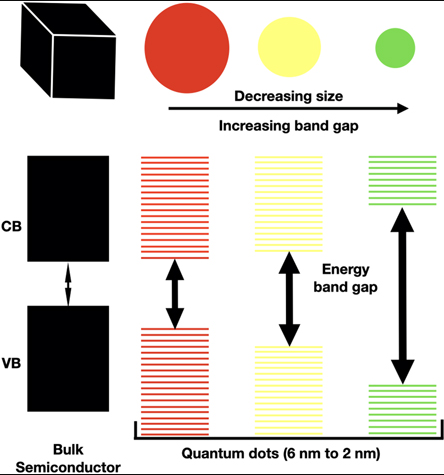
The size-dependent band gap energy is one of the main distinctions between bulk materials and QDs [5]. The band gap energy in bulk materials is a fixed characteristic that remains constant regardless its size. Secondly, the QDs band gap energy as depicted in Figure 1 is inversely related to QD size. Because it controls the quantum confinement effect’s strength, the size of the QDs is significant. Compared to bigger QDs, smaller ones have higher energy levels and stronger quantum confinement. A key element in the development of novel devices and their uses is controlling the size of the QD during growth [6]. Numerous optical characteristics are produced by this size-dependent band gap energy, such as adjustable emission and absorption spectra.
QDs for Drug Delivery
QDs are an ideal option for biosensing, bioimaging, and diagnostic applications, primarily in the biomedical and environmental sciences, due to their high luminescence, narrow emission, and (based on the elemental composition) low toxicity and biocompatibility. In this regards, fibrous phosphorus QDs were demonstrated to be fluorescent markers for bioimaging of human adenocarcinomas. Moreover, it has been shown that CuInS2/ZnS QDs can be useful as cell imaging markers due to their minimal nonspecific attachment and potential for biosynthesis [7]. Utilizing quantum dots (QDs) for drug delivery is an area of active research with both opportunities and challenges. Here’s an analysis: Targeted Delivery: Targeting ligands, like peptides or antibodies, can be functionalized on quantum dots to transport medications to particular cells or tissues. With few off-target effects, this tailored method can maximize therapeutic efficacy. Imaging Capabilities: Due to their exceptional an attractive optical characteristics, such as their great brilliance and photostability, quantum dots are useful agents for imaging- guided medication delivery. Researchers can track the distribution and uptake of medications in real-time by adding imaging agents into QD-drug combines, which helps to optimize delivery tactics. Adjusted Release: It is possible to construct QDs which will release medication in reaction to environmental factors like illumination, pH, temperature, or the activity of enzymes. With the exact spatiotemporal control this controlled-release mechanism provides over drug release, systemic toxicity may be reduced and therapeutic results may be enhanced. Multifunctionality: Within a single nanoparticle platform, quantum dots can be made to transport numerous payloads, such as medicinal medicines, imaging agents, and targeting moieties. Combination therapies and theranostic applications, where therapy and diagnosis are combined into one system, are made possible by this multifunctionality. Biocompatibility and Toxicity: A crucial factor to take into account is making sure quantum dot-based medication delivery systems are safe and biocompatible. Despite great advancements in the development of biocompatible QDs, questions about their long-term toxicity, biodistribution, and bodily clearance still need to be answered by thorough preclinical research [8]. Scalability and Manufacturing: For quantum dot synthesis and functionalization to be translated into applications in healthcare, efficiency and affordability are critical challenges. Maintaining the repeatability of QD-based drug delivery systems and optimizing manufacturing procedures are crucial to their wider implementation. Regulatory Hurdles: There are regulatory obstacles pertaining to safety, efficacy, and manufacturing standards for QD-based medication delivery devices. Strict adherence to good manufacturing standards (GMP), thorough preclinical examination, and strict quality control are necessary for satisfying regulatory criteria for translation into clinical trials.
Conclusion
To summarize, QDs have the potential to be used in drug delivery applications because of their versatility, controlled release, scanning abilities, and precise administration. To reach their full potential in clinical settings, though, issues with biocompatibility, scalability, and regulatory approval must be resolved. In order to triumph over these obstacles and get QD-based medication delivery closer to clinical translation, additional research and development work is required.
References
-
Bawendi MG, Brus LE, Yekimov A (2023) Press release. The Nobel Prize in Chemistry 2023.
-
Ameta SC (2023) Chapter 1 – Introduction. Quantum Dots pp: 1-13.
-
Kushagra A, Himanshu R, Sandip M (2023) Quantum dots: an overview of synthesis, properties, and applications. Mater Res Express 10: 062001.
-
Cotta MA (2020) Quantum Dots and Their Applications: What Lies Ahead. ACS Appl Nano Mater 3(6): 4920-4924.
-
EL Ghazi H, Ptere AJ (2015) Threshold pump intensity effect on the refractive index changes in InGaN SQD: Internal constitution and size effects. Physica B: Condensed Matter 462: 30-33.
-
Hu Y, Lindberg M, Koch S (1990) Theory of optically excited intrinsic semiconductor quantum dots. Phys Rev B 42: 1713.
-
Mallick S, Kumar P, Koner AL (2019) Freeze-Resistant Cadmium- Free Quantum Dots for Live-Cell Imaging. ACS Appl Nano Mater 2(2): 661-666.
-
Jeladhara S, Jose VR, Abdulaziz A, Edakkattuparambil SS, Yuta T, et al. (2023) Luminescent quantum dots: Synthesis, optical properties, bioimaging and toxicity. Advanced Drug Delivery Reviews 197: 114830.
- Solution-Processed Chiral Perovskites for Biomedical Applications
- Nanotechnology in Health Chemistry and Medicine: Current Challenges and Future Directions
- Human Exposure to Micro- and Nanoplastics: Pathways, Toxicity, and Intervention Strategies
- Exosome Nanomedicine for Cancer Therapy
- Micro and Nanoplastics–Plastisphere, Biotoxicity, Impact on Human Health, and Mitigation Strategies
- Process Validation of Cefixime Powder for Suspension Dosage Form, 50 mL