
Heat Transfer Enhancement of MHD Mixed Convective Nanofluid Flow in a Double Lid Driven Enclosure with Sinusoidal Boundary Heat Source
A numerical analysis of MHD mixed convective flow through copper-water nanofluid in a double lid driven enclosure with wavy bottom wall is executed. The top wall of the enclosure is kept insulated, the vertical walls are cooled isothermally and are moving at a constant speed in the upward and downward directions respectively whereas the wavy bottom wall is considered as sinusoidal heat source. The physical problem is represented mathematically by a set of governing equations and these equations are solved by using finite element method of Galerkin weighted residual approach. The fundamental flow physics and thermal behavior are explored in terms of relevant parameters through streamlines, isotherms and average Nusselt number. The results demonstrate that heat transfer rate intensifies with the increasing value of solid volume concentration of nanoparticle and declines with the enhancement of magnetic strength. Best heat transfer performance is apparent in absence of magnetic field in the natural convection regime.
Abbreviations
cp: Specific Heat at Constant Pressure; g: Gravitational Acceleration [ms-2]; h: Convective Heat Transfer Coefficient [Wm-2K-1]; k: Thermal Conductivity of Fluid [Wm-1K-1]; T: Dimensional Temperature [K]; ΔT: Dimensional Temperature Difference [K]; u,v: Dimensional Velocity Components [ms- 1]; U,V: Dimensionless Velocity Components; x,y: Cartesian Coordinates; X,Y: Dimensionless Cartesian Coordinates; c: Cold; α: Thermal Diffusivity [m2s-1]; β: Thermal Expansion Coefficient [K-1]; ν: Kinematic Viscosity [m2s-1]; Gr: Grashof Number; Ha: Hartmann Number; Re: Reynolds Number; Ri: Richardson Number; Nu: Nusselt Number; p: Dimensional Pressure [Nm-2]; P: Dimensionless Pressure; Pr: Prandtl Number; V_0: Lid Velocity [_ms-1]; B_0: Magnetic Induction [_Wbm-
2]; h: Heated; μ: Dynamic Viscosity of the Fluid [m2s-1]; θ: Non- Dimensional Temperature; ρ: Density of the Fluid [Kgm-3].
Introduction
There exist flows which are caused by the temperature differences and also by concentration differences. These
mass transfer differences affect the rate of heat transfer. In industries, many transference processes exist in which heat and mass transfer takes place simultaneously as a result of combined buoyancy effect of thermal diffusion and diffusion through chemical species. The occurrence of heat and mass transfer frequently takes place in chemically processed industries such as food processing and polymer production. Utilizing conventional fluids like water, oil, and ethylene glycol was the very first idea for heat transfer. Abu- nada E, et al. [1] investigated nanofluid flow of combined convection using a moving lid wavy walled enclosure. Armaghani T, et al. [2] considered entropy generation due to heat source/sink effect in an Al2O3Cu/water hybrid nanofluid in L-shaped cavity. They remarked that entropy generation for the source heat generation is 20% more than that of sink heat generation at volume fraction of 0.1. They have also remarked that amongst different types of nanofluids, the best local nusselt number is for Cu-water, which is 29% more than nusselt number in pure water. Bensouici FZ, et al. [3] focused on combined convection for various nanofluids cramped in a moving lid cavity furnished with a heat source. Their study shows that, the nanofluids with high thermal conductivity materials transfer more heat than low thermal conductivity materials. Chamkha AJ, et al. [4] used a moving lid cavity to analyze MHD combined convection of nanofluid to determine the impacts of entropy generation, heat sink and source. Choi SUS, et al. [5] were the first ones to introduce adding nanoparticles to the base fluid (water). Their ultimate goal was to boost up the thermal conductivity of water by mixing metallic nanoparticles of high thermal conductivity. Chowdhury K [6] used a square cavity to analyze the effect of a heated circular obstacle on free convection. Chowdhury K, et al. [7] analyzed MHD combined convection flow in a moving lid cavity equipped with wavy wall and heated circular body. Chowdhury K, et al. [8] used a partially heated and cooled square cavity equipped with diamond shaped heated block to investigate the free convection flow. Chowdhury K, et al. [9] studied combined convection in a double lid-driven wavy shaped moving lid cavity equipped with magnetic field and a cylindrical heat source. Javaherdeh K, et al. [10] used a wavy enclosure equipped with magnetic field and variable heat surface temperature to analyze natural convection of nanofluid flow. Keya ST, et al. [11] used a double-pipe heat exchanger in a moving lid enclosure to investigate conjugate combined convection flow. Mackolil J, et al. [12] used nanoparticle interfacial layer and cross diffusion to analyze marangoni convection in nanoliquid and optimized heat transfer using Sensitivity Analysis. Mahanthesh B, et al. [13] used inclined magnetic field and heat source to analyze convective heat transfer and optimized the result by using Sensitivity Analysis. Mahalakshmi T, et al. [14] focused on MHD mixed convective fluid flow in a moving lid enclosure with a center heater for Ag-water nanofluid. They reported that higher center heater length and solid concentration of nanoparticles boosts up the mean Nusselt number. They also found that the augmentation of Ha reduces the average Nu. Mamourian M, et al. [15] used entropy generation and inclination angles to analyze MHD natural convection flow in Al2O3-water nanofluid and also used Response Surface Methodolgy for Sensitivity Analysis. Mojumder S, et al. [16] used a porous L-shaped cavity to study combined convection. The objective of this work is to investigate numerically MHD mixed convective Cu-water nanofluid flow in a double lid driven enclosure with internal and sinusoidal boundary heat sources. Nasrin R [17] Analyzed MHD mixed convective fluid flow in a moving lid sinusoidal wavy walled cavity with a central heat-conducting body. Rahman MM, et al. [18] studied nanofluid using a moving lid cavity to analyze the intensification of heat transfer. Tiwari RK, et al. [19] used a two-sided lid driven non-uniformly heated square enclosure to study heat transfer phenomena of nanofluids. Uddin MN, et al. [20] analyzed double diffusive combined convection nanofluid flow using an inclined plate equipped with porous medium and heat generation to show the effects of viscous dissipation. Uddin MN, et al. [21] analyzed mixed convective nanofluid flow using a porous media to show the chemical reaction effects on the flow of Titanium Dioxide-water.
Based on the above discussion, it can be summarized that, no study on MHD mixed convective nanofluid flow in a double lid driven enclosure with sinusoidal boundary heat source has been done. That’s why, the objective of this work is to investigate numerically the flow behavior and heat transfer phenomena of nanofluid in a double lid driven cavity with wavy heat source. The effect of magnetic field and solid fraction of nanoparticles in different convective regimes are analyzed elaborately in this study.
Model Description and Governing Equations
The treated problem is investigated inside a double lid driven enclosure with wavy shaped bottom wall. The height and width of the enclosure are considered as H and L with H/L = 1. The physical configuration and coordinate system is shown in Figure 1. The vertical side walls are isothermally cooled, whereas the sinusoidal bottom surface is considered as isothermal heat source and the top wall is kept adiabatic. The left and right vertical walls are assumed to move in the upward and downward directions with velocity V_0=1 and_V_0 = -1 respectively while no-slip boundary conditions are imposed on other walls. A uniform external magnetic field _B_0 is applied in the direction of negative _X-axis normal to the vertical walls. The nanofluid inside the enclosure is considered as laminar, incompressible, Newtonian and the nanoparticles are assumed to have a uniform shape and size. The base fluid and nanoparticles are also considered in thermal equilibrium condition.
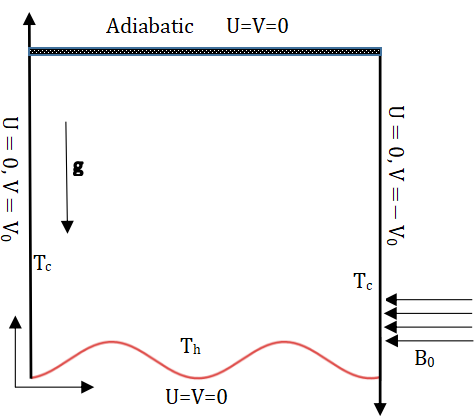
Based on the above assumptions, the governing equations for steady two-dimensional MHD mixed convective nanofluid flow can be written in dimensionless form as follows:
$$ \frac {\partial U}{\partial X} + \frac {\partial V}{\partial Y} = 0 \tag {1} $$ µ
2 1 Re
U U P U V U X Y X v
$$ V \frac {\partial U}{\partial X} + V \frac {\partial U}{\partial Y} = - \frac {\partial P}{\partial X} + \frac {\mu_ {n f}}{\rho_ {n f} v _ {f}} \frac {1}{\mathrm {R e}} \nabla^ {2} U \tag {2} $$ nf nf f $$ \frac {\partial U}{\partial X} + V \frac {\partial U}{\partial Y} = - \frac {\partial P}{\partial Y} + \frac {\mu_ {n f}}{\rho_ {n f} v _ {f}} \frac {1}{\mathrm {R e}} \nabla^ {2} V + \frac {\beta_ {n f}}{\beta_ {f}} \frac {G r}{\mathrm {R e} ^ {2}} \theta - \frac {H a ^ {2}}{\mathrm {R e}} V \tag {3} $$
2 2 2 1 Re Re Re
U U P Gr Ha U V V V X Y Y v
nf nf nf f f $$ V \frac {\partial \theta}{\partial X} + V \frac {\partial \theta}{\partial Y} = \frac {\alpha_ {n f}}{\alpha_ {f}} \frac {1}{\mathrm {R e P r}} \nabla^ {2} \theta \tag {4} $$
2 1 RePr
nf f U V X Y
With following boundary conditions
0, 1, 0 0 0 U V at X and Y L
θ $$ \left. \begin{array}{l} V = 0, V = 1, \theta = 0 a t X = 0 a n d 0 \leq Y \leq L \\ V = 0, V = - 1, \theta = 0 a t X = L a n d 0 \leq Y \leq L \\ V = V = 0, \frac {\partial \theta}{\partial y} = 0 a t Y = L a n d 0 \leq X \leq L \\ V = V = 0, \theta = 1 a t t h e w a v y b o t t o m s u r f a c e \end{array} \right\} $$
0, 1, 0 0 U V at X Land Y L
θ θ (5)
0, 0 0 U V atY Land X L y U V at thewavybottom surface
0, 1 θ Where,
the effective density of nanofluid
$$ \rho_ {n f} = \left(1 - \phi\right) \rho_ {f} + \phi \rho_ {s} $$ in which f ρ , sρ and φ are the density of the base fluid, density of the nanoparticle and solid fraction of the nanoparticles respectively. the heat capacity of nanofluid ( ) ( )( ) ( ) 1 p p p nf f s C C C ρ φ ρ φ ρ = − + the thermal expansion coefficient of the nanofluid ( ) ( )( ) ( ) 1 nf f s ρβ φ ρβ φ ρβ = − + k nf nf $$ 1 \alpha_ {n f} = \frac {k _ {n f}}{\left(\rho C _ {p}\right)} $$ the thermal diffusivity of the nanofluid ( ) p nf The Brinkman model is used in this study for the viscosity of the nanofluid. The effective dynamic viscosity of $$ \mu_ {n f} = \frac {\mu_ {f}}{\left(1 - \phi\right) ^ {2}} $$ the nanofluid is defined as .
( )
2.5 1 The effective thermal conductivity of the nanofluid is determined by using the Maxwell model. For the suspension of spherical nanoparticles in the base fluid ( ) ( ) ( ) ( )
2 2 k k k k k
φ $$ - = \frac {\left(k _ {s} + 2 k _ {f}\right) + 2 \phi \left(k _ {f} - k\right)}{\left(k _ {f} + 2 k _ {s}\right) + \phi \left(k _ {f} - k\right)} $$ s f f s nf k k k k k
2 φ f f s f s
The following dimensionless variables and parameters are used to convert the dimensional continuity, momentum and energy equations into dimensionless form T T x y u v pL X Y U V P L L V V V T T $$ \left. \begin{array}{l} = \frac {x}{L}, Y = \frac {y}{L}, U = \frac {u}{V _ {0}},, V = \frac {v}{V _ {0}}, P = \frac {p L ^ {2}}{\rho_ {n f} V _ {0}}, \theta = \frac {T - T _ {c}}{T _ {h} - T _ {c}} \\ r = \frac {g \beta_ {f} \Delta T L ^ {3}}{\upsilon_ {f} ^ {2}}, \mathrm {R e} = \frac {V _ {0} L}{\upsilon_ {f}}, R i = \frac {G r}{\mathrm {R e} ^ {2}}, \mathrm {P r} = \frac {\upsilon_ {f}}{\alpha_ {f}}, H a = B _ {0} L \sqrt {\sigma_ {f} / \rho_ {f} \upsilon_ {f}} \end{array} \right\} $$
g TL V L Gr Gr Ri Ha B L
3 0 0 2 2 β υ σ ρ υ υ υ α f f f f f f f f
,Re , ,Pr , / Re
(6) Where the dimensionless numbers Pr, Gr, Re, Ha and Ri are the Pr and tl number, Grash of number, Reynolds number, Hartmann number and Richardson number respectively. The heat transfer rate is computed at the wavy wall and is expressed in terms of the local Nusselt number as $$ \bar {N} u = \frac {h L}{k} = - \frac {\partial \theta}{\partial N} L, $$
, Where N is the spaces alongside y-axis perpendicular to wavy wall. The dimensionless normal temperature gradient can be written as
| Where,the effective density of nanofluid ρnf=(1-φ)ρf+φρs | $\frac{\partial \theta}{\partial N}=\frac{1}{L}\sqrt{\left(\frac{\partial \theta}{\partial X}\right)^{2}+\left(\frac{\partial \theta}{\partial Y}\right)^{2}}$ |
Table 1: Thermophysical Properties of Base Fluid and Solid Nanoparticles.
The average Nusselt number at the bottom sinusoidal surface of the enclosure is obtained by integrating the local k Nu ds k s N θ ∂ = − ∂ ∫ , Where S is the length of wavy wall.
0 1 s nf avg f
| Water | Copper (Cu) | |
|---|---|---|
| ρ | 997.1 | 8933 |
| β | 21 × 10-5 | 1.67 × 10⁻⁵ |
| k | 0.613 | 401 |
| Cp | 4179 | 385 |
| σ | 5 × 10⁻² | 5.96 × 10⁻⁷ |
Table 2: Thermophysical Properties of Base Fluid and Solid Nanoparticles.
Techniques of Numerical Simulation
The governing equations (1-4) along with boundary conditions (5) have been simulated using finite element method. In this method, the entire domain is segmented into finite number of triangular meshes. Then the conservation equations are transformed into a system of integral equations with the help of Galerkin’s method. These nonlinear equations are then transformed into linear equations and are solved using triangular factorization method to find the values of velocity components (U, V) and temperature (θ). Moreover, the numerical results are presented graphically using the post processing software Microsoft Excel.
Results and Discussion
The characteristics of fluid flow and temperature field in a double lid driven enclosure filled with Cu-water nanofluid with wavy bottom surface is examined in this study by exploring the effects of Richardson number (Ri), Hartmann number (Ha) and solid fraction of nanoparticle (ϕ). Prandtl number Pr and Reynolds number Re are kept constant as 6.2 and 100 respectively. Grashof number Gr is considered as $$ 1 0 ^ {3} \leq G r \leq 1 0 ^ {5}. $$
. The working fluid inside the enclosure is considered as Cu-water nanofluid with solid volume fraction $$ 0 \leq \phi \leq 0. 1. $$
. The flow behavior and temperature distribution are analyzed through streamlines and isotherms whereas average Nusselt number portrays the heat transfer rate within the enclosure.
Effect of Nanoparticle on Fluid Flow at Different Convective Regions
The significance of the effect of 3 types of convection phenomena is represented by the Richardson number (Ri) in heat transfer problems. If Ri≪1, then convection is insignificant, and conduction is dominant in the fluid flow but if Ri≫1 then natural convection dominates the fluid flow. Figure 2 depicts the fluid flow characteristics inside the enclosure through streamlines due to the variation of solid volume fraction ϕ and Richardson number Ri. As can be seen from figure, for purely forced convection dominated region, there exists a clockwise rotating unicellular vortex which turns to the cold vertical walls and falls down to form a weak elliptical shaped eddy in the center of the enclosure in wavy form owing to the presence of sinusoidal surface. This is due to the dominance of forced convection in the flow regime created by the movement of opposite lid driven walls. The pattern of the streamlines is almost identical for all values of ϕ. In the mixed convection dominated region (Ri = 1) where the forced and natural convection are equally dominant, no remarkable change is noticed in the shape of the vortex in comparison with Ri = 0.1. Further increase of Ri to 10 causes the nanofluid to circulate strongly occupying almost the whole enclosure by splitting the vortex vertically in three parts. Among which two vortices circulates clockwise and the middle one circulates counterclockwise direction. This is very logical because mounting the parameter Ri backings buoyancy flow and hence natural convection mode. The influence of Ri and ϕ on the temperature field inside the enclosure is depicted in Figure 3 through isothermal lines. It can be seen from figure that in the forced convection dominated region, the isothermal lines bifurcate creating a plume in the left side of the enclosure. These lines depart from the middle section of the enclosure and try to get crowded on the bottom wavy surface due to the influence of heated wall. These lines become wavy pattern due to the waviness of the bottom surface. Enhancing the convective parameter Ri to 10 steeper temperature gradient is noticeable, and the plume enlarges occupying more space in the enclosure. It is also evident that the flow pattern is balanced by the buoyancy effect and a thin boundary layer is developed near the bottom wavy surface.
| Φ=0 | |||
|---|---|---|---|
| Φ=0.04 | |||
| Φ=0.07 | |||
| Φ=0.1 | |||
| Ri=0.1 | Ri=1 | Ri=10 | |
| Φ=0.04 | |||
| Φ=0.07 | |||
| Φ=0.1 | |||
| Ri=0.1 | Ri=1 | Ri=10 |
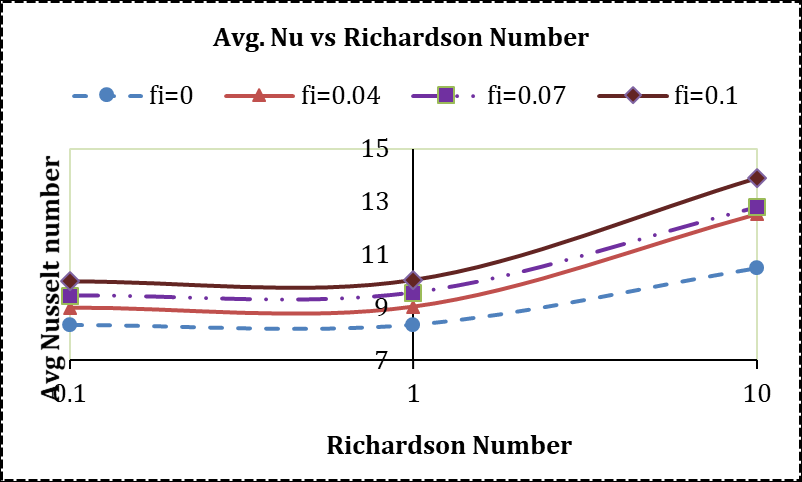
The variation of average Nusselt number along the wavy wall at different Richardson numbers for increasing values of solid fraction of nanoparticle is depicted in Figure 4. As can be seen from figure, heat transfer rate increases with the increasing values of solid fraction of nanoparticle which enhances the healthier thermal transport of the fluid within the enclosure. The better enrichment of heat transfer is obtained for increasing values of Richardson numbers and the rate of increase is developed in the natural convection regime than that of forced convection regime. It is apparent in the figure that heat transfer rate is minimum in the forced convection regime for pure fluid and maximum at ϕ = 0.1 in the natural convection regime.
The effect of magnetic field on fluid flow in different convective regimes is depicted in Figure 5. Figure shows that, in the absence of magnetic field (Ha = 0) the fluid flow is characterized by a clockwise unicellular vortex in the center of the enclosure which is generated by the movement of left and right vertical walls. The core of the recirculating vortex becomes weaker with mounting the strength of magnetic field from 0 to 90 gradually. The reason is that, magnetic field creates a Lorentz force which opposes the buoyancy force and slows down the fluid motion within the enclosure. At Ha = 0 streamlines circulate generously but boosting the value of Ha, the magnetic force quantifies and shrinks the core of the vortex. From the streamline contours it is noticeable that at Ri = 0.1 and Ha = 0 there exists a clockwise recirculating egg-shaped vortex in the center of the enclosure due to the dominance of forced convection in the flow regime. At Ri = 1 the streamlines started to distort and for further increase of Ri to 10, the streamlines circulate muscularly by splitting the core of the vortex in three parts occupying the whole enclosure which is a clear indication of natural convection. The influence of magnetic field on temperature field in different convective regimes is plotted in the Figure 6. As seen from figure, at Ha = 0 the isothermal lines occupy the whole enclosure with an instigation of the plume-like behavior but with the increasing value of Ha these lines started to be aligned to the heated wall and at Ha = 90 these lines become nearly parallel to the bottom wavy surface of the enclosure. As a result, with the increasing effect of magnetic field the density of the isothermal lines reduces and the thermal boundary layer becomes thinner near the hot surface. Figure also shows that, at Ri = 0.1 the isothermal lines are nearly parallel to the heated wall of the enclosure indicating that most of the heat is transferred by conduction. At Ri =1 the isothermal lines started to change their pattern. Further increase of Ri to 10 where the heat transfer befalls only for buoyancy force a remarkable change in isotherm pattern is found compared to that of Ri = 0.1. In this case, condition strongly favors the phenomena of natural convection.
| Ha=0 | |||
|---|---|---|---|
| Ha=30 | |||
| Ha=60 | |||
| Ha=90 | |||
| Ri=0.1 | Ri=1 | Ri=10 | |
| Ha=0 | |||
| Ha=30 | |||
| Ha=60 | |||
| Ha=90 | |||
| Ri=0.1 | Ri=1 | Ri=10 |
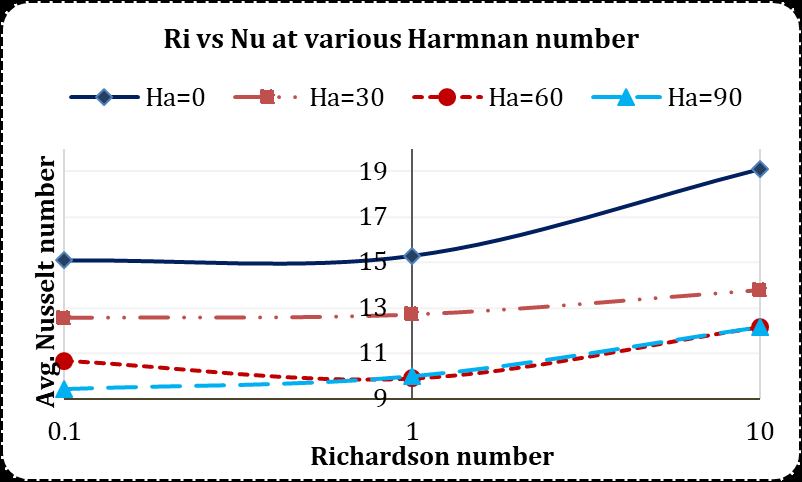
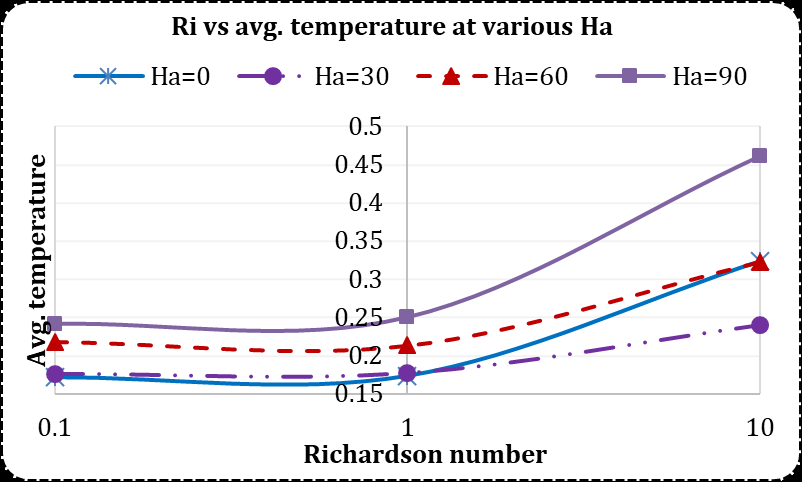
In order to evaluate the overall heat transfer rate as a function of Richardson number, the average Nusselt number at the hot surface for the above-mentioned Hartmann numbers is depicted in Figure 7. As shown in the figure, heat transfer rate increases gradually with the increasing value of Ri and the rate of increase is higher in natural convection regime than that of forced convection regime. Because with the augmentation of Ri, buoyancy force boosts up and huge amount of heat is transferred from the heated wall to the other part of the enclosure. From figure it is also evident that, average Nusselt number decreases with the increasing value of Hartmann number. In absence of magnetic field heat transfer rate is maximum and it decreases with the increasing value of Hartmann number. Since the magnetic field acts in opposition to the fluid velocity the strength of the circulation declines with the augmentation of Ha and tends to retard the fluid motion within the enclosure. The variation of average temperature within the enclosure at different Richardson numbers for increasing values of Hartmann number is depicted in Figure 8. As can be seen from figure, average temperature increases with the increasing values of Hartmann number and it is maximum at Ha = 90 in the natural convection regime.
Conclusion
- Solid fraction of nanoparticle exhibits a significant role on heat transfer rate. Heat transfer rate increases with the increasing value of ϕ. It is maximum for higher value of ϕ in the natural convection region and minimum for pure fluid in the forced convection region.
- Magnetic field has a strong influence on fluid flow. Heat transfer rate declines with the increasing value of magnetic strength and vice versa.
References
-
Abu-Nada E, Chamkha AJ (2014) Mixed convection flow of a nanofluid in a lid-driven cavity with a wavy wall. International Communications in Heat and Mass Transfer 57: 36-47.
-
Armaghani T, Sadeghi MS, Rashad AM, Mansour MA, Chamkha AJ, et al. (2021) MHD mixed convection of localized heat source/sink in an Al2O3-Cu/water hybrid nanofluid in L-shaped cavity. Alexandria Engineering Journal 60(3): 2947-2962.
-
Bensouici FZ, Boudebous F (2017) Mixed convection of nanofluids inside a lid-driven cavity heated by a central square heat source. Fluid Dynamics and Materials Processing 13(3): 189-212.
-
Chamkha AJ, Rashad AM, Mansour MA, Armaghani T, Ghalambaz M (2017) Effect of heat sink and source and entropy generation on MHD mixed convection of a Cu- water nanofluid in a lid driven square porous enclosure with partial slip. Physics of fluids 29(5): 1-22.
-
Choi SUS, Eastman JA (1995) Enhancing thermal conductivity of fluids with nanoparticles. Enhancing thermal conductivity of fluids with nanoparticle, USA.
-
Chowdhury K (2016) Effect of the presence of a heated circular obstacle on natural convection inside a square enclosure. Presidency University Journal 3(2): 38-46.
-
Chowdhury K, Alim A (2019) MHD mixed convection flow in a lid driven enclosure with a sinusoidal wavy wall and a heated circular body. International Journal of Fluid echanics & Thermal Sciences 5(4): 102-110.
-
Chowdhury K, Alim A, Hossen M (2020) Natural convection in a partially heated and cooled square enclosure containing a diamond shaped heated block. International Journal of Fluid Mechanics & Thermal Sciences. 6(1): 1-8.
-
Chowdhury K, Alim MA (2023) Mixed convection in a double lid-driven wavy shaped cavity filled with nanofluid subject to magnetic field and internal heat source. Journal of Applied Mathematics Hindawi: 1-13.
-
Javaherdeh K, Moslemi M, Shahbazi M (2017) Natural convection of nanofluid in a Wavy cavity in the presence of magnetic field on variable heat surface temperature. Journal of Mechanical Science and Technology 31(4): 1937-1945.
-
Keya ST, Yeasmin S, Rahman MM, Karim MF, Amin MR (2022) Mixed convective heat transfer in a lid- driven enclosure with a double-pipe heat exchanger. International Journal of thermofluids 13: 1-11.
-
Mackolil J, Mahanthesh B (2021) Heat transfer optimization and sensitivity analysis of marangoni convection in nanoliquid with nanoparticle interfacial layer and cross diffusion effects. International Communications in Heat and Mass Transfer 126: 1-10.
-
Mahanthesh B, Thriveni K (2020) Sensitivity analysis of heat transfer in nanoliquid with inclined magnetic field, exponential space-based heat source, convective heating, and slip effects. Heat Transfer 50(3): 2362-2379.
-
Mahalakshmi T, Nithyadevi N, Oztop HF, Abu-Hamdeh N (2018) MHD mixed convective heat transfer in a lid- driven enclosure filled with Ag-water nanofluid with center heater. International Journal of Mechanical Sciences 142-143: 407-419.
-
Mamourian M, Shirvan KM, Pop I (2016) Sensitivity analysis for MHD effects and inclination angles on natural convection heat 2 transfer and entropy generation of Al2O3-water nanofluid in square cavity by Response 3 Surface Methodology. International Communications in Heat and Mass Transfer 79(79): 46-57.
-
Mojumder S, Saha S, Rahman MR, Rahman MM, Rabbi KM, et al. (2017) Numerical study on mixed convection heat transfer in a porous L-shaped cavity. Engineering Science and Technology an International Journal 20(1): 272-282.
-
Nasrin R (2011) Mixed magnetoconvection in a lid driven cavity with a sinusoidal wavy wall and a central heat conducting body. Journal of Naval Architecture and Marine Engineering 8(1): 13-24.
-
Rahman MM, Billah MM, Hasanuzzaman M, Saidur R, Rahim NA (2012) Heat transfer enhancement of nanofluids in a lid driven square enclosure. Numerical Heat Transfer 62(12): 973-991.
-
Tiwari RK, Das MK (2007) Heat transfer augmentation in a two sided lid-driven differentially heated square cavity utilizing nanofluids. Int J Heat Mass Transfer 50(9-10): 2002-2018.
-
Uddin MN, Chowdhury K, Mim JF (2024) Chemical reaction effects on the flow of Titanium Dioxide-water in a mixed convective nanofluid along an inclined plate in a porous medium. Advances in Mathematical Physics 2024: 1-11.
-
Uddin MN, Tahrim T, Alim MA (2022) Effects of viscous dissipation on double diffusive mixed convective nanofluid flow along inclined plate in porous medium with heat generation. International Journal of Innovative Science and Research Technology 7(10): 569-577.
- Solution-Processed Chiral Perovskites for Biomedical Applications
- Nanotechnology in Health Chemistry and Medicine: Current Challenges and Future Directions
- Human Exposure to Micro- and Nanoplastics: Pathways, Toxicity, and Intervention Strategies
- Exosome Nanomedicine for Cancer Therapy
- Micro and Nanoplastics–Plastisphere, Biotoxicity, Impact on Human Health, and Mitigation Strategies
- Process Validation of Cefixime Powder for Suspension Dosage Form, 50 mL