
Involvement of Calcium, Ras, MAPK, PI3K-Akt and mTOR Signaling Pathways in Autism Spectrum Disorders
Autism Spectrum Disorders (ASDs) are a highly variable spectrum of behaviorally defined neuro-developmental conditions. The involvement of cell signaling pathways such as MAPK (mitogen-activated protein kinases, also known as ERK, extracellular signal-regulated kinases) signaling, PI3K (phosphatidylinositol 3–kinase) -Akt signaling, mTOR (mammalian target of rapamycin) signaling, Ras signaling and calcium signaling pathways have been observed in ASDs using methodologies from several disciplines, including genetics, bioinformatics and biological studies. These pathways interact with each other and profoundly influence a number of cellular activities including cell differentiation, proliferation, metabolism, and response to environmental signals. To understand how these signaling pathways may contribute to the mechanisms that may underlie ASDs, it is important to look at their interactions and function networks. This article discussed the involvement of these signaling pathways in ASDs and proposed a pathway network analysis for further studies.
Introduction
ASDs are characterized by social impairments, communication difficulties, and restricted, repetitive, and stereotyped patterns of behavior. While people with the diagnosis meet the same defining behavioral criteria, the spectrum involves great heterogeneity between individuals and across multiple levels - genes, brain characteristics, and comorbidities. A growing number of published studies have identified many conditions that comorbid to ASDs such as anxiety, sleep disorders, gastrointestinal symptoms, epilepsy, diabetes, etc. [1, 2, 3]. Although the discovery of these comorbid multisystem conditions adds further complexity to ASDs, it greatly extends the Pathophysiology of ASDs and begin to render it a systemic rather than strictly neurological phenotype. The mechanisms underlie the spectrum conditions possibly include a functional cellular network which would trigger multisystem dysfunction when disturbed. From reviewing existing findings in published literatures, it is worth noting that cell signaling pathways such as MAPK, PI3K-Akt, mTOR, Ras and calcium signaling pathways are all reported to be linked to ASDs and many other conditions that comorbid to ASDs. These pathways response to extracellular and intracellular cues and regulate a variety of cellular activities. To understand how they function in concert with regard to ASDs may shed lights to understand the pathophysiology.
Involvement of Cell Signaling Pathways to ASDs
Studies have uncovered many potential ASD candidate genes. As of December 2016, the SFARI (Simons Foundation Autism Research Initiative) Gene-Human Gene Module recorded 859 human genes implicated as relevant to ASDs. The signaling transduction pathways, Calcium, Ras, MAPK, PI3K-Akt, and mTor signaling pathways, have some of these ASD associated genes as components (Table 1). This suggests that these pathways may be influence by the genetic defects that associated with ASDs and their function may be disturbed in ASDs. Published studies from various disciplines and perspectives have identified links between these pathways and ASDs.
| Pathway | ASD Associated Genes in the Pathway |
|---|---|
| Calcium Signaling Pathway | ATP2B2, CHRM3, ADORA2A, ADRB2,DRD1, HTR7, GNAS, PLN, CACNA1C, CACNA1D, CACNA1F, CACNA1A, CACNA1B, CACNA1E, CACNA1G, CACNA1H, CACNA1I, CHRNA7, P2RX4, P2RX5, GRIN1, GRIN2A, GRM1, GRM5, GRPR, HTR2A, OXTR, AVPR1A, PTGER3, ERBB4, GNA14, PLCD1, PLCB1, CD38, CAMK4, NOS1, PDE1C, PRKCB |
| Ras Signaling Pathway | KIT, FLT1, MET, PTPN11, HTR7, GRIN1, GRIN2A, GRIN2B, HRAS, NF1, SYNGAP1, RASSF5, PIK3R2, MAPK1, MAPK3, PRKCB |
| MAPK Signaling Pathway | CACNA1A, CACNA1B, CACNA1C, CACNA1D, CACNA1E, CACNA1F, CACNA1G, CACNA1H, CACNA1I, CACNA2D3, CACNB2, PRKCB, NF1, BDNF, NTRK1, HRAS, BRAF, MAPK1, MAPK3, RPS6KA3, RPS6KA2, IL1R2, GADD45B, MAPK8IP2, MAPK12, MEF2C |
| PI3K-Akt Signaling Pathway | KIT, FLT1, MET, HRAS, MAPK1, MAPK3, IL6, LAMA1, LAMB1, LAMC3, RELN, THBS1, TNN, ITGA4, ITGB3, ITGB7, PIK3R2, PIK3CG, TSC1, TSC2, MTOR, EIF4E, PTEN, PPP2R1B, PPP2R5D, GSK3B, CDKN1B, YWHAE, BCL2 |
| mTOR Signaling Pathway | MTOR, EIF4E, DEPDC5, TSC1, TSC2, TBC1D7, WNT1, WNT2, DVL3, DVL1, GSK3B, HRAS, BRAF, MAPK1, MAPK3, RPS6KA3, RPS6KA2, PIK3R2, PTEN, PRKCB |
Table 1: ASD associated genes participate in the cell signaling pathways.
Calcium Signaling Pathway
Calcium ions are essential for signal transduction, and impact all kinds of cellular activities. Calcium signaling dysregulation has been studied in ASDs for many years. Mutation of the calcium channel gene CACNA1C was found to be associated with a syndromic autism, Timothy syndrome [4]. Later, more calcium channel genes were reported to be associated with ASDs by studying genome- wide association study (GWAS) data [5]. It has been suggested that disturbances in calcium signaling pathway may contribute greatly to the underlying molecular mechanism of autism [6, 7].
MAPK Signaling Pathway
MAPK signaling pathway is a chain of proteins that response to extracellular signals and transduce the signals to cell nucleus. It is involved in variety of fundamental cellular processes such as differentiation, proliferation, gene expression, mitosis, cell survival and apoptosis [8]. Recently several studies have suggested or supported a link between MAPK signaling and ASDs [7, 8, 9, 11].
PI3K-Akt Signaling Pathway
PI3K-Akt signaling pathway regulates cellular functions such as transcription, translation, proliferation, growth, and survival.PI3K catalyzes the production of phosphatidylinositol-3,4,5-triphosphate (PIP3) which in turn serves as a second messenger that helps to activate Akt. Once active, Akt controls key cellular processes by phosphorylating substrates involved in apoptosis, protein synthesis, metabolism, and cell cycle. Dysregulated PI3K- Akt signaling has been shown to be associated with ASDsb [12]. Mutations in genes TSC1, TSC2, NF1 and PTEN that participate in the PI3K-Akt signaling pathway have also been found to be associated to ASDs [13, 14, 15].
mTOR Signaling Pathway
mTOR is a serine/threonine protein kinase, which exists in two complexes termed mTOR complex 1 (mTORC1) and 2 (mTORC2). mTOR signaling response to both intracellular and extracellular signals and regulate several biological processes, including protein synthesis, cell metabolism, proliferation and survival [16]. Over activated mTOR signaling was found to be linked to ASDs [17], and mTOR was proposed to be a potential target for treating ASDs [18].
Ras Signaling Pathway
The Ras signaling pathway also regulates cell proliferation, survival, growth, migration, and differentiation. Ras proteins transducer signals from extracellular growth factors. It regulates multiple cellular functions through effectors including Raf, MAPK and PI3K. HRAS gene that encodes small GTPase H-Ras in the Ras family, is associated with ASDs [19, 20]. Higher prevalence and severity of autism traits were found in RAS opathies (a group of genetic conditions caused by mutations in genes of the Ras-MAPK pathway) compared to unaffected siblings [21]. This suggests a link between dysregulation of Ras/MAPK signaling and ASDs.
Multisystem Involvement of Cell Signaling Pathways
All these signaling pathways are involved in multiple systems and impact many aspects of cellular life. For example, calcium ion (Ca2+) is likely the most common intracellular massager in neurons, and calcium signaling is critical for neuronal development [22]. Calcium signaling also plays an important role in immune cells [23], regulates metabolism [24], and is involved in the digestive system (gastrointestinal tract, pancreas, and liver)[25]. Ras, MAPK, PI3K-Akt and mTOR signaling pathways are best known for their central roles in cell differentiation, proliferation, metabolism, mitosis, survival and apoptosis, etc. However, they also play roles in neural systems such as regulating dendritic morphogenesis [26]. MAPK and Ras pathways response to neurotransmitters which are the chemicals that allow the transmission of signals from one neuron to the next across synapse9 [27]. MAPK signaling regulates synaptic plasticity [28], PI3K/Akt/mTOR signaling pathways are involved in mental illnesses such as depression in regard to their functions in neuronal cells [29]. Overall, Calcium/Ras/MAPK/PI3K/Akt/mTOR signaling pathways are involved in multiple systems and influence a wide range of cellular activities. Together they form a complicated function network which would lead to variety of consequences when disturbed. The complexity of the signaling pathway network could fit into the great heterogeneity and diverse comorbidities of ASDs. However, how may these pathways specifically contribute to the underlying mechanism of ASDs is unclear. Further studies that emphasize on exploring the links between these signaling pathways and the common features of the spectrum conditions (e.g. social impairments and stereotyped patterns of behavior) may help develop biomarkers and treatment strategies for ASDs.
Signaling Pathway Network
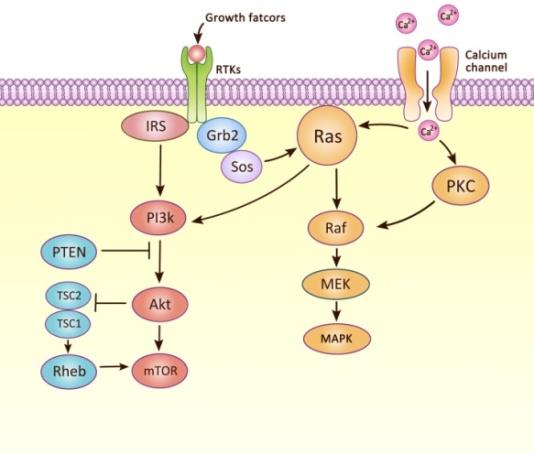
The signaling pathways regulate each other and co- regulate downstream functions. To gain better understanding of how this pathway works together, it is important to put them together and look at them in a framework. (Figure 1) illustrates these pathways in a cellular model. On the cell surface, the calcium channel mediates the influx of calcium ions (Ca2+). Intracellular changes in Ca2+ concentration modulate protein kinase C (PKC) and Ras, which activate proteins including MAPK, PI3K, Akt and Mtor [30]. The receptor tyrosine kinases (RTKs) on the cell membrane activates Ras/MAPK/PI3K/Akt/mTOR signaling too, by binding to extracellular growth factors, and intracellular signal molecules Grb2 (growth factor receptor-bound protein 2), Sos (son of sevenless) and IRS-1 (insulin receptor substrate 1). Activated Ras triggers a phosphorylation cascade Raf-MEK-MAPK. PI3K activation can be accomplished by three different ways: by binding to the phosphorylated intracellular domain of RTK, or by binding to IRS-1 which binds to RTK, or by binding to activated Ras. PI3K activation triggers activation of Akt by phosphorylating PIP3. Akt activates TOR, and eventually leads to series reactions such as protein synthesis [27].
Conclusion
In summary, the signaling transduction pathways: Calcium, Ras, MAPK, PI3K-Akt, and mTOR signaling pathways, are all involved in a wide range of biological activities, and are all linked to ASDs. These pathways share a common feature which is response to environmental signals, and process the information. They interact with each other and impact all kinds of cellular activities. Together they form a complex network. There are a number of ASD associated genes involved in the signal transduction pathway network. Alterations in their function or imbalance in the pathway network may lead to a variety of consequences in multiple systems. Further pathway network studies that put these pathways and ASD associated genes into one picture and focusing on their function in neurodevelopment should help illuminate their contribution to ASD pathophysiology, and even help develop more targeted treatment plans.
References
-
Doshi Velez F, Ge Y, Kohane I (2014) Comorbidity clusters in autism spectrum disorders: an electronic health record time-series analysis. Pediatrics Jan 133(1): 54-63.
-
Kohane IS, McMurry A, Weber G, Mac Fadden D, Rappaport L, et al. (2012) The co-morbidity burden of children and young adults with autism spectrum disorders. PloS One 7(4): 33224.
-
Mannion A, Leader G (2013) Comorbidity in autism spectrum disorder: A literature review. Res Autism Spectr Disord 7(12): 1595-1616.
-
Splawski I, Timothy KW, Sharpe LM, Decher N, Kumar P, et al. (2004) Ca V1.2 Calcium Channel Dysfunction Causes a Multisystem Disorder Including Arrhythmia and Autism. Cell 119(1): 19-31.
-
Lu AT H, Dai X, Martinez Agosto JA, Cantor RM (2012) Support for calcium channel gene defects in autism spectrum disorders. Mol Autism 3(1): 18.
-
Krey JF, Dolmetsch RE (2007) Molecular mechanisms of autism: a possible role for Ca2+ signaling. Curr Opin Neurobiol 17(1): 112-119.
-
Wen Y, Alshikho MJ, Herbert MR (2016) Pathway Network Analyses for Autism Reveal Multisystem Involvement, Major Overlaps with Other Diseases and Convergence upon MAPK and Calcium Signaling. PLOS ONE 11(4): 0153329.
-
Pearson G, Robinson F, Beers Gibson T, Xu B, Karandikar M, et al. (2001) Mitogen-Activated Protein (MAP) Kinase Pathways: Regulation and Physiological Functions. Endocr Rev 22(2): 153-183.
-
Ebert DH, Greenberg ME (2013) Activity-dependent neuronal signalling and autism spectrum disorder. Nature 493 (7432): 327-337.
-
Subramanian M, Timmerman CK, Schwartz JL, Pham DL, Meffert MK (2015) Characterizing autism spectrum disorders by key biochemical pathways. Front Neurosci 9: 313.
-
Garg S, Brooks A, Burns A, BurkittWright E, Kerr B, et al. (2017) Autism spectrum disorder and other neurobehavioural comorbidities in rare disorders of the Ras/MAPK pathway. Dev Med Child Neurol.
-
Chen J, Alberts I, Li X (2014) Dysregulation of the IGF- I/PI3K/AKT/mTOR signaling pathway in autism spectrum disorders. Int J Dev Neurosci Off J 35: 35-41.
-
Smalley SL (1998) Autism and tuberous sclerosis. J Autism Dev Disord 28(5): 407-414.
-
Marui T, Hashimoto O, Nanba E, Kato C, Tochigi M, et al. (2004) Association between the neurofibromatosis-1 (NF1) locus and autism in the Japanese population. Am J Med Genet Part B Neuro psychiatr Genet 131B (1): 43-47.
-
Goffin A, Hoefsloot LH, Bosgoed E, Swillen A, Fryns JP (2001) PTEN mutation in a family with Cowden syndrome and autism, Am J Med Genet 105(6) :521- 524.
-
Laplante M, Sabatini DM (2009) mTOR signaling at a glance. J Cell Scict 122(20): 3589-3594.
-
Sawicka K, Zukin RS (2012) Dysregulation of mTOR signaling in neuropsychiatric disorders: therapeutic implications. Neuropsychopharmacol 37(1): 305-306.
-
Sato A (2016) mTOR, a Potential Target to Treat Autism Spectrum Disorder. CNS Neurol Disord Drug Targets 15(5): 533-543.
-
Hérault J, Perrot A, Barthélémy C, Büchler M, Cherpi C, et al. (1993) Possible association of c-Harvey-Ras-1 (HRAS-1) marker with autism. Psychiatry Res 46(3): 261-267.
-
Hérault J, Petit E, Martineau J, Perrot A, Lenoir P, et al. (1995) Autism and genetics: clinical approach and association study with two markers of HRAS gene. Am J Med Genet 60(4): 276-281.
-
Adviento B, Corbin IL, Widjaja F, Desachy G, Enrique N, et al. (2014) Autism traits in the RAS opathies. J Med Genet 51(1): 10-20.
-
Rosenberg SS, Spitzer NC (2011) Calcium Signaling in Neuronal Development. Cold Spring Harb Perspect Biol -3(10): a004259.
-
Vig M, Kinet J-P (2009) Calcium signaling in immune cells. Nat Immunol 10(1): 21-27.
-
Nguyen MHT, Jafri MS (2005) Mitochondrial calcium signaling and energy metabolism. Ann N Y Acad Sci 1047: 127-137.
-
Nathanson MH (1994) May Cellular and subcellular calcium signaling in gastrointestinal epithelium. Gastroenterology 106(5): 1349-1364.
-
Kumar V, Zhang M-X, Swank MW, Kunz J, Wu G-Y (2005) Regulation of Dendritic Morphogenesis by Ras–PI3K–Akt–mTOR and Ras–MAPK Signaling Pathways. J Neurosci 25(49): 11288-11299.
-
Mendoza MC, Er EE, Blenis J (2011) The Ras-ERK and PI3K-mTOR Pathways: Cross-talk and Compensation. Trends Biochem Sci 36(6): 320-328.
-
Thomas GM, Huganir RL (2004) MAPK cascade signalling and synaptic plasticity. Nat Rev Neurosci 5(3): 173-183.
-
Kitagishi Y, Kobayashi M, Kikuta K, Matsuda S (2012) Roles of PI3K/AKT/GSK3/mTOR Pathway in Cell Signaling of Mental Illnesses. Depress Res Treat 752563.
-
Clapham DE (2007) Calcium Signaling. Cell Dec 131(6): 1047-1058.
- A Review of Gene Therapy for Parkinson's Disease to Control Dopaminergic Neurons
- Late-Onset Myasthenia Gravis in a Patient with Recurrent Breast Cancer: A Case Report
- Covid-Induced Dystonia and Opsoclonus: A Case Report
- Generalized Tonic-Clonic Seizure in a Pediatric Patient with Sunflower Syndrome: A Case Report
- Comparison of Doppler Guided Seldinger Technique Versus Classic Palpatory Seldinger Technique for Radial Artery Cannulation-an Open Label Randomized Controlled Trial
- Brown Sequard Syndrome: Understanding the Complexities of Spinal Cord Injury