
Acute Necrotizing Encephalitis- A Rare Entity
Apitherapy is the scientific term which refers to the medical use of honey, bee venom, propolis, royal jelly, bee pollen, beeswax and apilarnil. Bee venom therapy for arthritis, autoimmune and neurodegenerative diseases is the most wellknown. Numerous studies supported honey for healing of wounds and burns, and even as an anticancer agent. Moreover, several studies evaluating the cardiovascular effects of honey bee products revealed very promising results, paradoxically, apitherapy is still not in focus with a cardiovascular neuropharmacological viewpoint. In an effort to provide extensive information about the cardiovascular bioactivity of natural honey, as the major honey bee product, both in terms of familiarity and profit, this review overviews, for the first time; (1) cardioactive and vascoactive effects of natural honey, (2) mechanisms underlying cardioactive and vasoactive potentials of natural honey, and (3) how improving our knowledge of the mechanisms mediating protective and ameliorative outcomes of natural honey may lead to novel therapeutic strategies for the treatment of cardiovascular diseases? Future challenge remaining will be to permit full exploitation of apitherapy potency to expand novel horizons in the cardiovascular autonomic neuropharmacology
Short Communication
Acute necrotizing encephalitis is characterized by multiple, symmetrical lesions in the thalami, putamina, cerebral and cerebellar white matter, and brain stem tegmentum [1]. Sporadic cases have been reported worldwide and the etiology remains unknown. However, infections such as mycoplasma, influenza virus, herpes simplex virus, and human herpes virus-6 commonly intensify the disease. It is believed to metabolic and immune-mediated reactions. Cytokines such as tumor necrotizing factor-α and interleukins 1 and 6 can intensify the disease [2].
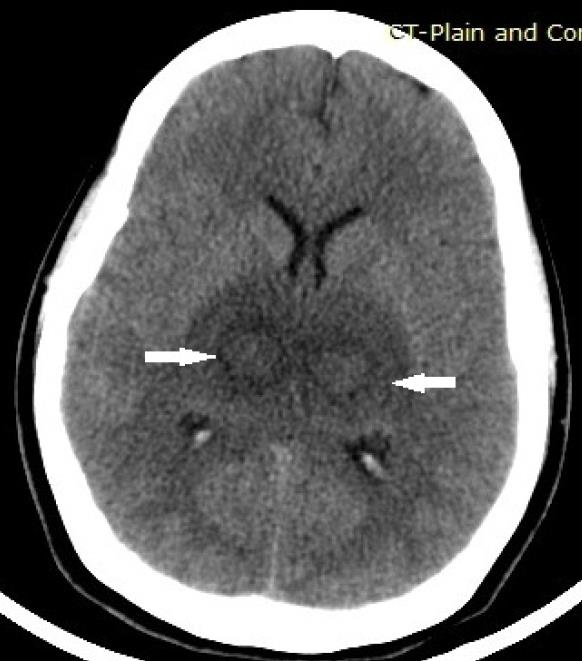
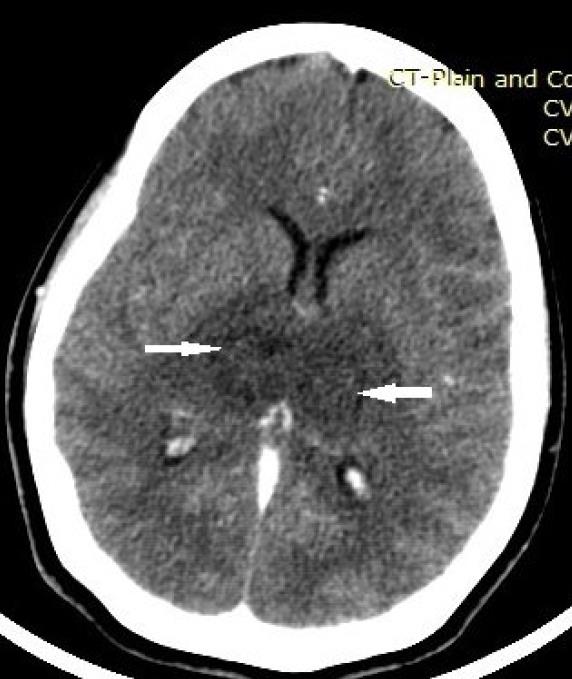
computed tomography brain (Figure 1) revealed symmetrical hypodensity in the thalami which appeared swollen. A centrally located hyperdense area was seen within the hypodensity on both sides resembling “owl’s eye appearance”. There was no post contrast parenchymal or leptomeningeal enhancement (Figure 2). The dural venous sinuses and deep veins were normally opacified with no evidence of any filling defect. Based on the clinical, imaging and laboratory findings a diagnosis of acute necrotizing encephalitis (ANE) was made. Patient was managed with supportive measures including intravenous antibiotics, antiepileptics and rehabilitative measures such as physiotherapy and speech therapy.
ANE is a rare but well recognized entity which usually follows viral infection. It is a clinicoradiologic diagnosis with supportive evidence from laboratory investigations. The sporadic form presents with a prodromal phase of viral infection followed by acute encephalopathy. There is characteristically symmetrical involvement of the thalami which appear hypodense on CT images with foci of haemorrhage. MRI shows bilateral thalamic T2 hyperintensity with areas of necrosis and blooming suggestive of haemorrhage. In addition brainstem, cerebral and cerebellar involvements are also well known [3]. It is associated with transaminitis without hyperammonemia. Thrombocytopenia indicates a bad
prognosis. Cytokine storm following viral infection is proposed as likely etiology. Prognosis varies from complete recovery in some cases to significant morbidity and mortality in others. In previous reports mortality rate was about 30% and less than 10% of patients recovered completely while the neurological sequelae were frequent in patients who survived [4, 5].
References
-
Mizuguchi M, Abe J, Mikkaichi K, Noma S, Yoshida K, et al. (1995) Acute necrotizing encephalopathy of childhood: a new syndrome presenting with multifocal, symmetric brain lesions. J Neurol Neurosurg Psychiatry 58(5): 555-561.
-
Skelton BW, Hollingshead MC, Sledd AT, Phillips CD, Castillo M (2008) Acute necrotizing encephalopathy of childhood: typical findings in an atypical disease. Pediatr Radiol 38(7): 810-813.
-
Wu X, Wu W, Pan W, Wu L, Liu K, et al. (2015) Acute necrotizing encephalopathy: an underrecognized clinicoradiologic disorder. Mediators Inflamm 2015: 792578.
-
Mastroyianni SD, Voudris KA, Ktsarou E, Gionnis D, Mavromatis P, et al. (2003) Acute necrotizing encephalopathy associated with parainfluenza virus in a Caucasian child. J Child Neurol 18(8): 570-572.
-
Lee JH, Lee M (2012) Recurrent acute necrotizing encephalopathy in a Korean child: the first non- caucasian case. Journal of Child Neurology 27(10): 1343-1 347.
- A Review of Gene Therapy for Parkinson's Disease to Control Dopaminergic Neurons
- Late-Onset Myasthenia Gravis in a Patient with Recurrent Breast Cancer: A Case Report
- Covid-Induced Dystonia and Opsoclonus: A Case Report
- Generalized Tonic-Clonic Seizure in a Pediatric Patient with Sunflower Syndrome: A Case Report
- Comparison of Doppler Guided Seldinger Technique Versus Classic Palpatory Seldinger Technique for Radial Artery Cannulation-an Open Label Randomized Controlled Trial
- Brown Sequard Syndrome: Understanding the Complexities of Spinal Cord Injury