
Nucleon Resonance Masses from QCD Sum Rules
We calculate the masses of the nucleon resonances [N+(1440), N (1535), N- (1650), N+(1710), N+(1880), N-(1895), N+(2100)] using an adaptation of the method of finite energy QCD sum rules (FESR) introduced recently in the determination of the masses of the vector meson resonances. This variation of finite energy sum rules involves as usual integration over a closed contour consisting of a circle of a large radius R and a cut in the complex energy (squared) plane. A specific integration kernel is used, however, which minimizes the integral over the cut. We obtain remarkably stable results over a wide range R, where R is the radius of the integration contour. The sum rule predictions agree well with the experimental values. We make use of the nucleonic correlator discussed in our previous FESR calculation of the nucleon mass.
Introduction
QCD Sum Rules and Nucleon Resonance Masses
QCD sum rules based on the Borel transformation of the operator product expansion (OPE) were applied to the calculation of low energy properties of hardons starting with the pioneering paper of Shifman, et al. [1]. The method was soon afterwards applied to the nucleon by Furnstahl RJ, et al. [2, 3]. An alternative more general approach is based on Finite energy sum rules (FESR) [4, 5]. Most recently was applied we applied our approach to the calculation of all vector meson masses [6]. We loffe BL, et al. [2] here extend our work to the calculation of the masses of the nucleon resonances.
Consider the nucleon correlator
$$\Pi(t = q^2) = i \int dx e^{i\theta} \langle 0 | T\eta(x) \eta(0) | 0 \rangle$$
where
$$\eta = \varepsilon^{abc} \left( u_a C \gamma u_b \right) \gamma_z \gamma_a d_c$$
The nucleon current proposed in Ioffe BL, et al. [2]. In a previous work Nasrallah NF, et al. [7, 8] we studied this correlator to calculate the mass of the nucleon. We used FESR with polynomial kernels designed to eliminate the contribution of the nucleon continuum. This continuum consists mainly of the
$$N^+ (1440), N^+ (1535), N^+ (1650), N^+ (1710), N^+ (1880), N^+ (1895), N^+ (2100)$$
Here we shall use a slightly modified integration kernel to calculate the masses of nucleon recurrences beginning with the Roper resonance N +(1440) (Equations 1-8).
The amplitude ( )t Π can be decomposed as $$ \Pi (t) = q / \Pi_ {1} (t) + \Pi_ {2} t \tag {1} $$ We shall work with ( ) 2 t Π . At low energies $$ \Pi_ {2} (t) = - \lambda^ {2} m _ {N} \frac {1}{t - m _ {N} ^ {2}} + \dots $$ ( ) (2) where λ is the coupling of the current to the nucleon. At high energies $$ \left(2 \pi\right) ^ {4} \Pi_ {2} ^ {Q C D} (t) \approx B _ {3} t \operatorname {I n} (- t) + \frac {B _ {7}}{t} + \frac {B _ {9}}{t ^ {2}} \tag {3} $$ The correlator and the parameters were given in Nasrallah NF, et al. [7, 8] where we calculated the nucleon mass proper and presented a detailed analysis $$ B _ {3} = 4 \pi^ {2} \left\langle \bar {q} q \right\rangle \left(1 + \frac {3}{2} a _ {s}\right) = - 0. 9 0 8 G e V \tag {4} $$ ( )
| q | |
|---|---|
( )
| q | |
|---|---|
where we use for
$$ r a _ {s} = \frac {\alpha_ {s}}{\pi} = 0. 1 0, $$
, the quark condensate
3 0.02 qq GeV = − and the gluon condensate π =
2 4 0.013 sa G GeV
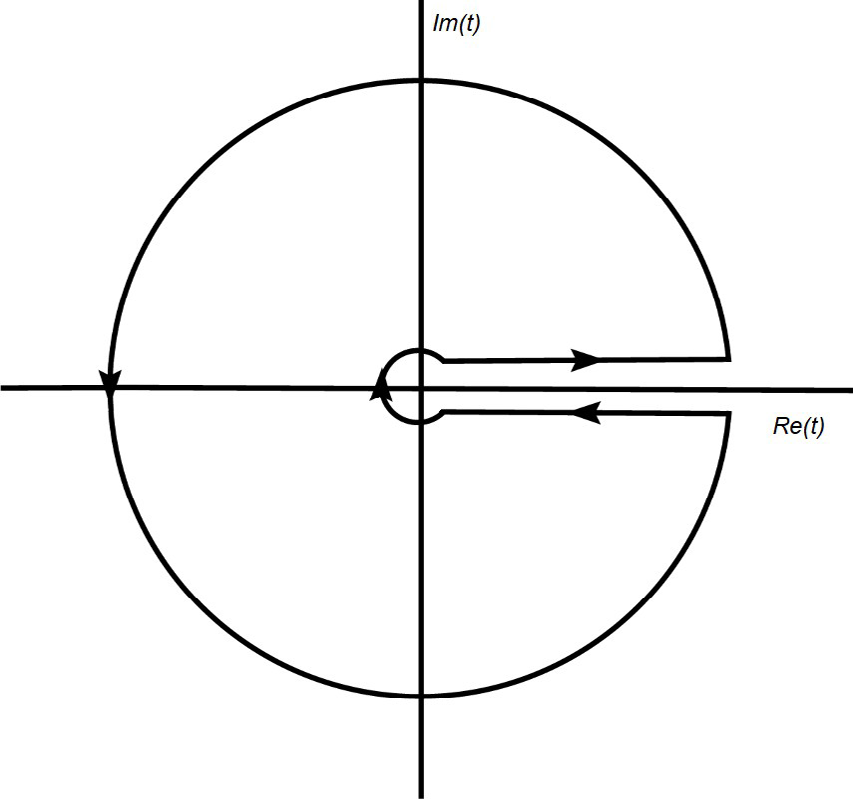
The basis of FESR is Cauchy’s theorem applied to the contour C of Figure 1 which implies R ( ) ( ) ( ) ( ) ( ) 2 2 exp 1 1 Im 2 $$ - \lambda^ {2} m _ {N} P \left(m _ {N} ^ {2}\right) = \frac {1}{\pi} \int_ {c u t} ^ {R} d t P (t) \operatorname {I m} \Pi^ {\exp} (t) + \frac {1}{2 \pi i} \oint_ {| t | = R} d t P (t) \Pi (t) \tag {7} $$ On the circle of large radius R the exact correlator ( )t Π can be replaced by its QCD expression ( ) QCD t Π .
This is the usual definition of duality. The QCD correlator involves a perturbative part and a non-perturbative part which we parametrise by condensates [8]. We do not consider genuine duality violations.
Where P(t) is an entire function, e. g. a polynomial. Over the circle of large radius R the correlator ( )t Π has been replaced by its QCD expression. The principal unknown in Equation 8 is the integral over the cut, i.e. over the higher nucleon resonances with mass
2 $$ m _ {N _ {i}} ^ {2} \leq R. $$
. To minimize this
integral (before neglecting it), a judicious choice of the
weight-function P(t) has to be made. With the classic choice ( ) ( ) 2 0 exp P t t M = − the Borel variable
2 0 M cannot be chosen too large because it would minimize the contribution of the nucleon. Also
2 0 M cannot be too small because the unknown condensates in Equation 3 would explode. It was hoped in 1 that a region of stability at an intermediate
2 0 M can be found. This can be shown to be not the case 3. In our FESR approach Nasrallah NF, et al. [7] we take $P(t)$ to be a polynomial
$$P(t) = \sum_{n=0}^{m_N} c_n t^n$$ 〔8〕
It is clear that the order $n_{\text{max}}$ cannot be chosen arbitrarily high because of the contribution of unknown higher condensates. To test the method we start with the nucleon proper (Equations 9-19). We choose
$$P(t, R) = \left(1 - \frac{t}{m_N^2}\right)\left(1 - \frac{t}{R}\right) = 1 - a_1 t - a_2 t^2$$ 〔9〕
where
$$a_1 R = \frac{1}{m_N^2} + \frac{1}{R}, a_2 (R) = -\frac{1}{m_N^2 R}$$
Equation 7 then becomes
$$\left(2\pi\right)^4 \lambda^2 m_N^3 P(m_N^2) = -B_3 I_2 (R) - B_9 + \Delta_2$$ 〔10〕
$$\left(2\pi\right)^4 \lambda^2 m_N^3 P(m_N^2) = -B_3 I_2 (R) - B_7 + a_1 B_9 + \Delta_1$$ 〔11〕
where
$$I_1 = \int_0^R dt t P(t, R), \quad I_2 = \int_0^R dt t^2 P(t, R)$$ 〔12〕
and
$$\Delta_1 = -\left(2\pi\right)^4 \int_0^R dt t P(t) \Im \Pi_2 (t), \quad \Delta_2 = -\left(2\pi\right)^4 \int_0^R dt t P(t) \Im \Pi_2 (t)$$ 〔13〕
$P(t)$ is designed to minimize the contribution of the continuum in Equation 7, i.e. to minimize the contribution of $\Delta_1 + \Delta_2$ so as to neglect it then. The nucleon mass is obtained from the ratio (Equations 10/11).
There is a wide region of stability $R$ for $I_1(R)$ and $I_2(R)$ at around $R = 3$ GeV$^2$. Using the sum rule Equation 7
$$\left(2\pi\right)^4 \lambda^2 m_N^3 P(m_N^2) = -B_3 I_2 (R) - B_9 - \Delta_2$$ 〔14〕
$$\left(2\pi\right)^4 \lambda^2 m_N^3 P(m_N^2) = -B_3 I_2 (R) - B_7 + a_1 B_9 - \Delta_1$$ 〔15〕
where
$$\Delta_1 (t) = -\left(2\pi\right)^4 \int_0^R dt t P(t) \Im \Pi_2 (t) \quad \Delta_2 (t) = -\left(2\pi\right)^4 \int_0^R dt t P(t) \Im \Pi_2 (t)$$ 〔16〕
The delta's denote the contribution of the nucleon continuum, they receive no contribution from the nucleon pole [9]. The aim is to choose $P(t)$ which minimizes $\Delta_1$ and $\Delta_2$ so as to neglect them and obtain $m_N$ from Equations (1/2). This was done in 7 from the choice
$$P(t) = 1 - a_1 t - a_2 t^3 = 1 - 0.807 t + 0.16 t^2$$ 〔17〕
This choice minimizes the integral $\int_2^{3\mathrm{GeV}^2} dt |P(t)|^2$
For $R = 2.5$ GeV$^2$ the result was
$$m_N = 0.830 \pm 0.05 \mathrm{GeV}$$ 〔18〕
Note that to obtain the physical mass one has to add the contribution of the $\Sigma$-term. Using higher moments we get we get information on the higher resonances.
We Nasrallah NF, et al. [7, 8] next proceed with a different choice for $P(t)$ which eliminates $\Delta_{1,2}$ as well.
$$P'(t, R) = \left(1 - \frac{t}{m_N^2}\right)\left(1 - \frac{t}{R}\right)$$ 〔19〕
which vanishes at the mass of the $m_{1,2}$ where $m_1 = m_N$ (1440) is the mass of the First exited state (the Roper) where we expect the bulk of the contribution to the continuum to come from. $R$ will be determined by stability considerations (Equations 20-28).
The expression for $m_N$ is
$$m_N^2 = \frac{I_2'(R) + \frac{B_9}{B_3}}{I_1'(R) + \frac{B_7}{B_3} - a_1' \frac{B_9}{B_3}}$$ 〔20〕
where
$$I_2' = \int_0^R dt t^2 P'(t, R), \quad I_1' = \int_0^R dt t P'(t, R)$$ 〔21〕
$$P(t) = 1 - a_1 t - a_2 t^2, \quad a_1' = \left(\frac{1}{m_N^2} + \frac{1}{R}\right) a_2' = \frac{1}{m_N^2 R}$$ 〔22〕
With $m_N^2$ as an input, Equation 20 determine $m_1$ as a function of $R$:
$$R = 2.1 \mathrm{GeV}^2 \quad m_1 = 1.57 \mathrm{GeV}$$
$$R = 2.4 \mathrm{GeV}^2 \quad m_1 = 1.46 \mathrm{GeV}$$
$$R = 3.0 \mathrm{GeV}^2 \quad m_1 = 1.49 \mathrm{GeV}$$
We Nasrallah NF, et al. [7, 8] combine and quote
$$m_1 = 1.46 \pm 0.03 \mathrm{GeV}$$
The procedure can be repeated using the general formula
$$m_N^2 = \int_0^{m_N^2-1} dt t^2 P_{n+1}(t, R) \int_0^{m_N^2-1} dt t P_{n+1}(t, R)$$
with
$$P_{n+1}(t, R) = \left(1 - \frac{t}{m_N^2}\right)\left(1 - \frac{t}{R}\right)$$ 〔23〕
$R$ being the maximum at which the maximum of $\int_0^{m_N^2-1} dt t P_{n+1}(t, R)$ takes place (which is also close to the maximum of $\int_0^{m_N^2-1} dt t^2 P_{n+1}(t, R)$).
We Nasrallah NF, et al. [7, 8] list our results below
$$m_2 = m_N(1535) = 1.47\text{GeV}, \quad R = 3.2\text{GeV}^2$$
$$m_3 = m_N(1650) = 1.57\text{GeV}, \quad R = 3.5\text{GeV}^2$$
$$m_4 = m_N(1710) = 1.74\text{GeV}, \quad R = 4.0\text{GeV}^2$$
$$m_{5,6} = m_N(1880,1895) = 1.80\text{GeV}, \quad R = 5.3\text{GeV}^2$$
$$m_7 = m_N(2100) = 1.98\text{GeV}, \quad R = 6.4\text{GeV}^2$$
The errors of the predicted masses of resonances are about ±10%.
**Heavy Baryons**
The $\Lambda_c, \Lambda_b, \Xi_c, \Xi_n$ and their parity doublets can be treated by the same sum rule method using an integration kernel of the form [10]
$$P(t,m^2) = \left(1 - \frac{t}{m^2}\right)\left(1 - \frac{t}{R}\right)$$
where $m'$ is mass of the first exited state or parity doublet and $R$ is the radius of the circle of Figure (1).
We Nasrallah NF, et al. [7, 8] first determine the mass of the ground state baryon for a knowledge of $m'$ and then determine $m'$ independently and self-consistently. We consider
$$\Lambda_c(2886.5)\left(0,\frac{1}{2}\right), \Lambda_c(2593)\left(0,\frac{1}{2}\right)$$
$$\Lambda_b(5620)\left(0,\frac{1}{2}\right), \Lambda_b(5912)\left(0,\frac{1}{2}\right)$$
In the correlator of Equation 7 we use the simplest current for $\Lambda_Q^9$
We define as above
$$jQ = \frac{1}{\sqrt{2}} \epsilon_{\text{abc}} \left(u_a^T C \gamma_s d_b - d_a^T C \gamma_s u_b\right) Q_c$$
$$\Pi(t) = gA(t) + Bt$$
On the hadronic side we make explicit the contribution of the positive and negative parity baryons,
$$A(t) = -\frac{\lambda_c^2}{t-m_+^2} - \frac{\lambda_c^2}{t-m_-^2}$$
$$B(t) = -\frac{\lambda_c^2 m_+^2}{t-m_+^2} - \frac{\lambda_c^2 m_-^2}{t-m_-^2}$$
where $\lambda_z$ the coupling of the current Equation 25 to the corresponding states (Equations 29-36).
The QCD spectral functions have been obtained in Nasrallah NF, et al. [7, 8], Ayala C, et al. [9] and Krasnikov V, et al. [10] and are conveniently expressed in Gorishnii SG, et al. [11], Kataev AL [12], Dominguez CA [13], Zyla PA, et al. [14], Wang ZG [15] and Zhao ZX, et al. [16].
We define
$$\rho A(t) = \frac{3m_Q^4}{128\pi^4} a(t)$$
with
$$a(t) = \int_{m_0}^1 dx x(1-x)^2 \left(\frac{t}{m_Q^2} - \frac{1}{x}\right)^2 + \frac{\pi^2}{6} \frac{\langle a_x GG \rangle}{m_Q^4} \left(1 - \frac{m_Q^4}{t^2}\right)$$
$$-\frac{\pi^2}{6} \frac{\langle a_x GG \rangle}{m_Q^4} \left(1 - \frac{m_Q^4}{t}\right) + \ldots$$
Consider now the integral $\frac{1}{2\pi i} \int_C dt A(t) P(t)$ where $C$ is the contour of Figure 1 in the complex t-plane.
We Nasrallah NF, et al. [7, 8], Wang ZG [15] claim that our choice of the damping kernel $P(t, R)$ essentially eliminates all hadronic contributions except that of the ground state so that
$$\lambda_z^2 P(m_c^2) = \int_{m_0}^R dt P(t, R) \rho A(t) = I_0$$
Another equation is obtained from the First moment
$$\lambda_c^2 m_c^2 P(m_c^2) = \int_{m_0}^R dt t P(t, R) \rho A(t) = I_1$$
R is chosen in the stability region of the integrals $I_0$ and $I_1$ for $\lambda_c$. These integrals turn out to be very at functions of $t$ which obtain a maximum between 4.5$^2$ and 5$m_c^2$. The result is
$$m_{\lambda_n} = 2.10\text{GeV} \left(\exp.2.23\text{GeV}\right)$$
$$m_{\lambda_n} = 5.92\text{GeV} \left(\exp.5.62\text{GeV}\right)$$
Using $B(t)P(t, R)$ yields practically identical results.
We now proceed to calculate $m_z$ independently. Because $b$ and $c$ quarks are heavy $\Pi(0)$ is given by its QCD expression.
which yields an additional sum rule
$$\frac{\lambda^2}{m_s^2} P\left(m_s^2\right) = \int_{m_0}^{R} \frac{dt}{t} P\left(t, R\right) \rho_{AI}\left(t\right) = I_{-1}$$
This implies
$$\frac{I_1}{I_0} = \frac{I_0}{I_{-1}}$$
from which we can determine $m_+$. The result is
$$m_{N_+} = \left(2.51 \pm 0.03\right) GeV \left(\exp.2.58 GeV\right)$$
$$m_{N_-} = \left(5.87 \pm 0.14\right) GeV \left(\exp.5.91 GeV\right)$$
The errors are estimated by varying $R$ by 10%.
Finally for the $\Xi$ baryon $\Xi_Q \left(2468/5797\right) \left(\frac{1}{2} \frac{1}{2}\right) \Xi_Q \left(2580/5935\right) \left(\frac{1}{2} \frac{1}{2}\right)$ the function $a(t)$ in Equation 29 picks up an additional term proportional to the strange quark mass $m_s$
$$\Delta a(t) = \frac{4\pi^2}{3} \frac{m_s \left(\bar{s} - 2\bar{q} \right)}{m_Q^4} \left(1 - \frac{m_Q^4}{t^2}\right)$$
The calculation proceeds as before, giving
$$m_{\Xi_+} = 2.05 GeV \left(\exp.2.468 GeV\right)$$
$$m_{\Xi_-} = 5.40 GeV \left(\exp.5.79 GeV\right)$$
$$m_{\Xi_+} = 2.46 GeV \left(\exp.2.58 GeV\right)$$
$$m_{\Xi_-} = 5.87 GeV \left(\exp.5.935 GeV\right)$$
**Conclusion**
We have calculated the masses of the baryon recurrences with a new variant of QCD finite energy sum rules. The only free parameter of the sum rules, the radius of the circle in the complex $t$-plane, is fixed by the requirement of stability. The method works well for all similar systems such as the vector resonances. The main source of error is the zero width approximation for the resonances. We have estimated this error by allowing the radius entering the sum rule to vary by $\pm 10\%$. Order $\alpha_s$ corrections are included, order $\alpha_s^*$ are calculated and found to be negligible. The sum rule predictions are compared with the experimental numbers and agreement within the expected accuracy is found. It can be concluded that QCD is applicable to single resonances and their recurrences.
**Acknowledgement**
This work was supported in part by the Alexander von Humboldt Foundation (Germany), under the Research Group Linkage Programme, and by the University of Cape Town (South Africa).
**References**
1. Shifman M, Vainshtein AI, Zakharov VI (1979) QCD and resonance physics. Applications. Nucl Phys B 147(5): 448-518.
2. Furnstahl RJ, Griegel DK, Cohen TD (1992) QCD sum rules for nucleons in nuclear matter. Phys Rev C 46(4): 1507.
3. Ioffe BL (1981) Calculation of Baryon Masses in Quantum Chromodynamics. Nuclear Physics B 188(2): 317-341.
4. Ioffe BL (2005) QCD at Low Energies. Prog Part Nucl Phys 56(1): 1-44.
5. Cohen TD, Griegel DK, Jin XM, Furnstahl RJ (1995) QCD Sum Rules and Applications to Nuclear Physics Prog Part Nucl Phys 35: 221-298.
6. Cvetic G, Villavicencio C, Portales D (2012) Operator Product Expansion with analytic QCD in tau decay physics. Phys Rev D 86(11): 116001.
7. Nasrallah NF, Schilcher K (2023) Isovector meson masses from QCD sum rules. Modern Physics Letters A 38(2): 235009.
8. Nasrallah NF, Schilcher K (2014) New sum rule determination of the nucleon mass and strangeness content. Phys Rev C 89(4): 045209.
9. Ayala C, Cvetic G, Teca D (2023) Borel–Laplace sum rules with $\tau$ decay data, using OPE with improved anomalous dimensions. Journal of Physics G: Nuclear and Particle Physics 50(4): 045004.
10. Krasnikov V, Kataev AL, Pivovarov AA (1983) The use of the finite energetic sum rules for the calculation of the light quark masses. Phys Lett B 123(1-2): 93-97.
11. Gorishnii SG, Tkachov FV, Chetyrkin KG, Larin SA (1984) Higher {QCD} Corrections to the Bjorken Sum Rule. Phys Lett B 137(3-4): 230-234.
12. Kataev AL (2005) QCD sum rules and radial excitations of light pseudoscalar and scalar mesons. Phys Atom Nucl 68: 567-572.
13. Dominguez CA (2018) Quantum Chromodynamics Sum Rules. Springer pp: 1-113.
14. Zyla PA, Barnett RM, Beringer J, Dahl O, Dwyer DA, et al. (2020) Review of Particle Physics. Prog Theor Exp Phys 2020(8): 083C01.
15. Wang ZG (2010) Analysis of the scalar and axial-vector heavy diquark states with QCD sum rules. Eur Phys J C 71(1524): 1-16.
16. Zhao ZX, Li RH, Shi YJ, Zhou SH (2005) The SVZ sum rules and the heavy quark limit for ΛQ. Arxiv pp: 1-10.
References
-
Shifman M, Vainshtein AI, Zakharov VI (1979) QCD and resonance physics. Applications. Nucl Phys B 147(5): 448-518.
-
Furnstahl RJ, Griegel DK, Cohen TD (1992) QCD sum rules for nucleons in nuclear matter. Phys Rev C 46(4): 1507.
-
Ioffe BL (1981) Calculation of Baryon Masses in Quantum Chromodynamics. Nuclear Physics B 188(2): 317-341.
-
Ioffe BL (2005) QCD at Low Energies. Prog Part Nucl Phys 56(1): 1-44.
-
Cohen TD, Griegel DK, Jin XM, Furnstahl RJ (1995) QCD Sum Rules and Applications to Nuclear Physics Prog Part Nucl Phys 35: 221-298.
-
Cvetic G, Villavicencio C, Portales D (2012) Operator Product Expansion with analytic QCD in tau decay physics. Phys Rev D 86(11): 116001.
-
Nasrallah NF, Schilcher K (2023) Isovector meson masses from QCD sum rules. Modern Physics Letters A 38(2): 235009.
-
Nasrallah NF, Schilcher K (2014) New sum rule determination of the nucleon mass and strangeness content. Phys Rev C 89(4): 045209.
-
Ayala C, Cvetic G, Teca D (2023) Borel–Laplace sum rules with $\tau$ decay data, using OPE with improved anomalous dimensions. Journal of Physics G: Nuclear and Particle Physics 50(4): 045004.
-
Krasnikov V, Kataev AL, Pivovarov AA (1983) The use of the finite energetic sum rules for the calculation of the light quark masses. Phys Lett B 123(1-2): 93-97.
-
Gorishnii SG, Tkachov FV, Chetyrkin KG, Larin SA (1984) Higher {QCD} Corrections to the Bjorken Sum Rule. Phys Lett B 137(3-4): 230-234.
-
Kataev AL (2005) QCD sum rules and radial excitations of light pseudoscalar and scalar mesons. Phys Atom Nucl 68: 567-572.
-
Dominguez CA (2018) Quantum Chromodynamics Sum Rules. Springer pp: 1-113.
-
Zyla PA, Barnett RM, Beringer J, Dahl O, Dwyer DA, et al. (2020) Review of Particle Physics. Prog Theor Exp Phys 2020(8): 083C01.
-
Wang ZG (2010) Analysis of the scalar and axial-vector heavy diquark states with QCD sum rules. Eur Phys J C 71(1524): 1-16.
-
Zhao ZX, Li RH, Shi YJ, Zhou SH (2005) The SVZ sum rules and the heavy quark limit for ΛQ. Arxiv pp: 1-10.
- Early Universe: Hadronic Crystals Coherent Micro Gravitational Wave Emitters PHYSICS Part II
- The Solar System Constraint Maze: A Scientific Dead-End Revealing the Interuniversal Machine
- Assessment of Radiofrequency Radiation from 2G and 3G Mobile Phone Handsets
- Early Universe Magneto-Gravitational Coupling Genesis Physics: Part I
- Falsifiability of the Classical Law of Gravitation and Unveiling the Time-temperature Entanglement of the Universe
- Origin of Ancient Civilisations The Southern Hemisphere’ Scenario