
The Dynamics of Electron Acoustic Solitary Waves in a Nonmagnetized Quantum Plasma with Two Temperature Electrons
In this article we have studied the linear and nonlinear properties of plasma waves using a one-dimensional quantum hydrodynamic (QHD) model specifically designed for quantum plasma with electron acoustic waves (EAWs). In particular, we use the standard reductive perturbation method to investigate the solitary structures resulting from nonlinearity. We use this method to derive and numerically analyze the Kortewegde Vries (KdV) equation relevant to the plasma system as well as the dispersion relation. Furthermore, in order to shed light on the dynamics of plasma waves under external influences, we investigate the temporal evolution of a forced KdV equation. PACS-52.20.j; 52.25.b; 52.30.d; 52.35.Mw; 52.65.Vv.
Introduction
Electron acoustic waves (EAWs) are one of the fundamental modes in plasma physics, crucial for understanding the collective behavior of electrons in plasmas. In recent years, the study of EAWs in quantum plasmas, where quantum effects significantly influence the plasma dynamics, has gained prominence. Moreover, the presence of two-temperature electrons adds another layer of complexity to the system, necessitating a thorough investigation of electron acoustic solitary waves (EASWs) in such environments.
Theoretical Frameworks
Theoretical studies on EASWs in un-magnetized quantum plasmas with two-temperature electrons have primarily focused on the development of nonlinear fluid models. These models incorporate quantum hydrodynamic equations coupled with temperature imbalances between the electron populations.
Analytical methods such as the reductive perturbation technique, Kadomtsev-Petviashvili (KP) equation, and Sagdeev pseudopotential approach have been employed to analyze the formation and propagation characteristics of EASWs. Additionally, quantum kinetic theory has been utilized to investigate the dispersion properties and stability of EASWs in these complex plasma systems.
Numerical Simulations
Numerical simulations play a crucial role in exploring the nonlinear dynamics of EASWs in un-magnetized quantum plasmas with two-temperature electrons. Particle- in-cell (PIC) simulations and fluid simulations have been employed to study the evolution of EASWs under various parameter regimes. These simulations provide insights into the generation mechanisms, nonlinear interactions, and stability properties of EASWs, elucidating their role in different physical scenarios.
Experimental Observations
Experimental investigations of EASWs in laboratory plasmas have been challenging but not entirely absent. Experiments conducted in laboratory setups, such as electron positron plasmas and ultra-cold neutral plasmas, have provided valuable insights into the existence and properties of EASWs. However, further experimental validation is necessary to corroborate theoretical predictions and numerical simulations.
Challenges and Future Directions
Despite significant progress, several challenges remain in the study of EASWs in un-magnetized quantum plasmas containing two-temperature electrons. These challenges include incorporating more realistic effects such as collisions, quantum degeneracy, and nonlocality into theoretical models and simulations.
Furthermore, experimental techniques need to be refined to accurately observe and characterize EASWs in laboratory settings. Future research directions may involve exploring novel quantum phenomena, such as quantum turbulence and quantum vortices, in the context of EASWs.
In summary, the literature on electron acoustic solitary waves in un-magnetized quantum plasmas containing two temperature electrons reflects a vibrant field of research at the intersection of plasma physics and quantum mechanics. Theoretical, numerical, and experimental studies have contributed to our understanding of the nonlinear dynamics and collective behavior of electrons in these exotic plasma environments [1, 2, 3, 4, 5, 6, 7, 8, 9, 10, 11, 12, 13, 14, 15, 16, 17, 18, 19, 20, 21, 22, 23, 24, 25, 26, 27, 28, 29, 30, 31, 32, 33, 34, 35, 36, 37]. Continued interdisciplinary efforts are essential to unraveling the full range of phenomena associated with EASWs and their implications for astrophysical and laboratory plasmas [38, 39, 40, 41, 42, 43, 44, 45, 46, 47, 48, 49, 50]. We have conducted a thorough investigation into the properties of electron acoustic waves (EAWs) within a quantum plasma containing two distinct groups of electrons with different temperatures. Our focus lies on examining the interplay of two critical aspects of plasma physics: the presence of two temperature electron populations and the influence of quantum effects. In plasmas with two different electron groups, EAWs emerge as high-frequency electrostatic modes, wherein the inertia is provided by cold electrons, while the restoring force is a result of the pressure from hot electrons. These waves exhibit phase velocities lying between the thermal velocities of cold and hot electrons [51].
This study aims to comprehensively explore one- dimensional nonlinear electron-acoustic waves in a dense, unmagnetized quantum plasma composed of three components: two distinct electron groups and stationary ions. In such plasma environments, nonlinear effects play a pivotal role, giving rise to various phenomena like stationary formations such as double layers, shocks, and solitary structures, among others. Among these structures, solitary formations, often referred to as nonlinear Korteweg-de Vries (KdV) solitons, are extensively investigated [52, 53, 54]. These solitons arise due to a delicate balance between nonlinear and dispersive effects, maintaining their shape as they propagate through space at a constant velocity.
The amplitude and width of these solitons serve as indicators of the interplay between nonlinear and dispersive factors. In practical scenarios, these solitary structures undergo temporal evolution when subjected to external time-dependent forces. Such external forces may either facilitate the formation or diminish the presence of these solitons. Previous studies have examined the behavior of forced KdV solitons under specific configurations. We also intend to investigate the impact of external periodic forces on KdV solitons. Considering the sinusoidal nature of nonlinear interactions in complex plasma systems, the external force is assumed to be periodic in our analysis.
Basic Equations
We investigate the behavior of electron acoustic waves within a complex plasma environment composed of three distinct components: cold electrons, hot electrons, and stationary ions, all within an unmagnetized quantum plasma framework. Cold electrons possess inertia, while hot electrons are considered inertia-less, and ions provide the charge-neutralizing background. We make the assumption that the frequency of the waves significantly surpasses the ion plasma frequency, and the phase velocity of the waves falls between the Fermi thermal velocities of the cold and hot electron populations. This is a fact based on the inertia of different species under considerations. This setup allows us to explore the unique dynamics arising from the interaction between these components, shedding light on the complex interplay of quantum effects and plasma physics phenomena. (i.e Fec Feh V V k ω << << ). We assume that the plasma particles behave like a one dimensional Fermi gas at absolute zero temperature and therefore the pressure law is [52].
2 3 2 0 3 m V P n n = (1)
j Fj j j j where j=h for hot electron, j=c for cold electron and j=i for ions, mj is the mass, 2 / Fj B Fj j V k T m = is the Fermi thermal speed, Fj T is the Fermi temperature and B k is the Boltzmann’s constant. jn is the number density with the equilibrium value . The dynamics of such a plasma is governed by the following quantum hydrodynamic equations:
( ) 0 h h h n u n t x
∂ ∂ + = ∂ ∂
(2) ( ) 0 c c c n u n t x
∂ ∂ + = ∂ ∂
(3)
| 1 ∂2 | n h |
|---|---|
| n ∂x2 h |
| 1 ∂2 | n c |
|---|---|
| n ∂x2 c |
η (5)
2
2 4 c h i i e n n Z n x φ π ∂ = + + ∂
( ) (6) Where , h c u u and hn , cn are respectively the fluid velocity, charge density corresponding to the hot and cold electrons and hP is pressure, η is the Planck’s constant divided by 2π and φ is the electrostatic wave potential. We now introduce the following normalisation,
0 / ; ; / 2 ; / c s c B Fe j j j x x c t t e k T n n n ω ω φ φ → → → → and / j j s u u c →
2 0 4 / c c e n e m ω π = the cold electron plasma where oscillation frequency, 2 / s B Fe e c k T m = is the electron- acoustic speed. Using the above normalisation equations (2)-(6) can be written as:
( ) 0 h h h n u n t x
∂ ∂ + = ∂ ∂
(7) ( ) 0 c c c n u n t x
∂ ∂ + = ∂ ∂ (8)
| 1 ∂2 | n h |
|---|---|
| n ∂x2 h |
(9) φ ∂ ∂ ∂ ∂ ∂ + = + ∂ ∂ ∂ ∂ ∂
2 2 n H u u t x x x x n
2 1 2 c c c
(10) c
2
2 h i c i n n n x δ φ δ δ ∂ = + + ∂ (11)
where / 2 c B Fe H k T ω = η is a non-dimensional [51] quantum diffraction parameter, 0 0 / c h n n δ = and
1 0 0 / ; i h Zin n δ = 0 cn , 0 hn , 0 in are the equilibrium number densities of cold and hot electrons and ions respectively. The parameter H is proportional to the ratio between the plasma energy c ω η (energy of an elementary excitation associated with an electron plasma wave) and the Fermi energy B Fe k T .
Analytical Studies on Linear and Nonlinear Behavior
Dispersion Relation: In order to investigate the nonlinear behaviour of electron-acoustic waves we make the following perturbation expansion for the field quantities , , , h h c c n u n u and about their equilibrium values:
= + + +
u u u u ε ε j j j
φ φ φ φ j
Substituting the expansion (12) in Eqs. (7)-(11) and then linearizing and assuming that all the field quantities vary as exp ( ) i kx t ω − , we get for normalized wave frequency ω and wave number k, the following linear dispersion relation:
+ − = + + +
2 4 2 2 4 2 0 2 4 2
H k k H k ku H k k
δ ω δ
4 (13) ( )
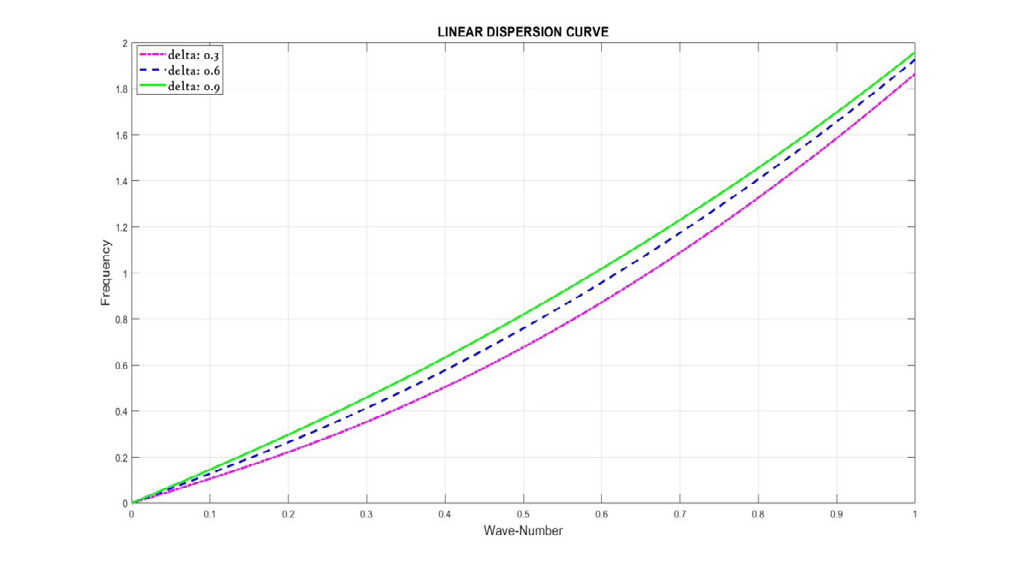
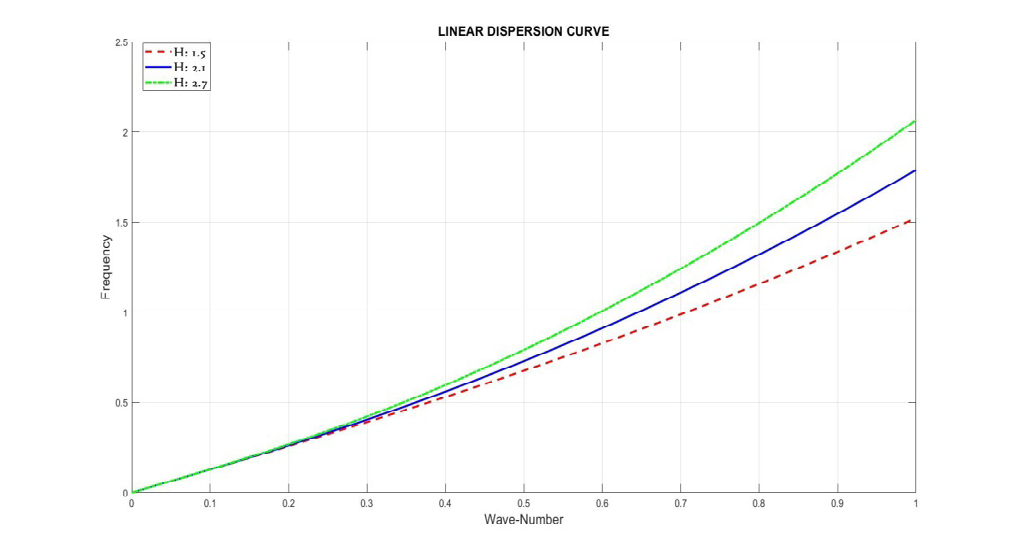
4 1 4 The normalized wave dispersion relation (13) is plotted in Figure 1 for different values of quantum diffraction H. It shows that the wave frequency increases with increase in quantum diffraction H for a given wavenumber k for a range.
Kdv Equation and Solitary Wave Behavior
In order to study the nonlinear behaviour of electron acoustic waves we consider inertia less hot electrons, inertial cold electrons and stationary ions. The pressure effect is assumed to be only due to the hot electrons. This kind of assumption has been made by many previous authors [55, 56, 57, 58]. Following the standard reductive perturbation technique we use the usual stretching of the space and time variables:
1 3 2 2 0 and x v t t ξ ε τ ε = − =
(14) ( ) Now writing the Equations (7)–(11) in terms of these stretched co-ordinates ξ and τ and then applying the perturbation expansion eq.(12) and solving for the lowest order equation with the boundary condition so that (1) (1) (1) (1) , , , h h c c n u n u and (1) 0 φ → , as | | ξ →∞,the following solutions are obtained;
(1) (1) (1) (1) (1) (1) (1) (1) (1) (1) 2 1 1 1 1 ; ; ; / ; / h h c c h c c u R n u R n n u R n R φ φ φ = = = = − = − (15) where, 1 0 0 ( ) R v u = − Going for the next higher order terms in ξ and following the usual method we obtain the desired Korteweg-de Vries (KdV) equation by substituting (1) φ by φ we get,
3
3 0 N D φ φ φ φ τ ξ ξ ∂ ∂ ∂ + + = ∂ ∂ ∂
(16) Where,
= − +
2 2 2 1 1 1 2 1
1 2 4 R R H D R R δ
4 1
3 2 R N R δ δ − = and
1 Here Eq. (16) is our required KdV equation; N and D are the non-linear and dispersive co-efficient respectively. To find the solution of Eq. (16) we transform the independent variables ξ and τ into one variable M η ξ τ = − , where M is the normalized constant speed of the wave frame. Applying the boundary conditions that as η →±∞
2
2 0; 0; 0 φ φ φ η η ∂ ∂ → → → ∂ ∂
the possible stationary solution of Eq. (16) is obtained as:
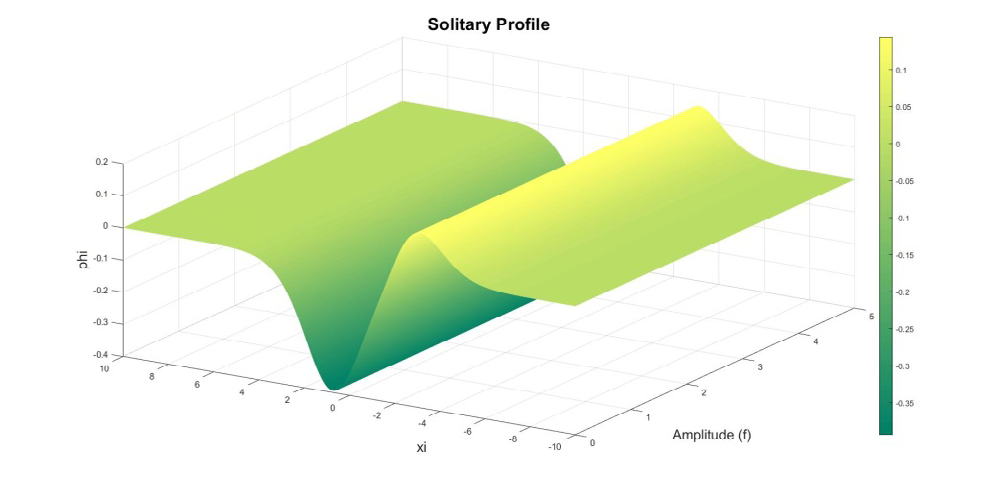
2 sech m η φ φ = ∆
(17) Where the amplitude m φ and width δ of the soliton are given by:
3 4 & m M B N M φ = ∆=
The solitary wave structure is formed due to balance between dispersive and nonlinear terms. The coefficients N and D, play a crucial role in determining the solitary wave structure. Also the nature and magnitude of the coefficients of these two terms mainly determine the characteristic of such soliton structure. So we study the dependency of Non-linear and Dispersive coefficients on different physical plasma parameters. The quantum effect enters only into the dispersion coefficient (D). Both these coefficients depend on δ , the equilibrium cold-to-hot electron concentration ratio. We see that while the coefficient D depends both on and quantum parameter H, the coefficient N depends only on δ .
Effect of an External Force on KdV Solitonic Behavior
From external effects the solitary structure will surely experience these forces, or the plasma particles will experience their forces individually. Now, let us suppose that some periodic forces applied on the system; the KdV equation describing the potential profile under the action of such a force will look like,
3
0 3 i N D f e ωτ φ φ φ φ τ ξ ξ ∂ ∂ ∂ + + = ∂ ∂ ∂
(18) Here the forced KdV eq. as a charge density force has been solved by Ali, et al. [56]. By using Hirota’s direct method and following the technique of Jun-Xiao and Bo-Ling [57], we have obtained the forcing term in the KdV equation itself. The amplitude of the forcing term 0_f_ in Eq. (18) is proportional to external disturbances. If 0 0 f = , then Eq. (17) is the solution to forced-KdV, which is basically a simple KdV equation. In order to investigate the effect of the periodic force 0 i f e ωτ on the solitary wave solution, Eq. (17), we apply the momentum conservation law. In presence of the small forcing term 0 i f e ωτ , we obtain +∞ −∞ = ∫ (19)
2 I d φ ξ
3 2 2 24 D I M N τ ⇒ = (20)
( )
| 12 | DM(τ ) |
|---|
+∞ and Differentiating Eq. (19) with respect to , using the integration in Eqs. (20) And (21) again, and equating the real terms, we get,
0 2 sin 3 Nf M M τ ωτ ω = + (22)
( ) Then the solution of the required forced KdV will be, ( ) ( ) ( )
− =
2 sech m M ξ τ τ φ φ τ ω τ (23)
Where,
( ) ( ) ( ) ( ) ( ) 3 / & 4 / m M N D M φ τ τ ω τ τ = = (24)
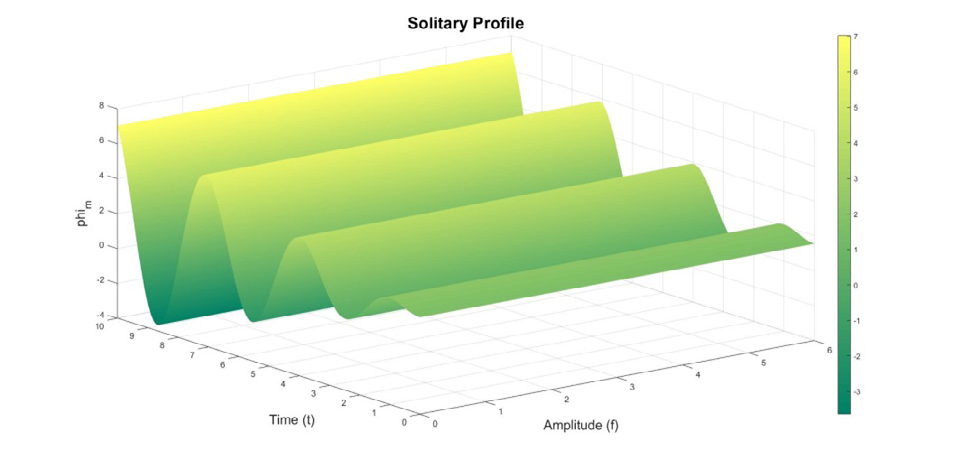
The dependence of the amplitude and the width of the forced KdV on time are shown in these eq. (24).
Results and Discussions
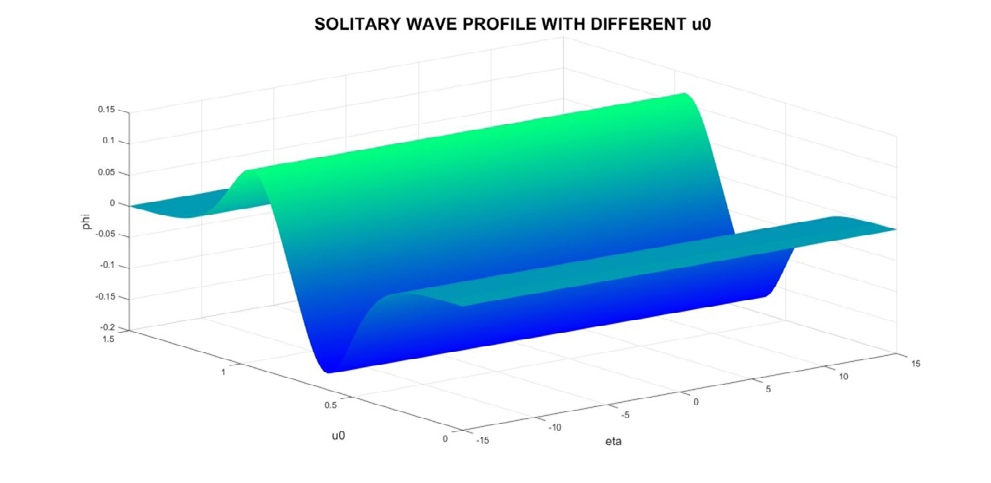
Figure 1 represents the long wave dispersion character of EAWs in a quantum plasma composed of inertia less hot electrons, inertial cold electrons and stationary ions. We numerically examine the behaviour of the dispersion relation (eq.13) with respect to the variations of 0_u_ , δ and H. Figure 1 shows the k ω − curves for different values of H and δ respectively. Obviously, the wave frequency ω also increases with increase in both δ and H. We showed that the wave frequency ω increases with an increase in the value of
0_u_ but after “1” it starts to decrease.
For this purpose, we have chosen some typical plasma parameters from high-density astrophysical situations (like the atmosphere of neutron stars, magnetars, white dwarf, etc.), where plasma densities are nearly
25 32 3 10 10 m− − and temperatures are nearly
5 7 10 10 − K. We have also considered the variation of thermal stability under convection in a time scale less than the relaxation time that modifies the frequency of the plasma [59, 60, 61]. Given the pivotal role of coefficients N and D in shaping the characteristics of electron acoustic (EA) solitons, it is illuminating to explore how these coefficients vary with the quantum parameter H. Employing the one- dimensional quantum hydrodynamic model alongside the standard reductive perturbation technique, we delve into both the linear and nonlinear properties of electron-acoustic waves. Through this investigation, a Korteweg-de Vries (KdV) equation is derived to examine the nonlinear behavior of the waves, revealing modifications in the coefficients of the nonlinear and dispersive terms attributable to quantum effects.
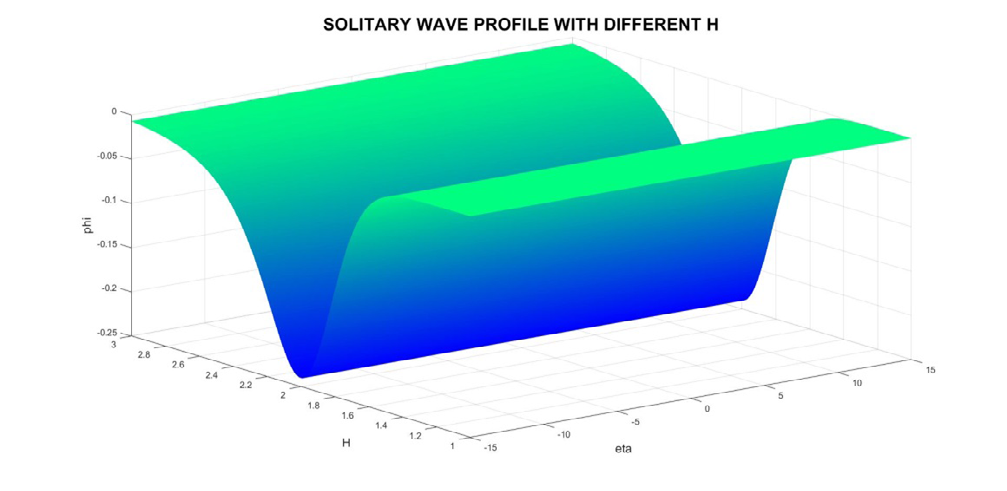
The amplitude and width of the soliton structure exhibit dependence on various plasma parameters, including H, streaming velocity, and delta. While the amplitude remains time-independent, the width increases with escalating values of H. Likewise, both the amplitude and width of the soliton structure increase with higher streaming velocity and delta.
In the presence of an external force, the soliton structure manifests both rarefactive and compressive solitons. Our findings indicate a decrease in amplitude with an increase in the amplitude of the external force. Conversely, the amplitude exhibits an upward trend with growing plasma parameters and “M,” representing the velocity of the wave frame.
Furthermore, elevating the frequency of the external force initiates a decline in the soliton’s amplitude. These observations elucidate the intricate interplay between external perturbations, plasma parameters, and the dynamic characteristics of EA solitons, offering valuable insights into their behavior in quantum plasma systems.
Conclusions
To conclude the article let us summarize in the following way as:
- The discussion focuses on the linear and nonlinear propagation characteristics of electron acoustic waves in dense plasma.
- Specifically, the plasma under consideration consists of two distinct groups of electrons and stationary ions.
- It is highlighted that the plasma can only support rarefactive solitary waves within certain restricted regions of plasma parameter space.
- The properties of these solitons are found to be dependent on several factors including the equilibrium hot to cold electron density ratio and the quantum diffraction parameter H.
- The study aims to enhance understanding of electron acoustic waves in super dense astrophysical objects such as white dwarfs and neutron stars.
- The investigation extends to the influence of external forces on solitary structures.
- Time evolution of solitary structures under external force fields is studied, and the impact of various parameters on this evolution is explored.
- The derivation of the Korteweg-de Vries (KdV) equation is achieved using a standard reductive perturbation technique.
- Integration and conservation of physical quantities such as momentum lead to the determination of a solitary profile characterized by time-dependent amplitude, width, and wave speed.
Acknowledgement
The authors would like to that the Institute of Natural Sciences and Applied Technology, Kolkata and PysicsJoint Forum for providing assistance to carry out the research work.
References
-
Banerjee S, Ghosh B, Chandra S (2015) Modulational instability of ion acoustic waves in a plasma with warm ions, nonthermal electrons and nonthermal positrons. Journal of Physical And Chemical Sciences 3(2): 1-9.
-
Banerjee S, Chandra S, Ghosh B (2014) Linear and nonlinear behavior of ionacoustic waves in a multicomponent plasma with positron and nonthermal electrons, in Proceedings of National Level Seminar on, Dynamical System–Its Application and Consequences. St. Paul’s Cathedral Mission College, India, pp: 27.
-
Gill RK, Chandra S (2015) Arbitrary amplitude ion acoustic waves in finite temperature fermi plasma. International Journal of Engineering Sciences & Management 5(2): 112-120.
-
Chandra S, Maji PS, Maiti I, Samanta K, Mukherjee S, et al. (2024) Double Layers and Solitary Structures Observed in Ion Acoustic Mode Around Critical Regime and Its Possible Precursory Mechanism. IEEE Transactions on Plasma Science pp: 1-14.
-
Moulick R, Chandra S, Goswami K (2014) Effect of sheath edge electric field at higher collision in electronegative glow discharges, in Proceedings of National Level Seminar on-Dynamical System–Its Application and Consequences. St. Paul’s Cathedral Mission College, India, pp: 22.
-
Pramanik S, Mandal S, Chandra S (2015) Large amplitude ion acoustic waves in ultra-relativistic degenerate plasma. International Journal of Engineering Sciences & Management 5(2): 89-97.
-
Chandra S (2016) Propagation of electrostatic solitary wave structures in dense astrophysical plasma: Effects of relativistic drifts & relativistic degeneracy pressure. Advances in Astrophysics, vol. 1(3): 187.
-
Basak A, Das S, Chandra S (2015) Arbitrary amplitude ion acoustic solitary waves in moderately relativistic degenerate plasma. International Journal of Engineering Sciences & Management 5(2): 98-106.
-
Sarkar J, Chandra S, Goswami J, Das C, Ghosh B (2021) Growth of RT instability at the accreting magnetospheric boundary of neutron stars. AIP Publishing 2319(1).
-
Chandra S, Das S, Chandra A, Ghosh B, Jash A (2015) Nonplanar ion-acoustic waves in a relativistically degenerate quantum plasma. International Journal of Nuclear and Quantum Engineering 9(5): 305-311.
-
Chandra S, Maji P, Ghosh B (2014) Propagation of nonlinear surface waves in relativistically degenerate quantum plasma halfspace. International Journal of Nuclear and Quantum Engineering 5: 842-845.
-
Goswami J, Chandra S, Sarkar J, Ghosh B (2021) Quantum two stream instability in a relativistically degenerate magnetised plasma. AIP Publishing 2319(1).
-
Chandra S, Ghosh B (2012) Relativistic effects on the nonlinear propagation of electron plasma waves in dense quantum plasma with arbitrary temperature. International Journal of Engineering Research and Development 3(1): 51-57.
-
Chandra S, Ghosh B, Paul S (2013) Propagation of electron acoustic solitary waves in weakly relativistically degenerate fermi plasma. International Journal of Nuclear and Quantum Engineering 7(3): 388-392.
-
Chandra S, Ghosh B (2012) Nonlinear solitary structures of electron plasma waves in a finite temperature quantum plasma. International Journal of Nuclear and Quantum Engineering 6(10): 1425-1428.
-
Chandra S, Ghosh B (2012) Modulational instability of electron plasma waves in finite temperature quantum plasma. International Journal of Nuclear and Quantum Engineering 11: 1493-1497.
-
Mukhopadhyay A, Bagui D, Chandra S (2021) Electrostatic shock fronts in two-component plasma and its evolution into rogue wave type solitary structures. The African Review of Physics 15: 25-32.
-
Ghosh S, Pramanick S, Sarkar S Dey A, Chandra S (2021) Chaotic scenario in three-component Fermi plasma. The African Review of Physics 15: 45.
-
Chatterjee M, Dasgupta M, Das S, Halder M, Chandra S (2021) Study of dynamical properties in shock & solitary structures and its evolutionary stages in a degenerate plasma. The African Review of Physics 15: 75.
-
Roychowdhury A, Banerjee S, Chandra S (2021) Stationary formation of dust-ion acoustic waves in degenerate dusty plasma at critical regime. The African Review of Physics 15: 102-110.
-
Majumdar A, Sen A, Panda B, Ghosal R, Mallick S, et al. (2021) Study of shock fronts and solitary profile in a weakly relativistic plasma and its evolution into an amplitude modulated envelop soliton. The African Review of Physics 15: 18-24.
-
Dey S, Maity D, Ghosh A, Samanta P, De A, et al. (2021) Chaotic excitations of rogue waves in stable parametric region for highly energetic pair plasmas. The African Review of Physics 15: 33.
-
Samanta P, De A, Dey S, Maity D, Chandra S, Ghosh A (2021) Nonlinear excitations in dust-ion acoustic waves and the formation of rogue waves in stable parametric region in a 3component degenerate plasma,” The African Review of Physics 15: 10.
-
Ballav S, Kundu S, Das A, Chandra S (2021) Nonlinear behaviour of dust acoustic wave mode in a dynamic dusty plasma containing negative dust particles and positrons. The African Review of Physics 15: 54-62.
-
Maiti A, Chowdhury S, Singha P, Ray S, Dasgupta R, et al. (2021) Study of small amplitude ionacoustic bunched solitary waves in a plasma with streaming ions and thermal electrons. The African Review of Physics 15: 97- 101.
-
Ghosh S, Saha S, Chakraborty T, Sadhukhan K, Bhanja R, et al. (2021) Linear and nonlinear properties of electron acoustic waves in a viscous plasma. The African Review of Physics 15: 90-96.
-
Ghosh M, Sharry K, Dutta D, Chandra S (2021) Propagation of rogue waves and cnoidal waves formations through low frequency plasma oscillations. The African Review of Physics 15: 63-74.
-
Ghosh A, Goswami J, Chandra S, Das C, Arya Y, et al. (2022) Resonant interactions and chaotic excitation in nonlinear surface waves in dense plasma. IEEE Transactions on Plasma Science 50(6): 1524-1535.
-
Ballav S, Das A, Pramanick S, Chandra S (2022) Plasma shock wave in gamma ray bursts: Nonlinear phenomena and radiative process. IEEE Transactions on Plasma Science 50(6): 1488-1494.
-
Das A, Ghosh P, Chandra S, Raj V (2022) Electron acoustic peregrine breathers in a quantum plasma with 1d temperature anisotropy. IEEE Transactions on Plasma Science 50(6): 1598-1609.
-
Goswami J, Chandra S, Das C, Sarkar J (2022) Nonlinear wave-wave interaction in semiconductor junction diode. IEEE Transactions on Plasma Science 50(6): 1508-1517.
-
Sahoo H, Das C, Chandra S, Ghosh B, Mondal KK (2022) Quantum and relativistic effects on the KdV and envelope solitons in ion-plasma waves. IEEE Transactions on Plasma Science 50(6): 1610-1623.
-
Thakur S, Das C, Chandra S (2022) Stationary structures in a four component dense magnetoplasma with lateral perturbations. IEEE Transactions on Plasma Science 50(6): 1545-1556.
-
Chandra S, Goswami J, Sarkar J, Das C, Ghosh B, et al. (2021) Formation of electron acoustic shock wave in inner magnetospheric plasma. Indian Journal of Physics 96(12): 3413-3427.
-
Dey A, Chandra S, Das C, Mandal S, Das T (2022) Rogue wave generation through nonlinear self interaction of electrostatic waves in dense plasma. IEEE Transactions on Plasma Science 50(6): 1557-1564.
-
Sarkar J, Chandra S, Dey A, Das C, Marick A, et al. (2022) Forced KdV and envelope soliton in magnetoplasma with kappa distributed ions. IEEE Transactions on Plasma Science 50(6): 1565-1578.
-
Sarkar S, Sett A, Pramanick S, Ghosh T, Das C, et al. (2022) Homotopy study of spherical ionacoustic waves in relativistic degenerate galactic plasma. IEEE Transactions on Plasma Science 50(6): 1477-1487.
-
Sharry, Dutta D, Ghosh M, Chandra S (2022) Magnetosonic shocks and solitons in fermi plasma with quasiperiodic perturbation. IEEE Transactions on Plasma Science 50(6): 1585-1597.
-
Shilpi, Sharry, Das C, Chandra S (2022) Study of quantum electron acoustic solitary structures in fermi plasma with two temperature electrons. Springer pp: 63-83.
-
Sarkar J, Chandra S, Goswami J, Ghosh B (2022) Heliospheric two stream instability with degenerate electron plasma. Springer pp: 25-42.
-
Chandra S, Banerjee R, Sarkar J, Zaman S, Das C, et al. (2022) Multistability studies on electron-acoustic wave in a magnetized plasma with suprathermal ions. Journal of Astrophysics and Astronomy 43: 71.
-
Das C, Chandra S, Sharry, Chatterjee P (2022) Semi- Lagrangian method to study nonlinear electrostatic waves in quantum plasma. IEEE Transactions on Plasma Science 50(6): 1579-1584.
-
Chandra S, Kapoor S, Nandi D, Das C, Bhattacharjee D (2022) Bifurcation analysis of eaws in degenerate astrophysical plasma: Chaos and multistability. IEEE Transactions on Plasma Science 50(6): 1495-1507.
-
Manna G, Dey S, Goswami J, Chandra S, Sarkar J, et al. (2022) Formation of nonlinear stationary structures in ionospheric plasma. IEEE Transactions on Plasma Science 50(6): 1464-1476.
-
Dey S, Ghosh S, Maity D, De A, Chandra S (2022) Two- stream plasma instability as a potential mechanism for particle escape from the Venusian ionosphere. Pramana- Journal of Physics 96: 213.
-
Singla S, Chandra S, Saini NS (2023) Simulation study of dust magnetosonic excitations in a magnetized dusty plasma. Chinese Journal of Physics pp: 524-533.
-
Chandra S (2023) Astronomy and space science: The key to future economy and politics. Open Access Journal of Astronomy 1(1): 16000102.
-
Chandra S, Das C, Batani D, Aliverdiev AA, Myrzakulov R, Majumdar A, Mallick S, Ghosal R, Panda B, Sen A, (2024) Evolutionary Stages of Envelope Soliton During Laser–Plasma Interaction. IEEE Transactions on Plasma Science pp: 1-10.
-
Das C, Chandra S, Saha A, Chatterjee P (2024) Field Modulations of Ion Acoustic Waves in Plasma With Vasyliunas–Schamel Distributed Electrons. IEEE Transactions on Plasma Science pp: 1-9.
-
Chandra S, Das C, Sarkar J, Chowdhari C (2023) Degeneracy affected stability in ionospheric plasma waves. Pramana-Journal of Physics 98: 2.
-
Chandra S, Paul SN, Ghosh B (2012) Linear and nonlinear propagation of electron plasma waves in quantum plasma. Indian Journal of Pure and Applied Physics 50(5): 314-319.
-
Ghosh B, Chandra S, Paul SN (2012) Relativistic effects on the modulational instability of electron plasma waves in quantum plasma. Pramana 78(5): 779-790.
-
JunXiao Z, Boling G (2009) Analytic solutions to forced KdV equation. Communications in theoretical Physics 52(2): 279-283.
-
Ali R, Saha A, Chatterjee P (2017) Analytical electron acoustic solitary wave solution for the forced kdv equation in superthermal plasmas. Physics of Plasmas 24(12): 122106.
-
Sah O, Manta J (2009) Nonlinear electron acoustic waves in quantum plasma. Physics of Plasmas 16(3): 032304.
-
Sahu B, Roychoudhury R (2006) Electron acoustic solitons in a relativistic plasma with nonthermal electrons. Physics of plasmas 13(7): 072302.
-
Sahu B, Roychoudhury R (2007) Cylindrical and spherical quantum ion acoustic waves. Physics of plasmas 14(1): 012304.
-
Falcón N (1997) Thermal instability for convection in astrophysical plasmas. Astrophysics and space science 256: 399-402.
-
Falcon N (2005) Compact stars cooling and secular instability. Scientific Journal from the Experimental Faculty of Sciences 13(3): 343-348.
-
Falcón N (2005) White Dwarf Cooling by Means of Heat Waves. In: 14th (Edn.), European Workshop on White Dwarfs, US, 334: 69.
- Early Universe: Hadronic Crystals Coherent Micro Gravitational Wave Emitters PHYSICS Part II
- The Solar System Constraint Maze: A Scientific Dead-End Revealing the Interuniversal Machine
- Assessment of Radiofrequency Radiation from 2G and 3G Mobile Phone Handsets
- Early Universe Magneto-Gravitational Coupling Genesis Physics: Part I
- Falsifiability of the Classical Law of Gravitation and Unveiling the Time-temperature Entanglement of the Universe
- Origin of Ancient Civilisations The Southern Hemisphere’ Scenario